Ohrenschmalz
Begutachtet von Dr Doug McKechnie, MRCGPZuletzt aktualisiert von Dr Philippa Vincent, MRCGPZuletzt aktualisiert 14. Nov 2024
Erfüllt die Anforderungen des Patienten Richtlinien des Patienten
- HerunterladenHerunterladen
- Teilen
- Language
- Diskussion
- Audio-Version
In dieser Serie:HörverlustHörverlust bei älteren MenschenPaukenergussOtosklerosePerforiertes TrommelfellCholesteatom
A build-up of earwax can cause reduced hearing and sometimes other symptoms. Earwax can usually be easily removed.
In diesem Artikel:
Videoauswahl für Hörprobleme
Lesen Sie unten weiter
What is earwax?
Earwax in ear canal
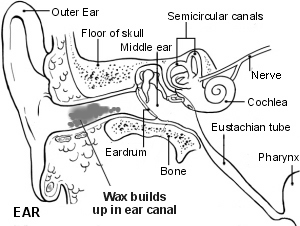
Earwax is a build-up of dead cells, hair, foreign material such as dust, and cerumen. Cerumen is the natural wax produced by glands in the ear. It forms a protective coating of the skin in the ear canal. Small amounts are made all the time. Flakes or crusts of earwax break off and fall out of the ear from time to time.
The quantity of earwax made varies greatly from person to person. Some people form plugs of earwax in their ear canal. This may cause a feeling of fullness and dulled hearing. It can feel uncomfortable. A hard plug of earwax can also sometimes cause 'ringing in the ear' (tinnitus) or occasionally even a mild type of dizziness (vertigo).
A clinician can look into the ear canal and confirm that a plug of earwax has formed. A plug of earwax is not a serious problem but can be a nuisance. Earwax only needs to be removed if it is causing symptoms such as reduced hearing. Earwax may also need to be removed for fitting of a hearing aid, or if the eardrum needs to be examined.
Hinweis: do not try to clean the ear canal with cotton wool buds, etc. This can make things worse as earwax can be pushed deeper inside. It may also cause an ear infection or even damage the eardrum itself. It is best to let the ear clean itself.
What can I do if earwax builds up and causes symptoms?
Zurück zum InhaltOhrentropfen
Ohrentropfen, die in der Apotheke erhältlich sind, entfernen oft einen Ohrenschmalzpfropf, ohne dass weitere Behandlung erforderlich ist. Zum Beispiel Olivenöl, Mandelöl, sodium bicarbonate, and sodium chloride ear drops are commonly used for this purpose.
The drops should be kept at room temperature before using them. (Let the bottle stand in the room for about half an hour.) Pour a few drops into the affected ear. Lie with the affected ear uppermost when putting in drops. Stay like this for 2-3 minutes to allow the drops to soak into the earwax.
The earwax is softened and it often breaks up if you put drops in 2-3 times a day for 3-7 days. Flakes or crusts of earwax often fall out bit by bit.
Ear microsuction
Microsuction is considered to be one of the safest ways of removing ear wax. A trained practitioner uses a microscope to look into the ear as the wax is suctioned away without using water. This is available on the NHS in some GP surgeries and in ear, nose and throat departments at hospitals. It is also available in many private clinics across the UK.
Ear irrigation (syringing)
Ear irrigation was a traditional method of removing ear wax. Ear irrigation involves lukewarm water being squirted into the ear canal which dislodges the wax plug which then falls out with the water. Although ear irrigation was mostly successful and painless there were complications associated with it in some instances (for example, damage to the eardrum, inflammation or infection). Ear irrigation is rarely offered any longer by GP surgeries, due to these risks and the fact that it is not part of the NHS contract.
Lesen Sie unten weiter
Can I prevent a build-up of earwax?
Zurück zum InhaltSome people are troubled by repeated build-up of earwax and require earwax removal every so often. In this situation, to prevent earwax building up and forming a plug, some doctors recommend using ear drops regularly - for example, olive oil ear drops. Some people also buy a bulb syringe to use at home to perform their own irrigation.
However, there is no clear research evidence on this issue. For example, it is not clear how often the drops should be used and different doctors advise different things - from daily, to once a fortnight. It is also not clear if regular use of ear drops does actually prevent earwax from building up. However, people troubled by build-up of earwax may wish to try using ear drops on a regular basis to see if this prevents the problem.
Patientenempfehlungen für Hörprobleme

Ohr, Nase und Hals
Cholesteatom
Cholesteatoma is the name given to a collection of skin cells that form a pearly-white greasy-looking lump deep in the ear, usually at the top of the area behind the eardrum.
von Dr. Doug McKechnie, MRCGP

Ohr, Nase und Hals
Auditive Verarbeitungsstörung
Auditive Verarbeitungsstörung wird in der Regel bei kleinen Kindern erstmals bemerkt. Es scheint, als hätte Ihr Kind ein Hörproblem, aber in der Regel ist ihr Gehör normal.
von Dr. Rosalyn Adleman, MRCGP
Weiterführende Lektüre und Referenzen
- Hörverlust bei Erwachsenen: Bewertung und Management; NICE-Richtlinie (Juni 2018 - zuletzt aktualisiert Oktober 2023)
- Aaron K, Cooper TE, Warner L, et al; Ear drops for the removal of ear wax. Cochrane Database Syst Rev. 2018 Jul 25;7:CD012171. doi: 10.1002/14651858.CD012171.pub2.
- Ohrenschmalz; NICE CKS, Mai 2023 (nur Zugang in Großbritannien)
Lesen Sie unten weiter
Artikelverlauf
Die Informationen auf dieser Seite wurden von qualifizierten Klinikern verfasst und begutachtet.
Nächste Überprüfung fällig: 13. Nov 2027
14. Nov 2024 | Neueste Version

Fragen, teilen, verbinden.
Durchsuchen Sie Diskussionen, stellen Sie Fragen und teilen Sie Erfahrungen zu Hunderten von Gesundheitsthemen.

Fühlen Sie sich unwohl?
Bewerten Sie Ihre Symptome online kostenlos
Abonnieren Sie den Patienten-Newsletter
Ihre wöchentliche Dosis klarer, vertrauenswürdiger Gesundheitsberatung - geschrieben, um Ihnen zu helfen, sich informiert, selbstbewusst und in Kontrolle zu fühlen.
Mit dem Abonnieren akzeptieren Sie unsere Datenschutzrichtlinie. Sie können sich jederzeit abmelden. Wir verkaufen Ihre Daten niemals.