Otosklerose
Begutachtet von Dr Colin Tidy, MRCGPZuletzt aktualisiert von Dr Toni Hazell, FRCGPZuletzt aktualisiert 23. Sept 2022
Erfüllt die Anforderungen des Patienten Richtlinien des Patienten
- HerunterladenHerunterladen
- Teilen
- Language
- Diskussion
- Audio-Version
- Zu bevorzugten Quellen bei Google hinzufügen
In dieser Serie:HörverlustHörverlust bei älteren MenschenOhrenschmalzPaukenergussPerforiertes TrommelfellCholesteatom
Otosklerose ist eine Erkrankung des Mittelohrs und betrifft hauptsächlich den kleinen Steigbügel (Stapes). Sie verursacht einen allmählichen Hörverlust.
Auf einen Blick
Otosclerosis is a condition causing hearing loss due to abnormal bone formation in the middle ear.
It typically affects people aged 15-35 years, with women affected more often than men.
Symptoms include gradual hearing loss, tinnitus, speaking softly, and sometimes dizziness.
You may hear better in noisy surroundings, which is called paracusis.
Diagnosis involves a doctor referral to an ENT specialist for hearing tests and possibly a tympanometry or CT scan.
Treatment options include hearing aids or surgery to replace a tiny bone called the stapes.
What is otosclerosis?
Otosclerosis is a common cause of hearing loss. It is caused by a problem with the tiny bones (ossicles) which transmit vibrations through the middle ear so we can hear sound. Usually both ears are affected in otosclerosis but sometimes only one ear is affected.
Otosclerosis affects about 1 or 2 in 100 people in the UK.
It usually first develops between the ages of 15-35 years but sometimes develops in younger children.
Women are affected twice as often as men.
Pregnancy is not a cause but may make the condition worse, so symptoms are commonly first noticed during pregnancy.
Nobody actually knows why otosclerosis happens. However, what is known is that otosclerosis is not caused or worsened by listening to loud music or working in a loud environment.
Otosclerosis happens because there is abnormal bone formation in one of the tiny bones in the middle ear. It is not clear why this happens but it is likely to be caused by a combination of various factors:
Hereditary (genetic) factors.
Complications from having had a virus.
Possible effect of low fluoride levels.
Otosclerosis symptoms
Hearing loss.
Speaking softly.
Hearing better in noisy surroundings.
Hearing sounds from within your body.
Dizziness and balance problems.
Hörverlust
Hearing loss is the main symptom of otosclerosis. The hearing loss may remain mild but commonly it gradually becomes worse. It usually affects both ears, but not always. In some people the hearing loss stays mild for a number of years before getting worse. In others the hearing loss quickly becomes worse. Without treatment, in time, the affected ears often become totally deaf.
The hearing loss is usually of lower sounds, whereas age-related hearing loss has more effect on higher-pitched sounds.
Speaking softly
If you have otosclerosis, you may speak unusually quietly. The effect of otosclerosis on your ears is to make your own voice sound loud to you.
Hearing better in noisy surroundings
Paracusis is also common. If you have this, you can hear better when there is a lot of background noise. For example, you seem to hear better when talking to someone in a pub or a café that is full of other people. This may be because other people raise their voices in noisy places.
Hearing sounds from within your body
Tinnitus is an abnormal noise which you hear but which seems not to come from outside your ear. It occurs in about 4 in 5 people with otosclerosis. Noises heard include ringing, whistles, roaring, machine-type noises, etc. Tinnitus tends to worsen as hearing loss worsens.
Dizziness and balance problems
Schwindel is a condition where problems with dizziness and balance are experienced. This condition develops in some people with otosclerosis, although it is less common. It occurs when the balance mechanism in the inner ear (the semicircular canals) is affected.
What causes otosclerosis?
Faulty bone formation
Bone is a living tissue and contains cells that make, mould and take back up (resorb) bone. Normally bone is continually being broken down and re-modelled. In otosclerosis, it seems that the re-modelling process of the stirrup (stapes) - one of the tiny bony ossicles in the middle ear - becomes faulty. New bone is not made properly and abnormal bone forms. However, the reason why this occurs mainly in the stapes (and sometimes the cochlea) is not entirely clear.
Have you inherited it?
Hereditary (genetic) factors seem to be important because a tendency for otosclerosis can be inherited. About 2 out of every 3 people with otosclerosis have other family members who also have this condition. However, some people with otosclerosis have no family history.
Could it be a virus?
It is also thought that a virus may play a part and the Masern virus has been suggested. Indeed, the number of people diagnosed with otosclerosis seems to have decreased since the measles virus vaccination has been given. It may be that a genetic tendency to develop otosclerosis is inherited by some people. Then a trigger, such as a viral infection, actually causes the condition to develop.
Low levels of fluoride
It is also possible that low levels of fluoride may have something to do with the development of otosclerosis. The number of cases of otosclerosis in the UK went down after fluoride was routinely added to drinking water. However, this possible link with low levels of fluoride is controversial.
How to treat otosclerosis
Hörgeräte
At first, when the hearing loss is mild, you may not need any treatment. As the disease progresses and hearing loss becomes worse, hearing aids can make a big difference. However, when the hearing loss becomes severe, hearing aids may not be of much help.
Operation
The most common operation that is done is to replace the stapes with an artificial bone made of plastic or metal. The operation is called a stapedectomy (or sometimes a stapedotomy). In most cases, this operation is successful and restores hearing. It may also reduce the chance of otosclerosis progressing to affect your inner ear.
However, it is a very delicate operation. There is a small risk that the operation will fail and cause total deafness in the operated ear. Also, there is a small risk of damaging other nerves during the operation and of causing disturbance to balance or taste. The operation may not cure tinnitus and will not improve hearing in the small number of cases which affect the cochlea. You should ask your surgeon about their success rates for this type of surgery.
So, although the operation is usually successful, it may be a difficult decision about if, or when, to opt for an operation. Because of the small chance of serious complications, some people decide to stick with hearing aids. They do so until their hearing becomes so bad that hearing aids are not helping very much. Other people opt for surgery earlier so as not to need hearing aids. When surgery is decided upon, the ear that is most badly affected is operated on first. This is the ear with most to gain if the operation is successful. It means that the best ear is still preserved in the small number of cases where the operation does not work.
There is debate about whether the second ear should be operated on in the future. Some surgeons feel not, because if anything were to go wrong with the ear already operated on, you would still have the possibility of wearing a hearing aid and hearing something with your second ear. You should discuss this with your surgeon.
Medikation
In the past, fluoride tablets have been used to treat otosclerosis. However they are not currently recommended because the evidence of benefit is low-quality, and there is a risk of increasing other fractures including those of the hip.
Other tablets called bisphosphonates have also been used in the past, but again the evidence is limited and they are not currently recommended.
Hormone tablets and the contraceptive pill
Some doctors feel that taking the Antibabypille oder Hormonersatztherapie may make otosclerosis worse and some women find that it worsens during pregnancy, possibly due to hormonal changes. If you have otosclerosis and are considering taking hormone treatment such as this, you should discuss the pros and cons fully with your doctor.
What is affected in otosclerosis?
Otosclerosis mainly affects the tiny bone (ossicle) called the stirrup (stapes). To have normal hearing, the ossicles need to be able to move freely in response to sound waves. In otosclerosis, abnormal bone material grows around the stapes bone. The foot of the stapes, where it attaches to the cochlea, is usually where the condition starts. The abnormal bone reduces the movement of the stapes, which reduces the amount of sound that is transferred to the cochlea. The growth of the abnormal bone is very gradual. However, eventually the stapes can become fixed, or fused, with the bone of the cochlea. This can cause severe hearing loss. The hearing loss is known as conductive hearing loss because sound vibrations cannot be conducted (transmitted) from the stapes to the cochlea.
In most cases, it is just the stapes which is affected. However, sometimes, over time, otosclerosis can also affect the bony shell of the cochlea and the nerve cells within it. If this is the case, the damage to the nerve cells means that the transmission of nerve impulses to the brain can be affected. A different type of hearing loss, called sensorineural hearing loss, can then occur.
Wie hören wir?
The ear is divided into three parts - the outer (external) ear, the middle ear, and the inner ear. The middle ear behind the eardrum is filled with air. Air comes from the back of the nose up a thin channel called the Eustachian tube. In the middle ear there are three tiny bones (ossicles) - the hammer (malleus), anvil (incus) and stirrup (stapes). The inner ear includes the cochlea and semicircular canals.
Human ear anatomy
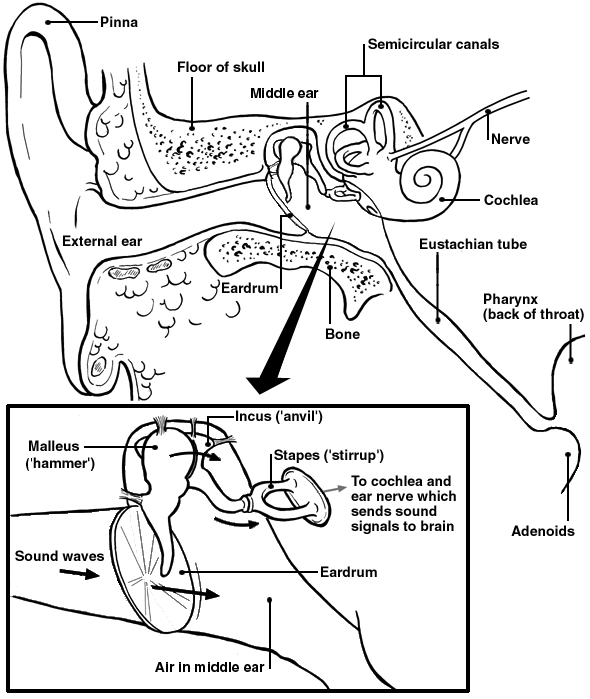
© (Assumed Patient copyright - Beverley Kenny diagram)
Sound waves come into the outer ear and hit the eardrum.
The sound waves cause the eardrum to vibrate.
The sound vibrations pass from the eardrum to the middle ear bones.
The bones then transmit the vibrations to the cochlea in the inner ear.
The cochlea converts the vibrations to sound signals which are sent along a nerve from the ear to the brain, allowing us to hear.
The semicircular canals in the inner ear contain a fluid that moves around as we move. The movement of the fluid is sensed by tiny hairs in the semicircular canals. These send messages to the brain along the ear (auditory) nerve to the brain to help maintain balance and posture.
How is otosclerosis diagnosed?
If you are worried about hearing loss, make an appointment to see your doctor. They will ask about the symptoms you have been getting and then they will generally look into your ears using an auriscope. This is the common instrument used to look inside your ears if you have earache. In otosclerosis, your eardrum usually looks normal and healthy when your doctor looks inside your ear.
Your doctor may refer you on to an ear, nose and throat specialist who will be able to make the diagnosis of otosclerosis. They will do hearing tests which will show a specific pattern of hearing loss in otosclerosis. The specialist may also use a small device that is placed in your ear, called a tympanometer. This can help them look at the movement of the bones within your ear. In otosclerosis, the stirrup (stapes) will move less. This test is very quick and does not cause any pain.
Sometimes the specialist may decide that you need to have a CT-Scan which will give them more information about how severe the otosclerosis is.
What happens long-term?
Generally the hearing loss progresses over time, although this may be very slow. If it becomes bad enough for you to need an operation, that is usually very successful at resolving the hearing problems and other symptoms.
Patientenauswahl für Hörprobleme

Ohr, Nase und Hals
Auditive Verarbeitungsstörung
Auditive Verarbeitungsstörung wird in der Regel bei kleinen Kindern erstmals bemerkt. Es scheint, als hätte Ihr Kind ein Hörproblem, aber in der Regel ist ihr Gehör normal.
von Dr. Rosalyn Adleman, MRCGP

Ohr, Nase und Hals
Perforiertes Trommelfell
Ein geplatztes (perforiertes) Trommelfell ist normalerweise nicht ernst und heilt oft innerhalb weniger Wochen von selbst. Manchmal treten Komplikationen auf, wie Hörverlust und Infektionen im Mittelohr. Ein kleiner Eingriff zur Reparatur des Trommelfells kann eine Option sein, wenn es nicht von selbst heilt, insbesondere wenn die Perforation zu Hörverlust führt.
von Dr. Surangi Mendis, MRCGP
Häufig gestellte Fragen
Can otosclerosis happen in children or does it only affect adults?
Otosclerosis usually develops for the first time between the ages of 15 and 35. However, it can sometimes affect younger children.
If I have otosclerosis, does that mean my children will definitely get it too?
Otosclerosis has hereditary (genetic) factors, and about two-thirds of people with the condition have other family members who also have it. However, it's not guaranteed, as some people without a family history can develop it.
What is the difference between conductive hearing loss and sensorineural hearing loss in otosclerosis?
Conductive hearing loss occurs when the abnormal bone growth around the stapes bone prevents sound vibrations from being properly transmitted to the cochlea. Sensorineural hearing loss can happen if the condition progresses to affect the bony shell of the cochlea and the nerve cells within it, impacting the transmission of nerve impulses to the brain.
Does my diet or lifestyle choices, like loud music, influence otosclerosis?
Nobody knows exactly why otosclerosis happens. However, it's confirmed that it is not caused or made worse by listening to loud music or working in noisy environments. There's a controversial suggestion that low fluoride levels might be a factor.
What's the typical long-term outcome for someone with otosclerosis?
Generally, the hearing loss from otosclerosis progresses over time, though this can be very slow. If surgery is needed, it is usually very successful in resolving the hearing problems and other symptoms.
If I need an operation, which ear gets operated on first?
If surgery is decided upon, the ear that is most severely affected is operated on first. This is because it has the most to gain if the operation is successful, and it preserves the better ear in the small chance that the operation doesn't work as expected.
Weiterführende Literatur und Referenzen
- Otosclerosis and deafness; British Tinnitus Association
- Hain TC; Otosclerosis treatment, Dizziness and Balance, 2021
- Otosklerose; RNID 2016
Über den AutorVollständige Biografie anzeigen

Dr Toni Hazell, FRCGP
MBBS, BSc, FRCGP, DFSRH, Dip GU med, DRCOG, DCH (London, UK, 2000)
Dr. Toni Hazell hat ihren Abschluss an der St. Mary’s Hospital Medical School gemacht und ihr VTS am Northwick Park Hospital absolviert.
Über den RezensentenVollständige Biografie anzeigen

Dr Colin Tidy, MRCGP
Allgemeinmediziner, Medizinischer Autor
MBBS, MRCGP, MRCP (Paediatrics), DCH
Dr. Colin Tidy ist ein NHS-Arzt mit Sitz in Oxfordshire.
Artikelverlauf
Die Informationen auf dieser Seite wurden von qualifizierten Klinikern verfasst und begutachtet.
Artikel auch verfügbar in Englisch, Deutsch, Spanisch, Französisch, Italienisch, Portugiesisch, Hindi, Hebräisch, Arabisch, und Schwedisch.
Nächste Überprüfung fällig: 22. Sept 2027
23. Sept 2022 | Neueste Version

Fragen, teilen, verbinden.
Durchsuchen Sie Diskussionen, stellen Sie Fragen und teilen Sie Erfahrungen zu Hunderten von Gesundheitsthemen.

Fühlen Sie sich unwohl?
Bewerten Sie Ihre Symptome online kostenlos
Abonnieren Sie den Patienten-Newsletter
Ihre wöchentliche Dosis klarer, vertrauenswürdiger Gesundheitsberatung - geschrieben, um Ihnen zu helfen, sich informiert, selbstbewusst und in Kontrolle zu fühlen.
Durch das Abonnieren akzeptieren Sie unsere Datenschutzrichtlinie. Sie können sich jederzeit abmelden. Wir verkaufen Ihre Daten niemals.