Mandelsteine
Tonsilloliths
Fachlich geprüft von Dr Toni Hazell, FRCGPZuletzt aktualisiert von Dr Philippa Vincent, MRCGPZuletzt aktualisiert 17. Dez. 2024
Entspricht den redaktionellen Richtlinien
- HerunterladenHerunterladen
- Teilen
- Language
- Diskussion
- Audio-Version
- Zu bevorzugten Quellen bei Google hinzufügen
Mandelnsteine sind Steine, die sich im hinteren Bereich des Rachens in den Mandeln bilden können. Sie sind nicht gefährlich, können aber manchmal zu Halsschmerzen oder schlechtem Atem führen.
Auf einen Blick
Tonsil stones are white or yellow collections of debris at the back of the throat.
They are made of minerals, cells, tissues, and bacteria that harden in tonsil crevices.
Symptoms can include bad breath, discomfort swallowing, or an irritating cough.
Good oral hygiene, gargling, and avoiding smoking may help prevent them.
Some tonsil stones can be removed at home using gargling or gentle irrigation.
What are tonsil stones?
Tonsil stones, otherwise known as tonsilloliths, are a white or yellow accumulation of debris at the back of the throat. They tend to occur in people who have large or craggy tonsils.
Tonsils are the soft lumps at the back of your throat, one at each side. They are lymph nodes which sometimes enlarge to help fight infection.
Not everyone has visible tonsils - people whose tonsils are not visible are unlikely to develop tonsilloliths. Some people have large tonsils with craggy ridges in them.
What do tonsil stones look like?
Mandelsteine
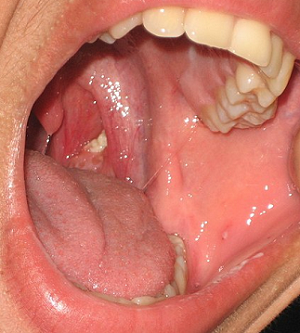
© By Glacko2021 at English Wikipedia, via Wikimedia Commons
They look like small white, yellow or pale grey pebbles, in the nooks and crannies of the tonsils.
What causes tonsil stones?
Tonsil stones are made up of minerals - mainly calcium salts. Debris from the surrounding cells, tissues and bacteria gets stuck in the crevices of the tonsils and then hardens (becomes calcified). They can be hard, like tiny rocks, or quite soft. They are usually quite small, but can sometimes get bigger.
They are not cancerous growths, and they are not attached to the tissues around them, but instead are stuck in the crevices of the tonsils.
Tonsil stones can actually help the immune system by blocking bacteria and viruses from entering the body.
Tonsilloliths can occur at any age but are more common in adults than in children. Some people just develop one, whereas others can have more than one at a time. In some people, when they get rid of one, another forms somewhere else on their tonsils.
Why do I keep getting tonsil stones?
Some people are more prone than others to developing tonsil stones.
Risikofaktoren umfassen:
Rauchen.
.
Recurrent tonsil infections.
Having tonsillar crypts.
Tonsillar crypts are the folds, gaps and crevices found in some people's tonsils. They are more common in larger or craggy-looking tonsils.
What are the symptoms of tonsil stones?
Often there are no symptoms of tonsil stones at all, though when there are they may include :
A feeling of something being stuck at the back of the throat.
Discomfort swallowing.
A bad taste in the mouth.
An irritating cough.
Ohrenschmerzen (sometimes a problem in the mouth can 'radiate' to the ear due to the way that the pain signal is carried along nerves).
Are any tests needed for tonsil stones?
Usually tonsil stones (tonsilloliths) can be seen at the back of the mouth and no special tests are needed. Sometimes they are seen coincidentally on X-rays or scans which have been done for other reasons.
How to get rid of tonsil stones
In many cases tonsil stones can be removed at home. Treatment is not necessarily needed, especially if there are no symptoms.
Salt water gargle. Try gargling with mouthwash or a salty water solution. This may dislodge the tonsil stones.
Gentle irrigation. This involves gently shooting water at the back of the mouth to try to dislodge tonsil stones. It is possible to buy a syringe specially for this purpose, which has a curved tip, or an irrigation kit. It is important to follow the instructions carefully, as it is possible to damage the tonsils if too much force is used. This may cause pain and bleeding.
Cotton swabbing. Gently massaging around the tonsils with a cotton swab can push the tonsil stone loose.
Chirurgische Entfernung. An ear, nose and throat (ENT) surgeon can remove tonsil stones which are causing problems but this will only be done if the tonsil stones are:
Large in size.
Schmerzhaft.
Causing repeated bacterial infections and sore throats.
A dentist may be able to help with the problem and can make the referral if needed.
How to prevent tonsil stones
Gute Mundhygiene helps with preventing tonsil stones. Teeth should be brushed twice a day, as advised by dentists, including the spaces in between them, to stop any debris accumulating.
Consider a tongue scraper to keep the tongue clear of any gunk or germs which might contribute to a stone forming.
Regular gargling with a mouthwash or salt water solution may also help.
Avoid Rauchen und übermäßiger Alkoholkonsum which can cause the mouth to be dry and may make tonsilloliths or tonsil stones more likely to build up.
For some people, an operation to flatten the surfaces of the tonsils may help to stop persisting problems with tonsilloliths recurring. This is called cryptolysis and can be done either by laser treatment or another type of treatment called coblation cryptolysis. This may need a general anaesthetic but is not available on the NHS.
Occasionally, removal of the tonsils (Tonsillektomie) is recommended to prevent ongoing problems with tonsil stones.
Patientenauswahl für Rachen und Mandeln

Ohr, Nase und Hals
Pfeiffersches Drüsenfieber
Glandular fever (also known as infectious mononucleosis) is a viral infection that most often affects teenagers and young adults. Although it can make some people feel quite ill, full recovery is usual.
von Dr. Philippa Vincent, MRCGP

Ohr, Nase und Hals
Laryngitis
Laryngitis ist eine Entzündung der Schleimhäute Ihres Kehlkopfes (Larynx), die dazu führt, dass Sie eine heisere Stimme haben. Sie wird meist durch eine Infektion verursacht, in der Regel durch ein Virus.
von Dr. Rosalyn Adleman, MRCGP
Häufig gestellte Fragen
Are tonsil stones a sign of anything serious?
No, tonsil stones are generally not a sign of a serious underlying condition. They are not cancerous growths. They are simply accumulations of debris, minerals, and bacteria that harden in the crevices of your tonsils.
Can tonsil stones be painful?
While many people experience no symptoms, tonsil stones can sometimes cause discomfort. This might include a feeling of something being stuck in the throat, difficulty swallowing, or even earache, as pain signals can radiate through nerves.
How common are tonsil stones?
Tonsil stones can occur at any age, but they tend to be more common in adults than in children. Some individuals may only develop one, while others might have multiple stones at once or experience them recurring after one is removed.
Can a GP remove tonsil stones?
The article does not explicitly state whether a GP can remove tonsil stones. However, it mentions that an ear, nose, and throat (ENT) surgeon can remove problematic tonsil stones and a dentist may also be able to assist or make a referral if needed. For removal at home, methods like gargling, gentle irrigation, or cotton swabbing are suggested.
Do tonsil stones get bigger over time?
Tonsil stones are usually quite small. However, the article notes that they can sometimes get bigger with continued accumulation of minerals and debris.
Weiterführende Literatur und Referenzen
- Bamgbose BO, Ruprecht A, Hellstein J, et al; The prevalence of tonsilloliths and other soft tissue calcifications in patients attending oral and maxillofacial radiology clinic of the university of iowa. ISRN Dent. 2014 Jan 22;2014:839635. doi: 10.1155/2014/839635. eCollection 2014.
- Halitosis; NICE CKS, September 2024 (nur für UK-Zugang)
- Shikino K, Ikusaka M; Tonsillolith. Clin Case Rep. 2021 Jun 22;9(6):e04243. doi: 10.1002/ccr3.4243. eCollection 2021 Jun.
Über den AutorVollständige Biografie anzeigen

Dr Mary Harding, MRCGP
Allgemeinmediziner, Medizinischer Autor
BA, MA, MB, BChir, MRCGP, DFFP
Dr. Mary Harding schloss 1989 ihr Medizinstudium an der Universität Cambridge ab.
Über den RezensentenVollständige Biografie anzeigen

Dr Toni Hazell, FRCGP
MBBS, BSc, FRCGP, DFSRH, Dip GU med, DRCOG, DCH (London, UK, 2000)
Dr. Toni Hazell hat ihren Abschluss an der St. Mary’s Hospital Medical School gemacht und ihr VTS am Northwick Park Hospital absolviert.
Artikelverlauf
Die Informationen auf dieser Seite wurden von qualifizierten Klinikern verfasst und begutachtet.
Artikel auch verfügbar in Englisch, Deutsch, Spanisch, Französisch, Italienisch, Portugiesisch, Hindi, Hebräisch, Arabisch, und Schwedisch.
Nächste Überprüfung fällig: 16. Dez. 2027
17. Dez. 2024 | Neueste Version
13 Sept 2018 | Ursprünglich veröffentlicht
Verfasst von:
Dr Mary Harding, MRCGP

Fragen, teilen, verbinden.
Durchsuchen Sie Diskussionen, stellen Sie Fragen und teilen Sie Erfahrungen zu Hunderten von Gesundheitsthemen.

Fühlen Sie sich unwohl?
Bewerten Sie Ihre Symptome online kostenlos
Abonnieren Sie den Patienten-Newsletter
Ihre wöchentliche Dosis klarer, vertrauenswürdiger Gesundheitsberatung - geschrieben, um Ihnen zu helfen, sich informiert, selbstbewusst und in Kontrolle zu fühlen.
Durch das Abonnieren akzeptieren Sie unsere Datenschutzrichtlinie. Sie können sich jederzeit abmelden. Wir verkaufen Ihre Daten niemals.
Mehr zu Ohr, Nase und Hals
- Audiologie
- Auditive Verarbeitungsstörung
- Barotrauma des Ohrs
- Furunkel im Gehörgang
- Paukenerguss
- Hörverlust
- Hörverlust bei älteren Menschen
- Hörtests
- Laryngitis
- Verlust von Geschmack und Geruch
- Menière-Krankheit
- Nasale Verstopfung
- Nasenverkleinerung (Rhinoplastik)
- Chronische Rhinitis
- Schnarchen
- Halsschmerzen
- Steroidhaltige Nasensprays
- Ein Nasenbluten stoppen
- Kehlkopfkrebs
- Tinnitus