Augeninfektion (Herpes simplex)
Begutachtet von Dr Colin Tidy, MRCGPZuletzt aktualisiert von Dr Hayley Willacy, FRCGP Last updated 22. Feb 2023
Erfüllt die Anforderungen des Patienten Richtlinien des Patienten
- HerunterladenHerunterladen
- Teilen
- Language
- Diskussion
- Audio-Version
- Add to preferred sources on Google
A herpes simplex eye infection, or eye herpes, is a viral infection caused by the herpes simplex virus (HSV). It can damage the eye and affect vision, so see a doctor if your eye becomes red, sore, or painful, especially after having a cold sore.
In diesem Artikel:
Video picks for Augensymptome
Wichtige Punkte
A herpes simplex eye infection is an infection of the eye, usually the cornea. It is caused by the herpes simplex virus (HSV), the same virus that causes cold sores.
If you’ve had a previous cold sore or HSV infection, the virus can reactivate and infect the eye. Eye herpes can also occur by touching the eyes with virus-contaminated hands.
Symptoms of a herpes simplex eye infection include redness, pain, tearing, blurred vision, light sensitivity, and a feeling of something in the eye.
It is treated with antiviral medications to control the infection and reduce inflammation. Prompt treatment is important to prevent serious complications, such as corneal scarring and permanent vision loss.
Lesen Sie unten weiter
Herpes-simplex-Virus
There are two types of herpes simplex virus. Type 1 is the usual cause of Fieberbläschen around the mouth and of herpes simplex infection in the eye. Type 2 is the usual cause of Genitalherpes. It rarely causes cold sores or eye infections. This leaflet is about herpes simplex eye infections.
How does herpes simplex virus affect my eye?
Zurück zum InhaltThe common situation is for the transparent front part of the eye (the cornea) to become infected. Infection of the cornea is called keratitis.
In most cases, the infection is just in the top (superficial) layer of the cornea. This is called epithelial keratitis. Sometimes deeper layers of the cornea are involved. This is called stromal keratitis. This is more serious, as it is more likely to cause scarring of the cornea.
Close-up diagram

Other parts of the eye are sometimes affected. Often at the same time as the cornea is infected, a minor and temporary inflammation may occur with active infection of:
The thin lining of the eyelid (the conjunctiva), called Bindehautentzündung.
The eyelids, called Blepharitis.
Sometimes, deeper structures, such as the retina or the iris. The retina is a layer of the eyeball, found on its back wall. The iris is the coloured part of the eye.
Lesen Sie unten weiter
Who gets herpes simplex infections of the eye?
Zurück zum InhaltPeople who have had cold sores before.
It usually affects adults in their 30s or 40s.
Overall it affects about 1 in 500 people in the western world.
Symptoms of herpes simplex eye infection
Zurück zum InhaltWhen should I worry about eye symptoms?
Most episodes of active infection are due to a reactivation of the virus at some point, often years after a primary infection. Symptoms include:
Redness of the eye - mainly around the transparent front part of the eye (the cornea).
Ache or pain in the eye.
Discomfort when opening the eyes in bright light.
Watering of the eye.
Verschwommenes Sehen.
You may also notice a blistery skin rash around the eyelids (but not in all cases). It is usually one eye that is affected.
This photo shows someone with herpes simplex eye infection:
Herpes simplex in eye area
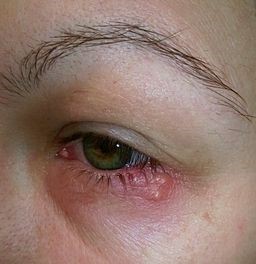
© Powerfloh, CC BY-SA 3.0, via Wikimedia Commons
Lesen Sie unten weiter
How is herpes simplex eye infection diagnosed?
Zurück zum InhaltEye from the front
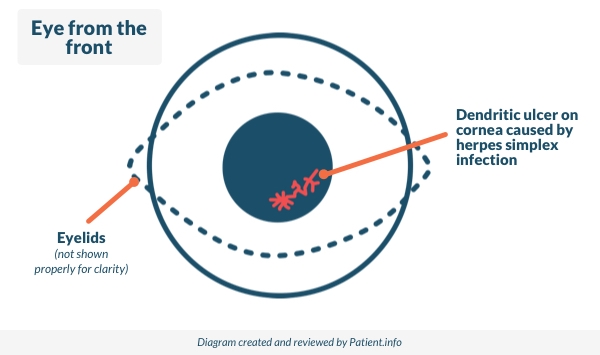
Your family doctor (GP) will usually examine your eye with a magnifier. They may also put some stain on the front of your eye. This is used to show up any irregular areas on the transparent front part of the eye. With a herpes simplex infection they will often see a small scratch on the cornea. The typical ulcer which develops is called a dendritic ulcer. Dendritic means branching. The ulcer is not round with a smooth edge but like a tree with many finger-like branches, as below:
Dendritic eye ulcer
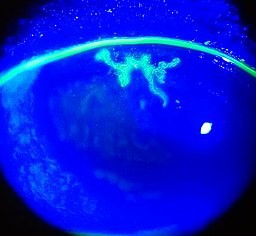
© Imrankabirhossain, CC BY-SA 4.0, via Wikimedia Commons
If your doctor suspects a herpes eye infection you will usually be referred urgently to an eye specialist (ophthalmologist). A specialist will do a detailed magnified examination of the eye. This is to confirm the diagnosis and to determine whether the infection is in the top layer of the cornea (epithelial keratitis), or if the deeper layers are involved (stromal keratitis).
How to treat herpes simplex eye infections
Zurück zum InhaltThe treatment depends on which part of the eye is affected.
Before you start to use any eye drops or ointment, your eye specialist (ophthalmologist) may make your eye numb and then gently scrape away some of the infected cells. This procedure is called debridement.
If the top (superficial) layer of the cornea is affected - epithelial keratitis
Treatment is with antiviral eye ointment or drops (such as aciclovir ointment oder ganciclovir gel). These do not kill the virus but stop it from multiplying further until the infection clears. You should take the full course exactly as prescribed. This is often several times a day for up to two weeks. The aim is to prevent damage to the transparent front part of the eye (the cornea).
If the deeper layer of the cornea is affected - stromal keratitis
Treatment is similar to epithelial keratitis (above). In addition to the antiviral eye ointment or drops, your specialist may add in some steroid eye drops. This helps to reduce inflammation.
Hinweis: steroid eye drops must only be used under close supervision of an eye specialist. He or she will prescribe the correct strength and dose in conjunction with antiviral treatment. If you use steroid eye drops wrongly they can make herpes simplex infections worse!
Antiviral tablets may be used in some cases.
If just the eyelids or the thin lining of the eyelid (conjunctiva) are affected
These infections will usually settle on their own in 1-3 weeks. No treatment may be advised. You are likely to be kept under review, until the infection clears, to check that the cornea does not become infected.
Hinweis: if you have herpes simplex eye infection, you should not wear contact lenses until 24 hours after your symptoms and the infection have completely gone away.
Can herpes simplex eye infection come back?
Zurück zum InhaltSome people develop repeated (recurring) episodes of active infection. As mentioned above, these occur if the virus reactivates from time to time - similar to cold sores. A recurrent infection may occur any time between a few weeks and many years after the first active infection.
At least half of people who have one episode of active infection will have a recurrence within 10 years of the first. Recurrences occur more often in some people than others.
If recurrences are frequent or severe, your eye specialist may advise that you take antiviral tablets each day to prevent episodes of active infection. Studies have shown that, on average, the number of recurrences is roughly halved in people who take regular antiviral tablets.
Some people say that episodes of active herpes infection may be triggered by strong sunlight. So, wearing sunglasses möglicherweise also help to prevent recurrences. It is also possible that active infection may be triggered if you are run down or unwell for another reason. However, the evidence for this is limited. Some women find that they get recurrences around the time of their period but again there is limited evidence to support this.
If a recurrence does occur, each episode is treated as described above.
Wie ist der Ausblick?
Zurück zum InhaltThe main concern with corneal infection (keratitis) is that it can cause scarring of the transparent front part of the eye (the cornea). With scarring, the normally clear cornea can become like frosted glass. This may sometimes seriously affect vision.
Epithelial keratitis tends to settle and go away within a few weeks. It has a good outlook and often causes little or no scarring.
Stromal keratitis is more likely to result in corneal scarring and loss of vision.
Recurring episodes of active infection can make any existing scarring worse.
Prompt treatment with antiviral eye ointment or drops helps to minimise damage during each episode of active infection.
Overall, good vision remains in about 9 in 10 eyes affected by herpes simplex infection - that is, vision good enough to drive. However, severe and recurrent herpes simplex eye infections may lead to serious scarring, impaired vision and even severe sight impairment in some cases. If severe sight impairment does develop, a corneal transplant may be the only option to restore vision.
Häufig gestellte Fragen
Zurück zum InhaltHow serious is a herpes eye infection?
A herpes eye infection can be serious if not treated promptly. It may cause scarring on the cornea and lead to vision problems, so it’s important to seek medical advice as soon as symptoms appear.
How long does it take for a herpes eye infection to heal?
A herpes eye infection usually starts to heal within one to two weeks with antiviral treatment. Full healing can take several weeks, depending on the severity and whether complications develop.
What are the first signs of herpes in the eye?
The first signs of a herpes eye infection often include redness, pain, watery eyes, and sensitivity to light. Some people may also notice blurred vision or a feeling of something in the eye.
Will herpes in the eye go away on its own?
Herpes in the eye usually does not go away on its own and can worsen without treatment. Prompt antiviral medication is important to reduce symptoms and prevent damage to the cornea.
Patient picks for Augensymptome
/og.png)
Augengesundheit
Augeninfektion (Herpes simplex)
Eine Herpes-simplex-Augeninfektion, oder Augenherpes, ist eine virale Infektion, die durch das Herpes-simplex-Virus (HSV) verursacht wird. Sie kann das Auge schädigen und das Sehvermögen beeinträchtigen. Suchen Sie einen Arzt auf, wenn Ihr Auge rot, wund oder schmerzhaft wird, insbesondere nach einer Fieberblase.
by Dr Hayley Willacy, FRCGP

Augengesundheit
Allergische Konjunktivitis
Allergic conjunctivitis causes red, watery, itchy or gritty eyes. The condition is not usually painful and does not make eyes sensitive to light. It does not affect vision. The most common cause is an allergy to pollen in the hay fever season. Other causes are allergies to house dust mite, cosmetics, and problems with contact lenses, although these are less common. Eye drops usually ease symptoms.
von Dr. Philippa Vincent, MRCGP
Weiterführende Literatur und Referenzen
- Herpes Simplex Keratitis Eye Infection; The College of Optometrists
- Herpes simplex - ocular; NICE CKS, Oktober 2021 (nur für UK-Zugang)
- Wilhelmus KR; Antiviral treatment and other therapeutic interventions for herpes simplex virus epithelial keratitis. Cochrane Database Syst Rev. 2015 Jan 9;1:CD002898. doi: 10.1002/14651858.CD002898.pub5.
- Kanukollu VM, Patel BC; Herpes Simplex Ophthalmicus.
Lesen Sie unten weiter
About the author

Dr Hayley Willacy, FRCGP
Allgemeinmediziner, Medizinischer Autor
MBChB (1992), DRCOG, DFFP, MRCOG (Part 1) MRCGP (2007), DFSRH (2013), MSc - medical education (2020)
Dr Hayley Willacy was an NHS GP working in northwest England, who retired from clinical practice in 2022 after 30 years.
About the reviewerView full bio

Dr Colin Tidy, MRCGP
Allgemeinmediziner, Medizinischer Autor
MBBS, MRCGP, MRCP (Paediatrics), DCH
Dr. Colin Tidy ist ein NHS-Arzt mit Sitz in Oxfordshire.
Artikelverlauf
Die Informationen auf dieser Seite wurden von qualifizierten Klinikern verfasst und begutachtet.
Nächste Überprüfung fällig: 21. Feb 2028
22. Feb 2023 | Neueste Version

Fragen, teilen, verbinden.
Durchsuchen Sie Diskussionen, stellen Sie Fragen und teilen Sie Erfahrungen zu Hunderten von Gesundheitsthemen.

Fühlen Sie sich unwohl?
Bewerten Sie Ihre Symptome online kostenlos
Abonnieren Sie den Patienten-Newsletter
Ihre wöchentliche Dosis klarer, vertrauenswürdiger Gesundheitsberatung - geschrieben, um Ihnen zu helfen, sich informiert, selbstbewusst und in Kontrolle zu fühlen.
By subscribing you accept our Datenschutzrichtlinie. Sie können sich jederzeit abmelden. Wir verkaufen Ihre Daten niemals.