
Was macht die Bauchspeicheldrüse?
Fachlich geprüft von Dr Adrian Bonsall, MBBSVerfasst von Dr. Roger Henderson, MBBSUrsprünglich veröffentlicht 30. Mai 2018
Erfüllt die Anforderungen des Patienten Richtlinien des Patienten
- HerunterladenHerunterladen
- Teilen
- Language
- Diskussion
- Audio-Version
- Zu bevorzugten Quellen bei Google hinzufügen
Die Bauchspeicheldrüse ist ein Organ im oberen Bauchraum (Abdomen). Chemikalien (Enzyme), die von Zellen in der Bauchspeicheldrüse hergestellt werden, gelangen in den Darm, um bei der Verdauung der Nahrung zu helfen. Die Hormone Insulin und Glukagon werden ebenfalls in der Bauchspeicheldrüse produziert und helfen, den Blutzuckerspiegel zu regulieren.
What is the pancreas?
The pancreas is an organ which is about the size of a hand.
Cross-section of the gut
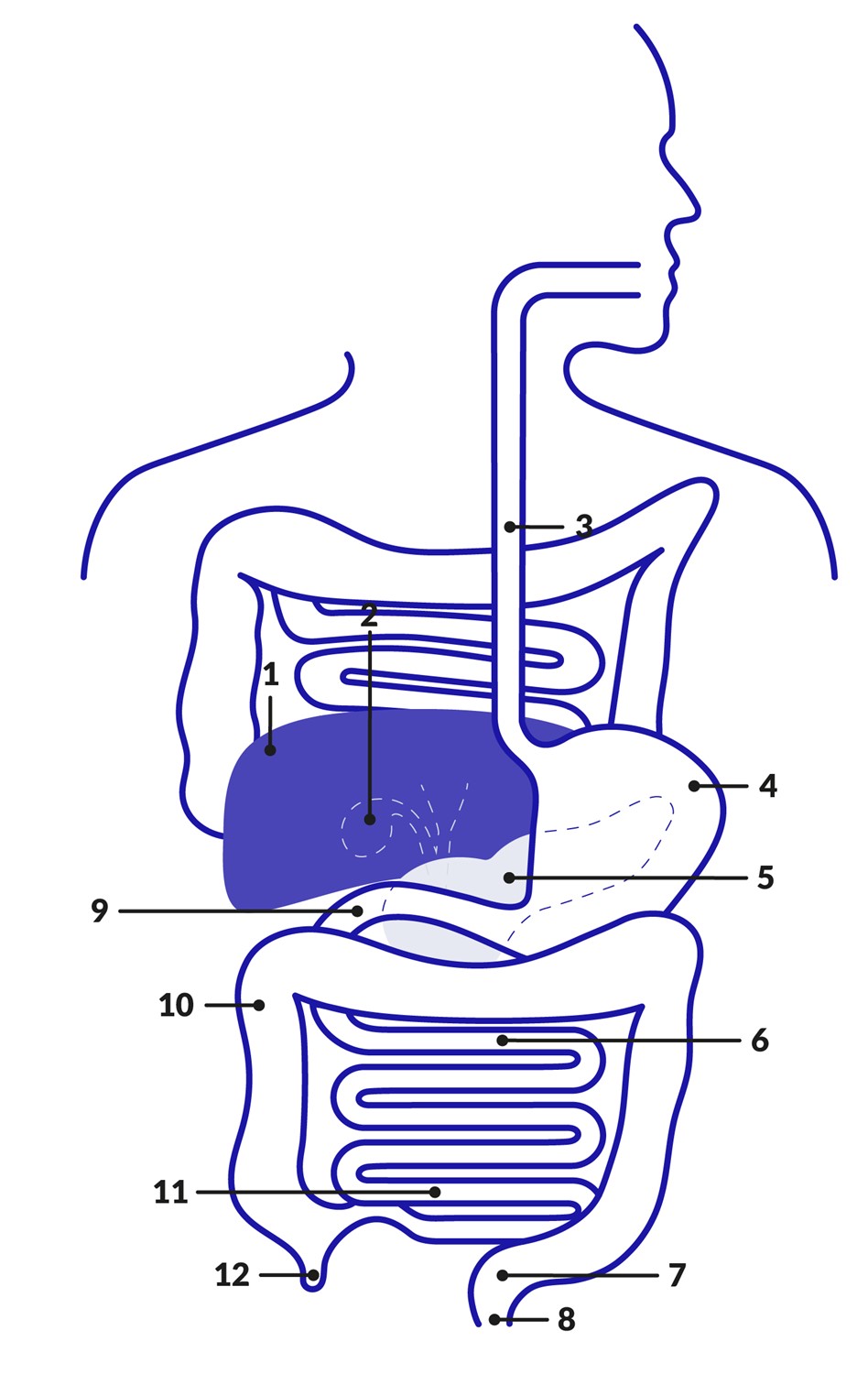
Schlüssel | |
|---|---|
1. Liver | 7. Rectum |
Where is the pancreas?
The pancreas is in the upper tummy (abdomen) and lies behind the stomach and guts (intestines). The pancreas has a connection via a tube (duct) to the first part of the gut (known as the duodenum) which is connected to the stomach. This connecting duct allows the chemicals (enzymes) produced by the pancreas to pass into the intestines.
Was macht die Bauchspeicheldrüse?
The pancreas has two main functions:
To make digestive chemicals (enzymes) which help us to digest food. Enzymes help to speed up your body's processes.
To make hormones which regulate our metabolism. Hormones can be released into the bloodstream. They act as messengers, affecting cells and tissues in distant parts of your body.
About 90% of the pancreas is dedicated to making digestive enzymes. Cells called acinar cells within the pancreas produce these enzymes. The enzymes help to make proteins, fats and carbohydrates smaller. This helps the guts (intestines) to absorb these nutrients. The acinar cells also make a liquid which creates the right conditions for pancreatic enzymes to work. This is also known as pancreatic juice. The enzymes made by the pancreas include:
Pancreatic proteases (such as trypsin and chymotrypsin) - which help to digest proteins.
Pancreatic amylase - which helps to digest sugars (carbohydrates).
Pancreatic lipase - which helps to digest fat.
Approximately 5% of the pancreas makes hormones which help to regulate your body's metabolism. These hormones are made by several different cells which clump together like little islands (islets) within the pancreas. The islets are called islets of Langerhans and there are about one million islets dotted about in an adult pancreas. The hormones made by the cells in the islets of Langerhans within the pancreas include:
Insulin - which helps to regulate sugar levels in the blood.
Glucagon - which works with insulin to keep blood sugar levels balanced.
Somatostatin - which helps to control the release of other hormones.
Gastrin - which aids digestion in the stomach.
How does the pancreas work?
The pancreas
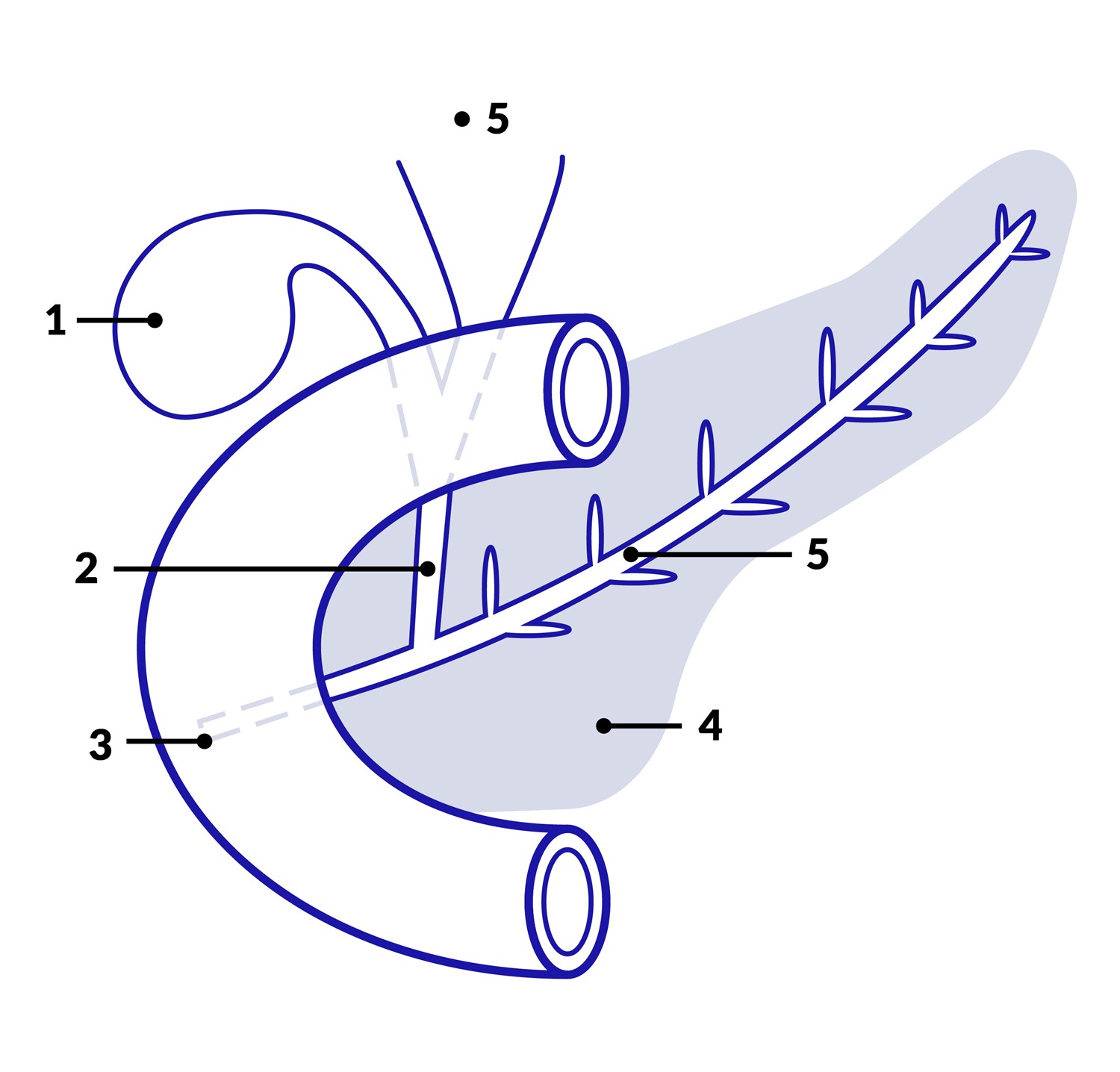
Schlüssel |
1. Gallbladder |
The digestive chemicals (enzymes) made by the pancreas are controlled by the body's nervous system and its hormones. When the body senses food in the stomach, electrical signals are sent to the pancreas via nerves. These signals stimulate the pancreas to put more enzymes into the pancreatic juice. Acinar cells respond by increasing the amount of enzymes they produce. The enzymes leave the cells and pass into tiny tubes (ducts). These ducts join together like branches of a tree to form the main pancreatic duct. The pancreatic duct drains the enzymes produced into the first part of the gut, known as the duodenum.
The enzymes are made in an inactive form so that they don't digest the pancreas itself. Once they enter the intestines the enzymes are activated and can begin breaking food down.
The main hormones released by the pancreas are insulin and glucagon. These hormones help to regulate the amount of sugar found in the blood and the body’s cells. The body's cells need energy to function. The most readily available form of energy is glucose, a type of sugar. Insulin helps to take glucose from the blood into the cells themselves. This allows the cells to function properly. Glucagon stimulates cells in the liver to release glucose into the blood when levels are low.
The pancreas carefully monitors the level of glucose in the blood. When levels of glucose are high in the blood, cells within the pancreas make insulin. Insulin gets released into the bloodstream where it causes glucose to move into cells. This decreases the amount of glucose in the bloodstream, lowering blood sugar levels. Low blood sugar levels stimulate the pancreas to make glucagon. Glucagon works on cells in the liver, causing the release of glucose. If sugar levels in the blood rise above normal, the pancreas stops releasing glucagon. Insulin may then be released to balance the system again.
This system helps to keep the level of glucose in your blood at a steady level. When you eat, levels of sugar in your blood rise and insulin helps to bring them down. Between meals, when your sugar levels fall, glucagon helps to keep them up.
Some disorders of the pancreas
Patientenauswahl für Allgemeine Verdauungsgesundheit
Verdauungsgesundheit
Wie man Blähungen loswird: Hausmittel, die wirken
Die meisten Menschen erleben von Zeit zu Zeit eingeschlossene Winde. Es ist dieses aufgeblähte, unangenehme Gefühl im Magen oder in der Brust, das einfach nicht verschwindet. Es ist normalerweise harmlos, kann aber peinlich und manchmal ziemlich schmerzhaft sein. Die gute Nachricht ist, dass ein paar einfache Hausmittel und Anpassungen im Lebensstil einen großen Unterschied machen können.
von Josh Alderman
Verdauungsgesundheit
Was ist eine Dünndarmbakterienüberwucherung (SIBO)?
SIBO (Dünndarmbakterienüberwucherung) ist eine häufige Darmstörung, die oft mit Reizdarmsyndrom (IBS) verwechselt wird. Was sind die Symptome von SIBO und wie wird es behandelt?
von Amberley Davis
Über den AutorVollständige Biografie anzeigen

Dr Roger Henderson, MBBS
Allgemeinmediziner, Medizinischer Autor
MBBS, LMSSA
Dr. Roger Henderson qualifizierte sich 1985 als Hausarzt und schreibt seit Anfang 2013 für EMIS.
Über den RezensentenVollständige Biografie anzeigen

Dr Adrian Bonsall, MBBS
Medizinischer Autor
MA (Chemie), MBBS (Hons), DCH
Seit 2000 ist Adrian in der Notfall- und Intensivmedizin für Kinder in Sydney tätig, mit besonderen Interessen in den Bereichen Toxikologie, Trauma und Wiederbelebung.
Artikelverlauf
Die Informationen auf dieser Seite werden von qualifizierten Klinikern begutachtet.
Artikel auch verfügbar in Englisch, Deutsch, Spanisch, Französisch, Italienisch, Portugiesisch, Hindi, Hebräisch, Arabisch, und Schwedisch.
30. Mai 2018 | Ursprünglich veröffentlicht
Verfasst von:
Dr Roger Henderson, MBBSFachlich geprüft von
Dr Adrian Bonsall, MBBS

Fragen, teilen, verbinden.
Durchsuchen Sie Diskussionen, stellen Sie Fragen und teilen Sie Erfahrungen zu Hunderten von Gesundheitsthemen.

Fühlen Sie sich unwohl?
Bewerten Sie Ihre Symptome online kostenlos
Abonnieren Sie den Patienten-Newsletter
Ihre wöchentliche Dosis klarer, vertrauenswürdiger Gesundheitsberatung - geschrieben, um Ihnen zu helfen, sich informiert, selbstbewusst und in Kontrolle zu fühlen.
Durch das Abonnieren akzeptieren Sie unsere Datenschutzrichtlinie. Sie können sich jederzeit abmelden. Wir verkaufen Ihre Daten niemals.
Mehr zur Verdauungsgesundheit
- Könnten es Gallensteine sein?
- Morbus Crohn bei Kindern: Wie Sie Ihr Kind unterstützen können
- Sodbrennen in der Nacht: So verbessern Sie die Schlafqualität bei Sodbrennen
- Wie Darmbakterien die Stimmung, Konzentration und Gehirngesundheit beeinflussen
- Wie man Magenbeschwerden vermeidet
- Wie man mit Gastroenteritis umgeht
- Wie man mit Sodbrennen während der Schwangerschaft umgeht
- Wie man Hämorrhoiden loswird
- Wie man Verstopfung und schwer zu entleerenden Stuhl behandelt
- Wie man eine Lebensmittelvergiftung zu Hause behandelt
- Ist es eine Verdauungsstörung oder ein Herzinfarkt?
- Kot – was ist normal?
- Das Verdauungssystem
- Was Blut im Stuhl bedeuten könnte
- Was sagt dein Stuhlgang über dich aus?
- Was ist die beste Ernährung bei Morbus Crohn?
- Was man bei einer Gastroenteritis essen sollte
- Was ist der Zusammenhang zwischen Angst und Darmgesundheit?
- Welche Lebensmittel lösen das Reizdarmsyndrom aus?
- Warum gibt es einen Anstieg von Hepatitis bei Kindern?