Nagelpsoriasis
Psoriasis der Nägel
Begutachtet von Dr Colin Tidy, MRCGPZuletzt aktualisiert von Dr Doug McKechnie, MRCGPZuletzt aktualisiert 17. Apr 2023
Erfüllt die redaktionelle Richtlinien
- HerunterladenHerunterladen
- Teilen
- Language
- Diskussion
- Ask Patient
- Audio-Version
- Zu bevorzugten Quellen bei Google hinzufügen
In dieser Serie:PsoriasisGuttate PsoriasisPsoriasis-Arthritis
Psoriasis is a persistent (chronic) skin condition which tends to flare up from time to time. About half of the people who have psoriasis also have changes affecting their nails. Psoriatic nail disease is very variable in appearance and severity.
Psoriasis affecting the nails can be mild and not need any treatment. More severe nail psoriasis is often difficult to treat but modern treatments can be effective.
Auf einen Blick
Nagelpsoriasis ist eine Art von Psoriasis, die Finger- und Zehennägel betrifft.
Es wird nicht durch eine Infektion verursacht und Sie können es nicht an andere weitergeben.
Symptome umfassen Grübchenbildung, Ablösung des Nagels von der Haut und einen kreideartigen Aufbau unter dem Nagel.
Halten Sie die Nägel kurz und trocken, tragen Sie Handschuhe bei manueller Arbeit und vermeiden Sie künstliche Nägel.
Wenn Nagelpsoriasis Probleme verursacht, kann Ihr Arzt Sie an einen Hautspezialisten überweisen.
Die Behandlung kann schwierig und langsam sein, da Nägel langsam wachsen.
Explore psoriasis treatments
Erhalten Sie fachkundige medizinische Beratung bequem von zu Hause aus. Füllen Sie eine kurze Online-Konsultation aus, die rund um die Uhr verfügbar ist. Ihre Anfrage wird von einer in Großbritannien registrierten medizinischen Fachkraft geprüft. Für ausgewählte Behandlungen ist eine Lieferung am nächsten Tag möglich.

What is nail psoriasis?
Psoriatic nail disease is a type of psoriasis. It is not caused by infection and you cannot pass it on to anyone else.
Psoriasis is a common skin condition that usually causes patches (plaques) of red, scaly skin but sometimes affects the nails and cuticles. There is also a form of arthritis that is linked to psoriasis, called psoriatic arthritis. Psoriatic nail disease is particularly common if you have psoriatic arthritis. You can read more about these conditions in the separate leaflets called Psoriasis und Psoriasis-Arthritis.
What causes nail psoriasis?
Nail psoriasis is caused by the same processes as psoriasis elsewhere. Skin cells grow abnormally rapidly, causing a layer of immature, poorly-functioning skin cells to emerge on the outermost layer of the skin. The immune system is involved in this process, as it seems to attack healthy skin cells by mistake, and trigger skin cells to divide and grow too quickly.
The symptoms and signs of nail psoriasis depend on which part of the nail is affected by psoriasis. For example:
If the nail matrix - the part which produces new nails - is affected, small areas of abnormal cells develop in patches on the nail. As the nail grows, those patches deepen and cause pitting of the nail plate (the hard part of the nail).
If an area of psoriasis grows in the nail bed (the area beneath the nail plate), it can push the nail plate up, detaching the nail plate from the nail bed (onycholysis).
What does nail psoriasis look like?
Psoriatic nail
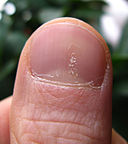
Nail psoriasis can affect fingernails and toenails. There are different types of nail changes that can occur. Signs of nail psoriasis include:
Pitting of the nails
Small pits appear on the surface of the nail. There may be one pit or many pits on the surface of a single nail.
Onycholysis
The nail separates from the skin underneath the nail. At first this looks like a white or yellow patch at the tip of the nail. This patch gradually gets bigger and reaches the base of the nail. The gap between the nail and the skin underneath the nail can become infected and change colour.
Subungual hyperkeratosis
A chalk-like material builds up under the nail. The nail becomes raised and often tender.
Oil drop or salmon patch - a see-through yellow-red patch appears in the nail bed that looks like there is a drop of oil under the nail.
Farbe
The colour of the nail may change, such as turning to yellow-brown.
Was könnte es sonst sein?
Infektionen of the nail can occur at the same time as psoriatic nail disease and can sometimes look like nail psoriasis. Pilzinfektionen der Nägel also cause thickening of the nails. It is important to get the correct treatment as some treatments for fungal nail diseases (eg, Terbinafin) can aggravate nail psoriasis.
Onycholysis is the loosening or separation of the nail from the skin underneath it. Treatment depends on the cause. Apart from nail psoriasis it has many other causes - for example:
Trauma to the nail bed - for example, by repeated tapping of the fingernails on a keyboard or by pressure from shoes in long-distance runners and walkers.
Allergy to nail glue (acrylate).
Infections, such as fungal infections, bacterial infections, or the Herpes-simplex-Virus (herpes simplex).
Many medicines - for example, some forms of Chemotherapie for cancer, and Tetracyclin and fluoroquinolone antibiotics.
Other diseases, such as Diabetes oder Schilddrüsenerkrankungen.
In most of these situations the onycholysis is not permanent and the nail will grow out normally once the cause has been removed or treated.
How common is nail psoriasis?
About 1 in 50 people have psoriasis at some time in their lives. It can first develop at any age but it most often starts between the ages of 15 and 30 years. Nail changes occur in about half of all people with psoriasis, so about 1 in a 100 people get nail psoriasis.
About 4 in every 5 people with psoriatic arthritis have psoriatic nail disease. Siehe das separate Informationsblatt namens Psoriasis-Arthritis für weitere Details.
Only a few people have psoriatic nail disease without having psoriasis affecting either their skin or their joints.
How is psoriatic nail disease diagnosed?
The diagnosis of psoriatic nail disease is usually made by the appearance of the affected nails. Sometimes scrapings from under the nail, and nail clippings, are sent to the laboratory to be tested for fungal infection of the nail, which can sometimes look like psoriatic nail disease.
Occasionally, a sample of nail (a biopsy) is needed to confirm the diagnosis.
How to help nail psoriasis
Keep your fingernails and toenails as short as possible - long or loose nails are more likely to catch and can cause more damage to the skin underneath the nail.
Keep your nails dry.
Protect your nails and wear gloves when doing any manual work.
Avoid a manicure of the base of the nail. This may cause an infection.
Avoid false nails as they may damage the cuticle and make it difficult to apply treatments to the nail.
Nail varnish can be used to cover up pitting. Nail varnish remover containing acetone should not be used, as it can cause damage to the nail.
If you have painful toenail psoriasis then you should see a person who is qualified to diagnose and treat foot disorders (a podiatrist).
Hinweis: if you have psoriatic nail disease and develop pain or swelling in one or more of your joints (including your fingers and toes) or if you develop pain in your heel (Achillessehnen-Tendinopathie) then you should see your doctor as soon as possible. You may be developing Psoriasis-Arthritis. It is important that you are seen by a doctor specialising in joint diseases (a rheumatologist) early. It has been shown that the sooner this condition is treated, the less likely you are to suffer permanent damage to your joints.
How to treat nail psoriasis
Mild nail disease which isn't causing discomfort does not need any treatment. If the nail disease is severe and causing problems then your doctor may refer you to see a skin specialist for advice and treatment. Unfortunately treatment of psoriatic nail disease is difficult and not always successful.
Treatments for nail psoriasis include:
Treatments applied to the nail, which include Steroide, salicylic acid, Calcipotriol oder tazarotene. Local treatments applied to the nail are often not very effective in treating nail psoriasis but are worth trying. If the nail is lifting off (onycholysis) then strong steroid scalp application can be trickled under the nail.
Antifungal treatment - this may be required for fungal nail infection if this is also present.
A steroid injected into the nail - this may be effective for some types of nail psoriasis but it is painful.
Light therapy (phototherapy) - psoralen plus ultraviolet light A (PUVA) treatment is effective for some types of nail psoriasis but not for pitting of the nail.
Removing an affected nail - this can be done by applying a special type of ointment and then covering the nail for seven days. Otherwise the nail can be surgically removed using local Anästhesie.
Patience is important. Once the nail has formed, nothing can be done to change it other than trimming it. The treatments are all aimed at treating the nail bed and the skin around the edge of the nail. Nails grow extremely slowly and it may take as long as a year for a damaged fingernail to grow out completely, or even two years for a damaged big toenail.
If nail psoriasis is severe and not helped by the treatments listed above then a powerful medicine which can suppress inflammation is sometimes used. For example, Methotrexat, ciclosporin, Acitretin, infliximab, etanercept, efalizumab, ustekinumab or adalimumab. There is some risk of serious side-effects with these medicines, so they are only used on the advice of a specialist and usually when there is psoriasis also affecting the skin.
What is the outlook (prognosis) for nail psoriasis?
Nail psoriasis can be difficult to treat and there is no cure. It doesn't usually grow out without treatment, so can continue to cause problems. The appearance of the affected nails can also sometimes cause distress.
The treatment of severe psoriatic nail disease is now improving with modern medicines.
Psoriatic nail disease can also be mild, not needing any treatment, and able to be hidden with nail varnish.
Explore psoriasis treatments
Erhalten Sie fachkundige medizinische Beratung bequem von zu Hause aus. Füllen Sie eine kurze Online-Konsultation aus, die rund um die Uhr verfügbar ist. Ihre Anfrage wird von einer in Großbritannien registrierten medizinischen Fachkraft geprüft. Für ausgewählte Behandlungen ist eine Lieferung am nächsten Tag möglich.
Patientenauswahl für Nail disorders
Haut-, Nagel- und Haargesundheit
Eingewachsener Zehennagel
Eingewachsene Zehennägel sind eine häufige Erkrankung, die Beschwerden verursachen oder sich entzünden kann. Manchmal wird die Erkrankung auch als „einwachsender Zehennagel“ bezeichnet; beide Begriffe bedeuten jedoch dasselbe. Verschiedene Behandlungen können von einem Arzt oder einer Pflegefachkraft oder von einer qualifizierten Fachperson für die Diagnose und Behandlung von Fußbeschwerden (Podologe) durchgeführt werden. Suchen Sie einen Arzt auf, wenn Sie Anzeichen einer Infektion im Bereich des Nagels bemerken – insbesondere, wenn Sie Diabetes, ein geschwächtes Immunsystem oder ein anderes Fußproblem haben.
von Dr. Doug McKechnie, MRCGP

Haut-, Nagel- und Haargesundheit
Paronychie
Paronychie ist eine häufige Infektion der Haut um die Nägel der Finger oder Zehen. Sie kann akut oder chronisch sein. Eine Behandlung ist nicht immer erforderlich, beinhaltet jedoch normalerweise Antibiotika für bakterielle Infektionen. Gelegentlich werden Antimykotika für Infektionen durch einen Hefepilz (Candida) eingesetzt. Gelegentlich können Steroidcremes für die Haut um den Nagel verwendet werden. Selten ist ein kleiner Eingriff erforderlich, um den angesammelten Eiter abzulassen.
von Dr. Philippa Vincent, MRCGP
Häufig gestellte Fragen
Can nail psoriasis be mistaken for other nail conditions?
Ja, Nagelinfektionen und Pilzinfektionen der Nägel können manchmal ähnlich wie Nagelpsoriasis aussehen. Es ist wichtig, eine korrekte Diagnose zu erhalten, da einige Behandlungen für Pilzinfektionen der Nägel, wie Terbinafin, die Nagelpsoriasis verschlimmern können.
Wenn sich meine Nägel vom Nagelbett lösen, könnte es an etwas anderem als Psoriasis liegen?
Ja, Onycholyse, die Lockerung oder Ablösung des Nagels von der darunterliegenden Haut, hat viele Ursachen außer Nagelpsoriasis. Dazu gehören Verletzungen des Nagelbetts (wie wiederholtes Klopfen oder Druck durch Schuhe), Allergien gegen Nagelkleber, verschiedene Infektionen (pilzartig, bakteriell oder das Herpes-simplex-Virus), einige Medikamente (einschließlich bestimmter Chemotherapeutika und Antibiotika) und andere Krankheiten wie Diabetes oder Schilddrüsenerkrankungen. In den meisten dieser Fälle wächst der Nagel normal, sobald die Ursache beseitigt oder behandelt wird.
Wie schnell wachsen Nägel mit Psoriasis heraus?
Fingernägel wachsen sehr langsam. Es kann bis zu einem Jahr dauern, bis ein beschädigter Fingernagel vollständig nachgewachsen ist, und sogar bis zu zwei Jahre für einen beschädigten großen Zehennagel. Das bedeutet, dass Geduld während der Behandlung wichtig ist, da die Effekte lange brauchen, um sichtbar zu werden.
Wie hoch ist die Wahrscheinlichkeit, Psoriasis-Arthritis zu entwickeln, wenn ich Nagelpsoriasis habe?
Etwa 4 von 5 Personen mit Psoriasis-Arthritis haben auch eine psoriatische Nagelerkrankung. Wenn Sie eine psoriatische Nagelerkrankung haben und Schmerzen oder Schwellungen in Ihren Gelenken oder Schmerzen in Ihrer Ferse bemerken, sollten Sie so schnell wie möglich Ihren Arzt aufsuchen. Dies könnte ein Anzeichen für die Entwicklung einer Psoriasis-Arthritis sein, und eine frühzeitige Behandlung ist wichtig, um dauerhafte Gelenkschäden zu verhindern.
Gibt es bestimmte Arten von Nagelpsoriasis, die auf bestimmte Behandlungen nicht gut ansprechen?
Ja, zum Beispiel ist die Lichttherapie (Psoralen plus ultraviolettes Licht A, oder PUVA) bei einigen Arten von Nagelpsoriasis wirksam, jedoch nicht bei der Grübchenbildung des Nagels. Auch lokale Behandlungen, die direkt auf den Nagel aufgetragen werden, sind oft nicht sehr effektiv, obwohl es sich lohnt, sie auszuprobieren.
Weiterführende Lektüre und Referenzen
- Psoriasis: Die Beurteilung und Behandlung von Psoriasis; NICE Klinische Leitlinie (Oktober 2012 - zuletzt aktualisiert September 2017)
- Nagelpsoriasis; DermNet NZ
- Ventura A, Mazzeo M, Gaziano R, et al; New insight into the pathogenesis of nail psoriasis and overview of treatment strategies. Drug Des Devel Ther. 2017 Aug 30;11:2527-2535. doi: 10.2147/DDDT.S136986. eCollection 2017.
- Psoriasis - nail psoriasis; Primary Care Dermatology Society. Last updated May 2022.
- Pasch MC; Nail Psoriasis: A Review of Treatment Options. Drugs. 2016 Apr;76(6):675-705. doi: 10.1007/s40265-016-0564-5.
- Psoriasis; NICE CKS, September 2022 (nur für UK-Zugang)
Über den AutorVollständige Biografie anzeigen
Aktualisiert von

Dr Doug McKechnie, MRCGP
Medizinischer Autor
MA, MBBS, MSc, DRCOG, MRCP(UK), MRCGP(2021), FHEA
Dr. Doug McKechnie ist ein NHS-Hausarzt, der in London arbeitet. Er arbeitet klinisch in Vollzeit und ist außerdem stellvertretender Leiter des Moduls für klinische und berufliche Praxis an der University College London Medical School.
Verfasst von

Dr Colin Tidy, MRCGP
Allgemeinmediziner, Medizinischer Autor
MBBS, MRCGP, MRCP (Paediatrics), DCH
Dr. Colin Tidy ist ein NHS-Arzt mit Sitz in Oxfordshire.
Über den RezensentenVollständige Biografie anzeigen
Dr Colin Tidy, MRCGP
Allgemeinmediziner, Medizinischer Autor
MBBS, MRCGP, MRCP (Paediatrics), DCH
Dr. Colin Tidy ist ein NHS-Arzt mit Sitz in Oxfordshire.
Artikelverlauf
Artikel auch verfügbar in Englisch, Deutsch, Spanisch, Französisch, Italienisch, Portugiesisch, Hindi, Hebräisch, Arabisch, und Schwedisch.
Nächste Überprüfung fällig: 15. Apr 2028
17. Apr 2023 | Neueste Version
20 Nov 2012 | Ursprünglich veröffentlicht
Verfasst von:
Dr Colin Tidy, MRCGP
Medizinische Fachkräfte
Looking for more in-depth clinical detail? Our Professional Reference articles are written for doctors, nurses and other healthcare professionals. They include comprehensive clinical guidance, diagnostic information and UK/European evidence summaries. If you need the clinical version, you can read the Professional Reference article on this topic.
Teilen Sie Ihre Gedanken oder Erfahrungen mit anderen in unserem Patientengemeinschaften.
Einfacher Zugang zu vertrauenswürdigen Behandlungen und Gesundheitsdiensten online.
Common conditions
Get help with common conditions through the NHS, without a GP appointment.





Abonnieren Sie den Patienten-Newsletter
Ihre wöchentliche Dosis klarer, vertrauenswürdiger Gesundheitsberatung - geschrieben, um Ihnen zu helfen, sich informiert, selbstbewusst und in Kontrolle zu fühlen.
Durch das Abonnieren akzeptieren Sie unsere Datenschutzrichtlinie. Sie können sich jederzeit abmelden. Wir verkaufen Ihre Daten niemals.