Behandlung wiederkehrender Hefepilzinfektionen
Begutachtet von Dr Philippa Vincent, MRCGPZuletzt aktualisiert von Dr Hayley Willacy, FRCGP Zuletzt aktualisiert 31. Juli 2024
Erfüllt die Anforderungen des Patienten redaktionellen Richtlinien
- HerunterladenHerunterladen
- Teilen
- Language
- Diskussion
- Audio-Version
- Zu bevorzugten Quellen bei Google hinzufügen
In dieser Serie:Vaginaler AusflussVaginale PilzinfektionBakterielle VaginoseVorbeugung und Behandlung von bakterieller Vaginose
Wiederkehrende Hefepilzinfektion (Vaginalpilz) ist definiert als eine Episode von Pilzinfektionen vier oder mehr Mal im Jahr. In einigen Fällen gibt es medizinische Gründe, warum Sie anfälliger für Pilzinfektionen sind. Einige Hormonbehandlungen können ebenfalls Ihr Risiko für wiederholte Episoden beeinflussen.
Auf einen Blick
Wiederkehrender vaginaler Soor bedeutet, vier oder mehr Episoden von Soor in einem Jahr zu haben.
Es kann durch schlecht kontrollierten Diabetes oder ein geschwächtes Immunsystem verursacht werden.
Ärzte können Tests wie einen Vaginalabstrich durchführen, um die Ursache Ihrer Symptome zu bestätigen.
Die Behandlung umfasst oft Antimykotika über einen längeren Zeitraum als gewöhnlich.
Eine Erhaltungstherapie mit Medikamenten wie Fluconazol kann helfen, das Wiederauftreten von Soor zu verhindern.
Lebensstiländerungen können helfen, Ihr Risiko für wiederkehrende Infektionen zu verringern.
Konsultieren Sie Ihren Arzt, wenn sich die Symptome nicht bessern oder wenn neue Symptome auftreten.
A vaginal yeast infection (Scheidenpilz) is an extremely common cause of vaginaler Ausfluss - up to 3 in 4 women will have at least one episode during their lives. In most cases, thrush in women settles with simple treatment, either topical (applied to the vagina in the form of pessaries or antifungal creams) or oral (a tablet or tablets). However, some women either have repeated new infections, or find that they still have symptoms because the initial thrush treatment has not been effective.
What causes recurring yeast infections?
Speculum examination showing vaginal thrush
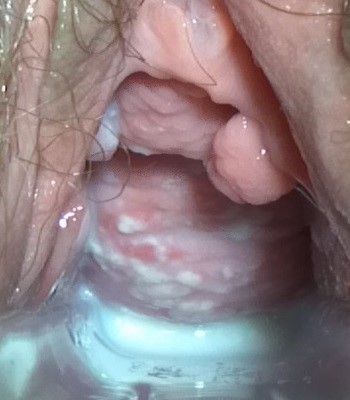
© Mikael Häggström, CC0, via Wikimedia Commons
Of women who develop a first bout of vaginal thrush, about 5 in 100 of them will get problems with recurring thrush. In most cases, the reason why this occurs is not known. Some women just seem more prone than usual to develop thrush. However women with high blood sugar (due to poorly controlled diabetes) and women with weakened immune systems may be more likely to develop recurrent thrush.
There is some debate as to whether women taking Hormonersatztherapie (HRT) or birth control pills such as the kombinierte orale Kontrazeptivum (KOK)-Pille are more likely to develop a recurring yeast infection - the evidence is not yet clear.
How do I get rid of a recurring yeast infection?
If you have repeated bouts of thrush then one option is simply to treat each bout as and when it occurs. See the separate leaflet Vaginal thrush (Yeast infection) for treatments for thrush.
Recurrent thrush is defined as 4 or more symptomatic episodes per year. If you have four or more episodes of vaginal thrush a year, with at least 2 episodes confirmed by a swab test, your doctor may suggest a different approach.
Before they do this, they may want to exclude another cause for your symptoms. This could include:
Taking a vaginal swab and sending it the laboratory to check for evidence of thrush or other infection.
Checking the pH (acidity level) in your vagina using a simple test strip. A lower pH (4.5 or below) makes it more likely that thrush is the cause. A higher pH (above 4.5) makes bakterieller Vaginose (BV) or trichomonas infection (a sexually transmitted infection) more likely.
Other swabs or tests as appropriate.
Treatment for recurrent thrush
Using one of the usual treatments for vaginal thrush (topical treatments or tablets) - but for longer than usual. Your doctor will advise exactly how long to use the treatment for. Vaginal thrush can be treated with over the counter medicines, but as you need a longer course of treatment, your GP will give you a prescription for treatment if you need it.
How the recurring yeast infection is treated will also depend on your preferences and other factors such as whether you can tolerate the treatment, or have ever reacted badly to it, your age and whether you're pregnant (in which case vaginal pessaries will usually be advised). If you're 12-15 years old, or it's not clear whether your symptoms are due to recurrent vaginal thrush, your doctor may recommend a hospital specialist referral.
The first-line recommended 'induction treatment' is three doses of fluconazole 150 mg tablets (to be taken every 72 hours).
This is followed by regular 'maintenance treatment' to stop the thrush coming back, with once weekly tablets of fluconazole 150 mg for six months.
If you can't take fluconazole tablets for whatever reason, topical therapy (such as clotrimazole 500 mg vaginal pessary) can be used as induction treatment for 7-14 days, depending on how your symptoms respond. Maintenance treatment would then be a clotrimazole 500 mg vaginal pessary inserted once a week for six months or itraconazole tablets 50-100 mg once daily for six months.
Most women remain clear of thrush during maintenance treatment. If you and your doctor decide maintenance treatment is best for you, this will usually last for six months.
After treatment is stopped, many women remain free of thrush, or only develop the occasional bout again. However, some women return to developing recurring yeast infections. If this happens, the treatment plan can be repeated, and maintenance treatment continued for longer.
Regardless of the treatment you and your doctor agree, it's important to use lifestyle measures to reduce your risk of recurring yeast infections (you can find out more below). In addition, you should speak to your doctor if:
Your symptoms don't improve with treatment.
You develop thrush whilst on maintenance treatment. This may indicate that you have a resistant strain of Candida spp. which may require an alternative treatment.
You become pregnant or are breastfeeding.
You develop side-effects from the medication.
You develop new symptoms, such as smelly discharge, ulcers or blisters, abnormal vaginal bleeding or a bloodstained discharge.
You feel unwell in yourself.
Can I prevent recurring yeast infections?
The yeast that causes yeast infections, called Candida spp. such as Candida albicans, thrives in warm, moist, airless environments. General lifestyle changes that help prevent single episodes of vaginal thrush can also help reduce the risk of recurrent thrush.
Wenn Sie Diabetes, your risk of recurring yeast infections is higher if your blood sugar is consistently high. Working with your diabetes team to bring your blood sugar under control can cut the risk of recurrent bouts of thrush.
If you experience recurring yeast infections, your doctor or nurse may also discuss your current method of contraception with you and suggest a change. There has been talk in the past about the kombinierte orale Kontrazeptivum (KOK)-Pille (the birth control pills that contain both oestrogen and progesterone hormones) possibly making recurrent vaginal thrush more likely. However, the evidence around this is a little unclear.
Patientenauswahl für Vaginale und vulväre Probleme
Frauengesundheit
Juckende Vulva
Die meisten Frauen erleben von Zeit zu Zeit einen juckenden Vulva und eine juckende Vagina. Bei Pruritus vulvae jedoch ist der Juckreiz anhaltend und verursacht Unbehagen.
von Dr. Rosalyn Adleman, MRCGP

Frauengesundheit
Lichen sclerosus
Lichen sclerosus ist eine seltene Hauterkrankung. Sie betrifft am häufigsten die Genitalhaut (Vulva) von Frauen. Sie kann in jedem Alter auftreten.
von Dr. Colin Tidy, MRCGP
Häufig gestellte Fragen
Kann wiederkehrender Soor ein Anzeichen für ein ernsteres zugrunde liegendes Gesundheitsproblem sein?
Obwohl die Ursache für wiederkehrenden Soor oft unbekannt ist, kann er manchmal mit bestimmten Gesundheitszuständen in Verbindung gebracht werden. Frauen mit hohem Blutzucker, wie zum Beispiel bei schlecht kontrolliertem Diabetes, oder Personen mit geschwächtem Immunsystem, können anfälliger für die Entwicklung von wiederkehrendem Soor sein. Wenn Sie unter wiederkehrendem Soor leiden, könnte Ihr Arzt diese Möglichkeiten untersuchen.
Wie stellen Ärzte fest, ob meine wiederkehrenden Symptome definitiv Soor oder etwas anderes sind?
Wenn Sie wiederholt Symptome von Scheidenpilz haben, wird Ihr Arzt wahrscheinlich einen Vaginalabstrich nehmen, um ihn an ein Labor zu senden. Dies hilft, das Vorhandensein von Scheidenpilz zu bestätigen oder andere Infektionen zu identifizieren. Möglicherweise überprüft er auch den pH-Wert in Ihrer Vagina mit einem einfachen Teststreifen. Ein niedriger pH-Wert (4,5 oder darunter) deutet auf Scheidenpilz hin, während ein höherer pH-Wert (über 4,5) auf eine bakterielle Vaginose oder eine Trichomonas-Infektion hinweisen könnte.
Ist die Behandlung von wiederkehrendem Soor anders, wenn ich zwischen 12 und 15 Jahre alt bin?
Ja, wenn Sie zwischen 12 und 15 Jahre alt sind oder wenn Unklarheit darüber besteht, ob Ihre Symptome auf wiederkehrenden Scheidenpilz zurückzuführen sind, könnte Ihr Arzt eine Überweisung an einen Facharzt im Krankenhaus zur weiteren Beurteilung und Behandlung empfehlen.
Was soll ich tun, wenn ich schwanger bin oder stille und wiederholt an Scheidenpilz leide?
Wenn Sie schwanger sind oder stillen und wiederholt an Scheidenpilz leiden, ist es wichtig, mit Ihrem Arzt zu sprechen. In diesen Fällen sind Vaginalzäpfchen in der Regel die empfohlene Behandlungsoption.
Gibt es Nebenwirkungen, auf die ich während der Behandlung von wiederkehrendem Scheidenpilz achten sollte?
Ja, wenn Sie Nebenwirkungen von dem Medikament, das Ihnen gegen wiederkehrenden Scheidenpilz verschrieben wurde, bemerken, sollten Sie umgehend Ihren Arzt kontaktieren. Er kann Ihnen Ratschläge geben, wie Sie damit umgehen können, oder gegebenenfalls eine alternative Behandlung vorschlagen.
Was ist, wenn sich meine Symptome mit der Behandlung gegen wiederkehrenden Soor nicht verbessern oder sich verschlimmern?
Wenn sich Ihre Symptome mit der verschriebenen Behandlung nicht verbessern oder wenn Sie neue Symptome wie übelriechenden Ausfluss, Geschwüre, Blasen, ungewöhnliche vaginale Blutungen oder blutigen Ausfluss entwickeln, sollten Sie unbedingt mit Ihrem Arzt sprechen. Kontaktieren Sie ihn auch, wenn Sie während der Erhaltungsbehandlung einen Pilzbefall entwickeln, da dies auf einen resistenten Stamm hinweisen könnte, der eine andere Behandlung erfordert.
Weiterführende Literatur und Referenzen
- Candida - weibliche Genitalien: wiederkehrende Infektion; NICE CKS, Oktober 2023 (nur für UK-Zugang)
- Candida - weibliche Genitalien; NICE CKS, Oktober 2023 (nur für UK-Zugang)
- Bakterielle Vaginose; NICE CKS, Juli 2023 (nur für UK-Zugang)
- Vaginaler Ausfluss; NICE CKS, Februar 2024 (nur für UK-Zugang)
Über den AutorVollständige Biografie anzeigen

Dr Hayley Willacy, FRCGP
Allgemeinmediziner, Medizinischer Autor
MBChB (1992), DRCOG, DFFP, MRCOG (Part 1) MRCGP (2007), DFSRH (2013), MSc - medical education (2020)
Dr. Hayley Willacy war eine NHS-Hausärztin, die in Nordwestengland arbeitete und 2022 nach 30 Jahren aus der klinischen Praxis ausschied.
Über den RezensentenVollständige Biografie anzeigen

Dr Philippa Vincent, MRCGP
Allgemeinmediziner, Medizinischer Autor
MB BS, Bsc, MRCGP (2000), DCH, DFSRH, DRCOG
Dr Philippa Vincent ist ein NHS-Arzt, der in Nordlondon arbeitet.
Artikelverlauf
Die Informationen auf dieser Seite wurden von qualifizierten Klinikern verfasst und begutachtet.
Artikel auch verfügbar in Englisch, Deutsch, Spanisch, Französisch, Italienisch, Portugiesisch, Hindi, Hebräisch, Arabisch, und Schwedisch.
Nächste Überprüfung fällig: 30. Juli 2027
31. Juli 2024 | Neueste Version

Fragen, teilen, verbinden.
Durchsuchen Sie Diskussionen, stellen Sie Fragen und teilen Sie Erfahrungen zu Hunderten von Gesundheitsthemen.

Fühlen Sie sich unwohl?
Bewerten Sie Ihre Symptome online kostenlos
Abonnieren Sie den Patienten-Newsletter
Ihre wöchentliche Dosis klarer, vertrauenswürdiger Gesundheitsberatung - geschrieben, um Ihnen zu helfen, sich informiert, selbstbewusst und in Kontrolle zu fühlen.
Durch das Abonnieren akzeptieren Sie unsere Datenschutzrichtlinie. Sie können sich jederzeit abmelden. Wir verkaufen Ihre Daten niemals.
Mehr zur Frauengesundheit
- Unterstützte Entbindung
- Windpocken-Kontakt in der Schwangerschaft
- Verhütungsimplantat
- Verhütungsspritze
- Eileiterschwangerschaft
- Epilepsie und Verhütung
- Weibliche sexuelle Funktionsstörung
- Gynäkologische Krebserkrankungen
- Ist es sicher, die Periode mit der Pille auszulassen?
- Juckende Vulva
- Schmerzen im linken Unterbauch während der Schwangerschaft
- Levonorgestrel-Intrauterinsystem
- Blasenmole
- Eierstockzyste
- Schmerzlinderung bei der Geburt
- Beckenorganprolaps
- Postnatale Depression
- Schwangerschaftsscreening-Tests
- Gestagen-alleinige Antibabypille
- Vaginaler Ausfluss