Fingerspitzen-Einheiten für topische Steroide
Begutachtet von Dr Colin Tidy, MRCGPZuletzt aktualisiert von Dr Doug McKechnie, MRCGPZuletzt aktualisiert 19. Jan 2023
Erfüllt die Anforderungen des Patienten Richtlinien des Patienten
- HerunterladenHerunterladen
- Teilen
- Language
- Diskussion
- Audio-Version
- Zu bevorzugten Quellen bei Google hinzufügen
In dieser Serie:SteroideSteroide InjektionenOrale SteroideTopische SteroideSteroidhaltige Nasensprays
Topische Steroide werden bei verschiedenen Hauterkrankungen eingesetzt. Die Menge an topischem Steroid, die Sie auftragen sollten, wird üblicherweise in Fingerkuppen-Einheiten gemessen.
Auf einen Blick
Topical steroids are creams, ointments, or lotions containing steroid drugs for skin conditions.
They reduce inflammation in the skin.
A fingertip unit (FTU) is a standard measure for topical steroids.
One FTU is the amount of steroid from a tube along an adult's fingertip.
One FTU covers an area twice the size of an adult's handprint.
The article provides guidance for measuring FTUs for adults and children.

Unsicher beim Mischen von Medikamenten?
Überprüfen Sie mögliche Wechselwirkungen zwischen Medikamenten, Nahrungsergänzungsmitteln und Lebensmitteln, bevor Sie sie zusammen einnehmen.
What are topical steroids?
Topical steroids are creams, ointments and lotions which contain steroid drugs. Topical steroids work by reducing inflammation in the skin. They are used for various skin conditions, such as atopisches Ekzem. Unlike many other creams and ointments, it is important to get the dose right when using topical steroids, to avoid giving too much, or too little. This is why a standard measure is often used - the fingertip unit (FTU).
See the separate leaflet called Topical Steroids for Eczema for more information.
Fingertip units
Picture of a fingertip unit of a topical steroid
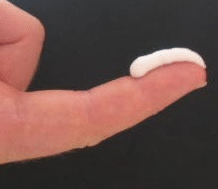
One FTU is the amount of topical steroid that is squeezed out from a standard tube along an adult's fingertip. (This assumes the tube has a standard 5 mm nozzle.) A fingertip is from the very end of the finger to the first crease in the finger. One FTU is enough to treat an area of skin twice the size of the flat of an adult's hand with the fingers together (ie a 'handprint').
Two FTUs are about the same as 1 g of topical steroid. Therefore, for example, say you treat an area of skin the size of eight adult hands. You will need four FTUs for each dose. (This is 2 g per dose. If the dose is once a day, then a 30 g tube should last for about 15 days of treatment.)
The following are further examples:
Area of skin to be treated (adults) | Size is roughly | FTUs each dose (adults) |
A hand and fingers (front and back) | About 2 adult hands | 1 FTU |
Front of chest and abdomen | About 14 adult hands | 7 FTUs |
Back and buttocks | About 14 adult hands | 7 FTUs |
Face and neck | About 5 adult hands | 2.5 FTUs |
An entire arm and hand | About 8 adult hands | 4 FTUs |
An entire leg and foot | About 16 adult hands | 8 FTUs |
Fingertip units and children
An FTU of cream or ointment is measured on an adult index finger before being rubbed on to a child. Again, one FTU is used to treat an area of skin on a child, equivalent to twice the size of the flat of an adult's hand with the fingers together. You can gauge the amount of topical steroid to use by using your (adult) hand to measure the amount of skin affected on the child. From this you can work out the amount of topical steroid to use.
The following gives a rough guide:
For a child aged 3-6 months
Entire face and neck - 1 FTU.
An entire arm and hand - 1 FTU.
An entire leg and foot - 1.5 FTUs.
The entire front of chest and tummy (abdomen) - 1 FTU.
The entire back including buttocks - 1.5 FTUs.
For a child aged 1-2 years
Entire face and neck - 1.5 FTUs.
An entire arm and hand - 1.5 FTUs.
An entire leg and foot - 2 FTUs.
The entire front of chest and abdomen - 2 FTUs.
The entire back including buttocks - 3 FTUs.
For a child aged 3-5 years
Entire face and neck - 1.5 FTUs.
An entire arm and hand - 2 FTUs.
An entire leg and foot - 3 FTUs.
The entire front of chest and abdomen - 3 FTUs.
The entire back including buttocks - 3.5 FTUs.
For a child aged 6-10 years
Entire face and neck - 2 FTUs.
An entire arm and hand - 2.5 FTUs.
An entire leg and foot - 4.5 FTUs.
The entire front of chest and abdomen - 3.5 FTUs.
The entire back including buttocks - 5 FTUs.
Patientenauswahl für Hautmedikamente
Behandlung und Medikamente
Topische Steroide gegen Ekzeme
Topical steroids are medicated steroid creams that are put on the skin. They are used in addition to moisturisers (also called emollients) for treating eczema. Topical steroids reduce skin inflammation. A short course will usually clear a flare-up of eczema. Side-effects are unlikely to occur with short courses.
von Dr. Toni Hazell, FRCGP

Behandlung und Medikamente
Emollientien und Ekzemcremes
Emollients (Feuchtigkeitscremes) werden häufig zur Behandlung von Ekzemen verwendet, da sie verhindern, dass die Haut austrocknet. Sie können Emollients so oft auftragen, wie Sie es benötigen. Dies kann 2-3 Mal am Tag oder öfter sein, wenn Ihre Haut sehr trocken wird. Das regelmäßige Auftragen von Emollients ist mühsam und langweilig, aber lohnenswert, da es verhindern kann, dass Ekzeme aufflammen.
von Dr. Philippa Vincent, MRCGP
Häufig gestellte Fragen
What does a fingertip unit (FTU) actually look like?
A fingertip unit (FTU) is the amount of topical steroid squeezed out from a standard tube (with a 5 mm nozzle) along an adult's fingertip. This is measured from the very end of the finger to the first crease.
How much skin area does one fingertip unit (FTU) cover?
One FTU is enough topical steroid to treat an area of skin that is twice the size of the flat of an adult's hand with their fingers held together, often referred to as a 'handprint'.
How many grams of topical steroid are in one fingertip unit (FTU)?
Approximately two fingertip units (FTUs) are equivalent to 1 gram of topical steroid.
How long will a 30g tube of topical steroid last if I apply it once a day?
If you are applying 2 grams of topical steroid per dose once a day, a 30-gram tube should last for about 15 days of treatment.
When applying topical steroids to a child, whose fingertip should be used to measure the dose?
When applying topical steroids to a child, the dose (FTU) should always be measured on an adult's index finger before being rubbed onto the child's skin. You can then use your own adult hand to estimate the size of the affected area on the child to determine how many FTUs are needed.
Weiterführende Literatur und Referenzen
- Long CC, Finlay AY; The finger-tip unit - a new practical measure. Clin Exp Dermatol. 1991 Nov;16(6):444-7.
- Bewley A; Expert consensus: time for a change in the way we advise our patients to use topical corticosteroids. Br J Dermatol. 2008 May;158(5):917-20. Epub 2008 Feb 22.
- Britisches Nationales Arzneimittelverzeichnis (BNF); NICE Evidenzdienste (nur in Großbritannien zugänglich)
- Kortikosteroide - topisch (Haut), Nase und Augen; NICE CKS, Juni 2022 (nur für UK-Zugang)
- Ekzem - atopisch; NICE CKS, April 2022 (nur für UK-Zugang)
Über den AutorVollständige Biografie anzeigen

Dr Doug McKechnie, MRCGP
Medizinischer Autor
MA, MBBS, MSc, DRCOG, MRCP(UK), MRCGP(2021), FHEA
Dr. Doug McKechnie ist ein NHS-Hausarzt, der in London arbeitet. Er arbeitet klinisch in Vollzeit und ist außerdem stellvertretender Leiter des Moduls für klinische und berufliche Praxis an der University College London Medical School.
Über den RezensentenVollständige Biografie anzeigen

Dr Colin Tidy, MRCGP
Allgemeinmediziner, Medizinischer Autor
MBBS, MRCGP, MRCP (Paediatrics), DCH
Dr. Colin Tidy ist ein NHS-Arzt mit Sitz in Oxfordshire.
Artikelverlauf
Die Informationen auf dieser Seite wurden von qualifizierten Klinikern verfasst und begutachtet.
Artikel auch verfügbar in Englisch, Deutsch, Spanisch, Französisch, Italienisch, Portugiesisch, Hindi, Hebräisch, Arabisch, und Schwedisch.
Nächste Überprüfung fällig: 18. Jan 2028
19. Jan 2023 | Neueste Version

Fragen, teilen, verbinden.
Durchsuchen Sie Diskussionen, stellen Sie Fragen und teilen Sie Erfahrungen zu Hunderten von Gesundheitsthemen.

Fühlen Sie sich unwohl?
Bewerten Sie Ihre Symptome online kostenlos
Abonnieren Sie den Patienten-Newsletter
Ihre wöchentliche Dosis klarer, vertrauenswürdiger Gesundheitsberatung - geschrieben, um Ihnen zu helfen, sich informiert, selbstbewusst und in Kontrolle zu fühlen.
Durch das Abonnieren akzeptieren Sie unsere Datenschutzrichtlinie. Sie können sich jederzeit abmelden. Wir verkaufen Ihre Daten niemals.
Mehr zu Behandlung und Medikamenten
- Aknebehandlungen
- Antazida
- Antikoagulantien
- Antidepressiva
- Audiologie
- Benzodiazepine und Z-Drugs
- Kontrollierte Atmung
- Erweitertes Spektrum Beta-Lactamasen
- Flüssigstickstoffbehandlung
- Medikamente und Behandlung bei Demenz
- Medikament gegen Bluthochdruck
- Medikamente gegen Harndrang und Inkontinenz
- Meningokokken-Impfstoff gegen Meningitis
- Orale Bronchodilatatoren
- Orale Steroide
- Kaliumsparende Diuretika
- Stoßwellentherapie
- Schlaftabletten
- Topische entzündungshemmende Schmerzmittel
- Verwendung von Sauerstofftherapie bei COPD