Mastozytose und Mastzellenerkrankungen
Begutachtet von Dr John Cox, MRCGPZuletzt aktualisiert von Dr Laurence KnottZuletzt aktualisiert 9. Jul 2017
Erfüllt die Richtlinien des Patienten
- HerunterladenHerunterladen
- Teilen
- Language
- Diskussion
- Audio-Version
- Zu bevorzugten Quellen bei Google hinzufügen
Diese Seite wurde archiviert.
Es wurde kürzlich nicht überprüft und ist nicht auf dem neuesten Stand. Externe Links und Referenzen funktionieren möglicherweise nicht mehr.
Eine Mastzelle ist eine Art weiße Blutkörperchen. Es gibt verschiedene Formen der Mastozytose. In einer sind zu viele Mastzellen im Körper: in einer anderen ist die Anzahl der Mastzellen normal, aber sie sind zu aktiv.
Auf einen Blick
Mastzellen spielen eine Schlüsselrolle im Immunsystem, indem sie helfen, Infektionen zu bekämpfen und Wunden zu heilen.
Mastozytose kann auftreten, wenn es zu viele Mastzellen gibt oder wenn sie überaktiv sind.
Die Symptome variieren stark je nach Art und Ort der Mastzellerkrankung.
Auslöser für Symptome können Hitze, Stress, bestimmte Lebensmittel, Insektenstiche und einige Medikamente sein.
Es gibt keine Heilung für Mastzellerkrankungen, aber verschiedene Behandlungen können helfen, die Symptome zu lindern.
What are mast cells?
Mast cells are a type of white blood cell - together, our white blood cells play a major role in our immune system, helping us fight off infection and other invaders. Mast cells are packed with histamine, a chemical released when you have an allergic reaction. They also contain heparin, a chemical which stops the blood from clotting. Mast cells are hard-working cells that have many functions, including helping to fight infection and healing wounds.
However, mast cell disorders can occur in which too many cells are produced or they become overactive.
What are the types of mast cell disorder?
Mastozytose
This is the term used when too many mast cells are produced. There are many different types of mastocytosis. The most common types are:
Those involving the skin (cutaneous).
Those which involve lots of different tissues of the body (systemic).
Much less commonly there is a localised type in which clumps of mast cells gather in one place.
Mast cell activation syndrome
You may also see mast cell activation syndrome (MCAS) called mast cell activation disorder (MCAD). The mast cells are present in normal numbers but they are triggered to release their chemicals more readily than usual. The symptoms are generally the same as mastocytosis.
Localised mast cell disorder
Rarely, clumps of mast cells can develop in one area of the body.
What causes mast cell disorders?
The cause is not known. It is suspected that there is a fault in the gene (the material inherited from your parents) that controls mast cell production.
Triggers for mastocytosis symptoms
Although not strictly speaking the cause of mastocytosis, a number of factors are known to trigger the symptoms. These include:
Physical triggers - for example, heat, cold, rubbing, sunlight, tiredness, lots of exercise, a high temperature (fever).
Emotional triggers - for example, stress.
Some foods - for example, cheese, spices, shellfish, food preservatives, flavourings and colourings, monosodium glutamate.
Toxic substances in the environment - for example, perfumes, pesticides.
Insektenstiche, Quallenstiche, Schlangenbisse.
Infection with germs (bacteria), funguses or viruses.
Alkohol.
Medicines - for example, anaesthetic agents, aspirin, antibiotics, opioids and many other medications.
Who gets a mast cell disorder?
These conditions are not very common. Altogether, they occur in about 1 in 150,000 people. The most common type - urticaria pigmentosa (see section on symptoms, below) - is seen in 1 person in every 1,000 who attends a skin (dermatology) clinic.
What are the symptoms of mast cell disorders?
Kutane Mastozytose
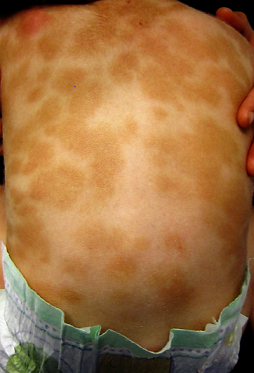
When larger than normal numbers of mast cells are present in the skin they commonly cause a condition called urticaria pigmentosa. Another less common condition called diffuse cutaneous mastocytosis is also sometimes seen.
Pigmentierte Urtikaria
Urticaria Pigmentosa
© James Heilman, MD (Own work)CC BY-SA 3.0, via Wikimedia Commons
This usually starts in babies a few months old but can go on for years. It causes a rash to appear anywhere on the body, made of light brown, itchy raised patches.
If you rub the patches, they become red and swollen and blisters develop. This is called Darier's sign.
Rarely, after rubbing or applying heat to the skin, a severe allergic effect (an anaphylactic reaction) can occur .
Your child may develop dermographism - this is a condition in which you can 'write' on the skin with a blunt object.
The condition usually gets better as your child becomes older and it usually disappears by the time they reach their teens. Rarely, an adult form can develop.
Diffuse kutane Mastozytose
This usually occurs in children less than 1 year old.
They develop a very itchy rash with yellow, thickened skin.
Large blisters can appear for no reason or after a very light amount of rubbing.
If large areas of skin are involved, bodily symptoms can develop such as flushing, headache and the sensation of having a 'thumping' heart (palpitations). Tummy pains, diarrhoea and breathlessness can occur., The child can go into shock and become very ill. Some children have died of this condition.
Localised mastocytosis
Rarely, clumps of mast cells can form a nodule in the skin, which is usually red, brown or yellow in colour. This is called a mastocytoma. Even more rarely, a cancerous (malignant) lump called a mast cell sarcoma can develop.
Systemische Mastozytose
This can cause a whole range of symptoms depending on the parts of the body where large numbers of mast cells are found. For example:
Skin - flushing of the face, urticaria pigmentosa (see above).
Digestive system - tummy pains, diarrhoea, pale stools that are difficult to flush, feeling sick (nausea) or being sick (vomiting), acid indigestion, stomach ulcers.
Swelling of the liver or spleen.
Circulatory problems - fainting, low blood pressure, anaphylactic shock.
Anaemia; other problems with the blood or bone marrow.
Fractures of the bones (because of bone marrow involvement).
Swollen lymph nodes.
Atembeschwerden.
Headaches, pins and needles, numbness.
How are these conditions diagnosed?
It's usually possible to guess the diagnosis if the skin is involved. However, the more generalised form causes so many different symptoms it may only become clear what the problem is once tests have been done.
Was könnte es sonst sein?
Because there can be so many different symptoms, the disorders can easily be confused with other conditions. These can include other skin disorders, liver and bowel problems, glandular conditions and rare tumours.
Werde ich Tests benötigen?
You will need a sample taken from your skin (eine Biopsie) for genetic testing. Chest and bone X-rays or scans may be needed. Various blood and urine tests will be arranged. The main test involves removing some bone marrow or tissue from an area other than the skin. The sample is tested for the presence of mast cells: various genetic and chemical tests may also be performed.
How are mastocytosis and other mast cell disorders treated?
There is no treatment that will actually cure these conditions but a wide variety of medicines is available to control the symptoms.
Akute Anaphylaxie
If you are prone to sudden severe allergy symptoms you should avoid trigger factors. It's a good idea to wear a medical emergency identification bracelet or similar. If you've been given treatment advice from a specialist about what to do during an attack, carry it with you. Acute severe reactions are usually treated with adrenaline (epinephrine) injections, anti-allergy medication, fluids into a vein and steroids. You might need to carry an adrenaline (epinephrine) pen injector with you which can be obtained from your doctor. Some people need a course of injections to reduce their sensitivity to insect stings.
Skin and symptoms related to blood circulation
Itching, flushing and other skin allergy symptoms can be controlled by medicines called H1-receptor and H2-receptor antagonists. These include Chlorphenamin, ketotifen und cimetidine.
Medication which stabilises the mast cells such as sodium cromoglicate, nedocromil and ketotifen.
Steroid creams or ointments and injections are sometimes used.
Treatment also used for psoriasis - called psoralen combined with ultraviolet A (PUVA) treatment - sometimes helps.
Keuchen
Inhalers to relax the airways - for example, Salbutamol - can be helpful.
Digestive symptoms
H2-receptor antagonists or Protonenpumpenhemmer help to control the effects of excess acid.
Oral sodium cromoglicate is beneficial in people with diarrhoea and tummy (abdominal) pain.
Anticholinergic medication such as propantheline (which blocks the effects of a body chemical called acetylcholine) may help control diarrhoea.
Andere Behandlungen
Medicines called leukotriene inhibitors used mainly in asthma - for example, montelukast - have been used. Low-dose aspirin and steroid tablets have been found helpful to control many different symptoms.
If the condition is severe, surgery to remove the spleen (splenectomy), medicines that have an effect on the immune system (such as interferon), bone marrow transplant or stem cell therapy may be considered.
Hinweis der Redaktion
Dr. Sarah Jarvis, 28th September 2021
Midostaurin zur Behandlung der fortgeschrittenen systemischen Mastozytose
The National Institute for Health and Care Excellence (NICE) has brought out new guidance on the use of midostaurin for people with mastocytosis.
Midostaurin targets and inhibits an enzyme called tyrosine kinases on the surface of the cell. This means it can help block the number of mast cells expanding. It is sometimes used as a treatment for certain types of the blood cancer called acute myeloid leukaemia.
NICE recommends that midostaurin is recommended as an option for people with severe forms of mastocytosis:
Aggressive systemische Mastozytose.
Systemic mastocytosis linked to blood cancer.
Mast cell leukaemia in adults.
You can find out more about NICE's recommendations from the further reading section below.
What is the outlook for these conditions?
Cutaneous mastocytosis in children often settles down with time. Adults can go on to develop the systemic form.
Systemic mastocytosis tends to be persistent and the outlook (prognosis) depends on which parts of the body are involved. In most cases, it just keeps going at a low level for decades, requiring treatment to control symptoms. Occasionally, however, it can become aggressive and even life-threatening.
Most cases of localised mastocytosis cause lumps that are nothing to worry about but occasionally cancers do occur which invade the surrounding tissue.
Patientenauswahl für Erkrankungen des Immunsystems

Allergien, Blut und Immunsystem
Das Immunsystem
This leaflet gives a brief overview of the immune system and how it works. A person with a weak immune system might have difficulty fighting off infections. In autoimmune diseases the body is unable to tell what is its own and what is foreign, so it attacks itself. Autoimmune diseases can attack any part of the body - eg, type 1 diabetes (pancreas), multiple sclerosis (brain and nerves), systemic lupus erythematosus (skin and organs). These diseases are managed by the specialist who knows most about the system affected for that person - eg, multiple sclerosis is managed by a neurologist.
von Dr. Toni Hazell, FRCGP
Allergien, Blut und Immunsystem
Immunsuppression
Immunsuppression beschreibt den Verlust der Immunfunktion. Sie kann aus verschiedenen Gründen auftreten, einschließlich Krankheit, Medikamente, Operationen, Alter oder genetischer Veranlagung.
von Dr. Philippa Vincent, MRCGP
Häufig gestellte Fragen
What is the difference between mastocytosis and mast cell activation syndrome (MCAS)?
Mastozytose ist eine Erkrankung, bei der der Körper zu viele Mastzellen produziert. Im Gegensatz dazu handelt es sich beim Mastzellaktivierungssyndrom (MCAS) um eine normale Anzahl von Mastzellen, aber diese Zellen werden leichter ausgelöst, um ihre Chemikalien freizusetzen als gewöhnlich. Beide Erkrankungen können ähnliche Symptome aufweisen.
Sind Mastzellenerkrankungen erblich?
Die genaue Ursache von Mastzellerkrankungen ist nicht bekannt, aber es wird vermutet, dass ein Fehler in einem Gen vorliegen könnte, das die Mastzellproduktion steuert und von den Eltern vererbt werden könnte.
Können Erwachsene eine kutane Mastozytose entwickeln, die in der Kindheit begann?
Während sich die kutane Mastozytose bei Kindern oft verbessert und normalerweise bis zu ihren Teenagerjahren verschwindet, kann sich selten eine adulte Form entwickeln oder bestehen bleiben.
Was ist das Darier-Zeichen?
Das Darier-Zeichen ist ein Phänomen, das bei Urtikaria pigmentosa, einer Art kutaner Mastocytose, beobachtet wird. Wenn die hellbraunen, juckenden, erhabenen Hautflecken gerieben werden, werden sie rot, schwellen an und können Blasen entwickeln.
Wie unterscheiden Ärzte Mastzellerkrankungen von anderen Erkrankungen mit ähnlichen Symptomen?
Da Mastzellenerkrankungen mit einer so breiten Palette von Symptomen auftreten können, werden sie leicht mit anderen Erkrankungen verwechselt. Dazu können verschiedene Hauterkrankungen, Leber- und Darmprobleme, hormonelle Störungen und seltene Tumore gehören. Die Diagnose erfordert oft spezifische Tests, um das Vorhandensein und die Aktivität von Mastzellen zu bestätigen.
Kann Midostaurin für alle Arten von Mastocytose verwendet werden?
Midostaurin ist ein spezifisches Medikament, das für schwere Formen der Mastocytose empfohlen wird, einschließlich aggressiver systemischer Mastocytose, systemischer Mastocytose im Zusammenhang mit Blutkrebs und Mastzellleukämie bei Erwachsenen. Es wirkt, indem es ein Enzym hemmt, das zur Vermehrung von Mastzellen beiträgt.
Weiterführende Literatur und Referenzen
- Cardet JC, Akin C, Lee MJ; Mastocytosis: update on pharmacotherapy and future directions. Expert Opin Pharmacother. 2013 Oct;14(15):2033-45. doi: 10.1517/14656566.2013.824424.
- Maculopapular cutaneous mastocytosis; DermNet NZ, 2014
- Pardanani A; Systemic mastocytosis in adults: 2017 update on diagnosis, risk stratification and management. Am J Hematol. 2016 Nov;91(11):1146-1159. doi: 10.1002/ajh.24553.
- Midostaurin zur Behandlung der fortgeschrittenen systemischen Mastozytose; NICE Technologie-Bewertungsleitlinie, September 2021
Über den AutorVollständige Biografie anzeigen

Dr. Laurence Knott
Allgemeinmediziner, Medizinischer Autor
BSc (Hons) Biochemie, MBBS
Dr. Laurence Knott qualifizierte sich 1973 und hat umfangreiche Erfahrung als Allgemeinmediziner.
Über den RezensentenVollständige Biografie anzeigen

Dr John Cox, MRCGP
MA, MB, B Chir, DCH, DRCOG, MRCP (UK), MRCGP
Dr. John Cox arbeitete als Assistenzarzt im Vereinigten Königreich und in Neuseeland sowie als Vertretungsarzt in Neuseeland.
Artikelverlauf
Die Informationen auf dieser Seite wurden von qualifizierten Klinikern verfasst und begutachtet.
Artikel auch verfügbar in Englisch, Deutsch, Spanisch, Französisch, Italienisch, Portugiesisch, Hindi, Hebräisch, Arabisch, und Schwedisch.
9. Jul 2017 | Neueste Version

Fragen, teilen, verbinden.
Durchsuchen Sie Diskussionen, stellen Sie Fragen und teilen Sie Erfahrungen zu Hunderten von Gesundheitsthemen.

Fühlen Sie sich unwohl?
Bewerten Sie Ihre Symptome online kostenlos
Abonnieren Sie den Patienten-Newsletter
Ihre wöchentliche Dosis klarer, vertrauenswürdiger Gesundheitsberatung - geschrieben, um Ihnen zu helfen, sich informiert, selbstbewusst und in Kontrolle zu fühlen.
Durch das Abonnieren akzeptieren Sie unsere Datenschutzrichtlinie. Sie können sich jederzeit abmelden. Wir verkaufen Ihre Daten niemals.
Mehr zu Allergien, Blut und Immunsystem
- Akute myeloische Leukämie
- Allergische Konjunktivitis
- Anämie
- Antihistaminika
- Morbus Behçet
- Blutzuckertest (Blutzucker) und HbA1c
- Bluttests zur Erkennung von Entzündungen
- Knochenmarkbiopsie und Aspiration
- Chronische lymphatische Leukämie
- Hyponatriämie
- Immunthrombozytopenische Purpura
- Eisenmangelanämie
- Leukämie
- Leberfunktionstests
- Lupus
- Orales Allergiesyndrom
- Purpura
- Sichelzellenanämie
- Geschwollene Lymphknoten
- Thrombophilie