Schnellender Finger
Begutachtet von Dr Colin Tidy, MRCGPZuletzt aktualisiert von Dr Hayley Willacy, FRCGP Zuletzt aktualisiert 10. Apr 2025
Erfüllt die Anforderungen des Patienten Richtlinien des Patienten
- HerunterladenHerunterladen
- Teilen
- Language
- Diskussion
- Audio-Version
- Zu bevorzugten Quellen bei Google hinzufügen
Ein Schnappfinger lässt sich nicht leicht strecken. Die Ursache ist unklar. Manchmal beruhigt es sich und verschwindet ohne Behandlung. Eine Steroidinjektion heilt das Problem in der Regel. In einer kleinen Anzahl von Fällen ist eine kleine Operation erforderlich.
Auf einen Blick
Schnellender Finger ist eine Erkrankung, bei der Ihr Finger oder Daumen einrastet oder klickt, wenn Sie versuchen, ihn zu strecken.
Es wird durch Entzündung und Verdickung einer Sehne oder ihrer Hülle im betroffenen Finger verursacht.
Zu den Symptomen gehören Schmerzen an der Basis des Fingers, Steifheit und ein Schnapp- oder Blockierungsgefühl.
Es ist häufiger bei Frauen über 40 und kann mit wiederholten Handbewegungen oder anderen Gesundheitszuständen in Verbindung gebracht werden.
Behandlungsoptionen umfassen Ruhe, Schienen, Steroidinjektionen oder eine Operation, falls andere Behandlungen fehlschlagen.
What is trigger finger?
Trigger finger (also known as stenosing tenosynovitis) is a condition that affects the tendons in your fingers or thumb, causing them to become inflamed and thickened. This can lead to difficulty in straightening or bending the affected finger, often resulting in it "locking" or "catching" in a bent position, like a trigger being pulled and released. It is difficult to straighten out without pulling on it by the other hand. When the finger "snaps" back into place, it can be painful.
You may hear a popping or clicking sound when it is pulled straight. This clicking may be worse in the morning. Sometimes there is mild pain and/or a small swelling at the base of the affected finger or thumb.
One or more fingers may be affected. Trigger finger most commonly affects your little finger, ring finger or thumb. It is actually more common in the right hand.
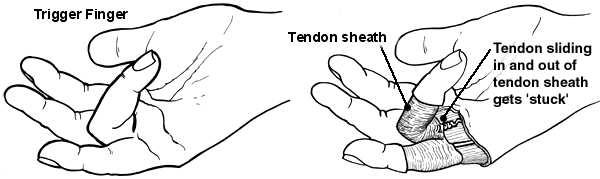
Diagram: trigger finger
What causes trigger finger?
The cause is often not clear. It is thought to be due to some inflammation which causes swelling of a tendon or the covering of the tendon (tendon sheath).
A tendon is a strong tissue that attaches a muscle to a bone. In this case the tendon comes from a muscle in the forearm. It passes through the palm and attaches to the finger bone. The muscle pulling on this tendon bends (flexes) the finger towards the palm.
A tendon sheath is like a tunnel that covers and protects parts of a tendon. Normally, the tendon slides easily in and out of the sheath as you bend and straighten the finger. In trigger finger the tendon can slide out of the sheath when you bend your finger. However, it cannot easily slide back in due to the swelling. The finger then remains bent (flexed) unless you pull it straight with your other hand.
Most cases occur for no apparent reason in healthy people. Around 2 in 100 people develop trigger finger. It is more common if you are aged over 40 and if you are female. It may also be more likely to develop if you have had a previous injury to your palm or finger.
In some cases it occurs after you have used your palm a lot - for example, it can happen:
After jobs which involve a lot of screwdriver use.
After working with tools that press on the palm.
These may cause some inflammation in the palm.
Sometimes trigger finger occurs as a feature of another disease. For example, trigger finger is more common in people with rheumatoide Arthritis, amyloidosis, Diabetes, unteraktive Schilddrüse gland, Dupuytren'sche Kontraktur und Karpaltunnelsyndrom and in people on dialysis. In these situations you will have other symptoms of the condition and the trigger finger is just one feature.
Hinweis: most people with trigger finger do nicht have any of these conditions.
What are the symptoms of trigger finger?
Symptoms can vary from mild to severe and typically affect one finger or the thumb. They may include:
Pain or tenderness: Pain is often felt at the base of the finger or thumb, particularly when bending or straightening the finger.
Stiffness: The finger may feel stiff, especially in the morning.
Snapping or clicking sensation: The finger may make a snapping or clicking sound as it moves, particularly when it is being straightened after being bent.
Locking or catching: The finger may "lock" in a bent position and may need help to straighten it. This can be painful.
Swelling: The affected area may be swollen or appear thicker than usual.
How is trigger finger diagnosed?
Your doctor will diagnose trigger finger based on your medical history, symptoms, and a physical examination. During the exam, they may ask you to move your fingers in different ways to assess for pain, stiffness, or clicking. In some cases, your doctor may use an ultrasound or an X-ray to rule out other conditions.
What is the treatment for trigger finger?
Not treating is an option at first
Around one in five people will improve without any treatment. Simply resting the hand and fingers, allowing any inflammation to settle, may resolve the problem without the need for treatment. You may be advised to take a painkiller (for example, paracetamol or ibuprofen) to relieve the pain.
Gelenksschiene
Your symptoms may improve if your finger (or trigger thumb) is strapped to a plastic splint so that it is completely straight. Some people wear a splint just at night.
Eine Steroidinjektion
A steroid injection into the tendon sheath is one treatment if the condition does not settle. The steroid is combined with a local anaesthetic to make the injection less painful.
Steroids work by reducing inflammation. A finger splint may be advised for a few days after the injection to rest the finger. This treatment works in about 9 in 10 cases. A second injection may be needed if the first does not work.
Operation
An operation done under local anaesthetic may be advised if the above does not work. A small cut is usually made at the base of the finger and the tendon sheath is widened. The surgical treatment of trigger finger is usually very successful.
An alternative operation is a percutaneous trigger finger release. A needle is used to release the tight mouth of the tunnel so an open operation is avoided.
If you have rheumatoid arthritis, these types of surgery may not be suitable for you. If you do need surgery, you may be offered an operation to remove part of the tendon sheath instead.
However, with an operation there is a small risk of damaging the tiny finger nerve and causing some numbness to the finger. Also, as with any operation, there is a small risk of any wound becoming infected.
Preventing trigger finger
While trigger finger may not always be preventable, you can reduce your risk by:
Taking breaks from repetitive hand movements.
Stretching your fingers and wrists regularly if you do activities that involve gripping or bending.
Using ergonomic tools that reduce strain on your hands.
Maintaining a healthy lifestyle to reduce the risk of conditions such as diabetes and arthritis, which can contribute to trigger finger.
Outlook for trigger finger (prognosis)
In most cases, trigger finger improves with treatment. Non-surgical treatments, such as rest, splinting, and corticosteroid injections, are often effective in reducing symptoms. Surgery is rarely necessary and is typically only recommended if other treatments fail. Most people recover fully and regain normal hand function.
Patientenauswahl für Bindegewebserkrankungen

Knochen, Gelenke und Muskeln
Tendinopathie und Tenosynovitis
Tendinopathie ist ein Oberbegriff für Erkrankungen der Sehne. Tendinosis ist ein anderer Begriff dafür. Tenosynovitis ist ein Oberbegriff für Erkrankungen der Hülle, die eine Sehne umgibt.
von Dr. Rachel Hudson, MRCGP

Knochen, Gelenke und Muskeln
Dupuytren'sche Kontraktur
Dupuytren-Kontraktur verursacht eine Verdickung des Gewebes (Faszie) in der Handfläche. Eine Faszie ist ein Band oder eine Gewebeschicht unter der Haut. Wenn die Dupuytren-Kontraktur fortschreitet, biegen sich ein oder mehrere Finger in die Handfläche und können nicht mehr gestreckt werden. Die Ursache ist unbekannt. In vielen Fällen bleibt sie mild und erfordert keine Behandlung. Wenn die Erkrankung schwerer wird oder die Funktion der Hand beeinträchtigt ist, kann ein Spezialist eine Behandlung empfehlen. Dupuytren-Kontraktur ist nach Baron Dupuytren benannt, der die Erkrankung beschrieb (und eine Operation dafür erfand) im Jahr 1831.
von Dr. Toni Hazell, FRCGP
Häufig gestellte Fragen
Kann ein Schnappfinger mehr als einen Finger betreffen?
Ja, ein oder mehrere Finger können vom Schnappfinger betroffen sein. Am häufigsten sind der kleine Finger, der Ringfinger oder der Daumen betroffen, und es tritt oft an der rechten Hand auf.
Verursacht ein Schnappfinger Schwellungen im betroffenen Bereich?
Ja, Schwellungen sind ein mögliches Symptom eines Schnappfingers. Der betroffene Bereich kann am Finger- oder Daumenansatz geschwollen oder dicker als gewöhnlich erscheinen.
Wie diagnostiziert ein Arzt einen Schnappfinger?
Ihr Arzt wird einen Schnappfinger diagnostizieren, indem er Ihre Krankengeschichte überprüft, Ihre Symptome bewertet und eine körperliche Untersuchung durchführt. Während der Untersuchung könnte er Sie bitten, Ihre Finger zu bewegen, um Schmerzen, Steifheit oder ein Klicken zu überprüfen. Gelegentlich kann ein Ultraschall oder Röntgenbild verwendet werden, um andere Erkrankungen auszuschließen.
Gibt es Risiken im Zusammenhang mit einer Operation bei einem Schnappfinger?
Ja, es gibt kleine Risiken, die mit einer Operation des Schnappfingers verbunden sind. Dazu gehört eine geringe Chance, einen kleinen Fingernerv zu beschädigen, was zu Taubheitsgefühlen im Finger führen könnte. Außerdem besteht, wie bei jedem chirurgischen Eingriff, ein geringes Risiko, dass sich die Wunde infiziert.
Wie kann ich das Risiko einer Sehnenscheidenentzündung verringern?
Sie können Ihr Risiko, einen Schnappfinger zu entwickeln, verringern, indem Sie Pausen von sich wiederholenden Handbewegungen einlegen, regelmäßig Ihre Finger und Handgelenke dehnen, wenn Ihre Aktivitäten Greifen oder Biegen beinhalten, ergonomische Werkzeuge verwenden, um die Handbelastung zu verringern, und einen gesunden Lebensstil pflegen, um das Risiko von Erkrankungen wie Diabetes und Arthritis zu senken, die zu einem Schnappfinger beitragen können.
Weiterführende Literatur und Referenzen
- Peters-Veluthamaningal C, van der Windt DA, Winters JC, et al; Corticosteroid injection for trigger finger in adults. Cochrane Database Syst Rev. 2009 Jan 21;(1):CD005617. doi: 10.1002/14651858.CD005617.pub2.
- Jeanmonod R, Harberger S, Waseem M; Trigger Finger. StatPearls.
- Fiorini HJ, Tamaoki MJ, Lenza M, et al; Surgery for trigger finger. Cochrane Database Syst Rev. 2018 Feb 20;2:CD009860. doi: 10.1002/14651858.CD009860.pub2.
- Merry SP, O'Grady JS, Boswell CL; Trigger Finger? Just Shoot! J Prim Care Community Health. 2020 Jan-Dec;11:2150132720943345. doi: 10.1177/2150132720943345.
- Ferrara PE, Codazza S, Maccauro G, et al; Physical therapies for the conservative treatment of the trigger finger: a narrative review. Orthop Rev (Pavia). 2020 Jun 26;12(Suppl 1):8680. doi: 10.4081/or.2020.8680. eCollection 2020 Jun 29.
- Abdulsalam AJ, Mezian K, Ricci V, et al; Injecting the Trigger Finger: Target (With Ultrasound), Then Shoot! J Prim Care Community Health. 2021 Jan-Dec;12:21501327211000237. doi: 10.1177/21501327211000237.
Über den AutorVollständige Biografie anzeigen

Dr Hayley Willacy, FRCGP
Allgemeinmediziner, Medizinischer Autor
MBChB (1992), DRCOG, DFFP, MRCOG (Part 1) MRCGP (2007), DFSRH (2013), MSc - medical education (2020)
Dr. Hayley Willacy war eine NHS-Hausärztin, die in Nordwestengland arbeitete und 2022 nach 30 Jahren aus der klinischen Praxis ausschied.
Über den RezensentenVollständige Biografie anzeigen

Dr Colin Tidy, MRCGP
Allgemeinmediziner, Medizinischer Autor
MBBS, MRCGP, MRCP (Paediatrics), DCH
Dr. Colin Tidy ist ein NHS-Arzt mit Sitz in Oxfordshire.
Artikelverlauf
Die Informationen auf dieser Seite wurden von qualifizierten Klinikern verfasst und begutachtet.
Artikel auch verfügbar in Englisch, Deutsch, Spanisch, Französisch, Italienisch, Portugiesisch, Hindi, Hebräisch, Arabisch, und Schwedisch.
Nächste Überprüfung fällig: 9. Apr 2028
10. Apr 2025 | Neueste Version

Fragen, teilen, verbinden.
Durchsuchen Sie Diskussionen, stellen Sie Fragen und teilen Sie Erfahrungen zu Hunderten von Gesundheitsthemen.

Fühlen Sie sich unwohl?
Bewerten Sie Ihre Symptome online kostenlos
Abonnieren Sie den Patienten-Newsletter
Ihre wöchentliche Dosis klarer, vertrauenswürdiger Gesundheitsberatung - geschrieben, um Ihnen zu helfen, sich informiert, selbstbewusst und in Kontrolle zu fühlen.
Durch das Abonnieren akzeptieren Sie unsere Datenschutzrichtlinie. Sie können sich jederzeit abmelden. Wir verkaufen Ihre Daten niemals.
Mehr über Knochen, Gelenke und Muskeln
- Gebrochene oder geprellte Rippen
- Kompartment-Syndrom
- Unterarmverletzungen und -frakturen
- Ganglion
- Leistenzerrung
- Schmerzen im Knie und in der Kniescheibe
- Beinkrämpfe
- Meniskusrisse
- Mittelfußfrakturen
- Motoneuronerkrankung
- Olekranon-Bursitis
- Osteoarthritis
- Ameisenlaufen
- Reaktive Arthritis
- Erholung von einem Beckenbruch
- Repetitive Belastungsverletzung
- Spinalanästhesie
- Temporomandibuläre Gelenkstörung (TMD)
- Tennisarm
- Thorakaler Rückenschmerz