Brustkrebs
Begutachtet von Dr Rosalyn Adleman, MRCGPZuletzt aktualisiert von Dr Hayley Willacy, FRCGP Zuletzt aktualisiert 31. Okt 2022
Erfüllt die redaktionelle Richtlinien
- HerunterladenHerunterladen
- Teilen
- Language
- Diskussion
- Audio-Version
- Zu bevorzugten Quellen bei Google hinzufügen
In dieser Serie:Brustkrebs bei MännernFakten und Risikofaktoren zu BrustkrebsBrustuntersuchungMammographie
If you notice any lump or change to how your breast normally feels you should see a doctor promptly.
Breast cancer is the most common cancer in women. Most cases occur in women over the age of 50 but breast cancer can occur in younger women. If breast cancer is diagnosed at an early stage, less treatment may be needed and it is more likely to be effective . In general, the more advanced the cancer (the more it has grown and spread), the less chance that treatment will be curative.
However, treatments are improving all the time and they can often slow the progress of the cancer. Over 3 out of 4 women diagnosed with breast cancer are still alive 10 years later.
Auf einen Blick
Brustkrebs ist eine häufige Krebserkrankung, die hauptsächlich Frauen über 50 betrifft, aber auch bei jüngeren Menschen und Männern auftreten kann.
Es ist wichtig, Ihre Brüste zu kennen und auf Veränderungen zu achten.
Zu den Symptomen gehören ein schmerzloser Knoten, Veränderungen der Brustgröße oder -form, Hautdellen oder eine eingezogene Brustwarze.
Wenn Sie eine Schwellung bemerken, suchen Sie immer umgehend einen Arzt auf, auch wenn die meisten Schwellungen nicht krebsartig sind.
Verschiedene Behandlungen sind verfügbar, darunter Chirurgie, Chemotherapie, Strahlentherapie und Hormontherapie.
Eine frühzeitige Diagnose von Brustkrebs verbessert die Heilungschancen erheblich.
What is breast cancer?
Breast cancer is one of the most common cancers. Around one in nine women develop breast cancer at some stage in their lives. About 48,000 cases occur in the UK each year. Most develop in women over the age of 50 but younger women are sometimes affected. Breast cancer develops from a cancerous (malignant) cell which develops in the lining of a duct or lobule in one of the breasts.
Breast cancer can also develop in men, although this is much less common than breast cancer in women.
Anatomy of the breasts
Cross-section view of breast
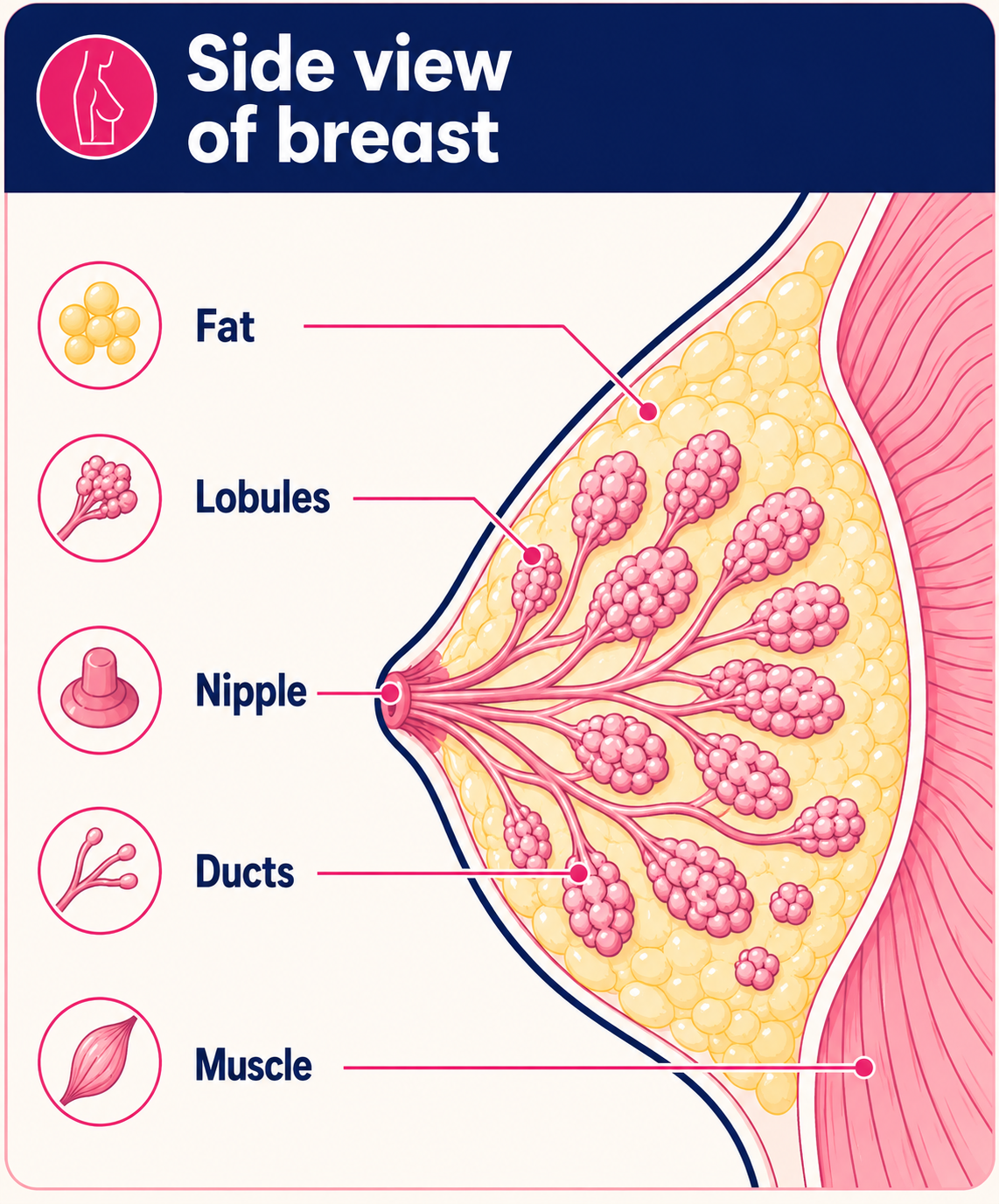
Breast tissue is attached to muscle on the chest wall. A tail of breast tissue extends up into the armpit. The breasts contain:
Many lobules which are made up of glandular tissue. They make milk after pregnancy.
Ducts. These are channels which take milk from the lobules to the nipple.
Fatty tissue and supporting connective tissue.
Blood vessels, lymph channels and nerves (like all other areas of the body).
Types of breast cancer
Carcinoma in situ
Some people are diagnosed when the cancerous cells are still totally within a duct or lobule. These are called carcinoma in situ (or non-invasive breast cancer), as no cancer cells have grown out from their original site.
Ductal carcinoma in situ (DCIS) is the most common type of non-invasive breast cancer and about 1 in 5 new breast cancer cases will be DCIS. A carcinoma in situ is easier to treat and has a better outlook than an invasive cancer.
Lobular carcinoma in situ (LCIS) results in abnormal cells in the milk producing glands of the breasts. These cells rarely spread outside of the lobules to other parts of the breast or body.
Invasive breast cancer
Most breast cancers are diagnosed when a tumour has grown from within a duct or lobule into the surrounding breast tissue. These are called invasive breast cancers:
Invasive ductal breast cancers begin in one of the ducts of the breast (see diagram below). They account for as many of 8 in 10 of breast cancer cases.
Invasive lobular breast cancers begins in one of the lobes of the breast. They account for about 1 in 10 of invasive breast cancers.
Invasive breast cancers are also divided into those where cancer cells have invaded into local blood or lymphatic vessels and those that have not. Invasive breast cancer is able to spread outside the breast.
Inflammatory breast cancer
Inflammatory breast cancer is an uncommon form of breast cancer but is very aggressive. It is often very advanced by the time of diagnosis. It is called inflammatory because the breast often looks swollen and red (inflamed).
Inflammatory breast cancer tends to be diagnosed in younger women and because it is aggressive and often diagnosed at a late stage. The outlook is usually worse than for other breast cancers.
Morbus Paget der Brust
Paget's disease of the breast is a rare type of cancer of the nipple area of the breast. It presents as eczema affecting the nipple and is often associated with an underlying in-situ or invasive carcinoma of the breast.
Breast cancer symptoms
Many women find that their breasts become more lumpy and tender before periods. Breasts also alter their size and shape with increasing age, pregnancy and marked weight changes. What is important is that you get to know your own breasts - how they look and feel - and report any changes promptly to a doctor.
There are a number of things to look out for which möglicherweise be breast cancer signs:
Ein Knoten in der Brust
The usual first sign is a painless lump in the breast. Hinweis: most breast lumps are nicht cancerous (malignant). Most breast lumps are fluid-filled cysts or fibroadenomas (a clumping of glandular tissue) which are non-cancerous (benign). However, you should always see a doctor if a lump develops, as the breast lump may be cancerous (malignant).
Other signs and symptoms of breast cancer
Other signs which may be noticed in the affected breast include:
Changes in the size or shape of a breast.
Dimpling or thickening of some of the skin on a part of a breast.
The nipple turning in (becoming inverted).
Rarely, a discharge occurring from a nipple (which may be bloodstained).
A rare type of breast cancer, causing a rash around the nipple, which can look similar to a small patch of eczema.
Rarely, pain in a breast. Hinweis: pain is not a usual early symptom. Many women develop painful breasts (mastalgia) and this is not usually caused by cancer.
The first place that breast cancer usually spreads to is the lymph glands (nodes) in the armpit (axilla). If this occurs, you may develop a swelling or lump in an armpit. If the cancer spreads to other parts of the body then various other symptoms can develop.
Breast cancer stages
Like any other cancer, breast cancer can be divided into stages depending on how much the cancer has spread both within the breast and also to other parts of the body. This helps to decide which treatments are best to use and also helps to give some idea of how likely it is that the breast cancer can be cured.
Breast cancer can be divided into the following stages at the time of diagnosis:
Stage 0
This means that the cancer has not grown away from the original site (for example, a breast duct or milk gland). This is sometimes called 'in situ' (see below).
Stufe I
The cancer has spread into fatty breast tissue or a few cancer cells have spread to the glands (lymph nodes) - for example, in your armpit (axilla).
Stadium 2
The cancer has either become a bit bigger or many more cancer cells have spread into up to 3 lymph nodes.
Stadium 3
The cancer has become more advanced and has spread to the chest wall or the skin around your breast, or has spread to a larger number of lymph nodes.
Stadium 4
Breast cancer cells have spread away from the breast and lymph nodes to more distant parts of the body. The most common sites are bones, lungs, liver and brain.
Grade of the cancerous cells
A sample of breast cancer tissue can be looked at under the microscope. By looking at certain features of the cells, the cancer can be graded.
Grade 1 - the cancer cells tend to be slow-growing and less aggressive.
Klasse 2 – ist eine Mittelstufe.
Grade 3 - the cancer cells tend to be fast-growing and more aggressive.
Presence of receptors
Some breast cancer cells have receptors, which allow certain types of hormones or proteins to attach to the cancer cell. The types of receptor tested for are:
Hormone. Tests on a sample of breast cancer cells can show if they contain oestrogen or progesterone receptors. These are female hormones. Overall, about 7 in 10 breast cancers are oestrogen receptor positive. Treatment can block the oestrogen in these cancers (see below).
Human epidermal growth factor (HER2) is a protein that can affect the growth of some cancer cells. It is found on the surface of normal breast cells. Some breast cancer cells have a very high number of HER2 receptors. Cancers having high levels of these receptors are called HER2-positive.
If a sample of cancer cells does not have any oestrogen, progesterone or HER2 receptors, it is called 'triple negative' breast cancer. It affects up to 20% of women with breast cancer and they tend to be a younger age group.
Siehe den separaten Beipackzettel mit dem Titel Krebs für allgemeinere Informationen über Krebs.
Causes of breast cancer
A cancerous (malignant) tumour starts from one abnormal cell. The exact reason why a cell becomes cancerous is unclear. It is thought that something damages or alters certain genes in the cell. This makes the cell abnormal and multiply out of control.
Risikofaktoren
Although breast cancer can develop for no apparent reason, there are certain risk factors which increase the chance that breast cancer will develop. These include:
Alter. The risk of developing breast cancer roughly doubles for every 10 years of age. Most cases develop in women over the age of 50.
Where you live. The rate of breast cancer varies between countries. This may reflect genetic or environmental factors.
Familiengeschichte. This means if you have close relatives who have or have had breast cancer. In particular, if they were aged under 50 when diagnosed.
If you have had a previous breast cancer.
Being childless, or if you had your first child after the age of 30.
Not having breast-fed your children.
Early age of starting periods.
Chest being exposed to radiation.
Ein menopause over the age of 55.
Taking continuous combined hormone replacement therapy (HRT) for several years (in women over 50 years) leads to an increased risk.
Übermäßiger Alkoholkonsum.
Family history and genetic testing
About 1 in 20 cases of breast cancer are caused by a faulty gene which can be inherited. The genes BRCA1 and BRCA2 are the most common faulty genes.
Diagnosing breast cancer
Erstbewertung
If you develop a lump or symptoms which may be breast cancer, a doctor will usually examine your breasts and armpits to look for any lumps or other changes. You will normally be referred to a specialist for a breast cancer diagnosis. Sometimes a biopsy of an obvious lump (see below) is arranged, but other tests may be done first, such as:
Mammographie. This is a special X-ray of the breast tissue.
Magnetic resonance imaging (MRI) scan of the breast. This is more commonly performed on younger women, who may have denser breast tissue.
Hinweis der Redaktion
Dr. Krishna Vakharia, 16. Oktober 2023
Das National Institute for Health and Care Excellence (NICE) hat empfohlen, dass eine Person innerhalb von 28 Tagen nach einer dringenden Überweisung durch ihren Hausarzt wegen Verdachts auf Krebs eine Diagnose oder einen Ausschluss von Krebs erhalten sollte.
Biopsy - to confirm the diagnosis
A biopsy is a procedure in which a small sample of tissue is removed from a part of the body. The sample is examined under the microscope, to look for abnormal cells. A specialist may take a biopsy with a needle which is inserted into the lump for some cells to be withdrawn. Sometimes the doctor may be guided as to where to insert the needle with the help of a mammogram or ultrasound scan. Sometimes a small operation is needed to obtain a biopsy sample.
The biopsy sample can confirm or rule out breast cancer. Also the cells from a tumour can be assessed and tested to determine their grade and receptor status (see above).
Bewertung des Umfangs und der Verbreitung
If you are confirmed to have breast cancer, further tests may be needed to assess if it has spread - for example:
Eine Ultraschalluntersuchung der Leber.
Chest X-ray.
A bone scan.
Other types of scan.
Wiedergabeliste: Breast Cancer Spread
2 Videos
How far can breast cancer spread?
Dr. Sarah Jarvis
How far can breast cancer spread?
Dr. Sarah Jarvis

Can breast cancer spread to the rest of the body?
Dr. Sarah Jarvis
Separate leaflets describe each of these tests in more detail. This assessment is called staging of the cancer. The aim of staging is to find out:
How large the tumour has grown.
Whether the cancer has spread to local lymph nodes in the armpit.
Ob der Krebs auf andere Bereiche des Körpers metastasiert hat.
See the separate leaflet called Stages of Cancer for more details.
Finding out the stage of the cancer, the grade of the cells and the receptor status of the cancer helps doctors to advise on the best treatment options. It also gives a reasonable indication of outlook.
Breast cancer treatment
Treatment options which may be considered include surgery, chemotherapy, radiotherapy and hormone treatment. Often a combination of two or more of these treatments is used. The treatments used depend on:
The cancer itself - its size and stage (whether it has spread), the grade of the cancer cells, and whether it is hormone responsive or contains HER2 receptors; AND
The woman with the cancer - your age, whether or not you have had your Wechseljahre, your general health and personal preferences for treatment.
Sie sollten ausführlich mit einer Fachärztin oder einem Facharzt sprechen, die oder der Ihren Fall kennt. Diese Person kann Ihnen die Vor- und Nachteile, die wahrscheinliche Erfolgsquote, mögliche Nebenwirkungen und weitere Einzelheiten zu den verschiedenen Behandlungsmöglichkeiten für Ihre Krebsart erläutern.
Besprechen Sie mit Ihrer Fachärztin oder Ihrem Facharzt auch die Behandlungsziele. Zum Beispiel:
Treatment aims to cure the cancer in many cases. In particular, the earlier the stage of the cancer, the better the chance of a cure. Because of routine mammography, many women are diagnosed with breast cancer in the early stages and have a good chance of a cure. Doctors tend to use the word remission rather than the word cured. Remission means there is no evidence of cancer following treatment. If you are in remission, you may be cured. However, in some cases a cancer returns months or years later. This is why doctors are sometimes reluctant to use the word cured.
Treatment may aim to control the cancer. If a cure is not realistic, with treatment it is often possible to limit the growth or spread of the cancer so it progresses less rapidly. This may keep you free of symptoms for some time.
Treatment may aim to ease symptoms of breast cancer in some cases. Even if a cure is not possible, treatments may be used to reduce the size of a tumour, which may ease symptoms such as pain. If a cancer is advanced then you may require treatments such as nutritional supplements, painkillers, or other techniques to help keep you free of pain or other symptoms.
Surgery for breast cancer
The types of operation which may be considered are:
Breast-conserving surgery. This is often an option if the tumour is not too big. A lumpectomy (or wide local excision) is one type of operation where just the tumour and some surrounding breast tissue are removed. It is usual to have radiotherapy following this operation. This aims to kill any cancer cells which may have been left in the breast tissue.
Removal of the affected breast (mastectomy). This may be necessary if there is a large tumour or a tumour in the middle of the breast. It is often possible to have breast reconstructive surgery to create a new breast following a mastectomy. This can often be done at the same time as the mastectomy, although it can also be done months or years later. There are now many different types of reconstruction operations available.
A sentinel lymph node biopsy may be performed. This is a way of assessing if the main lymph nodes draining the breast contain cancer. If they are clear then the remaining lymph nodes in the armpit will not need to be removed. If it is not possible to do this, one or more of the lymph nodes in the armpit may be removed. This helps to stage the disease accurately and to guide the specialist as to what treatment to advise following surgery.
Strahlentherapie
Radiotherapy is a treatment which uses high-energy beams of radiation which are focused on cancerous (malignant) tissue. This kills cancer cells, or stops cancer cells from multiplying. Siehe das separate Informationsblatt mit dem Titel Strahlentherapie für weitere Details.
For breast cancer, radiotherapy is mainly used in addition to surgery. For example, if you have breast-conserving surgery it is usual to have radiotherapy to the affected breast after the operation. This aims to prevent breast cancer returning in the same breast. When radiotherapy is used in addition to surgery it is called adjuvant radiotherapy.
Hormone treatments
Some types of breast cancer are affected by the female hormones oestrogen and progesterone. These hormones stimulate the cancer cells to divide and multiply. Most oestrogen and progesterone are made by the ovaries. Treatments which reduce the level of these hormones, or prevent them from working, are commonly used in people with breast cancer.
Hormone treatment works best in women with hormone-responsive breast cancer; however, it sometimes works in cancers classed as non-hormone-responsive.
Hormone treatments include:
Oestrogen blockers. Tamoxifen has been available for many years and is still widely used. It works by blocking the oestrogen from working on cells. It is usually taken for five years. Other oestrogen blocker medicines are now available.
Aromatase inhibitors. These are medicines which work by blocking the production of oestrogen in body tissues. They are used in women who have gone through the menopause. These medicines include Anastrozol, letrozole und exemestane.
Gonadotropin-Releasing-Hormon (GnRH) Analoga. These medicines work by greatly reducing the amount of oestrogen that you make in the ovaries. There are several GnRH analogue preparations. The commonly used one is goserelin. They are usually given by injection and may be used for women who have not yet reached the menopause.
An alternative which may be considered for women before the menopause is to remove the ovaries (or to destroy them with radiotherapy). This stops oestrogen from being made.
Chemotherapie
Chemotherapy is a treatment of cancer by using anti-cancer medicines which kill cancer cells, or stop them from multiplying. Siehe den separaten Beipackzettel mit dem Titel Chemotherapie für weitere Details.
When chemotherapy is used in addition to surgery it is known as adjuvant chemotherapy. For example, following surgery you may be given a course of chemotherapy. This aims to kill any cancer cells which may have spread from the main tumour site.
Chemotherapy is sometimes given to shrink a tumour before surgery so that surgery may have a better chance of success and also a smaller operation may be performed. This is known as neoadjuvant chemotherapy. The type of chemotherapy given may depend on the type of cancer.
New gene tests are being developed to help doctors decide which women will benefit the most from chemotherapy - see Further Reading.
Chemotherapy may also be used for some women to treat breast cancer which has spread to other areas of the body.
Trastuzumab (also known as Herceptin®) is a treatment that may be given to women who have a large number of HER2 receptors in their cancer. It is a type of medicine called a monoclonal antibody. It works by attaching to HER2 receptors on the surface of breast cancer cells, thereby stopping the cancer cells from dividing and growing.
Hinweis der Redaktion
Dr. Krishna Vakharia, 15th December 2022
NICE has advised that pembrolizumab is an option for adults with triple-negative early breast cancer at high risk of recurrence or in locally advanced breast cancer.
Es wurde gezeigt, dass die Zugabe von Pembrolizumab zur Chemotherapie vor der Operation (neoadjuvant) und die anschließende Fortsetzung mit Pembrolizumab allein nach der Operation (adjuvant) die Wahrscheinlichkeit erhöht, dass der Krebs verschwindet. Es verlängert auch die Zeit, bis der Krebs wieder zurückkehrt.
Dr. Krishna Vakharia, 22nd February 2023
NICE has recommended the option of trastuzumab deruxtecan with gelenktem Zugang for treating HER2-positive unresectable or metastatic breast cancer but only after they have had one or more anti-HER2 treatments.
Managed access means that this medication is only available to certain people as there is not much evidence for its use. Whilst people take it, information is collected and analysed to see whether it should be available to all who need it on the NHS. This process allows people access to promising new medications and treatments whilst gathering evidence.
In the case of trastuzumab deruxtecan, we know that it delays the time in which someone's cancer gets worse but we don't know yet if it allows people to live longer.
Zusammenfassung
The treatment plan that may be advised can vary greatly from case to case as optimal treatment can depend on many different factors.
Wie ist die Prognose?
The outlook (prognosis) has greatly improved in recent years. Deaths from breast cancer are now at the lowest ever in 40 years. This is mainly due to the improvements in the treatment of breast cancer. The outlook is best in those who are diagnosed when the cancer is still small and has not spread. More breast cancers are also now being diagnosed and treated at an early stage. In general, the more advanced the cancer (the more it has spread) then the less chance that treatment will be curative.
The treatment of cancer is a developing area of medicine. New treatments continue to be developed and the information on outlook above is very general. The specialist who knows your case can give more accurate information about your particular outlook and how well your type and stage of cancer is likely to respond to treatment.
Screening for breast cancer
Women in the UK aged between 50 and 70 are invited to have a routine mammography every three years. This is gradually being extended to women aged 47-73.
Mammography is a special X-ray test and aims to detect breast cancer at an early stage when treatment is most likely to be curative. See the separate leaflet called Breast Screening.
Genetic testing and mammography screening (and preventative treatments in some cases) may also be offered to younger women with a strong family history of breast cancer. See your doctor if you feel this applies to you.
Can breast cancer be prevented?
A lot of breast cancers are detected at an early stage, by breast screening. However, a small number are not. Some women may have developed breast cancer before they have their first mammogram and some may develop breast cancer between mammograms.
All women of every age should be breast aware. That is, get to know how your breasts and nipples normally look and feel. Try to recognise any changes that occur before and after your periods. See your GP if you notice any changes, lumps, or other abnormalities in your breasts or nipples. Don't wait until your next scheduled screening appointment.
There is some evidence that regular exercise may reduce your risk of breast cancer by as much as a third. If you have been through the menopause, it is particularly important you are not overweight or obese. This is because being overweight causes more oestrogen to be produced, which can increase the risk of breast cancer.
Studies have shown that women who breast-feed their children are less likely to develop breast cancer than those who do not. The most likely reason for this is that women do not produce an egg (ovulate) as regularly while they are breast-feeding and oestrogen levels remain stable.
A further study also suggests that switching from red meat to white meat may also reduce the risk of developing breast cancer by more than a quarter.
There is also preventative surgery to remove the breasts (mastectomy). Surgery can be used to treat breast cancer as well as reduce the chances of developing it. By removing as much breast tissue as possible, a mastectomy can reduce your risk of breast cancer by up to 90%. Like all operations there can be several complications and this is not an easy step to take. If genetic testing has shown you are one of the small number of women from a high-risk family, you will need an in-depth discussion with your doctors, before deciding to have this operation.
Medicines which reduce the levels of oestrogen in the body are also used. They have significant side-effects (like hot flushes and reducing bone strength). Your specialist will discuss the risks and benefits of these options with you.
Patientenauswahl für Brustkrebs
Krebs
Fakten und Risikofaktoren zu Brustkrebs
Die meisten Fälle von Brustkrebs treten zufällig auf. Allerdings kommt Brustkrebs in einigen Familien aufgrund ihrer genetischen Veranlagung häufiger vor als üblich.
von Dr. Colin Tidy, MRCGP

Krebs
BRCA-Gene
Es gibt einige bekannte Genveränderungen (Mutationen), die das Risiko für bestimmte Krebsarten erhöhen können, und Tests für einige von ihnen, einschließlich der BRCA1- und BRCA2-Genmutationen. Die BRCA1- und BRCA2-Gene schützen normalerweise vor bestimmten Krebsarten, insbesondere Brustkrebs und Eierstockkrebs. Wenn eine Mutation in einem dieser Gene vorliegt, kann dies bedeuten, dass der Schutz verloren geht und die Wahrscheinlichkeit, dass sich Krebs entwickelt, steigt.
von Dr. Colin Tidy, MRCGP
Häufig gestellte Fragen
Können Männer Brustkrebs bekommen?
Ja, Brustkrebs kann sich auch bei Männern entwickeln, obwohl er deutlich seltener vorkommt als bei Frauen.
Was ist der Unterschied zwischen duktalem Carcinoma in situ (DCIS) und invasivem duktalem Brustkrebs?
Duktales Carcinoma in situ (DCIS) bedeutet, dass die Krebszellen vollständig innerhalb der Milchgänge eingeschlossen sind und sich nicht über ihren ursprünglichen Ort hinaus ausgebreitet haben. Invasiver duktaler Brustkrebs hingegen bedeutet, dass der Tumor aus einem Gang in das umliegende Brustgewebe gewachsen ist.
Was ist ein 'dreifach negatives' Brustkrebs?
Triple-negativer Brustkrebs liegt vor, wenn die Krebszellen keine Östrogenrezeptoren, Progesteronrezeptoren oder HER2-Rezeptoren haben. Diese Art betrifft bis zu 20% der Frauen mit Brustkrebs und wird oft in einer jüngeren Altersgruppe gefunden.
Wie bestimmen Ärzte den 'Grad' von Brustkrebs?
Eine Probe von Brustkrebsgewebe wird unter einem Mikroskop untersucht, um spezifische Merkmale der Zellen zu betrachten. Basierend auf diesen Merkmalen wird der Krebs eingestuft, wobei Zellen der Stufe 1 langsam wachsend und weniger aggressiv sind, Stufe 2 eine mittlere Einstufung darstellt und Zellen der Stufe 3 schnell wachsend und aggressiver sind.
Welche Veränderungen an meiner Brustwarze sollten mir Sorgen bereiten?
Sie sollten sich über Veränderungen wie das Einziehen der Brustwarze (Inversion) oder einen Ausfluss aus der Brustwarze, insbesondere wenn er blutig ist, Sorgen machen. Zusätzlich könnte ein Ausschlag um die Brustwarze, der einem Ekzem ähnelt, ein Anzeichen für eine seltene Art von Brustkrebs sein, die als Paget-Krankheit bezeichnet wird. Jede dieser Veränderungen sollte umgehend einem Arzt gemeldet werden.
Was ist der Zweck von Hormonbehandlungen bei Brustkrebs und wann werden sie eingesetzt?
Hormonbehandlungen werden bei Brustkrebs eingesetzt, der von weiblichen Hormonen wie Östrogen beeinflusst wird. Diese Behandlungen reduzieren entweder die Hormonspiegel oder verhindern deren Wirkung, um das Wachstum von Krebszellen zu verlangsamen oder zu stoppen. Sie sind am effektivsten bei Frauen mit hormonempfindlichem Brustkrebs, wirken aber manchmal auch in nicht hormonempfindlichen Fällen. Verschiedene Arten von Hormonbehandlungen sind verfügbar, abhängig vom Menopausenstatus einer Frau.
Weiterführende Lektüre und Referenzen
- Brustkrebsstatistiken; Krebsforschung UK
- Familiärer Brustkrebs: Klassifikation, Betreuung und Umgang mit Brustkrebs und verwandten Risiken bei Menschen mit einer familiären Vorgeschichte von Brustkrebs; NICE Klinische Leitlinie (Juni 2013 - zuletzt aktualisiert November 2023).
- Fortgeschrittene Brustkrebserkrankung: Diagnose und Behandlung; NICE-Klinikleitlinie (Juli 2014, aktualisiert Aug 2017)
- Verdacht auf Krebs: Erkennung und Überweisung; NICE-Richtlinie (2015 - zuletzt aktualisiert im April 2026)
- Brustkrebs - Erkennung und Überweisung; NICE CKS April 2025 (nur Zugang in Großbritannien)
- Adjuvante Chemotherapie basierend auf einem 21-Gene-Expressionstest bei Brustkrebs; Sparano JA et al, New England Journal of Medicine, June 2018
- Früher und lokal fortgeschrittener Brustkrebs: Diagnose und Behandlung; NICE-Richtlinie (Juli 2018 - zuletzt aktualisiert April 2025).
- Welslau M, Muller V, Luftner D, et al; Update Breast Cancer 2022 Part 1 - Early Stage Breast Cancer. Geburtshilfe Frauenheilkd. 2022 Jun 3;82(6):580-589. doi: 10.1055/a-1811-6106. eCollection 2022 Jun.
- Pembrolizumab für neoadjuvante und adjuvante Behandlung von triple-negativem früh- oder lokal fortgeschrittenem Brustkrebs; NICE-Technologiebewertung, 14. Dezember 2022
- Trastuzumab deruxtecan zur Behandlung von HER2-positivem, unresectablem oder metastasiertem Brustkrebs nach einer oder mehreren Anti-HER2-Therapien; NICE-Technologiebewertung, Februar 2023
Über den AutorVollständige Biografie anzeigen
Aktualisiert von

Dr Hayley Willacy, FRCGP
Allgemeinmediziner, Medizinischer Autor
MBChB (1992), DRCOG, DFFP, MRCOG (Part 1) MRCGP (2007), DFSRH (2013), MSc - medical education (2020)
Dr. Hayley Willacy war eine NHS-Hausärztin, die in Nordwestengland arbeitete und 2022 nach 30 Jahren aus der klinischen Praxis ausschied.
Über den RezensentenVollständige Biografie anzeigen

Dr Rosalyn Adleman, MRCGP
MRCGP
Dr. Rosalyn Adleman ist eine NHS-Ärztin, die in Nordlondon arbeitet.
Artikelverlauf
Artikel auch verfügbar in Englisch, Deutsch, Spanisch, Französisch, Italienisch, Portugiesisch, Hindi, Hebräisch, Arabisch, und Schwedisch.
Nächste Überprüfung fällig: 13. Okt 2027
31. Okt 2022 | Neueste Version
Nehmen Sie an der Diskussion teil
Teilen Sie Ihre Gedanken oder Erfahrungen mit anderen in unserem Patientengemeinschaften.

Fragen, teilen, verbinden.
Durchsuchen Sie Diskussionen, stellen Sie Fragen und teilen Sie Erfahrungen zu Hunderten von Gesundheitsthemen.

Fühlen Sie sich unwohl?
Bewerten Sie Ihre Symptome online kostenlos
Abonnieren Sie den Patienten-Newsletter
Ihre wöchentliche Dosis klarer, vertrauenswürdiger Gesundheitsberatung - geschrieben, um Ihnen zu helfen, sich informiert, selbstbewusst und in Kontrolle zu fühlen.
Durch das Abonnieren akzeptieren Sie unsere Datenschutzrichtlinie. Sie können sich jederzeit abmelden. Wir verkaufen Ihre Daten niemals.