Pilzinfektion der Kopfhaut
Scalp ringworm
Begutachtet von Dr Colin Tidy, MRCGPZuletzt aktualisiert von Dr Philippa Vincent, MRCGPZuletzt aktualisiert 19. Mai 2023
Erfüllt die Anforderungen des Patienten Richtlinien des Patienten
- HerunterladenHerunterladen
- Teilen
- Language
- Diskussion
- Audio-Version
- Zu bevorzugten Quellen bei Google hinzufügen
Ringelflechte ist eine Hautinfektion, die durch einen Pilz (nicht einen Wurm) verursacht wird. Ringelflechte auf der Kopfhaut betrifft hauptsächlich Kinder, insbesondere afrikanischer oder karibischer Herkunft. Die Behandlung erfolgt mit antimykotischer Medikation, die mehrere Wochen lang eingenommen werden muss. Ein antimykotisches Shampoo ist in der Regel nicht allein wirksam, kann aber zusätzlich zur Medikation empfohlen werden.
Auf einen Blick
Kopfpilz ist eine Pilzinfektion der Haut, die nicht durch Würmer verursacht wird.
Es betrifft hauptsächlich junge Kinder und kann wie starker Schuppen aussehen.
Einige Infektionen verursachen Stellen von Haarausfall oder schmerzhafte Furunkel auf der Kopfhaut.
Kopfpilz kann von Mensch zu Mensch oder von Tieren übertragen werden.
Antimykotische Tabletten sind erforderlich, um die Infektion zu beseitigen.
Unbehandelt kann eine schwere Infektion zu dauerhaften Narben und Haarausfall führen.
What is ringworm?
Ringworm is a fungal skin infection. (It is not due to a worm as its name implies!) There are many types of fungal germs (fungi) and some can infect the skin, nails and hair. This leaflet just deals with scalp ringworm which is sometimes called tinea capitis (from the Latin word caput, meaning head).
For information on other fungal infections, see the separate leaflets called Ringworm (Tinea Corporis), Athlete's Foot (Tinea Pedis), Fungal Groin Infection (Tinea Cruris) und Fungal Nail Infections (Tinea Unguium).
What causes scalp ringworm?
Most cases of scalp ringworm are caught from person to person via touching, sharing towels, etc:
Fungi and their spores can remain alive on combs, brushes, unwashed towels, furniture and sheets for long periods.
Some people are carriers of the fungi. That is, they have fungi on their skin and hair but these do not invade into the skin to cause infection or symptoms. However, they may pass the fungi on to others who then do develop symptoms.
Sometimes an outbreak of scalp ringworm occurs in families or schools.
From animals. Some dogs, cats and other pets have fungal infections on their skin. They can pass on the infection, especially to children. (Animals can be treated too if a pet is the cause - vets can advise further). Farm animals can also be a source. Touching a farm gate where infected animals pass through may be enough to infect the skin.
No apparent reason. Fungi are common and an infection can occur 'out of the blue'. For example, fungal spores can get into the air from an infected person and land on the scalp of another person. The spores may then develop into fungi and cause infection.
Scalp ringworm mainly affects young children. It is uncommon in adults. This is thought to be because the normal skin oil (sebum) that increases on the scalp in the teenage years (after puberty) has properties that make it resistant to fungi.
What are the symptoms of scalp ringworm?
Tinea capitis
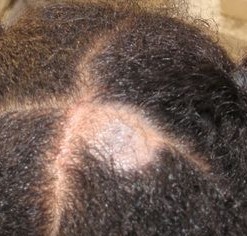
© Myself, CC BY-SA 4.0, via Wikimedia Commons
Commonly, the infection just looks like severe dandruff on various places on the scalp. This may be mistaken for Psoriasis.
Some infections cause patches of hair loss (bald patches) to develop. The bald patches are usually inflamed and scaly. Small broken-off hairs may remain scattered in the bald patches.
In some cases, several painful boils (pustules) develop on the scalp.
A more severe infection develops in a small number of cases. This causes a large 'boggy' swelling in a section of the scalp, called a kerion. This can be oozing and tender and, if not treated early, can cause permanent scarring and hair loss. (Read more of this below, in the paragraph about complications).
If there is a severe infection, such as a kerion or pustules, a hohem Fieber might develop and the glands in the neck may swell.
How is a scalp ringworm diagnosed?
Sometimes the symptoms strongly suggest a pilzliche Infektion. However, scalp ringworm may be confused with other problems at first. For example, some cases can look like psoriasis or bad dandruff and fungal infection is just one of several causes of bald patches and hair loss.
To confirm the diagnosis, a doctor will sometimes send a hair sample or a scraping of affected skin to the laboratory. This is looked at under the microscope and cultured to confirm that a fungal infection is the cause of the problem.
General advice if you are diagnosed with scalp ringworm
If a child (or adult) is confirmed as having scalp ringworm then:
Where possible, objects that may be contaminated with fungal spores should be thrown away or disinfected with bleach - for example, hats, combs, pillows, blankets and scissors. This aims to prevent re-infection after treatment and to prevent passing on the infection to others.
Towels should not be shared and towels should be washed frequently.
It is not necessary to keep children off school. However, to ensure that the infection is not transmitted to others, they should carefully follow the recommended treatment.
The scalps of other children in the household should be checked and monitored. If there are any signs of scaling or hair loss then medical advice should be sought.
If a pet is suspected of being the source of the fungal infection then advice should be sought from a vet.
What is the treatment for scalp ringworm?
Antifungal medicines
Ein antifungal medicine taken by mouth is needed to clear scalp ringworm. They usually work well.
Griseofulvin has been the first choice of treatment for scalp ringworm for many years. An 8- to 12-week course of griseofulvin is usually needed. At the moment there is no liquid form available but the tablets can be taken crushed, if necessary mixed with a little water, for children unable to swallow them whole.
Terbinafin is another option which is being increasingly used instead of griseofulvin. Strictly speaking, it is not licensed for this purpose but it is often an effective treatment. A four-week course is usually needed. It is important to finish the course to clear the fungus completely from the scalp.
Other antifungal medicines, such as Itraconazol und Fluconazol, are sometimes used.
Antifungal medicines are generally well tolerated and side-effects are uncommon. However, they do occur in some people and some people should not take them at all. For example, women of childbearing age should not become pregnant during (and for one month after) treatment with griseofulvin. Men should use contraception during (and for six months after) their own treatment with griseofulvin, as it has been known to damage sperm.
Therefore, it is important to read the leaflet that comes with the medicine packet for a full list of cautions and possible side-effects before taking any treatment.
Antifungal creams and shampoos
Antifungal creams or shampoos do not clear the infection fully. This is because fungi get into the hair shafts where creams and shampoos cannot reach. Therefore, they cannot cure the condition. They do, however, clear fungi and fungal spores from the hairs and surface of the scalp.
An antifungal shampoo or cream may be advised twice-weekly for a couple of weeks zusätzlich to antifungal medication - for example, selenium shampoo, ketoconazole shampoo or terbinafine cream. This is to clear any surface fungi quickly and make it much less likely for the fungus to spread to other children.
Gibt es mögliche Komplikationen?
If the infection is not treated and becomes severe, there is a risk of some permanent scarring and patches of hair loss (bald patches) remaining on the scalp even after treatment.
Sometimes the fungal infection beds down deeply into the scalp, which responds by creating a very sore, thick bumpy mass of fungal infection called a kerion. This can look like a cluster of boils and be mistaken for a bacterial infection, when the actual infection is caused by a fungus.
Antibiotics will not help for a kerion: antifungal tablets like terbinafine or griseofulvin are needed. This image shows a kerion:
Kerion on a child's scalp
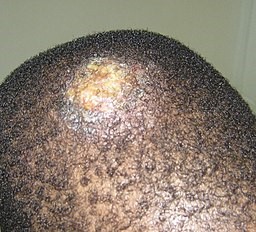
© Grook Da Oger, CC BY-SA 4.0, via Wikimedia Commons
Very occasionally the inflammation caused by a fungal infection can lead on to a 'secondary' bacterial skin infection. If this occurs then a course of antibiotics might be needed.
What about close contacts of affected people?
Some people with no symptoms may be contaminated with fungi in their hair. These people are called 'carriers'. Therefore, household members and other close contacts of an affected person may be advised to have a simple test. A special brush may be used on their hair which is then sent to the laboratory to see if their hair is contaminated with fungi or fungal spores.
Treatment of close contacts
Treatment may be offered if fungi or fungal spores are detected, to prevent the disease from 'taking hold' or from spreading to others. For example, some people found to have a heavy growth or high spore count may be advised to take a course of antifungal tablets.
Others with a low count may be treated with just an antifungal shampoo or cream.
Patientenauswahl für Haar- und Kopfhautprobleme

Haut-, Nagel- und Haargesundheit
Männlicher Haarausfall
Männlicher Haarausfall ist die häufigste Form des Haarausfalls, die sich bei den meisten Männern irgendwann entwickelt. Der medizinische Begriff dafür ist androgenetische Alopezie. Es dauert normalerweise 15-25 Jahre, um kahl zu werden, kann aber auch schneller gehen. Typischerweise beginnt das Haar zunächst an den Seiten (Schläfen) dünner zu werden (zurückzuweichen). Gleichzeitig wird das Haar auf dem Oberkopf normalerweise dünner. Eine kahle Stelle entwickelt sich allmählich in der Mitte der Kopfhaut. Die zurückweichenden Seiten und die kahle Stelle oben (die Krone) vergrößern sich allmählich und verbinden sich, wodurch ein Fleck vorne entsteht. Der Fleck vorne wird schließlich ebenfalls dünner. Oft bleibt ein Haarkranz um den Hinterkopf und die Seiten der Kopfhaut. Bei einigen Männern wird auch dieser Haarkranz dünner und verschwindet, was eine vollständig kahle Kopfhaut hinterlässt.
von Dr. Toni Hazell, FRCGP
Haut-, Nagel- und Haargesundheit
Seborrhoische Dermatitis
Die seborrhoische Dermatitis verursacht starken Schuppenbefall und manchmal einen Ausschlag, häufig im Gesicht und am Oberkörper. Ein Anti-Pilz (antimykotisches) Shampoo und/oder eine antimykotische Creme beseitigen in der Regel die Schuppen und den Ausschlag. Die Erkrankung neigt dazu, wiederzukehren (rezidivieren). Wenn sie häufig wiederkehrt, kann die regelmäßige Anwendung eines antimykotischen Shampoos und/oder einer Creme helfen, sie fernzuhalten.
von Dr. Toni Hazell, FRCGP
Häufig gestellte Fragen
Können Erwachsene Kopfpilz bekommen?
Kopfpilz betrifft überwiegend junge Kinder und tritt bei Erwachsenen seltener auf. Es wird angenommen, dass dies daran liegt, dass das nach der Pubertät auf der Kopfhaut produzierte Hautöl (Talg) hilft, Pilzinfektionen zu widerstehen.
Wie lange dauert die Behandlung von Kopfhautpilz normalerweise?
Die Dauer der Behandlung von Kopfhautpilz hängt von dem spezifisch verschriebenen Antimykotikum ab. Griseofulvin erfordert in der Regel eine 8- bis 12-wöchige Behandlung, während Terbinafin oft mit einer kürzeren Behandlungsdauer von vier Wochen wirksam sein kann. Es ist entscheidend, die gesamte Behandlung abzuschließen, um den Pilz vollständig zu beseitigen.
Wenn bei mir Kopfpilz diagnostiziert wird, muss ich mein Kind von der Schule zu Hause behalten?
Nein, es ist nicht notwendig, Kinder von der Schule fernzuhalten, wenn sie Kopfpilz haben. Um jedoch die Ausbreitung der Infektion auf andere zu verhindern, ist es wichtig, dass sie die empfohlene Behandlung und die allgemeinen Hygienehinweise ihres Arztes sorgfältig befolgen, wie zum Beispiel keine Handtücher zu teilen.
Kann mein Haustier mir Kopfpilz übertragen, und was soll ich tun, wenn ich vermute, dass es die Quelle ist?
Ja, Haustiere wie Hunde, Katzen und andere Tiere können Pilzinfektionen tragen und diese weitergeben, insbesondere an Kinder. Wenn Sie vermuten, dass Ihr Haustier die Quelle der Infektion ist, sollten Sie einen Tierarzt um Rat fragen. Tiere können auch gegen diese Infektionen behandelt werden.
Was ist ein Kerion und wie wird es behandelt?
Ein Kerion ist eine schwere Form von Kopfhautpilz, bei der die Pilzinfektion tief in die Kopfhaut eindringt und eine sehr schmerzhafte, dicke und unebene Masse verursacht. Es kann einem Haufen von Furunkeln ähneln und mit einer bakteriellen Infektion verwechselt werden. Ein Kerion erfordert eine Behandlung mit oralen Antimykotika wie Terbinafin oder Griseofulvin, da Antibiotika gegen die Pilzursache nicht wirksam sind.
Weiterführende Lektüre und Referenzen
- Gonzalez U, Seaton T, Bergus G, et al; Systemic antifungal therapy for tinea capitis in children. Cochrane Database Syst Rev. 2007 Oct 17;(4):CD004685.
- Coulibaly O, Kone AK, Niare-Doumbo S, et al; Dermatophytosis among Schoolchildren in Three Eco-climatic Zones of Mali. PLoS Negl Trop Dis. 2016 Apr 28;10(4):e0004675. doi: 10.1371/journal.pntd.0004675. eCollection 2016 Apr.
- Pai VV, Hanumanthayya K, Tophakhane RS, et al; Clinical study of Tinea capitis in Northern Karnataka: A three-year experience at a single institute. Indian Dermatol Online J. 2013 Jan;4(1):22-6. doi: 10.4103/2229-5178.105461.
- Pilzinfektion der Haut - Kopfhaut; NICE CKS, Juli 2022 (nur für UK-Zugang)
- Kerion; DermNet.
- Tinea Capitis; British Association of Dermatologists, 2017
- Tinea Capitis; DemNetNZ
Über den AutorVollständige Biografie anzeigen

Dr Philippa Vincent, MRCGP
Allgemeinmediziner, Medizinischer Autor
MB BS, Bsc, MRCGP (2000), DCH, DFSRH, DRCOG
Dr Philippa Vincent ist ein NHS-Arzt, der in Nordlondon arbeitet.
Über den RezensentenVollständige Biografie anzeigen

Dr Colin Tidy, MRCGP
Allgemeinmediziner, Medizinischer Autor
MBBS, MRCGP, MRCP (Paediatrics), DCH
Dr. Colin Tidy ist ein NHS-Arzt mit Sitz in Oxfordshire.
Artikelverlauf
Die Informationen auf dieser Seite wurden von qualifizierten Klinikern verfasst und begutachtet.
Artikel auch verfügbar in Englisch, Deutsch, Spanisch, Französisch, Italienisch, Portugiesisch, Hindi, Hebräisch, Arabisch, und Schwedisch.
Nächste Überprüfung fällig: 12. Mai 2028
19. Mai 2023 | Neueste Version

Fragen, teilen, verbinden.
Durchsuchen Sie Diskussionen, stellen Sie Fragen und teilen Sie Erfahrungen zu Hunderten von Gesundheitsthemen.

Fühlen Sie sich unwohl?
Bewerten Sie Ihre Symptome online kostenlos
Abonnieren Sie den Patienten-Newsletter
Ihre wöchentliche Dosis klarer, vertrauenswürdiger Gesundheitsberatung - geschrieben, um Ihnen zu helfen, sich informiert, selbstbewusst und in Kontrolle zu fühlen.
Durch das Abonnieren akzeptieren Sie unsere Datenschutzrichtlinie. Sie können sich jederzeit abmelden. Wir verkaufen Ihre Daten niemals.
Mehr über Haut-, Nagel- und Haargesundheit
- Aktinische Keratose
- Alopecia areata
- Katzenkratzkrankheit
- Hundebisse und Katzenbisse
- Epidermoide und Pilarzysten
- Follikulitis
- Pilzinfektion in der Leistengegend
- Nesselsucht
- Infizierte Wunden
- Eingewachsener Zehennagel
- Lichen planus
- Mückenstiche
- Mpox-Virus
- Periorale Dermatitis
- Polymorphe Lichtdermatose
- Gürtelrose
- Hautgeschwüre