Follikulitis
Begutachtet von Dr Doug McKechnie, MRCGPZuletzt aktualisiert von Dr Philippa Vincent, MRCGPZuletzt aktualisiert 15 Sept 2024
Erfüllt die Anforderungen des Patienten Richtlinien des Patienten
- HerunterladenHerunterladen
- Teilen
- Language
- Diskussion
- Audio-Version
- Zu bevorzugten Quellen bei Google hinzufügen
In dieser Serie:HautausschlägeZellulitisErythema toxicum neonatorumPeriorale DermatitisRosazeaKrätze
Folliculitis means inflammation of the hair follicles of the skin. Most of the skin is covered with tiny hairs which grow out of hair follicles. In folliculitis, many hair follicles in one area of the skin are affected.
Auf einen Blick
Follikulitis ist Schmerz und Entzündung der Haarfollikel.
Infizierte Follikel können anschwellen und rote Beulen oder mit Eiter gefüllte Stellen bilden, die verkrusten können.
Es tritt häufig an Gesäß, Beinen, Rücken, Brust, Gesicht und Kopfhaut auf.
Die meisten Fälle sind mild und lösen sich innerhalb von 7-10 Tagen ohne Behandlung.
Suchen Sie ärztlichen Rat, wenn einfache Maßnahmen nicht helfen oder sich die Infektion weiter ausbreitet.
What is folliculitis?
Folliculitis means inflammation of the hair follicles. Folliculitis can be a mild, short-lived condition or a severe long-term problem. Folliculitis can occur anywhere on hair-bearing skin. There are a number of causes of inflammation which can result in folliculitis.
Rash of folliculitis
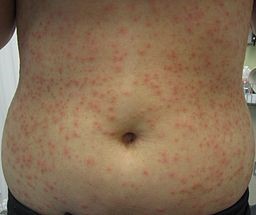
© James Heilman, MD, CC BY-SA 3.0, über Wikimedia Commons
Folliculitis symptoms
When hair follicles become infected or inflamed they swell causing a red bump on the skin.
Sometimes the affected follicles fill with pus, covering the affected skin with small, rounded, yellow-red spots (pustules).
Affected skin may develop a crust, which can be yellow or golden coloured due to infection.
The affected skin can feel painful, hot and may be itchy.
Folliculitis locations
Folliculitis can be found everywhere where hair grows but the following areas are particularly common:
Buttocks.
Legs.
Back.
Chest.
Gesicht.
Kopfhaut.
Types of folliculitis
Bacterial folliculitis
This is the commonest type of folliculitis and usually arises from the typical bacteria which normally live on the skin causing an infection in the hair follicles. It is very common and easily treated with antibiotics if it is significant enough to need treatment. Often it will settle on its own without treatment.
There are a few specific types of folliculitis:
Sycosis barbae
This is the medical name for a long-term (chronic) folliculitis in the beard area of the face. The skin is painful and crusted, with burning and itching on shaving. Numerous pustules develop in the hair follicles. It can be difficult to treat and some men grow a beard to solve the problem.
Hot tub folliculitis
As the name suggests, this tends to affect people after using a hot tub. The hot water encourages a bacteria called Pseudomonas aeruginosa to grow (particularly if there is not enough chlorine in the water to keep it clean). This type of folliculitis is generally harmless and is prevented by proper maintenance of hot tubs. Showering after using the hot tub does not seem to reduce the chance of folliculitis. Antibiotics are not needed for hot tub folliculitis; it usually settles within 2 weeks.
Gram-negative Follikulitis
This is a type of folliculitis that may occur after acne has been treated with long-term antibiotics. Gram-negative refers to a type of stain that is used in a laboratory to identify different types of bacteria.
Pseudo-folliculitis
Also known as "razor bumps", this is caused by inflammation from shaving and ingrowing hairs. Pseudo-folliculitis is more common in people with curly or Afro-Caribbean hair, as these hairs are more likely to curl back and grow into the skin. Ingrowing hairs can also be caused by dead skin cells blocking the hair follicle so the hair cannot exit the follicle.
Malassezia folliculitis
Also known as pityrosporum folliculitis, this is caused by yeasts which normally live on the skin but occasionally cause inflammation. Malassezia folliculitis is more common in adolescent boys and young men and is also more common in hot humid climates. Other things that make malassezia folliculitis more common are frequent use of sunscreen, excessive sweating, antibiotic use and the immune system being impaired.
Follikulitis
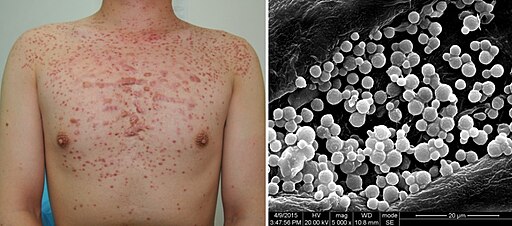
© Ran Yuping et al., CC BY-SA 3.0, via Wikimedia Commons
Eosinophilic folliculitis
This rare form of folliculitis is also known as eosinophilic pustular folliculitis or Ofuji disease. It causes itchy pustules and is more common in men than women. The pustules are usually seen on the head, neck and trunk and can persist for weeks or months. It may look like acne. It is associated with HIV but also occurs in people without HIV. Simple anti-inflammatory drugs have been reported to help in up to 7 out of 10 people with eosinophilic folliculitis. Antibiotics may also help.
Carbuncles
A carbuncle is a group of inflamed follicles close together which then join together into one hot red lump with pus coming out of several points. This can be very painful and antibiotics are often needed. Warm compresses may help avoid the need for antibiotics.
Furuncles (boils)
This is an infection deeper in the hair follicle which causes a small abscess just under the skin. It is hot and red. Antibiotics may be needed but warm compresses can often help.
Causes of folliculitis
Folliculitis occurs at sites where hair follicles are inflamed. There are a number of causes:
Infection. Most folliculitis infections are caused by a bacteria called Staphylococcus aureus (S. aureus), which usually lives harmlessly on the skin. Occasionally other bacteria, fungi (Pityrosporum or Candida albicans) or parasites are the cause.
Physical irritation caused by shaving or friction.
Chemical irritation caused by chemicals applied to the skin.
Blockage of the hair follicle eg, by dead skin cells or thick creams.
Übermäßiges Schwitzen (Hyperhidrose) due to overactivity of the sweat glands.
Steroid creams.
Inflammatory skin conditions are an uncommon cause.
Complications of folliculitis
Most cases of folliculitis get better without any complications. Occasionally the following can occur:
Scarring of the skin.
Darkening of the affected skin (hyperpigmentation).
Hair loss at the affected site due to scarring of the skin.
Deep folliculitis. This occurs if the infection spreads deeper into the follicles causing a boil.
Cellulitis. This is when infection spreads into the surrounding skin, making it hot and red.
Medical advice should be sought if there is an infection which is spreading deeper or onto surrounding skin.
Diagnosing folliculitis
There are no specific tests for folliculitis. Normally the diagnosis is obvious from the type of rash.
Occasionally a swab might help if there is discharge from the pustules.
Folliculitis treatment
Identifying the cause of the folliculitis will help decide what will help. General measures include:
Avoiding things that aggravate the condition.
Taking a break from hair removal until the folliculitis has settled down.
Avoiding wearing tight clothes over the affected area, particularly if it causing sweating.
Keeping cool and keeping folliculitis exposed to the fresh air.
Not sharing towels, flannels or razors.
Applying an antibacterial moisturiser (emollient) and soap substitute. See below for more information.
Leichte Fälle
Most cases of folliculitis are mild and do not need any treatment. It often clears without any treatment within 7-10 days.
It may be helpful to use:
A moisturiser (emollient) which contains an antibacterial agent - for example, Dermol® cream.
Lotion or Emulsiderm®.
These may help the folliculitis to clear more quickly and reduce the risk of it becoming worse. You can use one of these emollients as a soap substitute until the folliculitis has cleared (and long-term if needed). These can also be added to the bath or shower - specific bath or shower products are not needed.
If simple measures over a few days do not result in improvement of the folliculitis, medical advice should be sought for further advice and treatment.
Localised folliculitis
For localised areas of folliculitis, an antibiotic cream may be useful. Fusidinsäure is a suitable antibiotic cream that can be applied 3-4 times per day to affected areas. If the folliculitis is thought to be fungal, a different treatment may be used.
More severe cases
If the folliculitis is more severe or widespread then a course of oral Antibiotikum tablets may be needed.
Recurrent or long-term (chronic) folliculitis
Recurrent folliculitis occurs when the infection keeps coming back, although it disappears with treatment. The gaps between episodes may get shorter and, eventually, chronic folliculitis is the result.
In these cases, a clinician may take a sample (swab) from the skin where the folliculitis is. This swab can show if an infection is responsible and identify which type of infection it is. The correct medication can then be used to try and eradicate the bacteria from the skin.
Preventing folliculitis
To try and prevent folliculitis, the following actions may help:
Keeping skin clean, dry and free from abrasions or irritations.
Keeping skin well-moisturised.
Using clean, sharp razors and shaving in the direction of hair growth, or using an electric razor.
Using a shaving soap, gel or foam to lubricate the blades across the skin to help prevent nicks and cuts.
Using hair removal methods other than shaving.
Avoiding chemicals or items which irritate the skin.
Exfoliating regularly to remove dead skin cells.
Using antiseptic washes routinely is not generally recommended as they can make the skin sore and dry.
Is folliculitis contagious?
Folliculitis itself is not contagious. In hot-tub folliculitis, other people who have been exposed to the same hot tub are likely to develop folliculitis as well.
Patientenauswahl für Haar- und Kopfhautprobleme

Haut-, Nagel- und Haargesundheit
Männlicher Haarausfall
Männlicher Haarausfall ist die häufigste Form des Haarausfalls, die sich bei den meisten Männern irgendwann entwickelt. Der medizinische Begriff dafür ist androgenetische Alopezie. Es dauert normalerweise 15-25 Jahre, um kahl zu werden, kann aber auch schneller gehen. Typischerweise beginnt das Haar zunächst an den Seiten (Schläfen) dünner zu werden (zurückzuweichen). Gleichzeitig wird das Haar auf dem Oberkopf normalerweise dünner. Eine kahle Stelle entwickelt sich allmählich in der Mitte der Kopfhaut. Die zurückweichenden Seiten und die kahle Stelle oben (die Krone) vergrößern sich allmählich und verbinden sich, wodurch ein Fleck vorne entsteht. Der Fleck vorne wird schließlich ebenfalls dünner. Oft bleibt ein Haarkranz um den Hinterkopf und die Seiten der Kopfhaut. Bei einigen Männern wird auch dieser Haarkranz dünner und verschwindet, was eine vollständig kahle Kopfhaut hinterlässt.
von Dr. Toni Hazell, FRCGP

Haut-, Nagel- und Haargesundheit
Seborrhoische Dermatitis
Die seborrhoische Dermatitis verursacht starken Schuppenbefall und manchmal einen Ausschlag, häufig im Gesicht und am Oberkörper. Ein Anti-Pilz (antimykotisches) Shampoo und/oder eine antimykotische Creme beseitigen in der Regel die Schuppen und den Ausschlag. Die Erkrankung neigt dazu, wiederzukehren (rezidivieren). Wenn sie häufig wiederkehrt, kann die regelmäßige Anwendung eines antimykotischen Shampoos und/oder einer Creme helfen, sie fernzuhalten.
von Dr. Toni Hazell, FRCGP
Häufig gestellte Fragen
Kann sich Follikulitis von einem Bereich meines Körpers auf einen anderen ausbreiten?
Obwohl die Entzündung selbst nicht von Person zu Person ansteckend ist, können sich die Bakterien oder Pilze, wenn die Follikulitis durch eine Infektion verursacht wird, potenziell auf andere Haarfollikel auf Ihrem eigenen Körper ausbreiten, insbesondere wenn Sie den betroffenen Bereich kratzen oder wenn Bedingungen wie übermäßiges Schwitzen vorliegen.
Kehren Follikulitis normalerweise zurück, nachdem sie abgeklungen sind?
Follikulitis kann manchmal ein wiederkehrendes Problem sein, selbst nach der Behandlung. Wenn die zugrunde liegende Ursache, wie bestimmte Bakterien oder Reizungen, nicht vollständig behoben wird oder erneut auftritt, können neue Episoden von Follikulitis auftreten. Dies wird als rezidivierende Follikulitis bezeichnet, bei der die Infektion immer wiederkehrt. In einigen Fällen kann es sogar zu einem langfristigen (chronischen) Problem werden.
Wenn ich Follikulitis habe, sollte ich in Zukunft öffentliche Whirlpools meiden?
Wenn Sie Hot-Tub-Follikulitis erlebt haben, ist es eine gute Idee, die Wartung öffentlicher Whirlpools in Betracht zu ziehen. Diese Art von Follikulitis ist mit einem Bakterium verbunden, das in warmem Wasser gedeiht, insbesondere wenn nicht genügend Chlor vorhanden ist, um das Wasser sauber zu halten. Die Gewährleistung einer ordnungsgemäßen Wartung der von Ihnen genutzten Whirlpools ist der Schlüssel zur Vorbeugung.
Gibt es bestimmte Arten von Cremes, die bei Juckreiz durch Follikulitis helfen können?
Obwohl der Artikel antibakterielle Feuchtigkeitscremes (Emollients) wie Dermol-Creme erwähnt, um Follikulitis zu beseitigen und das Risiko einer Verschlimmerung zu verringern, empfiehlt er nicht speziell Cremes gegen Juckreiz. Diese Emollients können jedoch auch als Seifenersatz verwendet werden und könnten etwas Linderung bieten, da sie helfen, die Haut zu beruhigen.
Weiterführende Literatur und Referenzen
- Follikulitis; DermNet NZ
- Folliculitis and boils (furuncles/carbuncles), Primary Care Dermatology Society (PCDS), 2016
- Winters RD, Mitchell M; Folliculitis. StatPearls, September 2019.
- Eosinophilic Pustular Folliculitis; DermNet
Über den AutorVollständige Biografie anzeigen

Dr Philippa Vincent, MRCGP
Allgemeinmediziner, Medizinischer Autor
MB BS, Bsc, MRCGP (2000), DCH, DFSRH, DRCOG
Dr Philippa Vincent ist ein NHS-Arzt, der in Nordlondon arbeitet.
Über den RezensentenVollständige Biografie anzeigen

Dr Doug McKechnie, MRCGP
Medizinischer Autor
MA, MBBS, MSc, DRCOG, MRCP(UK), MRCGP(2021), FHEA
Dr. Doug McKechnie ist ein NHS-Hausarzt, der in London arbeitet. Er arbeitet klinisch in Vollzeit und ist außerdem stellvertretender Leiter des Moduls für klinische und berufliche Praxis an der University College London Medical School.
Artikelverlauf
Die Informationen auf dieser Seite wurden von qualifizierten Klinikern verfasst und begutachtet.
Artikel auch verfügbar in Englisch, Deutsch, Spanisch, Französisch, Italienisch, Portugiesisch, Hindi, Hebräisch, Arabisch, und Schwedisch.
Nächste Überprüfung fällig: 14. Sept 2027
15 Sept 2024 | Neueste Version

Fragen, teilen, verbinden.
Durchsuchen Sie Diskussionen, stellen Sie Fragen und teilen Sie Erfahrungen zu Hunderten von Gesundheitsthemen.

Fühlen Sie sich unwohl?
Bewerten Sie Ihre Symptome online kostenlos
Abonnieren Sie den Patienten-Newsletter
Ihre wöchentliche Dosis klarer, vertrauenswürdiger Gesundheitsberatung - geschrieben, um Ihnen zu helfen, sich informiert, selbstbewusst und in Kontrolle zu fühlen.
Durch das Abonnieren akzeptieren Sie unsere Datenschutzrichtlinie. Sie können sich jederzeit abmelden. Wir verkaufen Ihre Daten niemals.
Mehr über Haut-, Nagel- und Haargesundheit
- Akne
- Aktinische Keratose
- Bettwanzen
- Katzenkratzkrankheit
- Hühneraugen und Schwielen
- Discoider Lupus
- Ekzem bei Kindern
- Pilzinfektion der Nägel
- Nesselsucht
- Impetigo
- Eingewachsener Zehennagel
- Insektenstiche und -bisse
- Mpox-Virus
- Pflastertest für Kontaktdermatitis
- Periorale Dermatitis
- Polymorphe Lichtdermatose
- Hautgeschwüre
- Systemische Sklerose
- Vitiligo