Mastitis und Brustabszess
Begutachtet von Dr Hayley Willacy, FRCGP Zuletzt aktualisiert von Dr Colin Tidy, MRCGPZuletzt aktualisiert 19. Jan 2023
Erfüllt die Anforderungen des Patienten Richtlinien des Patienten
- HerunterladenHerunterladen
- Teilen
- Language
- Diskussion
- Audio-Version
- Zu bevorzugten Quellen bei Google hinzufügen
In dieser Serie:Ihr Baby fütternStillen Ihres Babys Flaschenernährung Ihres BabysBaby-gesteuertes AbstillenErnährung Ihres Kleinkinds
Brustentzündung ist eine schmerzhafte Erkrankung der Brust, die sich rötet, warm wird und schmerzhaft ist (entzündet). Sie wird in der Regel durch einen Milchstau in der Brust verursacht.
Auf einen Blick
Mastitis is a painful breast condition, making the breast red, hot, and sore.
It is commonly caused by a build-up of milk, or by germs entering the milk ducts.
Symptoms include an area of hardness, pain, and redness, often with flu-like feelings.
Continued breastfeeding is important for treatment, even from the affected breast.
See a doctor if symptoms worsen or if you suspect a breast abscess.
Melden Sie sich für unseren kostenlosen 8-wöchigen Kurs zur gesunden Schwangerschaft an!
Jede Woche teilen wir nützliche Informationen und wichtige Tipps zu Themen wie Ernährung, Bewegung, psychische Gesundheit, Symptome, auf die Sie achten sollten, und Vorbereitung auf die Geburt, um Ihnen zu helfen, Ihre Schwangerschaftsreise in jeder Phase zu meistern.
Durch das Abonnieren akzeptieren Sie unsere Datenschutzrichtlinie. Sie können sich jederzeit abmelden. Wir verkaufen Ihre Daten niemals.
Mastitis is a painful condition of the breast which becomes red, hot and sore (inflamed). It is usually caused by a build-up of milk within the breast (a blocked duct or engorgement). Sometimes it can be caused by germs (bacteria) that get into the milk ducts of the breast. This is often through a crack or sore in the nipple.
What is mastitis?
Cross-section view of breast
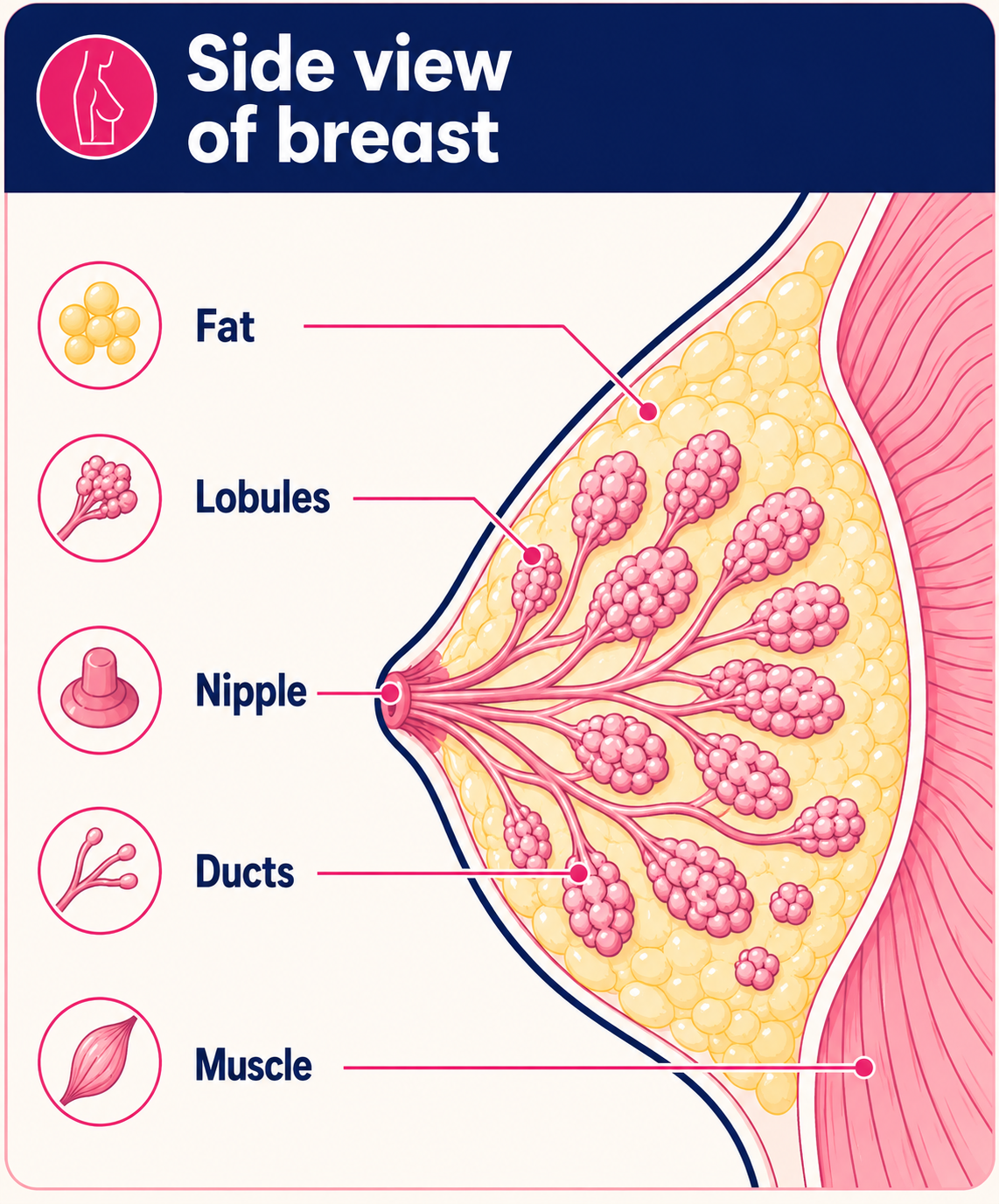
Mastitis is an inflammation of the breast, usually caused by a build-up of milk within the breast in women who are breastfeeding. It can be either:
Non-infectious - when the build-up of milk irritates the breast tissue, making it become red, hot and swollen (inflamed).
Infectious - when the build-up of milk becomes infected and the infection spreads to the breast tissue. The infection is caused by germs (bacteria) which may have come from the skin.
If non-infectious mastitis is not treated, it can become infectious mastitis. You can't tell which type of mastitis it is from looking at it, and the treatment is the same.
Anything which causes a build-up of milk in your breasts will make it more likely that you develop mastitis. Sometimes it occurs if you suddenly stop breast-feeding and the breasts become very swollen and sore because of the milk (engorged). This might happen if your baby starts to sleep through the night, or if you start using bottles for some feeds. If your baby is not feeding very well (for example, due to tongue-tie or illness) this might cause the milk to collect. Pressure on the breast due to a tight bra, or sleeping on your front, or wearing a seatbelt for a long time, may also be a cause. Breaks in the skin of the breast, such as cracked nipples due to your baby not latching on properly, can also make mastitis more likely. This is because the germs on the skin then have a route to the inside of the breast.
Who gets mastitis?
You are most likely to get mastitis if you are a woman who is des Stillens. It is sometimes called 'puerperal mastitis' or 'lactational mastitis'. It typically develops within the first few weeks of breastfeeding. At least 1 in every 10 breastfeeding women get mastitis, and it may be as many as 3 in every 10.
Mastitis sometimes occurs in women who are not breastfeeding (non-lactational mastitis). Germs (bacteria) get into the milk ducts of the breast to cause the infection. This may be through a crack or sore in the nipple or from a nipple piercing but it can happen when you don't have any problems with your nipples. Smoking can be a trigger because nicotine damages the ducts in your breasts.
Mastitis symptoms
Mastitis causes an area of hardness, pain, redness and swelling in the breast and makes you feel generally unwell. It often starts in a wedge-shaped section of breast. It usually occurs in one breast only.
You also develop a high temperature (fever) and feel like you are coming down with flu. Other symptoms might include muscle pains, headaches and feeling tired and low.
Mastitis or blocked milk duct?
A blocked milk duct sometimes occurs in breastfeeding women. A blocked milk duct also causes a painful, swollen area in a breast. The overlying skin is sometimes red and inflamed, but it tends not to be as bad as mastitis and doesn't make you feel unwell.
When you feed your baby, the pain may increase due to the pressure of milk building up behind the blocked duct. A blocked milk duct will usually clear within 1-2 days and symptoms will then go. However, in some cases a blocked milk duct becomes infected and develops into mastitis. So, some cases of mastitis develop as a complication of a blocked milk duct, but some cases occur without a blockage happening first.
A blocked milk duct may clear more quickly if you feed your baby more often from the affected breast and gently massage your breast towards your nipple while you are breastfeeding.
Mastitis treatment
Eat well and drink lots of fluids. Avoid tight-fitting bras.
Place a warm compress over your breast to help relieve the pain.
Regularly express milk from both breasts if you're breastfeeding.
See a midwife or doctor if you have any concerns
The quickest way to get rid of mastitis is to continue des Stillens. Mastitis may need to be treated with a course of an Antibiotikum. However, a mild case may get better without any medical treatment. If you notice a tender swollen area in your breast when you're breastfeeding, it may be a blocked milk duct or mastitis developing. It may be reasonable to 'see how it goes' over a day or so.
Can mastitis be treated without antibiotics?
Continue to breastfeed. This will empty the affected breast and it keeps the milk flowing, and stops the breast from becoming engorged and making things worse.
Feeding from an infected breast does not harm your baby. If your baby swallows germs (bacteria) from an infected breast, the germs will be killed by the acid in your baby's stomach.
Feed on the affected side first, so it will empty well, for the next two or three feeds. (However, don't let the unaffected side become too full of milk.)
After feeding, consider expressing from the affected side as well. This is to make sure the breast is completely empty after a feed.
Before feeding, massage your breast gently. Or apply heat with a warm flannel, or a heat pack or by having a warm shower.
Ask your midwife or health visitor to check your breastfeeding technique and to check that your baby is latching on well.
If it is too painful to feed from the affected side, express the milk from that side with a breast pump.
Try to eat well and drink plenty of fluid.
However, if your symptoms become worse you should see a doctor. After talking to you and examining you, they may prescribe an antibiotic. They may suggest that you wait 24 hours before starting the antibiotics, if your symptoms are mild or have only just begun. The mastitis will usually clear within a few days of starting the antibiotic.
Mastitis complications
Occasionally, an abscess may form inside an infected section of breast. An abscess is a collection of pus that causes a firm, red, tender lump. This is thought to happen to between about 3 and 7 women with mastitis, out of every 100. If this happens to you, you will need to go to hospital for treatment. As well as the breast symptoms, you may feel flu-like or that you have a high temperature (are feverish). If you suspect an abscess, you should contact a doctor. The pus in a breast abscess needs draining with a needle and syringe, or even with a small operation (called incision and drainage).
The pus can be seen with an Ultraschall-Scan. If the skin over the abscess is not broken, the pus can be drained with a needle and syringe by a doctor. If the skin is broken (or very thin) the doctor may need to make a small cut to let the pus drain out (called incision and drainage). You will probably need antibiotic medication as well.
If you have a breast abscess you should not feed from the affected side; however, you should express and discard the milk to stop your breast from becoming swollen with fluid (engorged).
Some other points about mastitis
Your doctor will choose an antibiotic that is safe to give to breastfeeding women and which will not harm your baby.
You can take simple painkillers (wie zum Beispiel Paracetamol oder Ibuprofen) to ease pain and reduce high temperature (fever). Cold packs can also be quite soothing when placed on the breast.
Your baby may refuse to feed from the affected breast, as the taste of the milk may change a little. If this happens, feed from the other breast. Do remember to express the milk (that your baby has refused to take) from the affected breast. This will stop the breast swelling and becoming more painful. It will also keep up the demand for milk, so production does not slow down.
Patientenauswahl für Schwangerschaftskomplikationen
Schwangerschaft
Zervikale Insuffizienz und Naht
Zervixinsuffizienz (manchmal auch als Zervixinkompetenz bezeichnet) tritt auf, wenn der Gebärmutterhals (die Zervix) sich ohne andere Wehenanzeichen erweicht, verkürzt und öffnet. Dies kann im zweiten Trimester oder früh im dritten auftreten und zu einer Frühgeburt des Babys führen. Eine Zervixnaht - auch als Zervixcerclage oder Zervixstich bezeichnet - ist eine Naht, die in/um die Zervix gelegt wird. Dies soll versuchen, eine späte Fehlgeburt oder Frühgeburt bei Frauen zu verhindern, die als hohes Risiko für Zervixinsuffizienz angesehen werden.
von Dr. Hayley Willacy, FRCGP

Schwangerschaft
Postpartale Psychose
Wochenbettpsychose ( puerperale Psychose oder postnatale Psychose) ist eine schwere psychische Erkrankung, die in den Tagen oder Wochen nach der Geburt auftritt.
von Dr. Mary Harding, MRCGP
Häufig gestellte Fragen
Does mastitis only affect one breast, or can it occur in both?
Mastitis usually occurs in one breast only. However, the article doesn't state it cannot affect both.
Can I continue to breastfeed my baby if I have mastitis?
Yes, continuing to breastfeed is the quickest way to get rid of mastitis. Feeding from an infected breast does not harm your baby because any germs swallowed will be killed by stomach acid. You should feed from the affected side first to help empty it, and express any milk your baby doesn't take if they refuse to feed from the affected breast.
What kind of pain relief can I use for mastitis?
You can take simple painkillers like paracetamol or ibuprofen to help ease the pain and reduce a high temperature. Applying cold packs to the breast can also be quite soothing.
What might cause the taste of my breast milk to change if I have mastitis?
If you have mastitis, the taste of the milk may change a little. The article does not specify the exact reason for this taste alteration, but it notes that it might lead your baby to refuse feeding from the affected breast.
If an abscess forms, will I still need antibiotics after it's drained?
Yes, if you have a breast abscess, you will probably need antibiotic medication as well, in addition to the pus being drained.
Weiterführende Literatur und Referenzen
- Die Babyfreundliche Initiative; UNICEF UK
- Mastitis und Brustabszess; NICE CKS, März 2025 (nur für UK-Zugang)
- Crepinsek MA, Taylor EA, Michener K, et al; Interventions for preventing mastitis after childbirth. Cochrane Database Syst Rev. 2020 Sep 29;9:CD007239. doi: 10.1002/14651858.CD007239.pub4.
- Pevzner M, Dahan A; Mastitis While Breastfeeding: Prevention, the Importance of Proper Treatment, and Potential Complications. J Clin Med. 2020 Jul 22;9(8):2328. doi: 10.3390/jcm9082328.
- Zakarija-Grkovic I, Stewart F; Treatments for breast engorgement during lactation. Cochrane Database Syst Rev. 2020 Sep 18;9(9):CD006946. doi: 10.1002/14651858.CD006946.pub4.
- Pileri P, Sartani A, Mazzocco MI, et al; Management of Breast Abscess during Breastfeeding. Int J Environ Res Public Health. 2022 May 9;19(9):5762. doi: 10.3390/ijerph19095762.
Über den AutorVollständige Biografie anzeigen

Dr Colin Tidy, MRCGP
Allgemeinmediziner, Medizinischer Autor
MBBS, MRCGP, MRCP (Paediatrics), DCH
Dr. Colin Tidy ist ein NHS-Arzt mit Sitz in Oxfordshire.
Über den RezensentenVollständige Biografie anzeigen

Dr Hayley Willacy, FRCGP
Allgemeinmediziner, Medizinischer Autor
MBChB (1992), DRCOG, DFFP, MRCOG (Part 1) MRCGP (2007), DFSRH (2013), MSc - medical education (2020)
Dr. Hayley Willacy war eine NHS-Hausärztin, die in Nordwestengland arbeitete und 2022 nach 30 Jahren aus der klinischen Praxis ausschied.
Artikelverlauf
Die Informationen auf dieser Seite wurden von qualifizierten Klinikern verfasst und begutachtet.
Artikel auch verfügbar in Englisch, Deutsch, Spanisch, Französisch, Italienisch, Portugiesisch, Hindi, Hebräisch, Arabisch, und Schwedisch.
Nächste Überprüfung fällig: 22. Dez 2027
19. Jan 2023 | Neueste Version

Fragen, teilen, verbinden.
Durchsuchen Sie Diskussionen, stellen Sie Fragen und teilen Sie Erfahrungen zu Hunderten von Gesundheitsthemen.

Fühlen Sie sich unwohl?
Bewerten Sie Ihre Symptome online kostenlos
Abonnieren Sie den Patienten-Newsletter
Ihre wöchentliche Dosis klarer, vertrauenswürdiger Gesundheitsberatung - geschrieben, um Ihnen zu helfen, sich informiert, selbstbewusst und in Kontrolle zu fühlen.
Durch das Abonnieren akzeptieren Sie unsere Datenschutzrichtlinie. Sie können sich jederzeit abmelden. Wir verkaufen Ihre Daten niemals.