Erythema toxicum neonatorum
Baby acne
Begutachtet von Dr Doug McKechnie, MRCGPZuletzt aktualisiert von Dr Hayley Willacy, FRCGP Zuletzt aktualisiert 20 Dez 2023
Erfüllt die Anforderungen des Patienten redaktionellen Richtlinien
- HerunterladenHerunterladen
- Teilen
- Language
- Diskussion
- Audio-Version
- Zu bevorzugten Quellen bei Google hinzufügen
Neonatales toxisches Erythem (ETN) ist ein häufiges Hautausschlag bei gesunden Neugeborenen. Es ist nicht ernsthaft, verursacht dem Baby keinen Schaden und verschwindet von selbst ohne Behandlung. Es ist manchmal bekannt als toxisches Erythem, Babyakne oder toxisches Erythem des Neugeborenen.
Auf einen Blick
Erythema toxicum neonatorum (ETN) ist ein häufiger, harmloser Ausschlag bei Neugeborenen, auch als Babyakne bezeichnet.
Es erscheint als rote Flecken, kleine erhabene Stellen oder eitergefüllte Punkte, hauptsächlich im Gesicht und am Körper.
Der Ausschlag ist nicht giftig, keine Infektion und verursacht dem Baby in der Regel keine Beschwerden.
ETN betrifft bis zu 4 oder 5 von 10 Babys und beginnt normalerweise einige Tage nach der Geburt.
Es gibt keine spezifische Behandlung für ETN, und es heilt von selbst innerhalb weniger Tage bis zu zwei Wochen ab.
Drücken oder quetschen Sie die Stellen nicht aus und setzen Sie die normalen Wasch- und Hautpflegeroutinen für Babys fort.
Wenn Ihr Baby unwohl ist oder Sie sich wegen eines Ausschlags Sorgen machen, suchen Sie medizinischen Rat.
What is erythema toxicum neonatorum?
Baby acne is small, inflamed bumps that can appear on a baby's neck, face, back and chest shortly after birth. The name erythema toxicum neonatorum is confusing because the condition is not toxic. It is also not the same as the acne that affects young people and adults.
Erythema is the medical word for redness. Neonatorum refers to the fact that the rash occurs in the neonatal period. The neonatal period is the time between birth and 28 days after birth. A baby in this age range is called a neonate.
What does baby acne look like?
Erythema toxicum neonatorum: baby acne
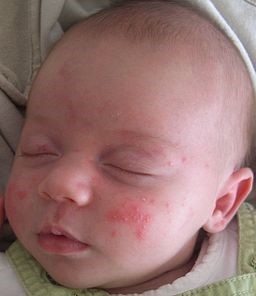
© Own image [selbst erstellt] (Fragegeist), Public domain, via Wikimedia Commons
The rash of ETN generally looks like red blotches, mainly affecting the face and body (trunk). It does occur on the arms and legs too (but is rare on the palms and soles of the feet). Characteristics of baby acne include:
Little, raised spots called papules are common.
Little pus-filled spots (pustules) or fluid-filled small blisters (vesicles).
There may be many spots or very few.
The different spots vary in size.
The spots blanch with light pressure (this means that they become pale and fade when pressed).
The rash can be temporary (very transient) and sometimes individual spots can disappear within hours while new ones will appear somewhere else.
The baby appears well and the rash does not seem to cause any bother.
Hinweis: if there is any doubt as to the cause of a skin rash in any baby or child, it is essential that you seek medical advice and a firm diagnosis for any other potential skin conditions. This is especially important if your baby seems unwell in any way. For example, if your baby has a temperature (fever), is not feeding, is lacking in energy (lethargic) or is inconsolable and not the same as normal. Other rashes can occur in babies and may be the sign of serious illness.
What causes baby acne?
The exact cause is unknown. It is not due to an infection, even though pus-filled spots (pustules) are often present.
Various ideas have been suggested, including the possibility that it is a normal effect of a baby's immune system reacting to the first microbes from the skin travelling down the hair follicles. It is nicht thought to be an allergic problem. It is also not related to whether the baby is breast-fed or bottle-fed.
How common is baby acne?
Erythema toxicum neonatorum is a very common rash. Up to 4 or 5 in every 10 babies develop baby acne. It seems to be more common in full term newborn babies(between 37 and 40 weeks of gestation) compared with premature babies.
Which babies get baby acne?
On average, baby acne occurs in healthy babies born at full term, between 3 and 14 days of life. The rash can occur in the first 48 hours of life but 9 out of 10 cases are in babies more than 2 days old.
Overall, it seems to be more common in babies who are heavier at birth, in babies born in the summer or autumn and in babies who are fed milk powder substitute or a mixed diet.
Diagnosing baby acne
Usually, no tests are needed to diagnose baby acne. The rash is generally easily recognisable by doctors and midwives. Tests may be needed if there is any uncertainty as to the cause of the rash, particularly if your baby is unwell.
What is the treatment for baby acne?
There is no specific treatment needed for baby acne. The rash settles completely without any treatment.
Was soll ich tun?
If your baby develops erythema toxicum neonatorum, there is no need to worry. Your baby will not be in any discomfort or have any distress related to the rash. The skin may look red and angry (and your baby may look less than perfect temporarily) but do your best to ignore it.
Avoid over-washing the baby - babies have delicate skin that can dry out easily with detergents (soaps) so continue to wash as normal using warm water. Resist any temptation to pick, squeeze or burst any pus-filled spots (pustules). This would make a skin infection more likely to occur and may lead to scarring.
Creams and lotions are not required for the rash. If you are already using products to moisturise and wash your baby it is fine to continue them but ensure they are fragrance-free and designed for use in babies.
How long does baby acne last?
Typically, baby acne lasts for a few days only. In almost all cases it has completely gone within two weeks of life. Very occasionally the rash can return (recur). This can happen up to 6 weeks of age. Usually recurrences are mild.
Are there any long-term effects?
There are no long-term problems associated with ETN. The rash settles spontaneously, leaving normal skin. Of course, some babies develop dry skin, Ekzem or other skin problems but these are not related to ETN.
Patientenauswahl für Baby und Kleinkind

Gesundheit von Kindern
Hodenhochstand
Ein nicht abgestiegener Hoden (Testis) ist häufiger bei Jungen, die vorzeitig geboren werden. Obwohl in den meisten Fällen der Hoden bis zum Alter von 6 Monaten absteigt, benötigen einige Jungen eine Operation. Diese wird Orchidopexie genannt. Diese Operation bringt den Hoden aus dem Bauch (Abdomen) in den Hodensack (Skrotum) hinunter. Es besteht ein erhöhtes Risiko für Unfruchtbarkeit und auch Krebs, wenn der Hoden im Bauchraum verbleibt.
von Dr. Laurence Knott

Gesundheit von Kindern
Plötzlicher Kindstod
Die Ursache des plötzlichen Kindstods ist nicht bekannt. Sie können jedoch das Risiko des plötzlichen Kindstods durch die unten aufgeführten Maßnahmen verringern. Am wichtigsten ist es, Ihr Baby auf den Rücken zu legen, um zu schlafen (nicht auf den Bauch oder die Seite) und eine rauchfreie Zone für Ihr Baby zu schaffen.
von Dr. Toni Hazell, FRCGP
Häufig gestellte Fragen
Kann Babyakne mein Baby unwohl oder gestresst machen?
Nein, wenn Ihr Baby Erythema toxicum neonatorum entwickelt, besteht kein Grund zur Sorge. Ihr Baby wird keine Beschwerden oder Unannehmlichkeiten im Zusammenhang mit dem Ausschlag haben, auch wenn die Haut rot und entzündet aussieht.
Abgesehen vom Ausschlag, worauf sollte ich noch achten, das auf ein ernsteres Problem hinweisen könnte?
Sie sollten ärztlichen Rat einholen, wenn Ihr Baby in irgendeiner Weise unwohl erscheint. Zum Beispiel, wenn Ihr Baby Fieber hat, nicht isst, an Energie mangelt (lethargisch ist) oder untröstlich ist und sich nicht normal verhält. Dies könnten Anzeichen für andere Hautausschläge oder ernsthafte Krankheiten sein, die nicht mit Erythema toxicum neonatorum zusammenhängen.
Was sollte ich speziell bei den Stellen vermeiden?
Sie sollten der Versuchung widerstehen, an eitergefüllten Stellen (Pusteln) zu kratzen, zu drücken oder sie aufzustechen. Dadurch könnte das Risiko einer Hautinfektion erhöht werden und es könnte zu Narbenbildung führen.
Ist es möglich, dass Babyakne zurückkommt, nachdem sie abgeklungen ist?
Sehr gelegentlich kann der Ausschlag zurückkehren (Rezidiv). Dies kann bis zu einem Alter von 6 Wochen passieren, aber diese Rückfälle sind normalerweise mild.
Hat Babyakne irgendeine Verbindung zu zukünftigen Hauterkrankungen wie Ekzemen?
Nein, es gibt keine langfristigen Probleme im Zusammenhang mit Erythema toxicum neonatorum. Der Ausschlag verschwindet spontan und hinterlässt normale Haut. Während einige Babys trockene Haut, Ekzeme oder andere Hautprobleme entwickeln, stehen diese nicht im Zusammenhang mit ETN.
Weiterführende Literatur und Referenzen
- Toxic erythema of the newborn; DermNet NZ
- Roques E, Ward R, Mendez MD; Erythema Toxicum. StatPearls, Jan 2023.
Über den AutorVollständige Biografie anzeigen

Dr Hayley Willacy, FRCGP
Allgemeinmediziner, Medizinischer Autor
MBChB (1992), DRCOG, DFFP, MRCOG (Part 1) MRCGP (2007), DFSRH (2013), MSc - medical education (2020)
Dr. Hayley Willacy war eine NHS-Hausärztin, die in Nordwestengland arbeitete und 2022 nach 30 Jahren aus der klinischen Praxis ausschied.
Über den RezensentenVollständige Biografie anzeigen

Dr Doug McKechnie, MRCGP
Medizinischer Autor
MA, MBBS, MSc, DRCOG, MRCP(UK), MRCGP(2021), FHEA
Dr. Doug McKechnie ist ein NHS-Hausarzt, der in London arbeitet. Er arbeitet klinisch in Vollzeit und ist außerdem stellvertretender Leiter des Moduls für klinische und berufliche Praxis an der University College London Medical School.
Artikelverlauf
Die Informationen auf dieser Seite wurden von qualifizierten Klinikern verfasst und begutachtet.
Artikel auch verfügbar in Englisch, Deutsch, Spanisch, Französisch, Italienisch, Portugiesisch, Hindi, Hebräisch, Arabisch, und Schwedisch.
Nächste Überprüfung fällig: 18. Dez. 2028
20 Dez 2023 | Neueste Version

Fragen, teilen, verbinden.
Durchsuchen Sie Diskussionen, stellen Sie Fragen und teilen Sie Erfahrungen zu Hunderten von Gesundheitsthemen.

Fühlen Sie sich unwohl?
Bewerten Sie Ihre Symptome online kostenlos
Abonnieren Sie den Patienten-Newsletter
Ihre wöchentliche Dosis klarer, vertrauenswürdiger Gesundheitsberatung - geschrieben, um Ihnen zu helfen, sich informiert, selbstbewusst und in Kontrolle zu fühlen.
Durch das Abonnieren akzeptieren Sie unsere Datenschutzrichtlinie. Sie können sich jederzeit abmelden. Wir verkaufen Ihre Daten niemals.
Mehr zur Gesundheit von Kindern
- Alpha-1-Antitrypsin-Mangel
- Wutbewältigung
- Angst bei Kindern
- Atembeschwerden bei Kindern
- Kinderkrebs
- Angeborene Herzkrankheit
- Lebensmittelvergiftung bei Kindern
- Paukenerguss
- Morbus Hirschsprung
- Marfan-Syndrom
- Meningitis
- Mumps
- Respiratorisches Synzytial-Virus (RSV)
- Rhabdomyosarkom
- Seborrhoische Dermatitis bei Babys
- Sichelzellenanämie
- Symptome einer Sepsis bei Kindern
- Turner-Syndrom