Hautausschläge
Begutachtet von Dr Colin Tidy, MRCGPZuletzt aktualisiert von Dr Hayley Willacy, FRCGP Zuletzt aktualisiert 14. Feb 2024
Erfüllt die redaktionelle Richtlinien
- HerunterladenHerunterladen
- Teilen
- Language
- Diskussion
- Audio-Version
- Zu bevorzugten Quellen bei Google hinzufügen
There are many different types of skin rashes and many different causes of skin rashes. Although most skin rashes are harmless, some do need treatment (which may be tablets, creams or ointments) from your doctor or pharmacist.
Some rashes (especially dark red or purple rashes that don't fade when you press them) may even need urgent medical treatment as they can be associated with meningitis and blood infection (septicaemia).
Auf einen Blick
Hautausschläge können durch ihr Aussehen beschrieben werden, wie Rötungen oder Blasen.
Hautausschläge können flach sein (Maculae), erhabene feste Bereiche (Papeln, Knötchen, Plaques) oder flüssigkeitsgefüllt (Bläschen, Pusteln).
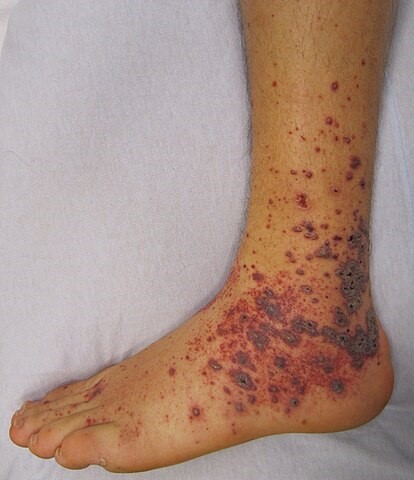
Einige dunkelrote oder violette Ausschläge, die bei Druck nicht verblassen, werden Purpura genannt.
Häufige Ursachen für Hautausschläge sind Infektionen, allergische Reaktionen und bestimmte medizinische Zustände.
Juckende Hautausschläge können durch trockene Haut, Ekzeme oder Psoriasis verursacht werden.
Suchen Sie umgehend ärztlichen Rat, wenn ein Ausschlag nicht schnell verschwindet, wenn Sie sich unwohl fühlen oder wenn er bei Druck nicht verblasst.
This leaflet is a guide but if you have any concerns, you must seek urgent clinical assessment if:
The rash doesn't quickly disappear.
Sie sich unwohl fühlen.
The rash does not fade with pressure (the best way to test this is to press a glass gently against the rash to see if it fades).
How are skin rashes described?
Skin rashes can be described in the following way:
Redness of the skin (called erythema).
Flat abnormally coloured areas of skin (called macules). Macules are often either red, dark red or purple, brown or white.
Solid raised areas which are up to half a centimetre across (called papules).
Solid raised areas which are more than half a centimetre across (called Knoten).
Areas of red raised skin (called plaques) and scales, which have a flaky silvery-white appearance.
Reddish-purple lesions which do not fade with pressure (called Purpura):
If less than one centimetre across then these are called Petechien.
If more than one centimetre across then they are called ecchymoses.
Blisters: these are swellings of the skin containing fluid:
If a blister is less than half a centimetre across then it is called a vesicle. If filled with yellow fluid (pus) then it is called a pustule.
If a blister is larger than half a centimetre across it is called a bulla (plural is bullae).
What skin conditions cause itching?
Skin disorders that can cause itching include (please click the links to separate leaflets which provide further information):
Trockene Haut.
What causes skin rashes?
Please click the links to separate leaflets which provide further information:
Red (erythema) but not scaly skin rash
A skin infection called Zellulitis.
An allergic reaction called Urtikaria.
Reaction to a medicine you are taking.
Virale Ausschläge - eg, Masern oder rubella (German measles).
Vasculitis. This is a condition involving inflammation of blood vessels, which may occur with various illnesses, including rheumatoide Arthritis.
Erythema nodosum. This is a condition which causes red rounded lumps (nodules), most commonly on the shins.
Redness on the palms of your hands may be caused by liver disease, pregnancy or an überaktive Schilddrüse (Hyperthyreose).
A red rash may occasionally be due to an inflammatory condition called systemischer Lupus erythematodes, especially if it is on the cheeks.
Red (erythema) and scaly skin rash
Psoriasis. This is a condition where there is inflammation of the skin.
Ekzem. This is sometimes called dermatitis and also involves inflammation of the skin. It may be caused by an allergy and is then called atopic dermatitis/eczema. This may happen in response to some plants - eg, poison oak or ivy.
Seborrhoische Dermatitis (in adults). This is a type of skin rash sometimes called seborrhoeic eczema. In babies it is known as cradle cap.
Fungal (or 'yeast') skin infection, such as Fußpilz, groin infection (tinea cruris), ringworm, scalp ringworm or infection with candida.
Röschenflechte. This condition is described as 'self-limiting' and the rash will clear itself naturally.
Kleienpilzflechte. This is a rash which is caused by a yeast-like germ.
Lichen planus. This condition mainly affects the skin and causes an itchy rash.
Macules
Red macules may be due to a reaction to a medicine or a viral rash - wie zum Beispiel Masern oder Röteln - as well as other causes.
A brown macule may be a mole but check with your doctor if a mole changes or you are concerned it might be a Melanom.
A white macule may be due to a condition which causes pale patches of skin (called Vitiligo) or a skin complaint with flaky discoloured areas (called pityriasis versicolor).
If a macule is dark red or purple and does not fade when you put pressure on it then it is a purpura (see below) and you need to see a doctor urgently. This is because it could be a sign of Meningitis or blood infection (Septikämie).
Papules
Common causes of papules include Akne, viral wart, seborrhoeic wart, molluscum contagiosum, scabies, Insektenstichen and skin tags.
Other causes include Psoriasis.
Purpura and petechiae
These are dark red or purple and don't fade when you press them. You need to see a doctor urgently because there may be a serious cause that needs urgent treatment, such as meningococcal infection.
However, common causes include injury to the skin or repeated coughing. More serious common causes include liver disease such as Leberzirrhose.
Less common causes include vasculitis (eg, Henoch-Schönlein-Purpura) or a low level of platelets in your blood (eg, thrombotisch-thrombozytopenische Purpura).
Vaskulitis
Knoten
Common causes of a nodule include a Talgzyste, Lipom, Hautkrebs, or a wart.
Other causes include rheumatoid nodules (associated with rheumatoide Arthritis) and Heberden's nodes (associated with Osteoarthritis).
Blisters
Skin inflammation, including reactions to medicines, Kontaktdermatitis, eczema. Eczema on your legs may be caused by varicose veins (Krampfaderneurodermitis).
Diseases of your immune system - eg, bullous pemphigoid.
Viral infections - eg, Windpocken, Hand-Fuß-Mund-Krankheit.
Skin infection: a germ (bacterial) infection with Impetigo or viral infection with herpes simplex (Fieberbläschen oder Genitalherpes) or with herpes zoster (shingles).
Seltener Ursachen sind pemphigus und pemphigoid.
Pustules
Skin infection by a virus (eg, Fieberbläschen due to herpes simplex virus) or bacterial germs (Impetigo).
Inflammation - eg Psoriasis.
Pustular skin reaction to medicine you are taking.
Pustules on your face may be acne or rosacea.
Geschwüre
Ulcers may be due to venous leg ulcers, pressure ulcers, diabetes skin ulcers oder cancerous (malignant) skin ulcers.
This leaflet is a guide but if you have any concerns, you must telephone or see your GP, especially if:
The rash doesn't quickly disappear.
Sie sich unwohl fühlen.
The rash does not fade with pressure (the best way to test this is to press a glass gently against the rash to see if it fades).
You are not sure what has caused the rash or have any other concerns.
Patientenauswahl für Hautausschläge
Haut-, Nagel- und Haargesundheit
Nesselsucht
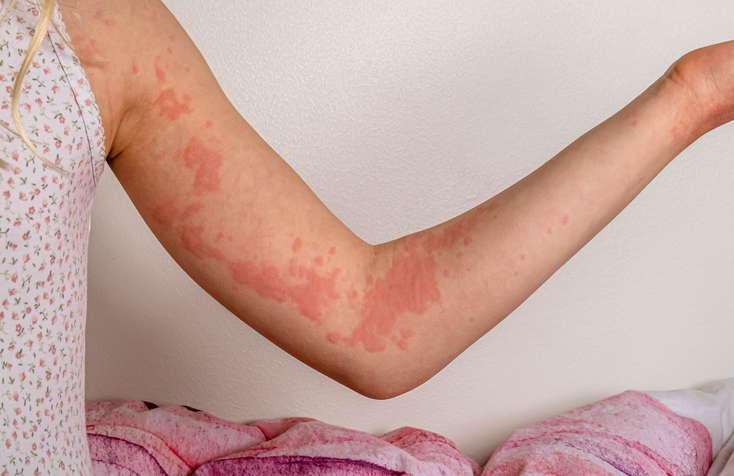
Nesselsucht (auch Urtikaria genannt) sind juckende rote oder weiße Beulen auf der Haut, die wie eine Brennnesselreaktion aussehen. Nesselsucht ist häufig und wird oft durch eine allergische Reaktion, Stress, Infektionen oder bestimmte Medikamente verursacht. Die meisten Nesselsuchterscheinungen bessern sich innerhalb weniger Tage von selbst. Dieses Informationsblatt erläutert die Ursachen, Arten und Behandlung von Nesselsucht.
von Dr. Philippa Vincent, MRCGP

Haut-, Nagel- und Haargesundheit
Rosazea
Rosazea ist eine Hauterkrankung, die Teile Ihres Gesichts betrifft. Die Symptome können Gesichtsrötung, Hautrötung, Pickel, Verdickung der Haut und Augenprobleme wie trockene Augen und gereizte Lidern sein. Nicht alle Symptome treten bei jedem Fall auf. Rosazea betrifft etwa 1 von 20 Menschen im Vereinigten Königreich, meist im mittleren Alter. Viele Fälle sind mild. Pickel können in der Regel mit Antibiotika behandelt werden. Für andere Symptome können weitere Behandlungen eingesetzt werden. Eine Komplikation, die die Vorderseite des Auges (die Hornhaut) betrifft, ist selten, aber ernst. Suchen Sie umgehend einen Arzt auf, wenn Sie Rosazea haben und Augenschmerzen oder Sehstörungen entwickeln.
von Dr. Rosalyn Adleman, MRCGP
Häufig gestellte Fragen
Was ist der Unterschied zwischen einer dunkelroten oder violetten Makula und Purpura?
Ein dunkelroter oder violetter Fleck ist ein flacher, abnormal gefärbter Hautbereich. Wenn er bei Druck nicht verblasst, wird er als Purpura klassifiziert. Purpura weist auf eine potenzielle Ernsthaftigkeit hin, wie Meningitis oder Blutinfektion, und erfordert dringend medizinische Aufmerksamkeit.
Können Ausschläge auf den Handflächen auf eine ernsthafte Erkrankung hinweisen?
Ja, Rötungen auf den Handflächen können ein Anzeichen für bestimmte zugrunde liegende Gesundheitsprobleme wie Lebererkrankungen, Schwangerschaft oder eine überaktive Schilddrüse (Hyperthyreose) sein. Wenn Sie dies bemerken, ist es wichtig, einen Arzt zu konsultieren.
Was ist der Unterschied zwischen einer Vesikel, einer Pustel und einer Bulla?
Diese Begriffe beschreiben alle Blasen, die Schwellungen der Haut sind, die Flüssigkeit enthalten. Ein Vesikel ist eine kleine Blase, weniger als einen halben Zentimeter groß. Wenn diese kleine Blase mit gelber Flüssigkeit (Eiter) gefüllt ist, wird sie Pustel genannt. Eine Bulla ist eine größere Blase, mehr als einen halben Zentimeter groß.
Was genau ist ein 'selbstlimitierender' Ausschlag wie Pityriasis rosea?
Ein 'selbstlimitierender' Ausschlag, wie zum Beispiel Pityriasis rosea, bedeutet, dass der Ausschlag von selbst auf natürliche Weise ohne spezifische medizinische Behandlung abheilt. Er verschwindet im Laufe der Zeit ohne Eingreifen.
Sind alle braunen Flecken eine Art Muttermal?
Während ein brauner Fleck ein Muttermal sein kann, ist es wichtig zu wissen, dass nicht alle braunen Flecken Muttermale sind. Sie sollten Ihren Arzt aufsuchen, wenn sich ein Muttermal in seinem Aussehen verändert oder wenn Sie Bedenken haben, dass es sich um ein Melanom handeln könnte, eine Art von Hautkrebs.
Wann sollte ich besorgt sein, wenn ein Fleck dunkelrot oder lila ist?
Wenn eine Makula dunkelrot oder violett ist und bei Druck nicht verblasst, wird sie als Purpura bezeichnet. In diesem Fall sollten Sie dringend einen Arzt aufsuchen, da dies auf ernsthafte Erkrankungen wie Meningitis oder eine Blutinfektion (Septikämie) hinweisen könnte.
Weiterführende Lektüre und Referenzen
- Bilder von Hautausschlägen bei Meningokokkeninfektionen; DermNet NZ
- DermIS – Dermatologisches Informationssystem
- Windelausschlag; NICE CKS, Oktober 2023 (nur für UK-Zugang)
Über den AutorVollständige Biografie anzeigen
Aktualisiert von

Dr Hayley Willacy, FRCGP
Allgemeinmediziner, Medizinischer Autor
MBChB (1992), DRCOG, DFFP, MRCOG (Part 1) MRCGP (2007), DFSRH (2013), MSc - medical education (2020)
Dr. Hayley Willacy war eine NHS-Hausärztin, die in Nordwestengland arbeitete und 2022 nach 30 Jahren aus der klinischen Praxis ausschied.
Über den RezensentenVollständige Biografie anzeigen

Dr Colin Tidy, MRCGP
Allgemeinmediziner, Medizinischer Autor
MBBS, MRCGP, MRCP (Paediatrics), DCH
Dr. Colin Tidy ist ein NHS-Arzt mit Sitz in Oxfordshire.
Artikelverlauf
Artikel auch verfügbar in Englisch, Deutsch, Spanisch, Französisch, Italienisch, Portugiesisch, Hindi, Hebräisch, Arabisch, und Schwedisch.
Nächste Überprüfung fällig: 12. Feb 2029
14. Feb 2024 | Neueste Version
Nehmen Sie an der Diskussion teil
Teilen Sie Ihre Gedanken oder Erfahrungen mit anderen in unserem Patientengemeinschaften.

Fragen, teilen, verbinden.
Durchsuchen Sie Diskussionen, stellen Sie Fragen und teilen Sie Erfahrungen zu Hunderten von Gesundheitsthemen.

Fühlen Sie sich unwohl?
Bewerten Sie Ihre Symptome online kostenlos
Abonnieren Sie den Patienten-Newsletter
Ihre wöchentliche Dosis klarer, vertrauenswürdiger Gesundheitsberatung - geschrieben, um Ihnen zu helfen, sich informiert, selbstbewusst und in Kontrolle zu fühlen.
Durch das Abonnieren akzeptieren Sie unsere Datenschutzrichtlinie. Sie können sich jederzeit abmelden. Wir verkaufen Ihre Daten niemals.