Periorale Dermatitis
Fachlich geprüft von Dr Toni Hazell, FRCGPZuletzt aktualisiert von Dr Doug McKechnie, MRCGPZuletzt aktualisiert 4 Aug 2024
Erfüllt die Anforderungen des Patienten für redaktionelle Inhalte
- HerunterladenHerunterladen
- Teilen
- Language
- Diskussion
- Audio-Version
- Zu bevorzugten Quellen bei Google hinzufügen
Periorale Dermatitis ist ein häufiges Hautausschlag. Perioral bedeutet „um den Mund“ und Dermatitis bezieht sich auf eine Entzündung der Haut. Dieses Faltblatt erläutert mögliche Ursachen, Symptome und die Behandlung der perioralen Dermatitis.
Auf einen Blick
Perioral dermatitis is a skin rash around the mouth, which can also affect the skin around the eyes and nose.
It typically appears as small red or pink lumpy spots that can resemble acne or eczema.
The exact cause is unclear, but triggers can include steroid creams, make-up, and strong winds.
It mainly affects young women between 15 and 45 years old.
Treatment involves stopping all facial creams and cosmetics, especially topical steroids.
Antibiotic creams or oral antibiotics are often used to treat the condition.
See a doctor if the rash does not settle or looks very inflamed.
What is perioral dermatitis?
Perioral dermatitis is a skin disorder that presents as a rash around the mouth - the word 'perioral' meaning 'around the mouth', and 'dermatitis' meaning 'inflammation of the skin'. Less commonly, it can affect the skin around the eyes and nose, which is sometimes called periorificial dermatitis. It is a type of dermatitis on the face only.
What does perioral dermatitis look like?
Typically, small red or pink lumpy spots develop on the skin anywhere around the outside of the mouth. These bumps around the mouth can resemble acne spots but perioral dermatitis is not acne. They can also look like eczema around the mouth, or a rash next to the mouth.
The skin under and next to each spot is often red or pink. If there are a lot of spots next to each other then the area of affected skin can just look red and lumpy. Sometimes the skin surface can become dry and flaky.
Periorale Dermatitis
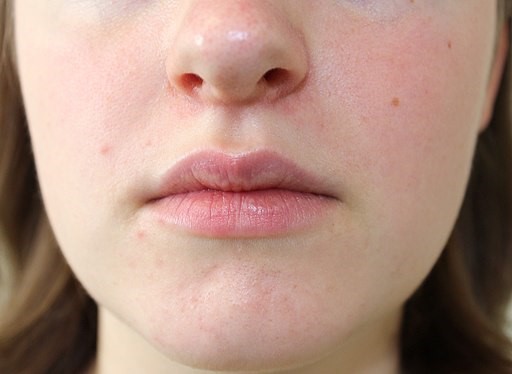
© Johannes Köhler, CC BY-SA 4.0, via Wikimedia Commons
The skin just next to the lips is often not affected, or is affected much less than, the skin just a little further away from the lips. In some cases it can look as though the rash almost forms a ring around the mouth, sparing a small border of skin next to the lips. Occasionally, the skin around the eyes is also affected.
The severity of the rash can vary from a few minor spots that are barely noticeable, to a definite and obvious lumpy rash that is around the mouth. The rash is not usually painful or itchy. However, some people report a mild burning sensation or itchy feeling. Others report that the affected skin feels tense. The rash is not serious and is not associated with any underlying disease. However, it can be unsightly.
What causes perioral dermatitis?
The exact cause is not clear. However, in many cases the rash seems to be triggered by one or more of the following:
Steroid creams and ointments are a main trigger. See below for details.
Make-up, cleansers and cosmetics applied to the area affected on the face. It may be that certain ingredients of cosmetics may act as the trigger. For example, one study found that make-up foundation seemed to be a particular provoking factor.
Physical factors such as strong winds and UV light.
Fluoridated toothpaste and chewing gum have been suggested as possible triggers.
Yeasts and germs (bacteria) that live on the skin and in hair follicles have been suggested as a possible trigger. (However, perioral dermatitis is not just a simple skin infection.)
Hormone factors may play a part, as some women find that the rash becomes worse just before a period.
Der Antibabypille may be a factor in some cases.
Recently, a study has found that some sun creams used on the face may be a trigger for perioral dermatitis in some children and adults. A liquid, gel or light milk sunscreen may be the best to use.
Lip-licking dermatitis
Lip-licking dermatitis is very similar to peri-oral dermatitis but tends not to spare any skin next to the lips so spreads out directly from the lips. It is more common in children, particularly those who habitually lick their lips. The mainstay of treatment is to avoid licking the lips and using bland lip balms such as Vaseline® to cover the skin. However, topical steroids can be used in lip-licking dermatitis and do have some benefit at times.
Lip-licking dermatitis
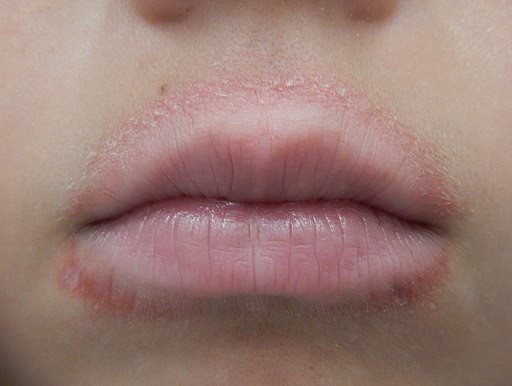
© James Heilman, MD, CC BY-SA 4.0, über Wikimedia Commons
Who gets perioral dermatitis?
There are a number of risk factors for perioral dermatitis. Almost all cases occur in young women, most commonly between the ages of 15 and 45 years. It is thought to affect up to 1 in 100 women at some point in their lives. Perioral dermatitis is uncommon in men and children (although lip-licking dermatitis is much more common in children). However, as the number of men using facial skin products increases, the number of men with perioral dermatitis is increasing.
Is perioral dermatitis contagious?
No. Perioral dermatitis is not contagious.
Perioral dermatitis caused by steroid cream
Steroidencreme
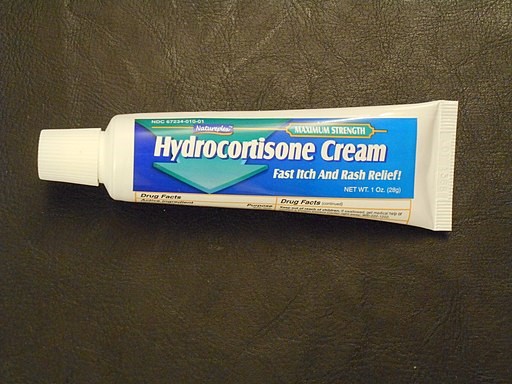
© Father Goose, CC BY-SA 4.0, via Wikimedia Commons
Verwendung eines topisches Steroid (steroid creams, gels, ointments, etc) on the face can cause people to develop perioral dermatitis. Many cases develop soon after using a topical steroid on the face for another condition, such as mild Ekzem.
It is also possible to rub some steroid onto the face without realising it - for example, after using steroid creams on another part of the body and then rubbing or scratching the face before washing the hands.
Topical steroids can temporarily clear a mild patch of perioral dermatitis. Some people will have tried a steroid cream, which can be bought at pharmacies, to treat what they think is mild eczema. However, as soon as the rash clears and the steroid is stopped, the rash reappears, only even worse. This can become a vicious cycle where more steroid cream is used to try to clear the new rash, which may clear again and then recur so the cream is started again. The rash tends to get worse each time.
How is perioral dermatitis diagnosed?
Diagnosing perioral dermatitis can usually be done by a doctor looking at its appearance. There is not much else that looks like it but there are a few other conditions it can be mistaken for:
Lip-licking dermatitis.
Tests are usually not needed unless perioral dermatitis does not improve with treatment. If it is not improving or has unusual features, a referral to a dermatology specialist may be made who may consider other tests such as a skin biopsy.
Perioral dermatitis treatment
Without perioral dermatitis treatment, the condition may last for months or years. The following treatments can usually help to clear the rash. However, it may take some time for the treatment to work.
Stop using anything on your face
It is usually advised to stop using any cream, ointment, cosmetic, etc, on the face. It is particularly important to stop using any topical steroid - if one has been used then the rash will worsen for several days before it gets any better. There is nothing that can be done to help this. Whilst the rash is present, wash your face with warm water only. There is some evidence that toothpastes containing fluoride can make perioral dermatitis worse so these should be avoided too.
If using topical steroids on another part of the body or applying them to a child, it is important to wash hands thoroughly after using them to prevent perioral dermatitis.
Even when the rash has gone, it is better to try to avoid cosmetics or creams on the affected area as the rash can reappear. Using mild skincare products such as a fragrance free cleanser to wash the face, rather than soap, is also advised.
Antibiotika
In mild perioral dermatitis, topical antibiotics (antibiotics in a cream applied to the skin), such as Metronidazol oder clindamycin, might be advised as part of the treatment plan.
Usually oral antibiotics, in the tetracycline group, are needed. The course of treatment is usually for six to twelve weeks and it may take several weeks to notice the benefit. Most cases do start to improve within two months of starting treatment so it is important to persevere.
The way antibiotics work in this condition is not clear. It is not a simple skin infection. However, tetracyclines and some other antibiotics have an action to reduce inflammation in addition to killing germs (bacteria) and this may be why they work.
Other treatment
Other perioral dermatitis treatment is sometimes used. This includes pimecrolimus cream. This cream works to reduce skin inflammation. It seems to be particularly effective in perioral dermatitis that has been caused by using topical steroids.
Wann sollten Sie einen Arzt aufsuchen?
Where there is a suspicion of perioral dermatitis all ointments and creams on the face should be stopped. This alone may improve the condition. However, it's best to see a GP or other clinician in the practice to make a diagnosis of the condition if it does not settle or is very angry-looking.
Patientenauswahl für Mundpflege und Probleme

Mund- und Zahnpflege
Fieberbläschen
Et etwa 1 von 5 Menschen im Vereinigten Königreich leidet wiederkehrend an Herpesbläschen. Herpesbläschen heilen in der Regel innerhalb von 7-10 Tagen von selbst ohne Behandlung ab. Antivirale Cremes können helfen, die Schwere der Herpesbläschen-Symptome zu verringern, und sie sind am wirksamsten, wenn sie frühzeitig angewendet werden, wenn sich ein Herpesbläschen zu entwickeln beginnt.
von Dr. Philippa Vincent, MRCGP

Mund- und Zahnpflege
Mundsoor
Mundsoor ist eine Infektion im Mund, die durch einen Hefepilz namens Candida verursacht wird. Sie ist in der Regel nicht ernst und kann normalerweise leicht mit einer Behandlung beseitigt werden.
von Dr. Philippa Vincent, MRCGP
Häufig gestellte Fragen
Can perioral dermatitis spread to other parts of the body?
Perioral dermatitis is a type of dermatitis that occurs only on the face, typically around the mouth. Less commonly, it can affect the skin around the eyes and nose. It does not spread to other parts of the body.
How long does perioral dermatitis usually last without treatment?
Without treatment, perioral dermatitis can last for months or even years. However, specific treatments can usually help to clear the rash, although it may take some time for them to work effectively.
If cosmetic products trigger my perioral dermatitis, what kind of products should I use?
If cosmetics are a trigger, it's generally advised to stop using any creams, ointments, or cosmetics on the face. After the rash has cleared, it's better to avoid applying products to the affected area, as the rash can reappear. When using skincare products, opt for mild, fragrance-free cleansers instead of soap to wash your face.
Does lip-licking dermatitis always spare the skin next to the lips like perioral dermatitis?
No, lip-licking dermatitis differs from perioral dermatitis in this aspect. Lip-licking dermatitis tends not to spare any skin directly next to the lips and spreads out from the lips, whereas perioral dermatitis often leaves a small border of skin next to the lips unaffected.
Why are antibiotics used to treat perioral dermatitis if it's not simply a skin infection?
The exact way antibiotics work in perioral dermatitis is not entirely clear, as it is not considered a simple skin infection. However, antibiotics like tetracyclines have properties that reduce inflammation in addition to killing bacteria, and this anti-inflammatory action is thought to be why they are effective in treating the condition.
Weiterführende Literatur und Referenzen
- Periorale Dermatitis; DermNet NZ
- Perioral Dermatitis; Gesellschaft für Dermatologie in der Primärversorgung
- Hall CS, Reichenberg J; Evidence based review of perioral dermatitis therapy. G Ital Dermatol Venereol. 2010 Aug;145(4):433-44.
- Perioral Dermatitis; DermIS (Dermatologisches Informationssystem)
- Tolaymat L, Hall MR; Perioral Dermatitis. StatPearls Publishing LLC; Last update: September 12,2020.
- Lip Licker's Dermatitis; DermNet
Über den AutorVollständige Biografie anzeigen

Dr Doug McKechnie, MRCGP
Medizinischer Autor
MA, MBBS, MSc, DRCOG, MRCP(UK), MRCGP(2021), FHEA
Dr. Doug McKechnie ist ein NHS-Hausarzt, der in London arbeitet. Er arbeitet klinisch in Vollzeit und ist außerdem stellvertretender Leiter des Moduls für klinische und berufliche Praxis an der University College London Medical School.
Über den RezensentenVollständige Biografie anzeigen

Dr Toni Hazell, FRCGP
MBBS, BSc, FRCGP, DFSRH, Dip GU med, DRCOG, DCH (London, UK, 2000)
Dr. Toni Hazell hat ihren Abschluss an der St. Mary’s Hospital Medical School gemacht und ihr VTS am Northwick Park Hospital absolviert.
Artikelverlauf
Die Informationen auf dieser Seite wurden von qualifizierten Klinikern verfasst und begutachtet.
Artikel auch verfügbar in Englisch, Deutsch, Spanisch, Französisch, Italienisch, Portugiesisch, Hindi, Hebräisch, Arabisch, und Schwedisch.
Nächste Überprüfung fällig: 3. Aug. 2027
4 Aug 2024 | Neueste Version

Fragen, teilen, verbinden.
Durchsuchen Sie Diskussionen, stellen Sie Fragen und teilen Sie Erfahrungen zu Hunderten von Gesundheitsthemen.

Fühlen Sie sich unwohl?
Bewerten Sie Ihre Symptome online kostenlos
Abonnieren Sie den Patienten-Newsletter
Ihre wöchentliche Dosis klarer, vertrauenswürdiger Gesundheitsberatung - geschrieben, um Ihnen zu helfen, sich informiert, selbstbewusst und in Kontrolle zu fühlen.
Durch das Abonnieren akzeptieren Sie unsere Datenschutzrichtlinie. Sie können sich jederzeit abmelden. Wir verkaufen Ihre Daten niemals.