Verklemmter Penis
Begutachtet von Patienten-Kliniker-TeamZuletzt aktualisiert von Dr. Richard Draper, MRCGPZuletzt aktualisiert 18. März 2011
Erfüllt die redaktionelle Richtlinien
- HerunterladenHerunterladen
- Teilen
- Language
- Diskussion
- Ask Patient
- Audio-Version
- Zu bevorzugten Quellen bei Google hinzufügen
Hinweis zum Inhalt
Diese Seite wurde in letzter Zeit nicht überprüft. Daher haben sich möglicherweise einige Informationen oder externe Links geändert.
Medizinische Fachkräfte
Fachartikel sind für die Nutzung durch Gesundheitsfachkräfte konzipiert. Sie werden von britischen Ärzten verfasst und basieren auf Forschungsergebnissen, britischen und europäischen Richtlinien. Möglicherweise finden Sie einen unserer Gesundheitsartikel nützlicher.
Beschreibung
An area of skin, often of the penis or neck, becomes painfully trapped in a zipper mechanism. Unzipping the zipper will lacerate the skin and cause further damage.
Epidemiologie
This condition is relatively rarely seen, but is the most common cause of prepuce injuries in children. In one study, only 6 boys were seen over a period of 3 years.1In another, there was only one case of zip entrapment in 4,068 new patient attendances.2
Behandlung
Various options can be tried, some more invasive than others. It is usually necessary to dismantle the zip. If the skin trapped is minor and recent, dismantling the zip from below will sometimes work. If this is not successful then a technique to release the pressure between the zip plates will free the trapped skin. The options include the following:
It may be possible to dismantle the zip. If the median bar at the front of the moveable zip head is cut in half, the zipper falls apart freeing the skin relatively painlessly. Use bone cutter or wire clippers for this. Considerable force may be needed.
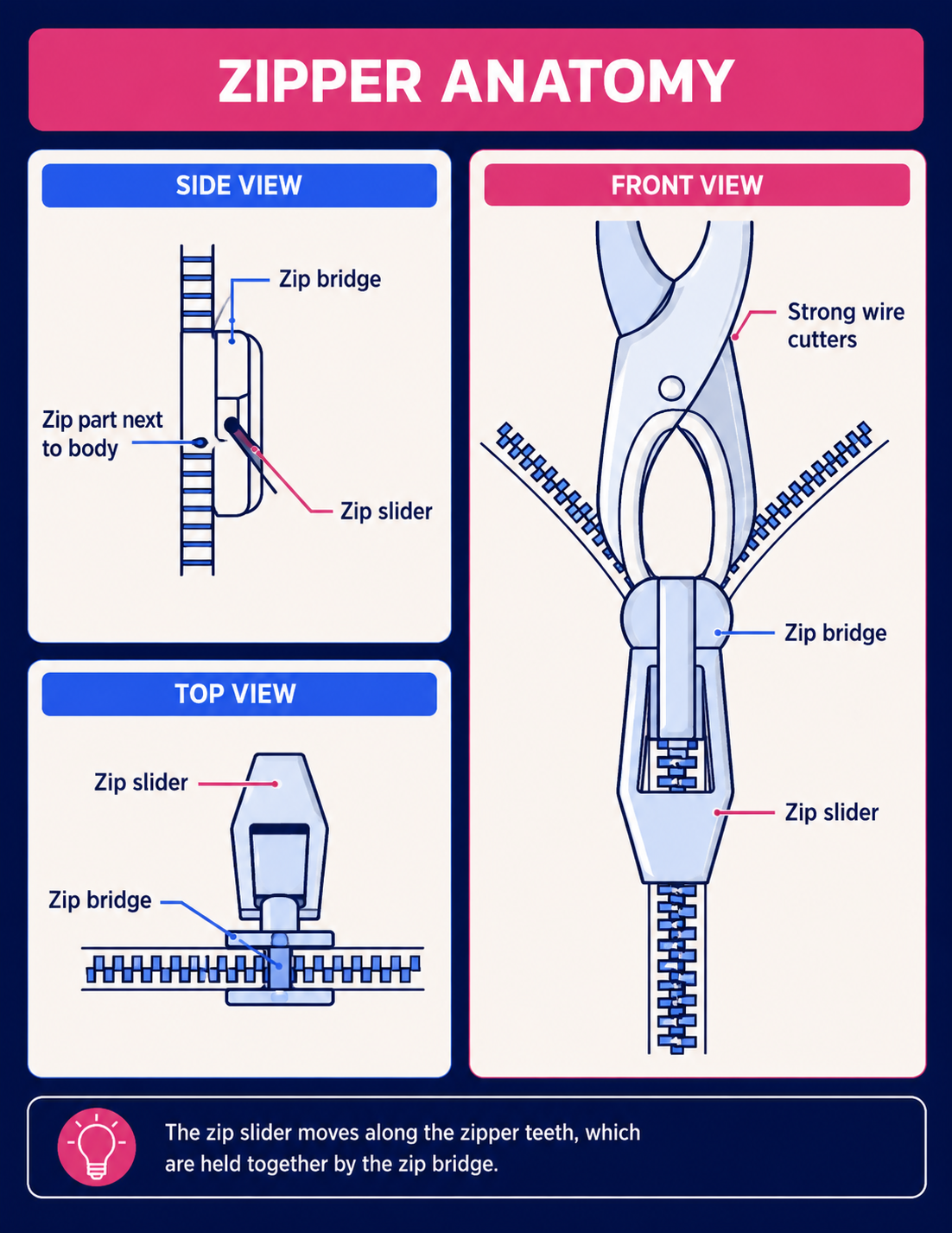
Lateral compression of the zip, using pliers, sometimes frees the prepuce.3
Cutting the teeth of the closed zipper is sometimes effective.4
The thin blade of a small screwdriver can be inserted between the outer and inner faceplates of the zip fastener and a twisting movement made toward the median bar. This will widen the gap between faceplates and may help to disengage the prepuce.5
If all else fails, the skin should be anaesthetised and the area of zipper and entrapped tissue should be excised. Mineral oil is sometimes used in these circumstances to lubricate the area and minimise trauma.6
Consider plastic surgical follow-up if the skin damage is significant.
Exklusive Updates für medizinisches Fachpersonal
Bleiben Sie informiert mit den neuesten klinischen Updates, professionellen Einblicken und evidenzbasierten Leitlinien. Der Patient Pro-Newsletter stellt wesentliche Inhalte für Gesundheitsfachkräfte zusammen – direkt in Ihren Posteingang geliefert.
Durch das Abonnieren akzeptieren Sie unsere Datenschutzrichtlinie. Sie können sich jederzeit abmelden. Wir verkaufen Ihre Daten niemals.
Weiterführende Lektüre und Referenzen
- Yip A, Ng SK, Wong WC, et al; Injury to the prepuce. Br J Urol. 1989 May;63(5):535-8.
- Wyatt JP, Scobie WG; The management of penile zip entrapment in children. Injury. 1994 Jan;25(1):59-60.
- Mishra SC; Safe and painless manipulation of penile zipper entrapment. Indian Pediatr. 2006 Mar;43(3):252-4.
- Inoue N, Crook SC, Yamamoto LG; Comparing 2 methods of emergent zipper release. Am J Emerg Med. 2005 Jul;23(4):480-2.
- Raveenthiran V; Releasing of zipper-entrapped foreskin: a novel nonsurgical technique. Pediatr Emerg Care. 2007 Jul;23(7):463-4.
- Mydlo JH; Treatment of a delayed zipper injury. Urol Int. 2000;64(1):45-6.
Über den AutorVollständige Biografie anzeigen
Aktualisiert von

Dr Richard Draper, MRCGP
Allgemeinmediziner, Medizinischer Autor
MB, ChB, DCH, DRCOG, MRCGP, DA (UK)
Dr. Richard Draper hat 1981 seinen Abschluss gemacht und 24 Jahre in der Allgemeinmedizin gearbeitet, derzeit als GP-Partner in der Oxshott Medical Practice, Oxshott Surrey.
Über den RezensentenVollständige Biografie anzeigen

Patienten-Klinik-Team
Das Patient.info-Klinikteam erstellt und überprüft unsere Gesundheitsinhalte, um sicherzustellen, dass sie genau, evidenzbasiert und von den vertrauenswürdigen Standards des NHS und NICE geleitet sind.
Artikelverlauf
Artikel auch verfügbar in Englisch, Deutsch, Spanisch, Französisch, Italienisch, Portugiesisch, Hindi, Hebräisch, Arabisch, und Schwedisch.
18. März 2011 | Neueste Version
Einfacher Zugang zu vertrauenswürdigen Behandlungen und Gesundheitsdiensten online.
Common conditions
Get help with common conditions through the NHS, without a GP appointment.





Mehr in Notfallmedizin und Trauma
- Aspirationspneumonie
- Bluttransfusionsreaktionen
- Herzbeuteltamponade
- Chlorgas
- Schlüsselbeinbruch
- Epilepsie bei Erwachsenen
- Nahrungsmittelallergie und Nahrungsmittelunverträglichkeit
- Pilzinfektionen der Lunge
- Hyperthyreote Krise
- Kniefrakturen und -luxationen
- Mollaret-Meningitis
- Musculocutaneus-Nervenläsion
- Berufsasthma
- Herzschrittmacher und Schrittmachertherapie
- Präklinische Analgesie
- Serotonin-Syndrom
- Sichelzellenkrankheit und Sichelzellenanämie
- Ventrikuläre Tachykardien
- Wolff-Parkinson-White-Syndrom