Furunkel im Gehörgang
Begutachtet von Dr Colin Tidy, MRCGPZuletzt aktualisiert von Dr Doug McKechnie, MRCGPZuletzt aktualisiert 19. Dez 2024
Erfüllt die Anforderungen des Patienten Richtlinien des Patienten
- HerunterladenHerunterladen
- Teilen
- Language
- Diskussion
- Audio-Version
- Zu bevorzugten Quellen bei Google hinzufügen
In dieser Serie:OhrenschmerzenEustachische-Röhren-DysfunktionMittelohrentzündung (Otitis media)Entzündung des äußeren Ohrs (Otitis externa)Pilzinfektion im OhrBarotrauma des Ohrs
A small boil (furuncle) that occurs in the ear canal can be very painful. It usually clears without treatment. However, painkillers and antibiotic medicines are sometimes needed. Tips on how to help prevent further episodes are given below.
Auf einen Blick
A boil in the ear canal can cause pain, itching, irritation, and temporary hearing loss.
Ear canal boils can develop if the skin inside the ear is damaged, for instance by poking it.
Painkillers and hot flannels can help with discomfort.
Most ear canal boils clear up naturally without specific treatment.
See a doctor if the boil is severe, does not clear up, or becomes very large.
Avoid poking or cleaning your ear canal with cotton buds, fingers, or towels.
Keep the ear canal dry, especially if your ears are sensitive to infection.
Symptoms of a boil in the ear canal
Furunkel im Gehörgang
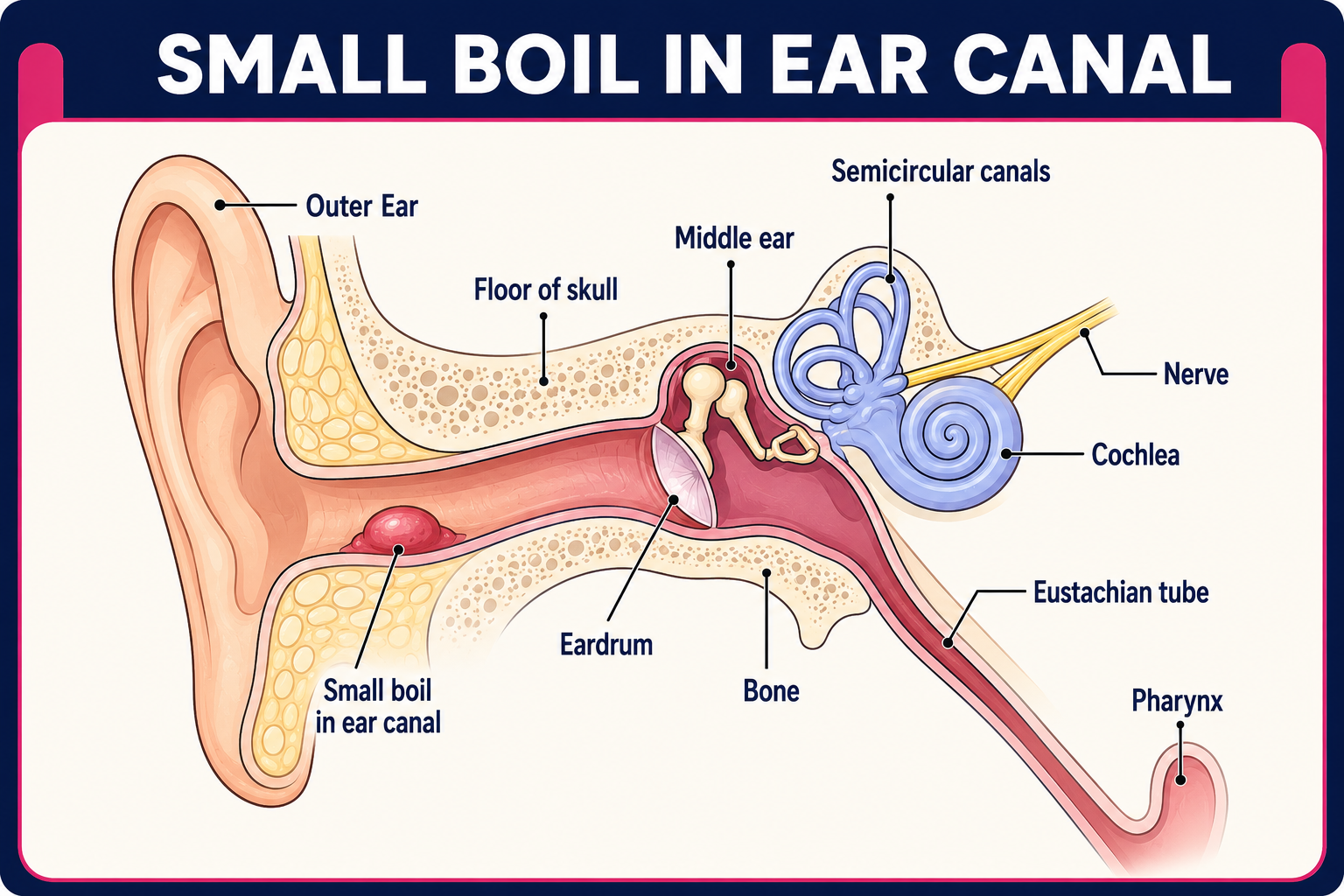
A boil in the ear canal can cause:
Pain that may become quite severe even though the boil is usually small.
Itch and skin irritation.
Temporary hearing loss.
Sudden discharge from the hear if the boil has bursts.
What causes a boil in the ear canal?
Was passiert, wenn sich Furunkel im Gehörgang bilden?
Mostly they occur 'out of the blue' for no apparent reason, like most spots or small boils that can occur on any area of the skin. In some cases the infection develops on damaged skin. The skin in the ear canal can become damaged by being poked with such objects as a cotton wool bud. Slightly damaged skin can quickly become inflamed and infected.
What is the treatment for a boil in the ear canal?
Like most small spots or tiny boils, a furuncle is likely to go without any treatment. The body's immune system can usually clear germs (bacteria) that cause boils. However, the pain may be significant until it goes.
The following may be used as treatment:
Pchmerzmittel such as paracetamol or ibuprofen can be bought over the counter.
A cloth (flannel) soaked in hot water and then held against the ear may relieve the pain.
Antibiotics, wie zum Beispiel Flucloxacillin, are sometimes needed if the infection does not clear on its own or if the infection is severe.
Occasionally the boil becomes very large and painful. An ear specialist referral may be needed if this happens.
How to prevent infections in the ear canal
Some people find that substances such as water, soap or shampoo which gets into their ears can cause irritation or itch. The itch may cause them to poke or scratch the ear canal with a finger or a cotton wool bud. This may damage the skin in the ear canal and cause inflammation. Inflamed skin can quickly become infected.
Some people try to clean out their ears with cotton buds. This is not only unnecessary but may damage the skin in the ear canal.
Prevention of boils or infections in the ear canal can be helped by:
Trying not to scratch or poke the ear canal with fingers, cotton buds, towels, etc.
Not cleaning the ear canal with cotton buds. They may scratch or irritate and may push dirt and wax further into the ear. The ear will clean itself, and bits of wax will fall out now and then.
For particularly sensitive ears which get frequent infections: Keeping the ear canal dry and avoid soap or shampoo getting in. This can be done whilst showering by placing a piece of cotton wool coated in soft white paraffin (for example, Vaseline®) in the outer ear. It is best not to use corners of towels or cotton buds to dry any water that does get into the ear canal as this will only push things further in. It is best to let the ear dry naturally. When swimming it is best to try to keep the ears dry. This can be done by wearing a tightly fitting cap that covers the ears. Some swimmers use silicone rubber earplugs. Some earplugs can cause more irritation to the skin in the ear canal.
Patientenauswahl für Ohreninfektionen
/og.png)
Ohr, Nase und Hals
Entzündung des äußeren Ohrs (Otitis externa)
Otitis externa, häufiger bekannt als eine äußere Ohrenentzündung, ist eine Entzündung des Gehörgangs. Die Entzündung wird normalerweise durch eine Infektion verursacht, obwohl sie manchmal auch durch Allergien oder Reizungen entstehen kann. Die Behandlung mit Ohrentropfen ist in der Regel wirksam. Weitere Episoden der Erkrankung können oft durch die unten gegebenen Tipps verhindert werden. Otitis externa klingt normalerweise innerhalb einer Woche oder so ab. Wenn sie von kurzer Dauer ist, wird dies als 'akute Otitis externa' bezeichnet. Gelegentlich kann sie jedoch drei Monate oder länger anhalten - dies wird als 'chronische Otitis externa' bezeichnet.'
von Dr. Colin Tidy, MRCGP

Ohr, Nase und Hals
Vestibularneuritis und Labyrinthitis
Vestibularisneuritis und Labyrinthitis werden vermutlich durch eine Virusinfektion verursacht, die das Innenohr betrifft. Diese beiden Zustände führen typischerweise zu Schwindel, oft begleitet von Übelkeit (Erbrechen). Schwindel ist das Gefühl, dass Sie oder Ihre Umgebung sich bewegen. In den meisten Fällen lassen die Symptome allmählich nach und verschwinden innerhalb weniger Tage oder Wochen. Medikamente können helfen, die Symptome zu lindern.
von Dr. Surangi Mendis, MRCGP
Häufig gestellte Fragen
Can a boil in the ear canal affect my hearing permanently?
A boil in the ear canal can cause temporary hearing loss. However, the article does not suggest that this hearing loss would be permanent.
What should I do if a boil in my ear canal bursts?
If a boil in the ear canal bursts, you might experience a sudden discharge from the ear. The article does not give further specific instructions for this situation beyond its general advice on treatment and prevention for boils.
Can I prevent a boil if I feel my ear canal is becoming irritated?
If your ear canal feels irritated or itchy, try to avoid poking or scratching it with fingers, cotton buds, or towels. This can damage the skin and lead to inflammation, which might then become infected and cause a boil. Preventing irritation is key to preventing infection.
Are there any specific types of earplugs that are better for swimming to prevent ear canal irritation?
The article mentions that some swimmers use silicone rubber earplugs to keep ears dry, but also notes that some earplugs can cause more irritation to the skin in the ear canal. It doesn't specify particular brands or types that are less irritating.
How can I tell if my ear infection is severe enough to need antibiotics?
Antibiotics are sometimes needed if the infection does not clear on its own or if it is severe. The article doesn't detail specific signs of a severe infection that would definitely require antibiotics, but mentions that if the boil becomes very large and painful, an ear specialist referral might be needed, which could involve antibiotics.
Weiterführende Literatur und Referenzen
- Otitis externa; NICE CKS, Mai 2024 (nur Zugang in Großbritannien)
- Boils, carbuncles, and staphylococcal carriage; NICE CKS, Mai 2024 (nur Zugang in Großbritannien)
Über den AutorVollständige Biografie anzeigen

Dr Doug McKechnie, MRCGP
Medizinischer Autor
MA, MBBS, MSc, DRCOG, MRCP(UK), MRCGP(2021), FHEA
Dr. Doug McKechnie ist ein NHS-Hausarzt, der in London arbeitet. Er arbeitet klinisch in Vollzeit und ist außerdem stellvertretender Leiter des Moduls für klinische und berufliche Praxis an der University College London Medical School.
Über den RezensentenVollständige Biografie anzeigen

Dr Colin Tidy, MRCGP
Allgemeinmediziner, Medizinischer Autor
MBBS, MRCGP, MRCP (Paediatrics), DCH
Dr. Colin Tidy ist ein NHS-Arzt mit Sitz in Oxfordshire.
Artikelverlauf
Die Informationen auf dieser Seite wurden von qualifizierten Klinikern verfasst und begutachtet.
Artikel auch verfügbar in Englisch, Deutsch, Spanisch, Französisch, Italienisch, Portugiesisch, Hindi, Hebräisch, Arabisch, und Schwedisch.
Nächste Überprüfung fällig: 18. Dez. 2027
19. Dez 2024 | Neueste Version

Fragen, teilen, verbinden.
Durchsuchen Sie Diskussionen, stellen Sie Fragen und teilen Sie Erfahrungen zu Hunderten von Gesundheitsthemen.

Fühlen Sie sich unwohl?
Bewerten Sie Ihre Symptome online kostenlos
Abonnieren Sie den Patienten-Newsletter
Ihre wöchentliche Dosis klarer, vertrauenswürdiger Gesundheitsberatung - geschrieben, um Ihnen zu helfen, sich informiert, selbstbewusst und in Kontrolle zu fühlen.
Durch das Abonnieren akzeptieren Sie unsere Datenschutzrichtlinie. Sie können sich jederzeit abmelden. Wir verkaufen Ihre Daten niemals.
Mehr zu Ohr, Nase und Hals
- Akute Sinusitis
- Audiologie
- Barotrauma des Ohrs
- Abschwellende Mittel
- Ohren und Fliegen
- Eustachische-Röhren-Dysfunktion
- Pilzinfektion im Ohr
- Hörverlust bei älteren Menschen
- Hörtests
- Laryngitis
- Verlust von Geschmack und Geruch
- Menière-Krankheit
- Mittelohrentzündung (Otitis media)
- Nasenpolypen
- Nasenbluten
- Chronische Rhinitis
- Steroidhaltige Nasensprays
- Kehlkopfkrebs
- Mandelsteine
- Mandelentzündung