Eustachische-Röhren-Dysfunktion
Begutachtet von Dr Caroline Wiggins, MRCGP Zuletzt aktualisiert von Dr Toni Hazell, FRCGPZuletzt aktualisiert 30. März 2026
Entspricht den Richtlinien redaktionelle Richtlinien
- HerunterladenHerunterladen
- Teilen
- Language
- Diskussion
- Audio-Version
- Zu bevorzugten Quellen bei Google hinzufügen
In dieser Serie:OhrenschmerzenMittelohrentzündung (Otitis media)Entzündung des äußeren Ohrs (Otitis externa)Pilzinfektion im OhrFurunkel im GehörgangBarotrauma des Ohrs
Eine Eustachische-Röhren-Dysfunktion (ETD) kann zu gedämpftem Hören und einem Gefühl von Druck oder Fülle im betroffenen Ohr führen. Sie dauert normalerweise einige Wochen während und nach einer Erkältung an.
Wichtige Punkte
Eustachian tube dysfunction happens when the tube connecting the ear to the back of the nose does not open properly, causing pressure to build up in the ear.
Common symptoms include a feeling of fullness or pressure in the ear, muffled hearing, popping or crackling sounds, and sometimes discomfort or mild pain.
It can be caused by colds, sinus infections, or allergies, and often gets better on its own.
Home remedies and medicines such as decongestants and steroid nasal sprays or drops may be needed if symptoms don't improve.
Was ist die Eustachische Röhre?
The Eustachian tube is a narrow tube that connects the space behind the ear (the middle ear) with the back of the nose. In adults it is about 3-4 cm long. The middle ear is normally filled with air. A well-functioning Eustachian tube is closed most of the time, but opens when we swallow, yawn, or chew.
Was ist eine Eustachische-Röhren-Dysfunktion?
Eustachian tube dysfunction occurs when the Eustachian tube in the ear is blocked or does not open properly. It can affect one or both ears.
When the tube is blocked air cannot enter the middle ear, causing the air pressure on the outer side of the eardrum to become greater than the air pressure in the middle ear. This pushes the eardrum inwards.
The eardrum then becomes tense and cannot vibrate normally, leading to symptoms such as ear fullness, pain, discomfort, and muffled hearing.
Eustachische-Röhren-Dysfunktion
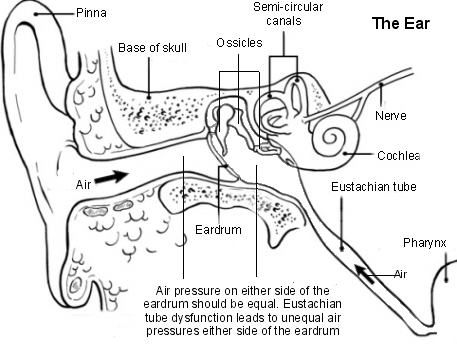
Types of Eustachian tube dysfunction
There are three types of Eustachian tube dysfunction, these are:
Obstructive - the Eustachian tube stays closed and doesn't open when it should. Sounds travel through the Eustachian tube to your middle ear and you therefore hear your voice too loudly, which can feel like an inner echo of your voice.
Baro-challenge induced - the Eustachian tube doesn't open when it should, but it only really affects you if you have a change in altitude, for example, when flying.
Patulous - the Eustachian tube stays open all the time. This is the least common type.
Symptoms of Eustachian tube dysfunction
The most common symptoms of ETD are:
Gedämpftes oder dumpfes Hören.
Ein Gefühl des Ploppens im Ohr.
Ohrdruck oder leichte Schmerzen.
Klingeln oder Summen im Ohr (Tinnitus).
Leicht Schwindel auftreten.
Some people may experience ear pain (earache) caused by the eardrum becoming tense and stretching. This pain may come and go; however Eustachian tube dysfunction rarely causes constant or severe ear pain.
Wie lange dauern die Symptome an?
Die Symptome können je nach Ursache nur wenige Stunden bis mehrere Wochen oder länger anhalten. In vielen Fällen ist die Ursache eine Erkältung, und die Symptome verschwinden wahrscheinlich innerhalb einer Woche oder so.
Während es sich verbessert, ist es üblich, Knallgeräusche im Ohr zu hören. Es ist auch üblich, dass das Gehör plötzlich wieder normal wird, dann aber wieder gedämpft wird, bevor es vollständig normal wird.
Was verursacht eine Eustachische-Röhren-Dysfunktion?
ETD happens if the Eustachian tube becomes blocked, if the lining of the tube swells, or if the tube does not open fully to allow air to travel into the middle ear.
Things that can cause the Eustachian tube to become blocked or swollen include:
Erkältung - this is the most common cause of ETD.
Ear, nose, throat or sinus infections.
Altitude change.
Rauchen.
Blockages - such as vergrößerte Adenoide bei Kindern.
Allergien.
Was verursacht eine langfristige Eustachische Röhrendysfunktion?
Some common causes of long-term (chronic) ETD are:
Chronische Sinusitis - up to half of people with chronic Eustachian tube dysfunction.
Raucherbedingte Veränderungen an Nase und Rachen.
Allergies - such as anhaltende Rhinitis und Heuschnupfen.
In around 1 in 5 people who have long-term Eustachian tube dysfunction, no cause is found. There is no evidence that there is a genetic cause and it does not appear to run in families. However, some conditions which cause ETD (such as glue ear) do run in families.
Diagnosing Eustachian tube dysfunction
If your symptoms have continued for more than six weeks you should see your doctor to make sure there is no underlying problem. This is especially important if your hearing is getting worse, particularly on one side.
You doctor might:
Examine your ears and also your throat and nose.
Suggest some of the treatments listed below - many cases of ETD can be managed by the GP, with no need for referral.
Refer you to an Ear, Nose and Throat (ENT) specialist.
Weitere Tests, die dann durchgeführt werden können, umfassen:
Tympanogramm, um die Druckverhältnisse hinter Ihrem Trommelfell zu testen.
Nasopharyngoskopie, bei dem eine kleine flexible Kamera verwendet wird, um die Rückseite Ihrer Nase (den Nasopharynx) zu betrachten und den Eingang der Eustachischen Röhre direkt zu sehen.
Treatment for Eustachian tube dysfunction
The treatment options for Eustachian tube dysfunction depends on how badly you are affected and what has caused it. In most cases no particular medical treatment is needed and the symptoms often soon go.
If treatment is needed it might include home remedies, medicines, or surgery.
Hausmittel
There are some things you can do get air to flow into the Eustachian tube, these are:
Swallowing, yawning, or chewing.
The Valsalva manoeuvre - take a breath in, then breathe out gently with your mouth closed and pinching your nose.
If you do this you may feel your ears go 'pop' as air is forced into the middle ear. This sometimes eases the problem. Occasionally doing this can make you dizzy so make sure you are sitting down.
Over-the-counter medicine
If you have a cold or other cause of nasal congestion, such as an allergy, you can try:
Decongestant nasal sprays or drops.
Antihistamine tablets and nasal sprays.
These are available to buy from a pharmacy and do not require a prescription, but be careful how long you use them for. In particular, using decongestant nasal sprays for more than one week can cause the condition rhinitis medicamentosa, where symptoms worsen with more use of the spray and it is then difficult to stop.
Prescribed medicine
If an allergy or other cause of persistent inflammation, such as chronic sinusitis or persistent rhinitis, is suspected your doctor may prescribe:
Steroid-Nasenspray (these can also be bought over the counter).
Steroid nose drops such as betamethasone nose drops.
These should only be used for the length of time you doctor has prescribed them for.
Operation
If symptoms continue or the cause of the ETD is not clear, you may be referred to an ear specialist for assessment and potential surgery.
Surgical options include:
A grommet - a small plastic tube is inserted through the eardrum, under an anaesthetic, to allow air to get into the middle ear.
Balloon dilatation - a tiny tube with a small balloon on the end is inserted into the Eustachian tube through the nose. The balloon is filled with salt water and left in place for a few minutes in order to stretch the Eustachian tube.
Kann eine Eustachische-Röhren-Dysfunktion verhindert werden?
It is not possible to completely prevent Eustachian tube dysfunction from occurring. However the risk can be reduced by:
Wearing ear plugs whilst ascending or descending in a plane - these should be a brand specifically designed for use on a plane, which help the pressure to equalise.
Drinking the recommended amount of water per day, 2-3 litres for adults, to keep the fluid lining the nose and throat passages thin.
Häufig gestellte Fragen
How long does Eustachian tube dysfunction last?
If there is a short-term cause (such as a sinus infection), it may go within a week or two. If there is a cause that needs medical care (for example, surgery for glue ear), it might not go until you have that treatment.
Can you fly with Eustachian tube dysfunction?
People with ETD do fly regularly but should take care - there is a risk of damage to the ear if pressure can't be equalised, especially when landing, but this risk is less if you do repeated Valsalva manoeuvres or suck on a sweet or an upturned teaspoon - children could suck on a baby bottle. If uncertain, seek advice from a private travel medicine clinic or your consultant - your GP is unlikely to be able to advise.
Can Eustachian tube dysfunction go away on its own?
Yes, this often happens, particularly if the cause (such as a cold or sinusitis) gets better.
With thanks to Dr Clare Hunter, MB BS DAvMed MRAeS MRCGP(2009) DOccMed, occupational and aviation physician, for her input into the advice on flying.
Patientenauswahl für Hörprobleme

Ohr, Nase und Hals
Paukenerguss
Ohrenschmalz ist eine Erkrankung, bei der sich im Mittelohr klebrige Flüssigkeit anstelle von Luft ansammelt. Dies führt zu einem dumpfen Hörvermögen. In den meisten Fällen verschwindet es von selbst ohne Behandlung. Falls das Glue Ear anhält, kann eine Operation zur Entfernung der Flüssigkeit und zum Einsetzen von Belüftungsröhrchen (Gummis) oder vorübergehende Verwendung von Hörgeräten empfohlen werden.
von Dr. Surangi Mendis, MRCGP

Ohr, Nase und Hals
Cholesteatom
Cholesteatom ist die Bezeichnung für eine Ansammlung von Hautzellen, die eine perlweiß glänzende, fettartige Beule tief im Ohr bilden, meist im oberen Bereich hinter dem Trommelfell.
von Dr. Doug McKechnie, MRCGP
Weiterführende Literatur und Referenzen
- Bal R, Deshmukh P; Management von Eustachischen Röhrendysfunktionen: Ein Überblick. Cureus. 2022 Nov 13;14(11):e31432. doi: 10.7759/cureus.31432. eCollection 2022 Nov.
- Mittelohrentzündung mit Erguss; NICE CKS, November 2025 (nur für UK-Zugang)
- Balloon dilation for chronic eustachian tube dysfunction; NICE HealthTech guidance, Dec 2019
- Hamrang-Yousefi S, Ng J, Andaloro C; Eustachian Tube Dysfunction.
Über den AutorVollständige Biografie anzeigen

Dr Toni Hazell, FRCGP
MBBS, BSc, FRCGP, DFSRH, Dip GU med, DRCOG, DCH (London, UK, 2000)
Dr. Toni Hazell hat ihren Abschluss an der St. Mary’s Hospital Medical School gemacht und ihr VTS am Northwick Park Hospital absolviert.
Über den RezensentenVollständige Biografie anzeigen

Dr Caroline Wiggins, MRCGP
Allgemeinmediziner, Medizinischer Autor
MBBS Auszeichnung (mit Auszeichnung), MRCGP (2016), MSc.SEM (mit Auszeichnung), BSc (Hons)
Dr. Caroline Wiggins ist derzeit als Vertretungsärztin im Südwesten Englands tätig.
Artikelverlauf
Die Informationen auf dieser Seite wurden von qualifizierten Klinikern verfasst und begutachtet.
Artikel auch verfügbar in Englisch, Deutsch, Spanisch, Französisch, Italienisch, Portugiesisch, Hindi, Hebräisch, Arabisch, und Schwedisch.
Next review due: 29 Sept 2029
30. März 2026 | Neueste Version

Fragen, teilen, verbinden.
Durchsuchen Sie Diskussionen, stellen Sie Fragen und teilen Sie Erfahrungen zu Hunderten von Gesundheitsthemen.

Fühlen Sie sich unwohl?
Bewerten Sie Ihre Symptome online kostenlos
Abonnieren Sie den Patienten-Newsletter
Ihre wöchentliche Dosis klarer, vertrauenswürdiger Gesundheitsberatung - geschrieben, um Ihnen zu helfen, sich informiert, selbstbewusst und in Kontrolle zu fühlen.
Durch das Abonnieren akzeptieren Sie unsere Datenschutzrichtlinie. Sie können sich jederzeit abmelden. Wir verkaufen Ihre Daten niemals.