Tränende Augen
Epiphora
Begutachtet von Dr Colin Tidy, MRCGPZuletzt aktualisiert von Dr Hayley Willacy, FRCGP Zuletzt aktualisiert 21. Feb 2023
Erfüllt die Anforderungen des Patienten Richtlinien des Patienten
- HerunterladenHerunterladen
- Teilen
- Language
- Diskussion
- Audio-Version
- Zu bevorzugten Quellen bei Google hinzufügen
In dieser Serie:Entropion
Tränende Augen sind häufig und können jeden betreffen. Ein verstopfter Tränenkanal ist die häufigste Ursache, insbesondere bei Babys und älteren Menschen, aber es gibt eine Reihe anderer Ursachen. Sie bessern sich normalerweise von selbst.
Wichtige Punkte
Watering eyes (epiphora) happen when too many tears are made or when tears can’t drain away properly because the drainage system is blocked.
Common causes of watery eyes include eye irritation, infections, blocked tear ducts, or eyelid problems (such as entropion or ectropion).
Tests including probing, syringing, or dye injection can be performed at an eye clinic to help find where the tear drainage is blocked or what else is the cause of your watery eyes.
Treatment depends on the cause - mild cases often settle on their own, while blocked ducts may need a small surgical procedure to fix the drainage.
Causes of watering eyes
Overactive tear ducts
Anything that irritates the eye can cause you to produce excess tears. The watering is a protective reflex to help clear irritants away from the eye. For example:
Chemical irritants such as onions or fumes from machines.
Eye infection in the front of the eye (infection conjunctivitis).
Allergy causing inflammation of the front of the eye (allergic conjunctivitis).
A small injury or scratch to the front of the eye, or a piece of dirt or grit which gets stuck in the eye.
Blocked drainage of tears
This is pretty common in babies: their tear ducts tend to be a bit narrow and can't handle all their tears (and babies do cry a lot). Babies' tears are quite thick and if they're blocked, they get a bit gunky. That's why a lot of babies have gunky eyes, even though there's no infection. It usually clears by itself in a few months, or certainly by the age of 1 year. All you need to do is wipe away the gunk with a clean cotton wool pad and warm water. See the separate leaflet called Tear Duct Blockage in Babies für weitere Informationen darüber.
Verwirrung elderly people their tear ducts often get narrower with age. So the tears can't drain away properly, making their eyes very watery. Occasionally the blocked tear duct gets a mild infection and makes the skin just between the nose and eye red and sore.
Problems with eyelashes or eyelids
In the elderly the eyelashes can turn inwards, scratching the eyeball and making it sore and watery. This is called entropion and can be corrected with surgery.
Because the eyelids can become a bit lax and relaxed with age, the lower eyelids can droop outwards. Then tears just drop out of the eye instead of draining away down the tear ducts. This is called ectropion and can be corrected with surgery.
How tears work
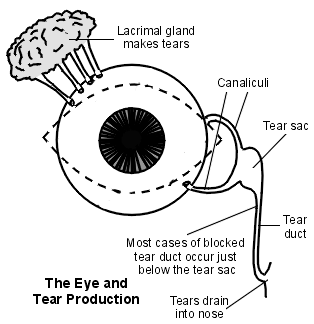
Just above, and to the outer side of, each eye is a small gland called the lacrimal gland. This constantly makes a small amount of tears. When you blink, the eyelid spreads the tears over the front of the eye to keep it moist.
The tears then drain down tiny holes (called canaliculi) on the inner side of the eye into a tear sac. From here they flow down a channel called the tear duct (the nasolacrimal duct) into the nose. This diagram shows how tears usually drain away:
Detailansicht
What tests do I need for watering eyes?
Usually the cause is easily identified - for example, infections, ectropion, entropion, and conjunctivitis. If there is no obvious cause revealed by a simple examination, further tests may be advised. These may depend on how bad the watering is, and how much it bothers you.
If a drainage problem is suspected, an eye specialist may examine the tear drainage channels, under local anaesthetic. They may push a thin stick (probe) into the small channels (canaliculi) towards the tear sac to see if it is blocked. If the probe goes as far as the tear sac then fluid can be syringed into the tear duct to see if it comes out in the nose.
Syringing may sometimes clear a blockage, but it may only give temporary relief. If there seems to be a blockage then a dye may be injected into the tear duct. An X-ray picture is then taken. You can see the dye in the duct on the X-ray film. It will show exactly where there is any obstruction or narrowing of the tear duct.
Other scans - for example, a Computertomographie (CT) oder Magnetresonanztomographie (MRT) scan - may be undertaken in some cases. An eye specialist will be able to advise you.
Treatment for watering eyes (epiphora)
Treating eye irritation
Quite often the cause of watery eyes can be treated. For example:
Eyelashes irritating the front of the eye (entropion) can be removed.
Conjunctivitis can usually be treated with drops.
Pieces of grit, etc, can be removed.
Treating tear drainage problems
Babies with watering eyes usually grow out of it with no treatment.
Blockage of the channels in adults:
You may not need treatment if the watering is mild or does not bother you much.
A blocked tear duct can be treated with an operation. The usual operation is called dacrocystorhinostomy (DCR). A tiny probe is passed through the blocked tear duct and can unblock it.
DCR surgery is worthwhile if the watering is bad enough to interfere with your activities of daily living. It is also recommended if you have had an infection in your tear sac as a result of the blocked tear duct. The surgery may prevent repeated attacks of a red, painful swelling at the corner of your eye.
The surgery is not without its risks and should only be done if you fully understand the pros and cons.
A narrowed small channel (canaliculus) which is not fully blocked may be widened by pushing in a probe.
Häufig gestellte Fragen
How can I make my eyes stop watering?
You can help stop your eyes from watering by avoiding triggers such as smoke, wind, and allergens, and by using lubricating eye drops if your eyes are dry. Applying a warm compress can also help if blocked tear ducts are the cause. If symptoms don’t improve, speak to your doctor or optician.
What is the best medicine for watery eyes?
The best medicine for watery eyes depends on the cause. Antihistamine eye drops can help if allergies are the cause, while antibiotic drops may be needed for infections. If the problem is due to dryness or blocked tear ducts, lubricating drops or prescription treatments may be more effective.
When should I see a doctor about watery eyes?
You should see a doctor about watery eyes if the problem lasts more than a few days, affects your vision, or is accompanied by pain, redness, or discharge. Persistent or severe symptoms may indicate an infection, blocked tear duct, or another underlying eye condition that needs medical attention.
Patientenauswahl für Allgemeine Anzeichen und Symptome

Anzeichen und Symptome
Juckender Po
Ein juckender Po (Pruritus ani) ist ein anhaltender Juckreiz um den Anus. Es gibt viele verschiedene Ursachen, wie Hämorrhoiden, Hauterkrankungen oder Infektionen. Die Behandlungen hängen von der Ursache ab, umfassen jedoch Hygienemaßnahmen sowie Cremes oder Salben zur Behandlung des Juckreizes.
von Dr. Doug McKechnie, MRCGP

Anzeichen und Symptome
Trockener Mund
Trockener Mund hat verschiedene Ursachen. Einfache Maßnahmen wie häufiges Trinken von Wasser, Eiswürfel lutschen und zuckerfreier Kaugummi kauen helfen oft. In vielen Fällen sind sie alles, was benötigt wird. Manchmal werden künstlicher Speichel oder Medikamente zur Anregung der Speicheldrüsen verwendet.
von Dr. Doug McKechnie, MRCGP
Weiterführende Literatur und Referenzen
- Shams PN, Chen PG, Wormald PJ u.a; Behandlung der funktionellen Epiphora bei Patienten mit einer anatomisch offenen Dacryocystorhinostomie. JAMA Ophthalmol. 2014 Sep 1;132(9):1127-32. doi: 10.1001/jamaophthalmol.2014.1093.
- Verstopfung des Tränen-Nasen-Gangs (Dysfunktion der Tränen-Nasen-Drainage); College of Optometrists, März 2016
- Alam MS, Kundu D; Is dacryocystectomy effective in reducing epiphora? Indian J Ophthalmol. 2022 Dec;70(12):4416-4418. doi: 10.4103/ijo.IJO_972_22.
Über den AutorVollständige Biografie anzeigen

Dr Hayley Willacy, FRCGP
Allgemeinmediziner, Medizinischer Autor
MBChB (1992), DRCOG, DFFP, MRCOG (Part 1) MRCGP (2007), DFSRH (2013), MSc - medical education (2020)
Dr. Hayley Willacy war eine NHS-Hausärztin, die in Nordwestengland arbeitete und 2022 nach 30 Jahren aus der klinischen Praxis ausschied.
Über den RezensentenVollständige Biografie anzeigen

Dr Colin Tidy, MRCGP
Allgemeinmediziner, Medizinischer Autor
MBBS, MRCGP, MRCP (Paediatrics), DCH
Dr. Colin Tidy ist ein NHS-Arzt mit Sitz in Oxfordshire.
Artikelverlauf
Die Informationen auf dieser Seite wurden von qualifizierten Klinikern verfasst und begutachtet.
Artikel auch verfügbar in Englisch, Deutsch, Spanisch, Französisch, Italienisch, Portugiesisch, Hindi, Hebräisch, Arabisch, und Schwedisch.
Nächste Überprüfung fällig: 20. Feb 2028
21. Feb 2023 | Neueste Version

Fragen, teilen, verbinden.
Durchsuchen Sie Diskussionen, stellen Sie Fragen und teilen Sie Erfahrungen zu Hunderten von Gesundheitsthemen.

Fühlen Sie sich unwohl?
Bewerten Sie Ihre Symptome online kostenlos
Abonnieren Sie den Patienten-Newsletter
Ihre wöchentliche Dosis klarer, vertrauenswürdiger Gesundheitsberatung - geschrieben, um Ihnen zu helfen, sich informiert, selbstbewusst und in Kontrolle zu fühlen.
Durch das Abonnieren akzeptieren Sie unsere Datenschutzrichtlinie. Sie können sich jederzeit abmelden. Wir verkaufen Ihre Daten niemals.
Mehr zu Anzeichen und Symptomen
- Angina
- Apathie
- Brustknoten
- Kostochondritis
- Ohrenschmerzen
- Epidermoide und Pilarzysten
- Epworth-Schläfrigkeitsskala
- Fieber
- Schultersteife
- Schluckauf
- Hypoglykämie
- Idiopathische intrakranielle Hypertension
- Appetitlosigkeit
- Mikrovaskuläre Angina
- Nasenbluten
- Pneumothorax
- Proteinurie
- Tinnitus
- Vestibularneuritis und Labyrinthitis
- Keuchhusten