Weibliche Sterilisation
Begutachtet von Dr Hayley Willacy, FRCGP Zuletzt aktualisiert von Dr Toni Hazell, FRCGPZuletzt aktualisiert 19. Mai 2023
Erfüllt die redaktionelle Richtlinien
- HerunterladenHerunterladen
- Teilen
- Language
- Diskussion
- Audio-Version
- Zu bevorzugten Quellen bei Google hinzufügen
In dieser Serie:SterilisationVasektomie
Die weibliche Sterilisation ist eine Verhütungsmethode. Es ist ein Verfahren, um zu verhindern, dass Eizellen die Spermien erreichen.
Auf einen Blick
Die Sterilisation bei Frauen ist eine dauerhafte Verhütungsmethode.
Es beinhaltet das Durchtrennen oder Blockieren der Eileiter, um zu verhindern, dass Eizellen auf Spermien treffen.
The procedure usually takes about 20 minutes and is often done as a day-case.
Es ist zu 99,5% wirksam, was bedeutet, dass 1 von 200 Frauen innerhalb eines Jahres schwanger werden könnte.
Die Erholung von einem Schlüssellochverfahren dauert in der Regel ein paar Tage.
Sterilisation schützt nicht vor sexuell übertragbaren Infektionen.
Wenn Sie nach der Sterilisation Schmerzen oder unerklärliche Blutungen haben, suchen Sie schnell einen Arzt auf.
Want to access contraception online?
Start a quick NHS Pharmacy First consultation online through Patient.info.
- Online and available 24/7, treatment can often be delivered next day.
- Free service, just pay the NHS prescription charge online if required.
- Just answer a few questions then choose a time for a clinician call.
Powered by Evaro, a UK regulated healthcare service supporting over 2 million patients. Reviewed by UK registered clinicians.

How is female sterilisation done?
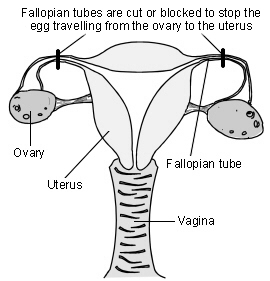
The tubes between the ovary and the womb (the Fallopian tubes) are cut or blocked with rings or clips. This stops the eggs which are released by the ovary from reaching the sperm.
Female reproductive organs
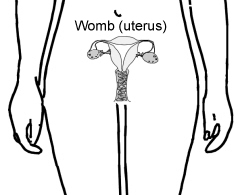
Diagram showing how female sterilisation is performed
The operation is usually done under general anaesthetic but can be done with a local or regional anaesthetic while you are awake. For most women the operation is done with the help of a special telescope called a laparoscope.
The laparoscope is inserted through a very small cut in your tummy (abdomen). It allows the surgeon to see what they are doing. Another small cut is then made to insert an instrument to block the tubes. A number of ways are used to do this. Most often clips or rings are applied to your tubes. The clips or rings provide a block in the tubes and prevent the egg from meeting sperm.
A larger cut may have to be made, and a more traditional operation done, in some women. This is more likely if Laparoskopie is too risky, such as if you have had multiple previous operations, or if you are overweight. This is called a mini-laparotomy.
If blocking the Fallopian tubes doesn't work then either part or all of the tubes can be removed. This is called a salpingectomy.
Sterilisation can be performed at the same time as a Kaiserschnitt, when a segment of the tube is removed. This is done after the delivery of the baby. It has a higher failure rate than a sterilisation which is not done at the time of caesarean delivery.
How long does the procedure take?
The procedure itself usually takes about 20 minutes, and should be done as a day-case, so you arrive at hospital early in the morning and go home the same day (unless there are unexpected complications).
How reliable is female sterilisation?
The failure rate of female sterilisation is 0.5%, so 1 in 200 women will get pregnant within one year As a comparison, when no contraception is used, more than 800 out of 1,000 sexually active women will become pregnant within one year. This failure rate is much higher than for some long-acting reversible contraceptive (LARC) methods (for example only 1 woman in 2000 will get pregnant per year on the implant) and so a LARC should always be offered to a woman who is considering sterilisation.
After sterilisation, women can become pregnant if the tubes come back together again after being cut. If clips were used to block the tubes, the clips can occasionally work their way off - even when they have been put on correctly.
Advantages of female sterilisation
It is permanent and you (and your partner) don't have to think about contraception again. There are no hormones involved, so you do not have the side-effects of many other types of contraception.
Disadvantages of female sterilisation
Sterilisation is permanent and very difficult to reverse. Some women may regret having the operation in future years, particularly if their circumstances change. Periods may become heavier after sterilisation - sometimes this is because you have stopped using another method, such as the pill, which lightens your periods, but it can also happen if you have not moved from another method.
In the rare event that the procedure fails and you become pregnant, you are more likely to have an ektopische Schwangerschaft. This occurs when the pregnancy develops outside of the womb, usually in the Fallopian tube. You would need emergency treatment if this were to happen. If you think you are pregnant after a sterilisation, or have unexplained bleeding or pain in your tummy (abdomen), then see a doctor quickly.
Laparoscopic sterilisation is also not as easy to do or as effective as male sterilisation (vasectomy). There is a small risk from the insertion of the laparoscope which has to be done 'blind' (ie without any image guidance). This means the surgeon cannot see exactly where they are putting the instrument in the tummy to gain access to the tubes.
It may at times damage organs like bowel or a blood vessel inside the abdomen. This sounds worrying. However, the surgeon takes many precautions to make the procedure safe and to avoid causing damage to any other organ and, in most cases, this does not happen.
Sterilisation doesn't protect against sexually transmitted infection (STIs) so you may need to use condoms if you think you may be at risk of STI.
As with any operation there is a risk of a wound infection and the slight risk from a general anaesthetic. There may be some tummy discomfort or bloating, or mild discomfort or pain at the site of the cut.
How soon is female sterilisation effective?
For laparoscopic sterilisation it depends on when you have it done in your menstrual cycle. If it is done whilst you have your period, you will not have produced an egg yet. In this case the procedure is effective immediately.
At any other time in your cycle, you will usually be advised to continue your previous method of contraception until your next period.
(The procedure is only done after checking you are not pregnant. That is, a pregnancy test would be done. If you have had sex without using contraception in the previous three weeks it is not possible to be sure you will not be pregnant. In this case, the operation would be delayed.)
Does female sterilisation affect sex drive?
No. Sex may seem more enjoyable, as the worry of pregnancy and contraception is removed.
How long does it take to recover from female sterilisation?
It usually takes a few days to recover from a laparoscopic sterilisation and most people can return to work within five days, but should avoid heavy lifting for a week. If a mini-laparotomy (open surgery rather than keyhole) was needed then recovery will be longer, and you may need to be off work for 3-4 weeks and avoid heavy lifting for 6 weeks. It is always important to care for yourself after surgery.
Points to consider
Don't consider having the operation unless you and your partner are sure you do not want children, or further children. It is wise not to make the decision at times of crisis or change - for example, after a new baby or termination of pregnancy. Don't make the decision if there are any major problems in your relationship with your partner. It will not solve any sexual problems.
Doctors normally like to be sure that both partners are happy with the decision before doing this permanent procedure. However, it is not a legal requirement to get your partner's permission. If you have any doubts and questions, make sure you discuss these with your doctor or practice nurse.
Have you considered the alternatives? Female sterilisation is not 100% effective. Other reversible methods of contraception are often more effective, such as the Intrauterinsystem (IUS), contraceptive implants und contraceptive injections. Also, male sterilisation is easier and safer to do and is more effective.
Want to access contraception online?
Start a quick NHS Pharmacy First consultation online through Patient.info.
- Online and available 24/7, treatment can often be delivered next day.
- Free service, just pay the NHS prescription charge online if required.
- Just answer a few questions then choose a time for a clinician call.
Powered by Evaro, a UK regulated healthcare service supporting over 2 million patients. Reviewed by UK registered clinicians.
Patientenauswahl für Allgemeine Chirurgie und Verfahren
Chirurgie und Verfahren
Kolposkopie und zervikale Behandlungen
Die Kolposkopie ist eine detaillierte Untersuchung des Gebärmutterhalses (Zervix). Sie wird in der Regel in einer Kolposkopie-Praxis von einem Arzt oder spezialisierten Pflegepersonal durchgeführt.
von Dr. Philippa Vincent, MRCGP
Chirurgie und Verfahren
Kniegelenkersatz
Ein Kniegelenkersatz ist ein Eingriff, um beschädigte Teile des Kniegelenks zu ersetzen. Es kann entweder ein vollständiger Kniegelenkersatz (TKR) oder ein teilweiser (unikompartimenteller) Kniegelenkersatz sein. Der neue Teil des Gelenks wird Prothese genannt.
von Dr. Philippa Vincent, MRCGP
Häufig gestellte Fragen
Was ist der Vorteil der Sterilisation im Vergleich zu anderen Verhütungsmethoden?
Der Hauptvorteil der weiblichen Sterilisation ist, dass sie dauerhaft ist, was bedeutet, dass Sie und Ihr Partner nicht mehr an Verhütung denken müssen. Außerdem sind keine Hormone beteiligt, sodass Sie die Nebenwirkungen vermeiden, die mit vielen anderen Arten hormoneller Verhütung verbunden sind.
Ist die Sterilisation bei Frauen ein völlig sicheres Verfahren?
Obwohl Chirurgen viele Vorsichtsmaßnahmen treffen, um die Sicherheit zu gewährleisten, gibt es einige Risiken im Zusammenhang mit der weiblichen Sterilisation. Dazu gehört ein geringes Risiko für Schäden an Organen wie dem Darm oder Blutgefäßen während des Einführens des Laparoskops. Wie bei jeder Operation besteht auch ein Risiko für Wundinfektionen und ein geringes Risiko durch die Allgemeinanästhesie. Es kann zu vorübergehenden Bauchbeschwerden, Blähungen oder Schmerzen an der Einschnittstelle kommen.
Bietet die weibliche Sterilisation Schutz vor sexuell übertragbaren Infektionen (STIs)?
Nein, die Sterilisation bei Frauen schützt nicht vor sexuell übertragbaren Infektionen. Wenn Sie glauben, dass Sie einem Risiko für sexuell übertragbare Infektionen ausgesetzt sind, müssen Sie weiterhin Kondome verwenden.
Gibt es bestimmte Situationen, in denen die Entscheidung zur Sterilisation verschoben werden sollte?
Es wird empfohlen, die Entscheidung zur Sterilisation nicht in Krisenzeiten oder bei bedeutenden Lebensveränderungen zu treffen, wie zum Beispiel nach der Geburt eines Kindes oder einem Schwangerschaftsabbruch. Auch wenn es größere Probleme in Ihrer Beziehung gibt, wird empfohlen, die Entscheidung zu verschieben. Der Eingriff sollte nicht in der Erwartung durchgeführt werden, dass er sexuelle Probleme löst.
Wer trifft typischerweise die Entscheidung für die Sterilisation von Frauen, und ist die Zustimmung des Partners erforderlich?
Obwohl Ärzte normalerweise bevorzugen, dass beide Partner aufgrund der dauerhaften Natur des Verfahrens mit der Entscheidung einverstanden sind, ist es rechtlich nicht erforderlich, die Erlaubnis des Partners für die weibliche Sterilisation einzuholen.
Weiterführende Lektüre und Referenzen
- Trussell J; Verhütungsversagen in den Vereinigten Staaten, Verhütung, 2011
- Männliche und weibliche Sterilisation; Fakultät für sexuelle und reproduktive Gesundheitsversorgung (September 2014)
- Empfängnisverhütung - Sterilisation; NICE CKS, Mai 2021 (nur in Großbritannien zugänglich)
Über den AutorVollständige Biografie anzeigen
Aktualisiert von

Dr Toni Hazell, FRCGP
MBBS, BSc, FRCGP, DFSRH, Dip GU med, DRCOG, DCH (London, UK, 2000)
Dr. Toni Hazell hat ihren Abschluss an der St. Mary’s Hospital Medical School gemacht und ihr VTS am Northwick Park Hospital absolviert.
Über den RezensentenVollständige Biografie anzeigen

Dr Hayley Willacy, FRCGP
Allgemeinmediziner, Medizinischer Autor
MBChB (1992), DRCOG, DFFP, MRCOG (Part 1) MRCGP (2007), DFSRH (2013), MSc - medical education (2020)
Dr. Hayley Willacy war eine NHS-Hausärztin, die in Nordwestengland arbeitete und 2022 nach 30 Jahren aus der klinischen Praxis ausschied.
Artikelverlauf
Artikel auch verfügbar in Englisch, Deutsch, Spanisch, Französisch, Italienisch, Portugiesisch, Hindi, Hebräisch, Arabisch, und Schwedisch.
Nächste Überprüfung fällig: 12. Mai 2028
19. Mai 2023 | Neueste Version
Nehmen Sie an der Diskussion teil
Teilen Sie Ihre Gedanken oder Erfahrungen mit anderen in unserem Patientengemeinschaften.

Fragen, teilen, verbinden.
Durchsuchen Sie Diskussionen, stellen Sie Fragen und teilen Sie Erfahrungen zu Hunderten von Gesundheitsthemen.

Fühlen Sie sich unwohl?
Bewerten Sie Ihre Symptome online kostenlos
Abonnieren Sie den Patienten-Newsletter
Ihre wöchentliche Dosis klarer, vertrauenswürdiger Gesundheitsberatung - geschrieben, um Ihnen zu helfen, sich informiert, selbstbewusst und in Kontrolle zu fühlen.
Durch das Abonnieren akzeptieren Sie unsere Datenschutzrichtlinie. Sie können sich jederzeit abmelden. Wir verkaufen Ihre Daten niemals.