Chikungunya-Fieber
Begutachtet von Dr Philippa Vincent, MRCGPZuletzt aktualisiert von Dr Toni Hazell, FRCGPZuletzt aktualisiert 4. Aug 2026
Erfüllt die redaktionelle Richtlinien
- HerunterladenHerunterladen
- Teilen
- Language
- Diskussion
- Ask Patient
- Audio-Version
- Zu bevorzugten Quellen bei Google hinzufügen
Chikungunya fever is an illness caused by a virus. The virus infects you when you are bitten by a certain type of mosquito. You cannot catch chikungunya fever in the UK but you may be at risk of catching it when abroad.
It usually causes a high temperature (the 'fever') and joint pains. In most people it goes away completely after one or two weeks. In a few people it may be a more serious illness. There is no specific treatment.
Before travelling, always check for the latest information on infections in the area to which you are going. Chikungunya can be prevented by taking measures to avoid mosquito bites. See Travel Health Pro in Further reading and references below.
Auf einen Blick
Chikungunya is a viral illness spread by mosquito bites, mainly in warmer parts of the world.
Symptoms typically start 4-8 days after a bite and include fever and severe joint pain.
Other symptoms can include tiredness, rash, muscle pains, and headache.
Most people recover in one to two weeks, but joint pain can last longer for some.
There is no vaccine or specific treatment; paracetamol or ibuprofen can help with symptoms.
If travelling to affected areas, use insect repellent and wear protective clothing to prevent bites.
Seek medical advice if you develop symptoms during or after travel.
Looking for Insect repellent options?
Erhalten Sie fachkundige medizinische Beratung bequem von zu Hause aus. Füllen Sie eine kurze Online-Konsultation aus, die rund um die Uhr verfügbar ist. Ihre Anfrage wird von einer in Großbritannien registrierten medizinischen Fachkraft geprüft. Für ausgewählte Behandlungen ist eine Lieferung am nächsten Tag möglich.

What is chikungunya?
Chikungunya (or chikungunya fever) is an illness caused by a virus. The virus gets into your system when you are bitten by a particular type of mosquito. The type of mosquito which transmits the chikungunya virus is called an Aedes mosquito. These mosquitoes tend to bite in the daytime rather than at night.
The mosquito carries the virus after biting another person or animal who has the chikungunya infection. The virus multiplies in your bloodstream, causing you to become unwell usually 4-8 days after the mosquito bite. The virus causes you to develop a temperature and joint pains. There may be other symptoms.
What causes chikungunya?
Anyone bitten by a mosquito infected with the chikungunya virus, can get the illness. It only occurs in certain parts of the world. It only occurs in countries where it is warm enough for the mosquito to survive.
It is not warm enough for this type of mosquito in the UK, so you cannot get the infection in the UK. However, if you travel to a country where there is an outbreak of chikungunya fever, you may become infected if you are bitten by an infected mosquito.
Up until 2013, chikungunya fever was mainly a risk only in certain parts of Africa and Asia. In 2013, however, cases were reported in the Caribbean and in North and South America. Since then there have been outbreaks across the Caribbean and the Americas, with many thousands of people catching the virus.
Who gets chikungunya?
Anybody at any age can get chikungunya fever. However, it tends to be more severe in certain groups of people. This includes:
Newborn babies and very young children.
People aged over 65 years.
People with other medical conditions.
Is chikungunya contagious?
Chikungunya is not contagious; that is, you cannot catch chikungunya fever from another person. It is only passed on if you are bitten by a mosquito which has bitten another person or animal infected with the virus.
The exception to this is that newborn babies have been known to develop chikungunya fever shortly after birth if their mother has the infection. Infection with chikungunya fever during pregnancy may also result in infection and problems for the developing baby.
How common is chikungunya?
How common chikungunya is varies because it tends to occur in outbreaks. Since being first reported in the Caribbean and the Americas, there have been more than 1.2 million cases in these regions.
In the UK it is very rare. There were 295 cases reported in 2014 in England, Wales and Northern Ireland. All these illnesses happened in people who had travelled abroad. Cases dropped in the years after 2014 but have recently risen, with 160 cases reported in 2025 - this is nearly half as much again as the number reported in 2024. They were all in people who had travelled abroad, with half linked to Sri Lanka and many of the rest linked to travel to India and Bangladesh.
What are chikungunya symptoms?
The symptoms of the illness usually start four to eight days after the person has been bitten by the infected mosquito. It starts with a high temperature (fever) and joint pains. The joint pains may be very severe.
The word 'chikungunya' comes from an African word which means 'that which bends up'. This is because people with the illness may be bent over in pain. Any joint can be affected but most commonly the joints of the hands, wrists and ankles are painful.
Other symptoms which may be present include:
Sich müde fühlen.
Übelkeit.
Ein Ausschlag.
Muskelschmerzen.
Kopfschmerzen.
Chikungunya rash
Chikungunya fever rash
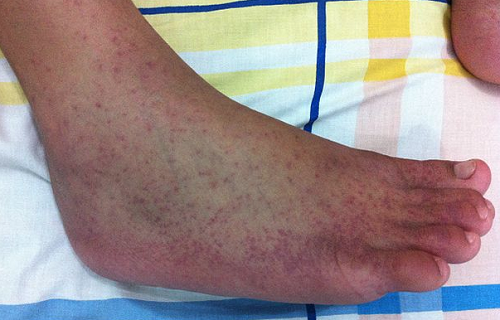
Usually the symptoms last one or two weeks, and then completely settle. In a few people, however, the joint pains can carry on for weeks or months after the infection has gone.
Very rarely more serious symptoms occur. These are more likely in more vulnerable people. For example, young babies, the elderly or people with other medical conditions may be more prone to the more serious symptoms. These more unusual complications include:
Pains in the eye or loss of vision.
Fits (Anfällen).
Schläfrigkeit.
Infections in parts of the brain (Meningitis oder Enzephalitis).
Watery stools (Durchfall).
Atemprobleme.
Herzprobleme.
Nierenprobleme.
Liver infection.
Are there any tests for chikungunya fever?
A blood test can be taken to confirm chikungunya. In the UK it has to be sent to a special laboratory for rare imported diseases. The blood sample can be checked to see if the virus can be found. It may also be checked for antibodies which are produced by your immune system to fight the virus.
What is the treatment for chikungunya?
There is no specific medication which tackles the virus itself. Normally you will be advised to take medicines such as Paracetamol oder Ibuprofen to help with the joint pains and high temperature (fever). You will be advised to drink plenty of fluid. People who become very unwell may need to have extra care in hospital.
What is the usual outcome?
Most people make a full recovery within one to two weeks. Some people may be left with joint pains which can go on for weeks or months.
A very few people have complications (see the 'symptoms' section above). It is rare to die from chikungunya fever but it can happen occasionally.
How to prevent chikungunya fever - Advice for UK travellers
If travelling to an area where chikungunya fever occurs, take all possible precautions to avoid being bitten by a mosquito. For example:
Use insect repellent. Those containing a chemical called N, N-diethylmetatoluamide (DEET) are known to be the most effective. Apply insect repellent regularly and re-apply after swimming. If also using sunscreen, apply the insect repellent after the sunscreen.
Sleep in rooms with mosquito screens and/or mosquito nets.
The use of mosquito coils may be helpful outside.
Wear clothing that protects you from bites - ie long sleeves and long trousers. For areas affected by chikungunya fever, you need this type of clothing even in the daytime. This is because the Aedes mosquitoes tend to bite in the daytime, unlike other types which usually bite in the evenings. There are some insecticides available which can be sprayed on to clothing.
Get advice about whether you should be vaccinated against chikungunya. There are two vaccines available, but there have been significant safety concerns raised about one of them when given to people who are over 60 or have some pre-existing medical conditions. Neither are available on the NHS. If you are considering being vaccinated against chikungunya, you should seek the advice of a private travel clinic and do this in plenty of time before your trip.
If you develop a high temperature or joint pains while abroad, or shortly after you return, seek medical advice.
The risk areas are constantly changing and evolving, and travellers should check the latest information the Travel Health Pro website before they travel. See Further reading and references.
Looking for Insect repellent options?
Erhalten Sie fachkundige medizinische Beratung bequem von zu Hause aus. Füllen Sie eine kurze Online-Konsultation aus, die rund um die Uhr verfügbar ist. Ihre Anfrage wird von einer in Großbritannien registrierten medizinischen Fachkraft geprüft. Für ausgewählte Behandlungen ist eine Lieferung am nächsten Tag möglich.
Patientenauswahl für Reisebedingte Infektionen

Reisen und Impfungen
Typhus und Paratyphus
Typhus und Paratyphus sind Infektionen, die durch verwandte, aber unterschiedliche Bakterienstämme verursacht werden. Die beiden Krankheiten sind ähnlich und werden beide als Darmtyphus bezeichnet, obwohl Paratyphus weniger schwerwiegend ist. Sie werden in der Regel durch den Verzehr von kontaminierten Lebensmitteln oder Wasser übertragen. Diese Infektionen treten am häufigsten in Ländern mit schlechter sanitärer Versorgung auf. Erste typische Symptome sind hohes Fieber und Kopfschmerzen, aber wenn sie nicht behandelt werden, können ernstere Probleme auftreten. Die Behandlung mit Antibiotika ist in der Regel wirksam. Ohne Behandlung sterben etwa 1 von 5 Menschen mit Typhus, während Paratyphus normalerweise nicht tödlich verläuft. Gründliches Händewaschen und das Trinken von Flaschenwasser können helfen, eine Ansteckung mit Typhus zu verhindern. Außerdem sollten Sie in Gebieten, in denen Typhus häufig vorkommt, Lebensmittel vor dem Verzehr kochen, schälen oder abkochen. Impfungen können ebenfalls helfen, Typhus vorzubeugen, daher ist es sinnvoll, sich vor einer Reise in ein Gebiet mit erhöhtem Typhusrisiko impfen zu lassen.
von Dr. Colin Tidy, MRCGP
Reisen und Impfungen
Malaria
Malaria ist eine sehr ernste Infektion, die durch einen Stich einer infizierten Mücke verursacht wird. Die häufigsten Symptome sind hohes Fieber und eine grippeähnliche Erkrankung. Die Symptome von Malaria können bis zu einem Jahr nach einem Stich in einem Gebiet auftreten, in dem Malaria vorkommt. Eine schnelle Behandlung von Malaria ist unerlässlich, da sie ohne Behandlung tödlich sein kann. Dieses Merkblatt gibt allgemeine Informationen über Malaria und deren Behandlung.
von Dr. Philippa Vincent, MRCGP
Häufig gestellte Fragen
Can chikungunya affect animals too?
Yes, the Aedes mosquito carries the chikungunya virus after biting another person or animal who has the infection.
Is it safe to travel when pregnant if there's a chikungunya outbreak?
Infection with chikungunya fever during pregnancy may result in infection and problems for the developing baby. This suggests caution is warranted, and travellers should check the latest information on the Travel Health Pro website before they travel.
What is the typical incubation period for chikungunya?
The virus usually causes you to become unwell 4-8 days after the mosquito bite. The symptoms of the illness usually start within this timeframe after being bitten by an infected mosquito.
Can I get chikungunya more than once?
The article does not explicitly state whether a person can get chikungunya more than once.
Are there any specific pain relievers that are better for chikungunya symptoms?
Normally, you will be advised to take medicines such as paracetamol or ibuprofen to help with the joint pains and high temperature (fever).
Will I automatically get a rash if I have chikungunya?
A rash is listed as one of the symptoms that may be present, but it's not stated that everyone with chikungunya will develop one.
What should I do if I think I have chikungunya after returning to the UK?
If you develop a high temperature or joint pains shortly after you return from an area where chikungunya fever occurs, you should seek medical advice.
Weiterführende Lektüre und Referenzen
- Chikungunya; Weltgesundheitsorganisation
- Chikungunya-Fieber; Öffentliche Gesundheit England
- Chikungunya; Travel Health Pro.
- Ojeda Rodriguez JA, Haftel A, Walker, III JR; Chikungunya Fever.
Über den AutorVollständige Biografie anzeigen
Aktualisiert von

Dr Toni Hazell, FRCGP
MBBS, BSc, FRCGP, DFSRH, Dip GU med, DRCOG, DCH (London, UK, 2000)
Dr. Toni Hazell hat ihren Abschluss an der St. Mary’s Hospital Medical School gemacht und ihr VTS am Northwick Park Hospital absolviert.
Über den RezensentenVollständige Biografie anzeigen

Dr Philippa Vincent, MRCGP
Allgemeinmediziner, Medizinischer Autor
MB BS, Bsc, MRCGP (2000), DCH, DFSRH, DRCOG
Dr Philippa Vincent ist ein NHS-Arzt, der in Nordlondon arbeitet.
Artikelverlauf
Artikel auch verfügbar in Englisch, Deutsch, Spanisch, Französisch, Italienisch, Portugiesisch, Hindi, Hebräisch, Arabisch, und Schwedisch.
Next review due: 4 Feb 2031
4. Aug 2026 | Neueste Version
Medizinische Fachkräfte
Looking for more in-depth clinical detail? Our Professional Reference articles are written for doctors, nurses and other healthcare professionals. They include comprehensive clinical guidance, diagnostic information and UK/European evidence summaries. If you need the clinical version, you can read the Professional Reference article on this topic.
Teilen Sie Ihre Gedanken oder Erfahrungen mit anderen in unserem Patientengemeinschaften.
Einfacher Zugang zu vertrauenswürdigen Behandlungen und Gesundheitsdiensten online.
Common conditions
Get help with common conditions through the NHS, without a GP appointment.





Abonnieren Sie den Patienten-Newsletter
Ihre wöchentliche Dosis klarer, vertrauenswürdiger Gesundheitsberatung - geschrieben, um Ihnen zu helfen, sich informiert, selbstbewusst und in Kontrolle zu fühlen.
Durch das Abonnieren akzeptieren Sie unsere Datenschutzrichtlinie. Sie können sich jederzeit abmelden. Wir verkaufen Ihre Daten niemals.