Gallium scan
Peer reviewed by Dr Adrian Bonsall, MBBSLast updated by Dr Mary Harding, MRCGPLast updated 22 Jan 2019
Meets Patient’s editorial guidelines
- DownloadDownload
- Share
- Language
- Discussion
- Audio Version
- Add to preferred sources on Google
This page has been archived.
It has not been reviewed recently and is not up to date. External links and references may no longer work.
A gallium scan uses a radioactive chemical to help create pictures which can show areas of possible infection, injury, inflammation or cancer. It does this by looking for areas where there is rapid cell division within the body.
Note: the information below is a general guide only. The arrangements, and the way tests are performed, may vary between different hospitals. Always follow the instructions given by your doctor or local hospital.
At a glance
A gallium scan is a test that helps find areas of infection, inflammation, injury, or cancer in the body.
You will have an injection of a special liquid, and then images will be taken one to three days later.
The scan involves lying still while a camera detects radiation from your body, but you are not enclosed.
Tell your doctor if you are pregnant or breastfeeding, as the scan involves a small amount of radiation.
You might need to take laxatives before the scan if your tummy is being checked.
Drink plenty of fluids after the scan to help your body remove the gallium.
What is a gallium scan?
A gallium scan is a type of nuclear medicine, or radionuclide scan.
There are different types of radionuclides. Different ones tend to collect or concentrate in different organs or tissues. So, the radionuclide used depends on which part of the body is to be scanned.
Gallium tends to concentrate in areas of the body where there is rapid cell division. This is seen on pictures taken with the gamma camera. Where large amounts are seen, this can be a sign of infection, inflammation, injury or possible cancer. The image below shows how sarcoidosis may be diagnosed by gallium scan.
Gallium scan image
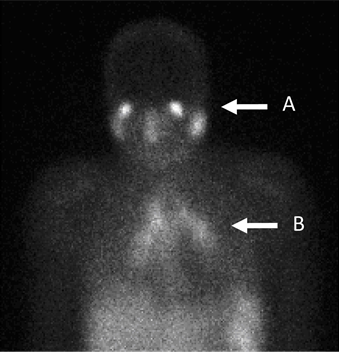
© By A B Allard, J Buscombe, D P Kidd [CC BY-SA 4.0], via Wikimedia Commons
What happens during a gallium scan?
The test is normally done in two parts. In the first part you will receive an injection of the gallium citrate, usually into your arm. This may be a little uncomfortable as the needle is inserted but after that you will normally feel no effects. Usually, you can go home after the injection - to allow the gallium to work its way around your body.
The second part of the test involves coming back to hospital for the pictures to be taken (the scan). Depending on your hospital and the reason for doing the test, you may be asked to return for the scans to be done one day, two days, or three days after the injection.
When it is time to do the scanning, you lie on a couch while the gamma camera detects the gamma rays coming from your body. The computer turns the information into a picture. You need to lie as still as possible whilst each picture is taken (so it is not blurred). Some pictures can take 20 minutes or more to expose. The camera does not produce any radiation, so you are not exposed to any additional radiation while the scan is being done.
The number of pictures taken, and the time interval between each picture, varies depending on what is being scanned. So, the whole process can take several hours. During the scan you are NOT enclosed in a tunnel.
You will not have to undress for the scan. You may be asked to remove metal objects such as keys or coins from your pockets. You may be asked to remove belts with buckles, or large necklaces.
What is a gallium scan used for?
A gallium scan can be used to:
Detect the source of an infection that is causing a high temperature (fever), called a fever of unknown origin.
Find an abscess or certain infections. This is particularly used to detect infection in the bones (osteomyelitis).
Monitor the response to antibiotic treatment.
Diagnose inflammatory conditions such as pulmonary fibrosis or sarcoidosis - as image above.
Detect certain types of cancer (such as lymphoma). A gallium scan also may be done to see if cancer has spread (metastasised) to other areas of the body, or to watch how well a cancer treatment is working. Nowadays gallium scans are used less to detect cancer. Positron-emission tomography (PET) scans are most commonly used for cancer.
What should I do to prepare for a gallium scan?
Usually very little. Your local hospital should give you information to help you prepare for the test. As a gallium scan involves a small amount of radiation, pregnant women should not have it done. Let your doctor know if you are, or think you could be, pregnant. You should also let your doctor know if you are breastfeeding. You may be asked to stop breastfeeding for a certain length of time before and after the test.
If pictures of your tummy (abdomen) are needed, you may be given some laxative tablets before the scan. These tablets will make you go to the toilet. This helps to make the pictures clearer. If you need these tablets, you will be given them by hospital staff. You will also be given advice about when to take them.
What can I expect after a gallium scan?
Radionuclide scans such as a gallium scan do not generally cause any after effects. Through the natural process of radioactive decay, the small amount of radioactive chemical in your body will lose its radioactivity over time. It may also pass out of your body through your urine or poo (faeces) during the first few hours or days following the test. You may be instructed to take special precautions when urinating. These may include flushing the toilet twice and to wash your hands thoroughly.
If you have contact with children or pregnant women you should let your doctor know. Although the levels of radiation used in the scan are small, your doctor may advise special precautions. Your hospital should give you more advice on this.
If you are travelling abroad in the three months after your scan, ask your doctor for further advice. Ports and airports have very sensitive radiation detectors which may pick up tiny amounts of radioactivity remaining after your scan. Usually, it is possible for your hospital to provide you with a letter that you can show to officials at ports or airports. Or you could take your appointment letter with you to show you have had this scan done.
Are there any side-effects or complications from a gallium scan?
The term 'radioactivity' may sound alarming. But, the radioactive chemicals used in radionuclide scans such as a gallium scan are considered to be safe. They start to leave the body in the urine during the first 24 hours and through the gut after that. Drink plenty to help your body remove the gallium. The half life of gallium is 78 hours and it is excreted relatively slowly from the body. The average retained dose is 65% after seven days, so it will take a few weeks to be removed from your body.
The dose of radiation that your body receives is very small. In many cases, the level of radiation involved is not much different to a series of a few normal X-rays. However:
As with any other types of radiation (such as X-ray), there is a small risk that the gamma rays may affect an unborn child. So, tell your doctor if you are pregnant or if you may be pregnant.
Rarely, some people have an allergic reaction to the injected chemical.
How does a gallium scan work?
The first part of the test involves an injection of a chemical called gallium citrate into the bloodstream. Gallium citrate behaves rather like iron and some of it attaches to proteins in your blood, particularly to the protein called transferrin. It then circulates around your body with your blood and begins to collect in different parts of your body. The gallium will naturally concentrate in areas where there is inflammation or where white blood cells have collected. It can take several days for the gallium to build up, which is why the second part of the scan is done a few days later.
Gallium emits gamma rays, a type of radioactive wave. Gamma rays are similar to X-rays and are detected by a device called a gamma camera. The gamma rays which are emitted from inside the body are detected by the gamma camera, are converted into an electrical signal and are sent to a computer. The computer builds a picture by converting the differing intensities of radioactivity emitted into different colours or shades of grey.
For example, areas of the target organ or tissue which emit lots of gamma rays may be shown as red ('hot spots') on the picture on the computer monitor. Areas which emit low levels of gamma rays may be shown as blue ('cold spots'). Various other colours may be used for in-between levels of gamma rays emitted.
Patient picks for Imaging

Tests and investigations
PET scan
A PET scan create images which show where cells are particularly active in the body. It is most commonly used to diagnose and assess cancer. Note: the information below is a general guide only. The arrangements, and the way tests are performed, may vary between different hospitals. Always follow the instructions given by your doctor or local hospital.
by Dr Rosalyn Adleman, MRCGP
Tests and investigations
Endoscopic ultrasound scan
An endoscopic ultrasound scan uses an endoscope with an ultrasound probe attached to create detailed pictures of internal organs and structures. Note: the information below is a general guide only. The arrangements and the way tests are performed, may vary between different hospitals. Always follow the instructions given by your doctor or local hospital.
by Dr Toni Hazell, FRCGP
Frequently asked questions
Will I feel claustrophobic during a gallium scan?
No, during the scan itself, you will lie on a couch and the camera does not enclose you in a tunnel. This means you will not experience the confined feeling often associated with some other types of scans.
Why do I need to drink plenty of fluids after a gallium scan?
Drinking plenty of fluids helps your body to remove the gallium. Although it leaves the body over time naturally through a process called radioactive decay, extra fluids can aid its excretion, primarily through urine in the first 24 hours and then through faeces.
What is the primary difference between a gallium scan and a PET scan for detecting cancer?
While gallium scans can detect certain types of cancer and check for spread, PET scans are now more commonly used for cancer detection. The article doesn't go into details about the differences, but highlights that PET scans have largely superseded gallium scans for cancer diagnostics.
How soon after the injection does the gallium start to work effectively?
The gallium citrate is injected into your arm and then circulates around your body, beginning to collect in target areas. It can take several days for enough gallium to build up to allow for clear images to be taken, which is why the scanning part of the test is usually done one, two, or three days after the injection.
Why would I be given laxatives before a gallium scan?
If your scan requires pictures of your tummy (abdomen), you might be given laxative tablets beforehand. These help you go to the toilet, which in turn helps to make the pictures taken during the scan clearer.
Further reading and references
- Guidelines on various nuclear medicine procedures and topics; European Association of Nuclear Medicine (various dates)
- Neoscan® Gallium Citrate Ga 67; Diagnostic for Intravenous Use - Information Leaflet, Nuclear Education Online
About the authorView full bio

Dr Mary Harding, MRCGP
General Practitioner, Medical Author
BA, MA, MB, BChir, MRCGP, DFFP
Dr Mary Harding qualified from Cambridge University medical school in 1989.
About the reviewerView full bio

Dr Adrian Bonsall, MBBS
Medical Author
MA (Chemistry), MBBS (Hons), DCH
Since 2000 Adrian has been employed in emergency and critical care paediatrics based in Sydney, with particular interests in toxicology, trauma and resuscitation.
Article history
The information on this page is written and peer reviewed by qualified clinicians.
Article also available in English, German, Spanish, French, Italian, Portuguese, Hindi, Hebrew, Arabic, and Swedish.
22 Jan 2019 | Latest version
Join the conversation
Share your thoughts or experiences with others in our patient communities.

Ask, share, connect.
Browse discussions, ask questions, and share experiences across hundreds of health topics.

Feeling unwell?
Assess your symptoms online for free
Sign up to the Patient newsletter
Your weekly dose of clear, trustworthy health advice - written to help you feel informed, confident and in control.
By subscribing you accept our Privacy Policy. You can unsubscribe at any time. We never sell your data.
More in tests and investigations
- Amniocentesis
- Antibody and antigen tests
- Arterial blood gases
- Audiology
- Blood groups and types
- Blood tests to detect inflammation
- Cerebral angiography
- Chorionic villus sampling
- Electrocardiogram
- Faecal immunochemical test
- Hearing tests
- Hyponatraemia
- Nerve conduction studies
- Newborn hearing test
- Osmolality, osmolarity and fluid homeostasis
- PET scan
- Sickle cell trait
- Thalassaemia
- Urine dipstick test
- Voiding cystourethrogram