X-Beine
Begutachtet von Dr Doug McKechnie, MRCGPZuletzt aktualisiert von Dr Hayley Willacy, FRCGP Last updated 15. Juni 2023
Erfüllt die Anforderungen des Patienten Richtlinien des Patienten
- HerunterladenHerunterladen
- Teilen
- Language
- Diskussion
- Audio-Version
- Add to preferred sources on Google
X-Beine beschreibt einen ungewöhnlichen Winkel der Unterschenkel. Am häufigsten ist es eine normale Form, während sich die Beine von Kindern entwickeln, aber gelegentlich kann es bei Kindern oder Erwachsenen Probleme verursachen oder eine zugrunde liegende Ursache haben. Die meisten Kinder mit X-Beinen wachsen aus der Erkrankung heraus.
At a glance
Knock knees (genu valgum) is when your knees touch but your ankles are apart.
It is a normal part of development in children between the ages of 2 and 8 years old.
In most cases, knock knees correct themselves without treatment as a child grows.
You should see a doctor if only one leg is affected or if your child has pain or walking difficulties.
See a doctor if knock knees are present before age 2 years or after age 8 years.
In diesem Artikel:
Video picks for Entwicklung
Lesen Sie unten weiter
What are knock knees?
The medical term for knock knees is 'genu valgum' - genu meaning 'knee' in Latin, and valgum meaning 'bending outwards'. In knock knees, if the knees touch it is the lower leg which seems bent outwards. So if you have knock knees you are unable to stand with your knees AND your ankles together.
As children grow up, they tend to start off 'bow-legged'. This means if their feet are together, their knees are apart, leaving a diamond shape between the legs. This is normal in babies and toddlers until the age of about 2 years.
As the child's leg bones grow and develop, they then tend to take on a 'knock-kneed' shape. Now if their knees are together, their feet and ankles are apart. It tends to be most obvious around the age of 3 or 4 years, usually gradually improving to the correct position after that, as the child stands for longer periods of time. Knock knees are normal up to the age of 7 or 8 years, although the condition may last longer.
Valgus
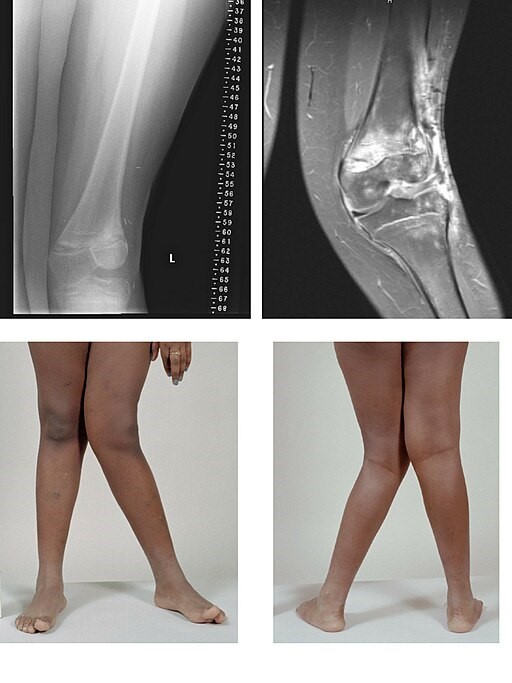
© BioMed Central, CC BY 2.0, via Wikimedia Commons
Do knock knees cause any problems?
Zurück zum InhaltKnock knees in children do not cause problems. If the condition is severe, or caused by an underlying problem, it may cause pain or difficulty walking.
Lesen Sie unten weiter
Causes of knock knees
Zurück zum InhaltIn most cases, knock knees are purely caused by the normal phase of growth and development. Occasionally - in either older children or adults - there can be an underlying problem causing the condition. For example:
Vitamin deficiency (particularly vitamin D deficiency causing rickets). Vitamin C and calcium deficiency can also affect the way bones grow.
Operations or injuries to the knee or legs.
Inherited (genetic) conditions which affect the way that the knees develop.
Do I need to see a doctor about knock knees?
Zurück zum InhaltYou do not need to see a doctor if your child is at an age where having knock knees is normal (aged more than 2 years and less than 8 years) and if the deformity is not very severe. If your child lies on their back with their knees together, you can measure the distance between their ankles.
If it is less than 10 cm around age 4 years, this is likely to correct itself as they grow. If you take photos of your child every 3-6 months, standing with their knees together, you should see that the legs gradually become straighter from the age of 4 years or so.
See a doctor if:
Only one leg is affected.
Your child has knock knees before the age of 2 years or after the age of 8 years.
There is a larger gap between the ankles than that described above.
Your child has pain in the lower legs or knees.
Your child has problems walking or walks with a limp.
You develop knock knees as an adult.
Lesen Sie unten weiter
How are knock knees diagnosed?
Zurück zum InhaltThe diagnosis of knock knees can be made by just looking at a child. If it is particularly severe, or if it occurs outside the normal age range, then further tests may be needed. This might include Röntgenaufnahmen oder Bluttests.
The severity of the knock knees can be assessed by measuring the distance between the ankles when the child is standing with knees together. or by measuring other angles of the legs.
Treatment for knock knees
Zurück zum InhaltIn most cases no treatment is needed. For children who develop knock knees as a normal part of their childhood growth, the condition corrects itself as they continue to grow. They do not need any special shoes or braces, and do not need to avoid any sporting activities. They do not need any physiotherapy or other special treatment.
If the condition is severe, or caused by an underlying problem, then treatment may be needed. This will then depend on the underlying condition, the severity of the deformity and the stage of growth that the child is in.
If the knock knees are caused by a metabolic problem, such as Vitamin D deficiency, the deformity may correct with vitamin replacement.
If the angle of bone growth is around 15-20 degrees in a child who is less than 10 years old, guided growth may be suitable to treat knock knees. Plates, or screws or staples may be implanted into the bone to aid correct growth.
Occasionally an operation to correct the deformity is needed. This is called an osteotomy and is usually followed by physiotherapy.
What is the outlook for children with knock knees?
Zurück zum InhaltChildren who have knock knees as part of their normal growth pattern do very well without any medical assistance. Children who have an underlying condition can also do very well as long as their condition is recognised and treated. Complications only usually occur when an underlying condition is missed.
Patient picks for Entwicklung

Gesundheit von Kindern
Duchenne-Muskeldystrophie
Duchenne-Muskeldystrophie ist eine Erkrankung, die zu fortschreitender Muskelschwäche führt. Sie beginnt im Kindesalter und kann bemerkt werden, wenn ein Kind Schwierigkeiten hat aufzustehen, zu klettern oder zu laufen. Es ist eine genetische Erkrankung und kann vererbt werden. Sie betrifft in der Regel nur Jungen, obwohl Mädchen das Duchenne-Gen tragen können. Jungen mit Duchenne-Muskeldystrophie sollten ab dem Kindesalter regelmäßig untersucht und physiotherapeutisch betreut werden. Sie benötigen wahrscheinlich zunehmende Unterstützung und Behandlungen.
von Dr. Philippa Vincent, MRCGP

Gesundheit von Kindern
Entwicklungsdysplasie der Hüfte
Entwicklungsbedingte Hüftdysplasie ist ein Problem mit der Entwicklung des Hüftgelenks. Sie ist in der Regel bei der Geburt vorhanden, kann sich aber auch später entwickeln. Sie tritt häufiger bei Mädchen auf. Wenn die Hüftdysplasie früh bei einem kleinen Baby diagnostiziert und behandelt wird, sind die Aussichten in der Regel ausgezeichnet. Wird die Behandlung verzögert, ist sie komplexer und hat geringere Erfolgsaussichten.
von Dr. Jacqueline Payne, FRCGP
Häufig gestellte Fragen
My child was bow-legged as a baby; is it normal for them to now have knock knees?
Yes, it is common for children to start off bow-legged, where their knees are apart when their feet are together, up to about 2 years of age. As they grow, their leg bones develop, and they typically transition to having knock knees, where their knees touch but their ankles are apart. This knock-kneed phase is usually most noticeable around ages 3 or 4 and is considered normal up to about 7 or 8 years.
Can knock knees affect my child's ability to participate in sports or other activities?
In most cases where knock knees are a normal part of a child's growth, they do not need to avoid any sporting activities. Special shoes, braces, or physiotherapy are also not usually needed when the condition is naturally correcting itself.
What kind of doctor should I see if I am concerned about my child's knock knees?
If you are concerned about your child's knock knees and believe they meet the criteria for needing medical attention (e.g., severe deformity, pain, problems walking, or occurring outside the normal age range), you should see a doctor. They can assess the condition and determine if any further investigations or treatment are necessary.
Could adult knock knees be a sign of another health issue?
Yes, if knock knees develop in adulthood, it can be a sign of an underlying problem. Potential causes in adults include conditions like rheumatoid arthritis, osteoarthritis, obesity, or issues resulting from previous operations or leg injuries. Inherited conditions affecting knee development can also be a factor.
How do doctors determine the severity of knock knees?
Doctors can assess the severity of knock knees by measuring the distance between the ankles when a child stands with their knees together. They may also measure other angles of the legs. If the condition is severe or outside the normal age range, further tests like X-rays or blood tests might be performed.
What is 'guided growth' treatment for knock knees?
Guided growth is a treatment suitable for children under 10 years old where the angle of bone growth is around 15-20 degrees. It involves implanting plates, screws, or staples into the bone to help guide correct growth. This can correct the deformity as the child continues to grow.
Weiterführende Literatur und Referenzen
- Rerucha CM, Dickison C, Baird DC; Lower Extremity Abnormalities in Children. Am Fam Physician. 2017 Aug 15;96(4):226-233.
- Patel M, Nelson R; Genu Valgum.
- Soheilipour F, Pazouki A, Mazaherinezhad A, et al; The Prevalence of Genu Varum and Genu Valgum in Overweight and Obese Patients: Assessing the Relationship between Body Mass Index and Knee Angular Deformities. Acta Biomed. 2020 Oct 5;91(4):ahead of print. doi: 10.23750/abm.v91i4.9077.
Lesen Sie unten weiter
About the authorView full bio

Dr Hayley Willacy, FRCGP
Allgemeinmediziner, Medizinischer Autor
MBChB (1992), DRCOG, DFFP, MRCOG (Part 1) MRCGP (2007), DFSRH (2013), MSc - medical education (2020)
Dr Hayley Willacy was an NHS GP working in northwest England, who retired from clinical practice in 2022 after 30 years.
About the reviewerView full bio

Dr Doug McKechnie, MRCGP
Medizinischer Autor
MA, MBBS, MSc, DRCOG, MRCP(UK), MRCGP(2021), FHEA
Dr. Doug McKechnie ist ein NHS-Hausarzt, der in London arbeitet. Er arbeitet klinisch in Vollzeit und ist außerdem stellvertretender Leiter des Moduls für klinische und berufliche Praxis an der University College London Medical School.
Artikelverlauf
Die Informationen auf dieser Seite wurden von qualifizierten Klinikern verfasst und begutachtet.
Nächste Überprüfung fällig: 12. Mai 2028
15. Juni 2023 | Neueste Version

Fragen, teilen, verbinden.
Durchsuchen Sie Diskussionen, stellen Sie Fragen und teilen Sie Erfahrungen zu Hunderten von Gesundheitsthemen.

Fühlen Sie sich unwohl?
Bewerten Sie Ihre Symptome online kostenlos
Abonnieren Sie den Patienten-Newsletter
Ihre wöchentliche Dosis klarer, vertrauenswürdiger Gesundheitsberatung - geschrieben, um Ihnen zu helfen, sich informiert, selbstbewusst und in Kontrolle zu fühlen.
By subscribing you accept our Datenschutzrichtlinie. Sie können sich jederzeit abmelden. Wir verkaufen Ihre Daten niemals.