Temporallappenläsionen
Begutachtet von Dr Caroline Wiggins, MRCGP Zuletzt aktualisiert von Dr Rachel Hudson, MRCGPZuletzt aktualisiert 29. Apr 2022
Erfüllt die Anforderungen des Patienten Richtlinien des Patienten
- HerunterladenHerunterladen
- Teilen
- Language
- Diskussion
- Audio-Version
- Zu bevorzugten Quellen bei Google hinzufügen
Der Temporallappen des Gehirns ist an der Verarbeitung und Speicherung dessen beteiligt, was wir sehen (Sehen), an der Sprach- und Sprachverständnis sowie an der Verarbeitung von Emotionen. Der Temporallappen kann durch verschiedene Bedingungen beeinträchtigt werden, insbesondere durch einen Schlaganfall, einen Gehirntumor oder eine Kopf- oder Gehirnverletzung.
Untersuchungen beinhalten in der Regel eine MRT-Untersuchung, um die zugrunde liegende Ursache der Temporallappenläsion zu identifizieren. Die Behandlung und der Ausgang (Prognose) hängen von der zugrunde liegenden Ursache ab.
Auf einen Blick
The cerebrum is the main part of the brain, involved in thought and memory.
The temporal lobe, part of the cerebrum, helps with vision, speech, memory, and emotions.
Temporal lobe lesions are uncommon but can be caused by strokes, tumours, or infections.
Symptoms of a temporal lobe lesion can include forgetfulness, speech problems, or seizures.
Symptoms vary depending on the cause and whether other brain areas are also affected.
An MRI scan is often used to diagnose temporal lobe lesions.
Treatment depends on the cause, and young people may recover function more easily.
Das Gehirn verstehen
Querschnittsdiagramm des Gehirns
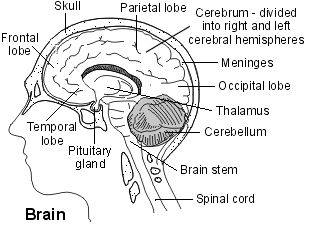
Das Großhirn ist der Hauptteil des Gehirns. Es liegt innerhalb deines Schädels und die Oberfläche ähnelt einer Walnuss. Es ist in die rechte Seite (rechte Hemisphäre) unterteilt, die die linke Körperseite steuert, und die linke Hemisphäre, die die rechte Körperseite steuert.
Das Großhirn ist auch der Ort, an dem Sie denken und Ihr Gedächtnis speichern (insbesondere das Langzeitgedächtnis). Jede Hemisphäre ist in Teile unterteilt, die mit bestimmten Funktionen verbunden sind. Die Hauptunterteilungen sind der Frontallappen, der Temporallappen, der Parietallappen und der Okzipitallappen.
Was macht der Temporallappen?
Der Temporallappen ist beteiligt an:
Verstehen und Erinnern an das, was wir sehen (Sehen).
Verstehen von Sprache und Sprachgebrauch.
Verstehen und Bewältigen von Emotionen.
Speichern und Abrufen von Erinnerungen.
Was verursacht Läsionen des Temporallappens?
Es gibt viele mögliche Ursachen für Läsionen des Temporallappens. Die häufigsten Ursachen sind:
A Schlaganfall. Ein Schlaganfall betrifft normalerweise andere Teile des Gehirns, kann aber im Schläfenlappen auftreten. Schlaganfälle können durch ein Blutgerinnsel oder eine Blutung verursacht werden.
Gehirntumore may affect the temporal lobe of the brain.
A serious Kopfverletzung or a surgical operation to remove a brain tumour may may also cause damage or injury to the temporal lobe.
Progressive worsening of language can be part of a Art von Demenz genannt frontotemporale Demenz.
The temporal lobe can be affected by an Gehirninfektion (Enzephalitis), insbesondere Enzephalitis durch das Herpes-simplex-Virus.
Other conditions affecting the brain, wie Multiple Sklerose, kann auch die Temporallappen des Gehirns beeinflussen.
Wie häufig sind Läsionen des Temporallappens?
Temporallappenläsionen sind ungewöhnlich, aber nicht selten. Einige Temporallappenläsionen können jedoch sehr klein sein und keine offensichtlichen Symptome verursachen. Daher ist nicht genau bekannt, wie häufig Temporallappenläsionen sind.
Welche Symptome verursachen Läsionen des Temporallappens?
The symptoms caused by temporal lobe lesions are usually much less obvious than when other parts of the brain are affected. For example, many strokes will cause muscle weakness (paralysis), often affecting one side of the body. However, the symptoms caused by a stroke affecting the temporal lobe will be much less obvious.
Eine Läsion des Temporallappens kann verschiedene Symptome verursachen, die von anderen Personen möglicherweise nicht bemerkt werden. Diese Symptome können umfassen:
Vergesslichkeit.
Probleme mit Sprache und Sprechen (insbesondere das Verstehen dessen, was andere sagen).
Probleme mit dem Sehen.
Temporal lobe lesions may also cause fits (seizures).
Probleme mit dem Hören.
Objekte identifizieren.
Learning new information and being unable to identify emotions in others.
Läsionen des Temporallappens können auch Gedächtnisprobleme verursachen und Veränderungen in Ihrer Persönlichkeit hervorrufen.
The symptoms you experience will depend on what is causing the problem in the temporal lobe. A stroke will usually cause a sudden onset of symptoms, but a brain tumour will often cause a slow onset and progression of symptoms.
Die Symptome hängen auch davon ab, ob nur der Temporallappen betroffen ist oder ob auch andere Teile des Gehirns von der zugrunde liegenden Erkrankung betroffen sind.
Temporallappenepilepsie
Seizures which begin in the temporal lobe can cause a wide variety of symptoms.
These symptoms may include different feelings, emotions, thoughts and experiences.
Diese Gefühle könnten Ihnen vertraut sein oder Sie haben diese Gefühle zum ersten Mal.
You may suddenly remember something from your past or feel that everything around you is strange and unknown to you.
You may feel that you have already experienced something that is actually happening for the first time (this is called déjà vu).
Sie können sich auch Stimmen, Musik, Gerüche oder Geschmäcker vorstellen, die nicht wirklich da sind (Halluzinationen).
Die Symptome des Anfalls können sehr mild sein und kaum bemerkt werden oder sehr schwerwiegend sein und Ihnen große Angst machen. Der Anfall kann auch angenehme Empfindungen hervorrufen und erfreulich sein.
Temporal lobe epilepsy can be treated with medicines that are used for epilepsy, but treatment will also depend on any underlying temporal lobe lesion. Siehe das separate Informationsblatt mit dem Titel Epilepsie mit fokalen Anfällen für weitere Details.
Wie werden Läsionen des Temporallappens diagnostiziert?
Der wichtigste Teil bei der Diagnose eines Problems im Temporallappen ist eine gründliche Anamnese Ihrer Symptome. Eine Anamnese Ihrer Symptome von jemandem, der Ihnen nahesteht und gesehen hat, was passiert, wenn Sie die Symptome haben, ist ebenfalls sehr hilfreich.
Die Symptome können sehr komplex sein und manchmal ist eine Beurteilung durch einen Psychologen erforderlich, um genau zu identifizieren, welche Symptome auf die vermutete Läsion des Temporallappens zurückzuführen sind.
Temporal lobe lesions may cause you to be unable to see one area in your field of vision (this is called a visual field defect). Your visual fields will therefore also be tested.
The best way to find the cause of a temporal lobe lesion is by eine MRT-Untersuchung haben of your brain. Any further investigations will depend on the underlying cause of the temporal lobe lesion. If an infection (for example, HSV encephalitis) is suspected, then blood tests and a lumbar puncture (where a sample of fluid is taken from around the spinal cord in your back) may be performed.
Gibt es Behandlungen für Läsionen des Temporallappens?
Ein Psychologe kann Ihnen oft helfen, einige der durch eine Schädigung des Temporallappens verursachten Symptome zu überwinden.
Die Behandlung hängt ansonsten von der Ursache der Läsion im Temporallappen ab.
Was ist das Ergebnis (Prognose)?
The outcome will depend on the underlying cause and whether any other parts of the brain are also affected.
Junge Menschen, insbesondere Kinder, sind in der Lage, einen anderen Teil des Gehirns zu nutzen, um die Funktion eines beschädigten Teils des Gehirns zu übernehmen, aber diese Fähigkeit geht verloren, wenn wir älter werden. Daher ist es wahrscheinlicher, dass junge Menschen im Vergleich zu älteren Menschen einige der Gehirnfunktionen wiedererlangen, die durch eine Schädigung des Temporallappens verloren gegangen sind.
Können Läsionen des Temporallappens verhindert werden?
There is a great deal we can do to reduce our risk of a stroke. See the separate leaflet called Herz-Kreislauf-Erkrankungen (Atheroma) für weitere Details.
Patientenauswahl für Nervenstörungen

Gehirn und Nerven
Neuropathischer Schmerz
Neuropathischer Schmerz (Neuralgie) ist ein Schmerz, der durch Probleme mit Nervensignalen verursacht wird. Es gibt verschiedene Ursachen. Er unterscheidet sich von der üblichen Art von Schmerz, die durch eine Verletzung, Verbrennung, Druck usw. verursacht wird. Traditionelle Schmerzmittel wie Paracetamol, Entzündungshemmer und Codein helfen in der Regel nicht sehr viel. Allerdings wird neuropathischer Schmerz oft durch Antidepressiva oder antiepileptische Medikamente gelindert - durch eine Wirkung, die unabhängig von ihrer Wirkung auf Depressionen und Epilepsie ist. Auch andere schmerzlindernde Medikamente und Techniken werden manchmal eingesetzt.
von Dr. Surangi Mendis, MRCGP

Gehirn und Nerven
Postherpetische Neuralgie
Postherpetische Neuralgie ist ein Schmerz, der bei einigen Menschen, die Gürtelrose hatten, bestehen bleibt. Er lässt oft nach und verschwindet mit der Zeit. Medikamente können oft den Schmerz lindern.
von Dr. Philippa Vincent, MRCGP
Häufig gestellte Fragen
Wie häufig sind Läsionen des Temporallappens?
Temporal lobe lesions are considered uncommon but not rare. However, it's difficult to know the exact prevalence because some lesions can be very small and may not cause any noticeable symptoms, meaning they go undetected.
What is the cerebrum and where is it located?
The cerebrum is the main and largest part of the brain, situated inside your skull. Its surface has a wrinkled appearance, similar to a walnut. It is divided into two hemispheres, the right and the left, and is responsible for thought and memory storage.
What specifically does the frontal temporal lobe control?
The article describes the temporal lobe's functions, including understanding and remembering what we see, understanding speech and language, managing emotions, and storing and recalling memories. It also mentions the frontal lobe as a separate division of the cerebrum, but does not specifically detail what the 'frontal temporal lobe' controls as a combined entity.
Can problems with the temporal lobe affect one's personality?
Yes, temporal lobe lesions can lead to changes in your personality. They can also cause problems with memory.
Is it possible to recover from temporal lobe damage?
The ability to recover from temporal lobe damage depends on the underlying cause and if other parts of the brain are affected. Young people, especially children, have a greater capacity to adapt, as other parts of their brain can take over the functions of the damaged area. This ability decreases with age.
Weiterführende Literatur und Referenzen
- Faust K, Schmiedek P, Vajkoczy P; Ansätze zur Behandlung von Läsionen des Temporallappens: ein Vorschlag zur Klassifikation. Acta Neurochir (Wien). 2014 Feb;156(2):409-13. doi: 10.1007/s00701-013-1917-4. Epub 2013 Nov 8.
- Zhao F, Kang H, You L, et al; Neuropsychologische Defizite bei Temporallappenepilepsie: Ein umfassender Überblick. Ann Indian Acad Neurol. 2014 Okt;17(4):374-82. doi: 10.4103/0972-2327.144003.
- Patel A, Biso GMNR, Fowler JB; Neuroanatomy, Temporal Lobe
Über den AutorVollständige Biografie anzeigen

Dr Rachel Hudson, MRCGP
Allgemeinmediziner und Medizinischer Autor
MBChB, MRCGP (2008), BSc (Medical Science), DFSRH, DRCOG, DCH
Dr. Rachel Hudson ist eine NHS-Ärztin, die im Nordwesten Englands arbeitet.
Über den RezensentenVollständige Biografie anzeigen

Dr Caroline Wiggins, MRCGP
Allgemeinmediziner, Medizinischer Autor
MBBS Auszeichnung (mit Auszeichnung), MRCGP (2016), MSc.SEM (mit Auszeichnung), BSc (Hons)
Dr. Caroline Wiggins ist derzeit als Vertretungsärztin im Südwesten Englands tätig.
Artikelverlauf
Die Informationen auf dieser Seite wurden von qualifizierten Klinikern verfasst und begutachtet.
Artikel auch verfügbar in Englisch, Deutsch, Spanisch, Französisch, Italienisch, Portugiesisch, Hindi, Hebräisch, Arabisch, und Schwedisch.
Nächste Überprüfung fällig: 28. Apr 2027
29. Apr 2022 | Neueste Version

Fragen, teilen, verbinden.
Durchsuchen Sie Diskussionen, stellen Sie Fragen und teilen Sie Erfahrungen zu Hunderten von Gesundheitsthemen.

Fühlen Sie sich unwohl?
Bewerten Sie Ihre Symptome online kostenlos
Abonnieren Sie den Patienten-Newsletter
Ihre wöchentliche Dosis klarer, vertrauenswürdiger Gesundheitsberatung - geschrieben, um Ihnen zu helfen, sich informiert, selbstbewusst und in Kontrolle zu fühlen.
Durch das Abonnieren akzeptieren Sie unsere Datenschutzrichtlinie. Sie können sich jederzeit abmelden. Wir verkaufen Ihre Daten niemals.
Mehr über Gehirn und Nerven
- ADHS bei Erwachsenen
- ADHS bei Kindern
- Aphasie
- Bell-Lähmung
- Ursachen von Gedächtnisverlust und Demenz
- Zerebralparese
- Gehirnerschütterung
- Legasthenie
- Epilepsie und Verhütung
- Funktionelle neurologische Störung
- Kopfverletzungen
- Lumbalpunktion
- Medikamentenübergebrauchskopfschmerz
- Gedächtnisverlust und Demenz
- Migränebehandlung
- Neuroblastom
- Parkinson-Krankheit
- Stottern
- Schlaganfall
- Zittern