Was ist Kreatin? Vorteile, Anwendungen und Risiken
Begutachtet von Dr Colin Tidy, MRCGPVerfasst von Josh AldermanUrsprünglich veröffentlicht 12 Mar 2026
Erfüllt die Anforderungen des Patienten Richtlinien des Patienten
- HerunterladenHerunterladen
- Teilen
- Language
- Diskussion
- Audio-Version
Creatine is one of the most popular sports supplements in the UK. Often associated with gym training and muscle building, creatine is widely used to support strength and performance. But it isn’t just for athletes - it’s a naturally occurring substance found in your body and in certain foods.
So, what does creatine do, what are the potential creatine benefits, and are there any downsides to consider?
In diesem Artikel:
Videoauswahl für Vitamine und Nahrungsergänzungsmittel
Lesen Sie unten weiter
What is creatine?
Creatine is a natural compound made in your liver, kidneys and pancreas from amino acids. Around 95% of it is stored in your muscles, with small amounts found in your brain.1
You also get creatine from foods such as red meat and fish. However, the amount from diet alone is much lower than the amount typically provided by supplements.
Creatine supplements are usually sold as powders, capsules, or tablets. The most widely studied and commonly used form is creatine monohydrate.2
How does creatine work?
Zurück zum InhaltCreatine plays an important role in energy production. It helps your body make adenosine triphosphate (ATP), which is the main energy source your cells use, especially during short bursts of intense activity.
Taking creatine increases the amount stored in your muscles.
This may help your muscles:
Produce energy more quickly.
Sustain high-intensity activity for slightly longer.
Recover more effectively between sets.
So when it comes to short, high-powered efforts such as weightlifting, sprinting, or HIIT, creatine can make a real impact-but it doesn’t offer the same benefit for longer, steady-state endurance exercise.
Lesen Sie unten weiter
What are the benefits of creatine?
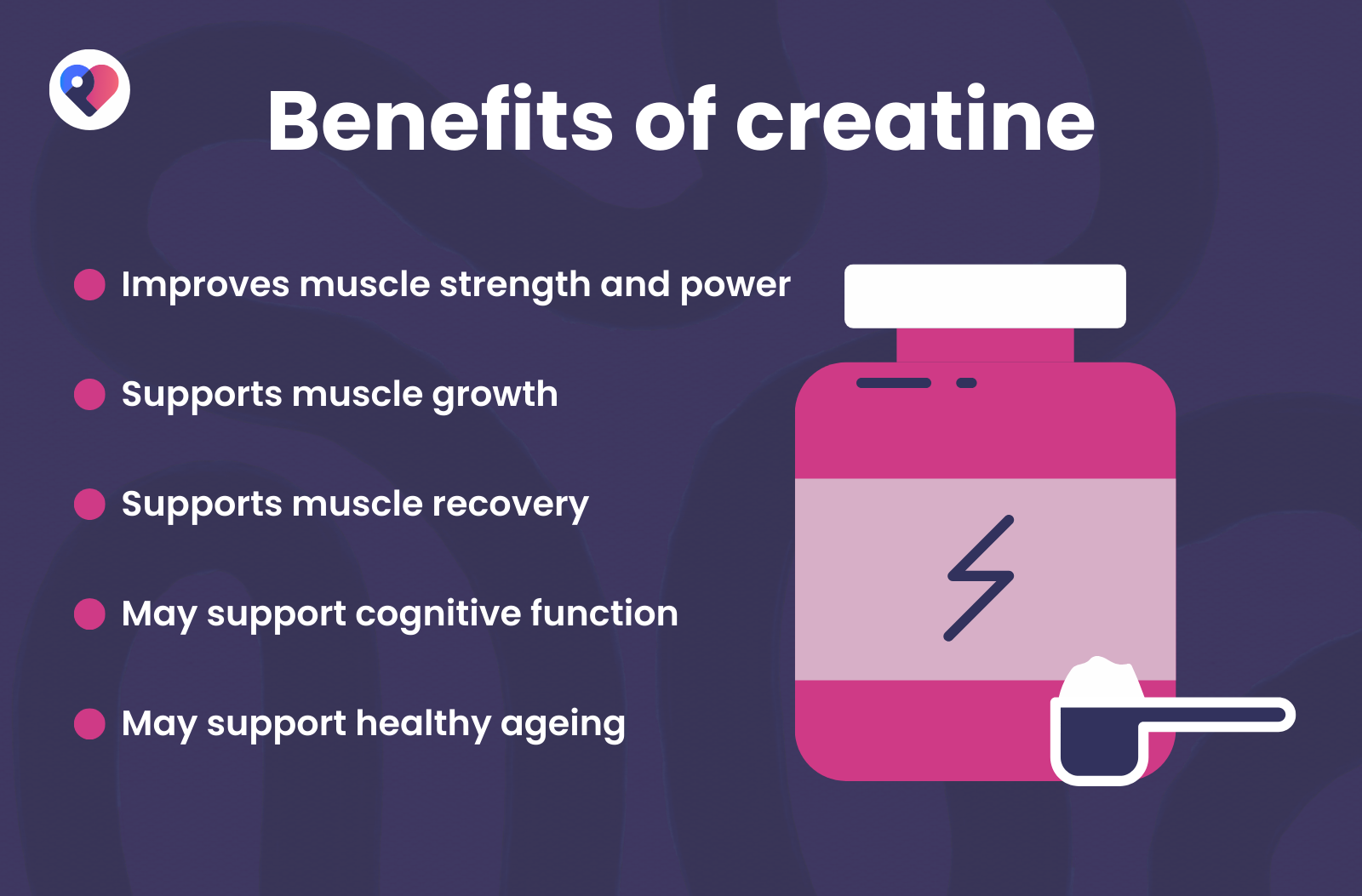
Zurück zum InhaltIf you're thinking about adding creatine to your routine, here are five reasons it might be worth it.
© Patient / Heather Ainsworth
1. Improves muscle strength and power
Creatine may increase muscle strength and power output.3Many people find they can lift slightly heavier weights or perform more repetitions.
2. Supports muscle growth
Creatine can contribute to increased muscle size.4 This is partly due to greater training capacity and partly because creatine draws water into muscle cells.
A small increase in body weight is common in the first few weeks. This is usually water stored in muscle, not fat.
3. Supports muscle recovery
Some evidence suggests creatine may help support muscle recovery after intense exercise,5 allowing more consistent training.
4. May support cognitive function
Because creatine is also present in the brain, researchers are studying whether it may support memory or mental performance in certain situations as well as possibly aid in combating conditions such as Demenz.5 More research is needed before firm conclusions can be made.
5. May support some medical conditions
Creatine has also been studied in a range of medical conditions that affect muscle strength and energy production. These include inherited muscle disorders such as muscular dystrophy and other myopathies,6 as well as mitochondrial disorders,8 where the body’s ability to produce energy is impaired.
Researchers have also explored its potential role in neurological conditions such as Parkinson’s disease7und Multiple Sklerose,8 und im age-related muscle loss (sarcopenia). 9
While some small studies suggest creatine may improve muscle strength or reduce fatigue in certain groups, results have been mixed and benefits are not consistent.
Is creatine safe?
Zurück zum InhaltFor healthy adults taking recommended doses, creatine is generally considered safe. It is one of the most researched supplements available.
Side effects of creatine
Possible side effects include:
Temporary weight gain.
Bloating.
Mild stomach discomfort.
These effects are more likely with higher doses. Drinking enough fluids may help reduce digestive symptoms.
There is no strong evidence that creatine causes kidney damage in healthy people using standard doses.
Should you speak to a doctor before taking creatine?
Creatine may not be suitable for everyone.
Seek medical advice if you:
Have kidney or liver disease.
Are pregnant or breastfeeding.
Are under 18.
Have a long-term medical condition.
Take regular medicine.
As with all supplements, product quality can vary. Choosing reputable brands is advisable.
Lesen Sie unten weiter
Zusammenfassung
Zurück zum InhaltCreatine is a naturally occurring compound that helps your muscles produce energy during short bursts of high-intensity activity. When taken as a supplement, it may improve strength, power, and muscle mass - particularly when combined with structured training.
The main creatine benefits relate to improved exercise performance and increased muscle size. For most healthy adults taking recommended doses, creatine is considered safe, with mild side effects such as temporary weight gain or bloating.
However, creatine isn’t suitable for everyone. If you have kidney disease, are pregnant, or manage a long-term health condition, it’s important to seek medical advice before starting supplementation.
Creatine can be a useful addition to a well-balanced training plan - but it’s not a replacement for regular exercise and a healthy diet.
Häufig gestellte Fragen
Zurück zum InhaltIs creatine safe to take every day?
Yes, for most healthy adults, taking 3-5 grams of creatine daily is considered safe. Consistency is more important than cycling on and off.
Does creatine cause hair loss?
There is limited evidence linking creatine to hair loss. A small study suggested it may increase levels of a hormone linked to male pattern baldness, but this has not been confirmed in larger research. There is no clear evidence that creatine directly causes hair loss.10
Does creatine damage your kidneys?
In healthy people using recommended doses, creatine has not been shown to damage kidney function. However, people with existing kidney disease should avoid it unless advised by a doctor.
Do you need a loading phase?
A loading phase (around 20 grams daily for 5-7 days) can increase muscle creatine stores more quickly. However, it is not essential. Taking 3-5 grams daily will achieve similar levels over several weeks.
Can you take creatine without exercising?
Creatine may still increase muscle stores without exercise, but most creatine benefits are seen when combined with resistance training.
Patientenempfehlungen für Vitamine und Nahrungsergänzungsmittel

Ernährung und Diät
Was sind die Vorteile von Vitamin E?
Vitamin E ist ein beliebter Bestandteil jeder Hautpflegeroutine. Aber es ist auch wichtig für Ihre Gesundheit und die Funktionsweise Ihres Körpers. Erfahren Sie hier, warum und wie Sie genug Vitamin E bekommen.
von Victoria Raw

Seniorengesundheit
Die besten Anti-Aging-Nahrungsergänzungsmittel für Ihre Gesundheit
Der Begriff Anti-Aging steht auf vielen Schönheitscremes und anderen Hautpflegeprodukten. Aber was bedeutet Anti-Aging im Körper? Hier geht es über das Erscheinungsbild unserer Gesichtslinien hinaus zu einem gesunden inneren Altern. Das bedeutet, wie gut unsere Zellen und Organe gesund bleiben und in der Lage sind, Rückgang und Krankheit zu bekämpfen, während wir älter werden - damit wir so lange wie möglich glücklich leben können. Wir untersuchen die Anti-Aging-Nahrungsergänzungsmittel, die unseren Körpern dabei helfen, genau das zu tun, laut Experten.
von Lawrence Higgins
Weiterführende Lektüre und Referenzen
- Felipe Ribeiro et al. "Creatine supplementation and muscle-brain axis: a new possible mechanism?." Frontiers in Nutrition, 12 (2025).
- R. Kreider et al. "Bioavailability, Efficacy, Safety, and Regulatory Status of Creatine and Related Compounds: A Critical Review."
- Camic CL, Hendrix CR, Housh TJ, et al; The effects of polyethylene glycosylated creatine supplementation on muscular strength and power. J Strength Cond Res. 2010 Dec;24(12):3343-51. doi: 10.1519/JSC.0b013e3181fc5c5c.
- Drzewiecki, Artur, et al. “The Effect of Creatine on Muscle Mass Gain: A Literature Review”. Quality in Sport,
- Xu, Chen, et al. “The Effects of Creatine Supplementation on Cognitive Function in Adults: A Systematic Review and Meta-Analysis.”
- Kley, Rudolf A, et al. “Creatine for Treating Muscle Disorders.” Cochrane Database of Systematic Reviews
- Yea-Hyun Leem, et al. “Creatine Supplementation with Exercise Reduces α-Synuclein Oligomerization and Necroptosis in Parkinson’s Disease Mouse Model.” The Journal of Nutritional Biochemistry, vol. 126
- Ostojic, Sergej M. “Creatine and Multiple Sclerosis.” Nutritional Neuroscience
- Dolan, Eimear, et al. “Muscular Atrophy and Sarcopenia in the Elderly: Is There a Role for Creatine Supplementation?”
- Lak, Mohammadyasin, et al. “Does Creatine Cause Hair Loss? A 12-Week Randomized Controlled Trial.” Journal of the International Society of Sports Nutrition, vol. 22
Lesen Sie unten weiter
Artikelverlauf
Die Informationen auf dieser Seite werden von qualifizierten Klinikern begutachtet.
Next review due: 12 Mar 2029
12 Mar 2026 | Ursprünglich veröffentlicht
Verfasst von:
Josh AldermanBegutachtet von
Dr Colin Tidy, MRCGP

Fragen, teilen, verbinden.
Durchsuchen Sie Diskussionen, stellen Sie Fragen und teilen Sie Erfahrungen zu Hunderten von Gesundheitsthemen.

Fühlen Sie sich unwohl?
Bewerten Sie Ihre Symptome online kostenlos
Abonnieren Sie den Patienten-Newsletter
Ihre wöchentliche Dosis klarer, vertrauenswürdiger Gesundheitsberatung - geschrieben, um Ihnen zu helfen, sich informiert, selbstbewusst und in Kontrolle zu fühlen.
Mit dem Abonnieren akzeptieren Sie unsere Datenschutzrichtlinie. Sie können sich jederzeit abmelden. Wir verkaufen Ihre Daten niemals.