Urethritis bei Männern
Urethral discharge
Fachlich geprüft von Dr Colin Tidy, MRCGPZuletzt aktualisiert von Dr Toni Hazell, FRCGPZuletzt aktualisiert 20. Juni 2024
Entspricht den redaktionellen Richtlinien
- HerunterladenHerunterladen
- Teilen
- Language
- Diskussion
- Audio-Version
- Zu bevorzugten Quellen bei Google hinzufügen
In dieser Serie:Sexuell übertragbare InfektionenGenitalwarzenGenitalherpesGonorrhöTrichomoniasisMycoplasma genitalium
Urethritis bedeutet eine Entzündung der Harnröhre (dem Schlauch in Ihrem Penis, der den Urin aus Ihrer Blase transportiert). Urethritis wird normalerweise durch eine sexuell übertragbare Infektion (STI) verursacht, aber nicht immer. Sie kann auch in einer stabilen Beziehung auftreten.
Auf einen Blick
Urethritis ist eine Entzündung der Harnröhre, des Kanals, der den Urin aus dem Körper transportiert.
Häufige Symptome sind Ausfluss aus dem Penis oder Schmerzen beim Wasserlassen.
Einige Männer mit Urethritis haben keine Symptome.
Es tritt am häufigsten bei sexuell aktiven Männern unter 25 Jahren auf, die kürzlich ihre Partner gewechselt haben.
Wenn Sie vermuten, dass Sie eine Urethritis haben, wenden Sie sich an eine urogenitale Klinik oder Ihren Hausarzt.
Es ist wichtig, die Behandlung abzuschließen, um ernsthafte Komplikationen für sich selbst und andere zu verhindern.
Do not have sex until you and your partner(s) have completed treatment.
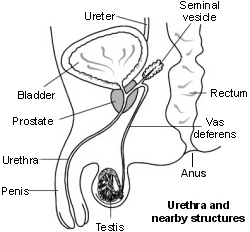
Cross-section diagram showing urethra and nearby structures in men
What causes urethritis in men?
Any man can develop urethritis. However, it's most common among sexually active men under 25 who have recently changed their sexual partner. It's also more likely if you have unprotected sex (without a condom). If you have, or have had any STI, you are at more risk of getting another.
Gonorrhö is one type of STI which can cause urethritis.
Non-gonococcal urethritis (NGU) is the term used to describe urethritis caused by anything other than gonorrhoea. Infection with a germ (bacterium) - either Chlamydia trachomatis or Mycoplasma genitalium - is the common cause of NGU. It can also be caused by a variety of other germs (bacteria or viruses). NGU may rarely have a non-infective cause, such as trauma or blockage or a reaction to a soap or cream.
Beide. Some men have gonococcal and non-gonococcal urethritis at the same time, for example infection with both gonorrhoea and chlamydia.
No obvious cause can be found in up to three out of ten men with urethritis.
Urethritis symptoms
A fluid (discharge) from the end of the penis is common but does not always occur.
Pain or burning when you pass urine. This may be confused with a Harnwegsinfektion.
You may have soreness or irritation inside the penis, or a feeling of wanting to pass urine frequently.
Some men with urethritis never develop any symptoms. For example, up to half of men with chlamydial infection (the most common cause of NGU) do not have any symptoms.
Ulceration on the skin at the head of the penis - this may be caused by herpes simplex virus.
How does urethritis progress?
Occasionally, symptoms may clear without treatment but may take months to do so. If your condition has been caused by an infection, germs (bacteria) may still be present, even if the symptoms have gone. You are therefore likely to still be able to pass the infection on to a partner.
One bacterium that commonly causes inflammation of the urethra (urethritis) in men (chlamydia) can cause serious problems in women, including pelvic inflammatory disease (PID) and difficulties with getting pregnant in the future. It is important that you get tested, and treated if necessary, in order to prevent complications for yourself and others.
You can read about possible complications in the separate leaflets called Gonorrhö und Nicht-gonorrhoische Urethritis.
What should I do if I have symptoms of urethritis?
If you suspect that you have urethritis, contact your local genitourinary (GUM) clinic - find one from the 'Find a sexual health clinic' link in Further Reading below. Alternatively, contact your GP.
You are likely to be offered tests for HIV, Hepatitis und Syphilis, as people with inflammation of the urethra (urethritis) sometimes have these conditions as well.
Men who have sex with men may also need to have swabs taken from the back of the throat (pharynx) and back passage (rectum).
The GUM clinic will protect your confidentiality but, if they confirm you have an infection, they will suggest that you contact anyone you had sex with up to three months before you were diagnosed. This is called 'contact tracing'. The clinic can do this for you if you wish and they do not have to give your name.
Medikamente genannt Antibiotika will usually clear an infection. The antibiotic prescribed depends on the cause. Make sure you complete the course.
If your urethritis is due to gonorrhoea, it is vital that you have another test after you have been treated to make sure the infection has been cured. This will usually be done 7 - 14 days after treatment.
Tell your sexual partner(s) to see their doctor or go to a GUM clinic, even if they have no symptoms. Many women with sexually transmitted infections do not have symptoms.
Don't have sex (including oral and anal sex) until you and your sexual partner(s) have completed tests and treatment. You should wait seven days after you have had your treatment course to avoid passing on the infection: your doctor will advise.
Patientenauswahl für Sexuelle Gesundheit von Männern

Sexuelle Gesundheit
Klinefelter-Syndrom
Das Klinefelter-Syndrom ist eine genetische Erkrankung, die nur Männer betrifft. Betroffene Männer haben ein zusätzliches X-Chromosom. Es wird manchmal einfach XXY genannt. Zwischen 1 von 500 und 1 von 1.000 Jungen werden mit dem Klinefelter-Syndrom (KS) geboren. Viele Menschen mit KS werden erst im Erwachsenenalter diagnostiziert, und es wird angenommen, dass bis zu zwei Drittel möglicherweise nie diagnostiziert werden. Männer mit Klinefelter-Syndrom haben kleine Hoden, die vor der Geburt und während der Pubertät nicht genügend des männlichen Hormons Testosteron produzieren. Dieser Mangel an Testosteron bedeutet, dass sich während der Pubertät die normalen männlichen Geschlechtsmerkmale möglicherweise nicht vollständig entwickeln. Es neigt dazu, dass weniger Gesichts- und Körperbehaarung vorhanden ist, und es entwickelt sich oft etwas Brustgewebe. Der Mangel an Testosteron ist auch für andere Symptome des Klinefelter-Syndroms verantwortlich, einschließlich Unfruchtbarkeit. Die Behandlung umfasst den Ersatz von Testosteron. Dies kann helfen, einige der Symptome zu verbessern, hat jedoch keinen Einfluss auf die Fruchtbarkeit. Die Mehrheit der Männer mit Klinefelter-Syndrom führt ein unabhängiges Leben, geht Beziehungen ein und hat einen normalen Job. Sie haben oft auch eine normale Lebenserwartung.
von Dr. Toni Hazell, FRCGP

Sexuelle Gesundheit
Niedriger Testosteronspiegel
Niedriger Testosteronspiegel bei Männern (Testosteronmangel) ist oft Teil des Alterungsprozesses und daher bei älteren Männern häufig. Er kann auch in jedem Alter als Folge von Erkrankungen auftreten, die die Hoden oder die Hypophyse im Gehirn betreffen. Niedriger Testosteronspiegel kann mit einer Testosteronersatztherapie behandelt werden. Jede zugrunde liegende Ursache für den Testosteronmangel muss ebenfalls behandelt werden. Die Prognose hängt von der zugrunde liegenden Ursache ab.
von Dr. Philippa Vincent, MRCGP
Häufig gestellte Fragen
Kann sich eine Urethritis von selbst lösen?
Gelegentlich können die Symptome einer Urethritis ohne Behandlung verschwinden. Dies kann jedoch mehrere Monate dauern. Selbst wenn die Symptome abklingen, können die infektionsverursachenden Keime (Bakterien) noch vorhanden sein, was bedeutet, dass Sie die Infektion immer noch an einen Sexualpartner weitergeben könnten.
Betroffen von Urethritis nur sexuell aktive Männer?
Obwohl Urethritis am häufigsten bei sexuell aktiven Männern unter 25 Jahren auftritt, die kürzlich den Partner gewechselt oder ungeschützten Sex hatten, kann jeder Mann eine Urethritis entwickeln. Es ist auch wahrscheinlicher, wenn Sie zuvor eine STI hatten.
Can urethritis be caused by something other than an infection?
Ja, in seltenen Fällen kann nicht-gonorrhoische Urethritis (NGU) eine nicht-infektiöse Ursache haben. Dazu können Traumata, eine Blockade in der Harnröhre oder eine allergische Reaktion auf eine Seife oder Creme gehören.
Warum ist es wichtig, dass sich meine Sexualpartner testen lassen, wenn ich Urethritis habe?
Es ist wichtig, dass sich Ihre Sexualpartner testen lassen, auch wenn sie keine Symptome haben, da viele Frauen mit sexuell übertragbaren Infektionen keine Symptome zeigen. Außerdem können einige Bakterien, die bei Männern Urethritis verursachen, wie Chlamydien, bei Frauen zu ernsthaften Problemen führen, wie entzündliche Beckenerkrankungen (PID) und zukünftige Fruchtbarkeitsprobleme. Sich testen und behandeln zu lassen, verhindert Komplikationen sowohl für Sie als auch für andere.
Was ist 'Kontaktverfolgung'?
Kontaktverfolgung ist ein Prozess, bei dem die Klinik, nachdem sie eine Infektion bei Ihnen bestätigt hat, Ihnen vorschlägt, alle Personen zu informieren, mit denen Sie bis zu drei Monate vor Ihrer Diagnose Geschlechtsverkehr hatten. Die Klinik kann dies anonym für Sie tun, wenn Sie es bevorzugen, ohne Ihren Namen preiszugeben.
Werden weitere Tests durchgeführt, wenn auf Urethritis untersucht wird?
Wenn Sie auf Urethritis getestet werden, werden Ihnen wahrscheinlich auch Tests auf HIV, Hepatitis und Syphilis angeboten. Dies liegt daran, dass Menschen mit Urethritis manchmal auch diese Erkrankungen haben. Männer, die Sex mit Männern haben, benötigen möglicherweise auch Abstriche aus ihrem Rachen und Rektum.
Weiterführende Literatur und Referenzen
- BASHH 2015 UK National Guideline on the management of non-gonococcal urethritis; International Journal of STD & AIDS. Last updated 2018,
- 2018 UK national guideline for the management of infection with Neisseria gonorrhoeae; British Association for Sexual Health and HIV (BASHH) - 2018: reviewed 2020
- Finden Sie eine Sexualgesundheitsklinik in Ihrer Nähe; NHS-Dienste
- CKS Urethritis - male; NICE CKS, Mai 2024 (nur Zugang in Großbritannien)
Über den AutorVollständige Biografie anzeigen

Dr Toni Hazell, FRCGP
MBBS, BSc, FRCGP, DFSRH, Dip GU med, DRCOG, DCH (London, UK, 2000)
Dr. Toni Hazell hat ihren Abschluss an der St. Mary’s Hospital Medical School gemacht und ihr VTS am Northwick Park Hospital absolviert.
Über den RezensentenVollständige Biografie anzeigen

Dr Colin Tidy, MRCGP
Allgemeinmediziner, Medizinischer Autor
MBBS, MRCGP, MRCP (Paediatrics), DCH
Dr. Colin Tidy ist ein NHS-Arzt mit Sitz in Oxfordshire.
Artikelverlauf
Die Informationen auf dieser Seite wurden von qualifizierten Klinikern verfasst und begutachtet.
Artikel auch verfügbar in Englisch, Deutsch, Spanisch, Französisch, Italienisch, Portugiesisch, Hindi, Hebräisch, Arabisch, und Schwedisch.
Nächste Überprüfung fällig: 19. Juni 2027
20. Juni 2024 | Neueste Version

Fragen, teilen, verbinden.
Durchsuchen Sie Diskussionen, stellen Sie Fragen und teilen Sie Erfahrungen zu Hunderten von Gesundheitsthemen.

Fühlen Sie sich unwohl?
Bewerten Sie Ihre Symptome online kostenlos
Abonnieren Sie den Patienten-Newsletter
Ihre wöchentliche Dosis klarer, vertrauenswürdiger Gesundheitsberatung - geschrieben, um Ihnen zu helfen, sich informiert, selbstbewusst und in Kontrolle zu fühlen.
Durch das Abonnieren akzeptieren Sie unsere Datenschutzrichtlinie. Sie können sich jederzeit abmelden. Wir verkaufen Ihre Daten niemals.
Mehr zur sexuellen Gesundheit
- Chlamydien
- Kondom
- Verhütungsmethoden mit Barriere
- Verhütungsimplantat
- Verhütungsspritze
- Erektile Dysfunktion
- Weibliche Sterilisation
- Klinefelter-Syndrom
- Levonorgestrel-Intrauterinsystem
- Langwirksame reversible Verhütungsmittel
- Niedriger Testosteronspiegel
- Nicht-gonorrhoische Urethritis
- Beckenentzündung
- Gestagen-alleinige Antibabypille
- Sicherer Sex
- STI-Tests
- Soor bei Männern
- Trichomoniasis
- Vaginaler Ausfluss
- Vaginale Trockenheit