Legionärskrankheit
Begutachtet von Dr Rosalyn Adleman, MRCGPZuletzt aktualisiert von Dr Toni Hazell, FRCGPZuletzt aktualisiert 6. Aug 2024
Erfüllt die Anforderungen des Patienten Richtlinien des Patienten
- HerunterladenHerunterladen
- Teilen
- Language
- Diskussion
- Audio-Version
- Zu bevorzugten Quellen bei Google hinzufügen
Legionnaires' disease is a serious lung infection (pneumonia) with chills, high temperature (fever) and muscle pains. You get the infection by breathing in droplets of water which contain legionella germs (bacteria) from contaminated water systems.
The earlier the illness is treated with antibiotic medication, the better the likely outcome. The illness is serious and can be fatal. However, it cannot be passed from person to person (it is not contagious). Pontiac fever is a milder illness caused by the same bacterium.
Auf einen Blick
Legionnaires' disease is a serious lung infection caused by legionella bacteria.
It can cause a cough, high temperature, shivers, headaches, and general unwellness.
Symptoms can include breathlessness, a tight chest, confusion, nausea, vomiting, and diarrhoea.
You catch it by breathing in contaminated water droplets, not by drinking infected water.
The bacteria multiply in warm, stagnant water, often in man-made water systems.
Most people with Legionnaires' disease are admitted to hospital for antibiotics and supportive care.
About 1 in 10 healthy people with the disease may die, with higher risks for those with existing health issues.
Was ist die Legionärskrankheit?
Legionnaires' disease (also called legionellosis) is an uncommon infection caused by a germ (bacterium) called legionella. The name came about from a 1976 outbreak of lung infection (pneumonia) among American ex-servicemen (Legionnaires) who attended a conference. A new germ (bacterium) that had never been identified before was found to be the cause.
There are two types of illness which can develop after being infected with this bacterium:
Legionärskrankheit. This causes a lung infection (pneumonia). It is usually a severe illness which is sometimes fatal.
Pontiac-Fieber. This occurs when the bacteria cause a flu-like illness. It is not usually serious.
What are the symptoms of Legionnaires' disease?
Lungs and airways - Legionnaires' disease
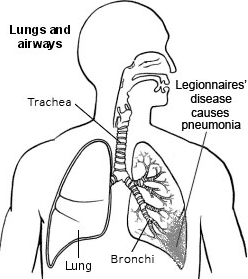
The incubation period is the period of time between breathing in the germs (bacteria) and developing symptoms of the illness. This period is normally 2-10 days. However, it can be up to 2 weeks. On average, the incubation period is 3-6 days.
The usual first symptoms are:
Husten.
Hohe Temperatur (Fieber).
Sweat.
Shivers.
Losing your appetite.
Sich allgemein unwohl fühlen.
Kopfschmerzen.
Schmerzen und Beschwerden.
Phlegm (sputum) may become yellow/green and is sometimes bloodstained.
Symptoms tend to become worse quite quickly as the infection spreads through the lung tissue. You may become breathless, breathe fast and develop a tight chest.
You may have pain in the side of the chest when breathing, worse when taking a deep breath. (This is called pleuritic chest pain and is probably due to the surface of the lung becoming inflamed.) These are typical symptoms of the lung infection pneumonia. See separate leaflet called Pneumonia for more details.
Other symptoms of Legionnaires' disease include:
fühlen.
Ein Gefühl von Übelkeit (Nausea).
Erbrechen.
Durchfall.
About 3 in 10 people have symptoms that affect the gut (gastrointestinal tract).
Complications can develop and can cause heart, brain, kidney or blood problems.
How do you get Legionnaires' disease?
Infected water
The source of the germs (bacteria) in an outbreak is usually a man-made water distribution system where the bacteria have multiplied in great numbers.
Warm storage tanks where the water stagnates are ideal for legionella bacteria to multiply. The bacteria thrive in water temperatures between 25°C and 45°C - about 35°C is the optimum temperature - particularly if the water is still and contains debris of any sort. They are killed by temperatures of 60°C and above.
This means that Legionnaires' disease can be caught from:
Piped water, especially hot water, in large buildings where long runs of pipe work can be a source of the bacteria.
Circulating water droplets in air-conditioning and cooling systems, cooling towers and evaporative condensers.
Whirlpool spas (jacuzzis), other warm-water baths and shower heads.
Decorative fountains.
Nebulisers and humidifiers (including some types of breathing equipment) if topped up with contaminated tap water.
Potting compost.
Plastics factories.
In all of the above it is particularly likely to breed if the temperature is right and the water is still.
You become infected with legionella by breathing in (inhaling) water droplets (aerosol) that are contaminated by many legionella bacteria.
An outbreak can affect many people in the same hospital, hotel, office complex or other large building, around the same time. However, they do not infect each other - they all acquire the disease from the same place.
It cannot be acquired by drinking infected water, only by inhaling droplets which allow the bacteria to reach the lungs directly.
Individual (sporadic) cases
Individual cases occur from time to time. Where only one person is infected then the source of the bacteria is often not found. There have been individual cases thought to have been caused by walking past offices with infected air-conditioning systems. About 2 in 100 cases of pneumonia that occur in previously well people are thought to be due to legionella bacteria.
Risk factors for developing Legionnaires' disease
Anyone can develop Legionnaires' disease. However, you are more likely to develop Legionnaires' disease (and pneumonia caused by other bacteria) if you are already in poor health.
Some long-term health conditions reduce your body's natural immune responses and ability to fight infection. This makes you more at risk of Legionnaires' disease, and more at risk of a serious illness if you contract Legionnaires' disease.
Conditions which lower your resistance in this way include:
Chronic lung disease. This includes Asthma and especially chronisch obstruktive Lungenerkrankung (COPD).
Other long-term conditions affecting your major organs, such as chronische Nierenerkrankung and heart disease.
Alcohol or drug dependence.
Cancer - especially Lungenkrebs oder Leukämie.
Human immunodeficiency virus (HIV) infection or acquired immune deficiency syndrome (AIDs).
The effect of medicines which affect the immune system, including:
Long-term steroid medication.
Chemotherapy for cancer.
Immunosuppressant medication, such as azathioprine, mycophenolate, ciclosporin, tacrolimus, rituximab and interferon. Immunosuppressant medication is used in the treatment of:
Joint (rheumatological) conditions.
Inflammatory diseases such as Crohn's disease.
Organ transplants.
You are also more at risk of contracting Legionnaires' disease if you are a smoker and if you are aged over 50 years.
How is Legionnaires' disease diagnosed?
Röntgenbild
Eine Röntgenaufnahme des Brustkorbs can confirm that you have lung infection (pneumonia). However, pneumonia is common and there are many germs (bacteria) and other types of germs that can cause pneumonia. (Legionnaires' disease is an uncommon cause of pneumonia.)
Blood and phlegm tests
If Legionnaires' disease or other unusual causes of pneumonia are suspected, blood tests and phlegm (sputum) tests are then done to try to identify the bacterium or other germ that is causing the pneumonia. These include blood cultures in which laboratory scientists try to make the legionella bacteria grow and multiply, so that it can be identified under a microscope.
Other blood tests can look for antibodies against legionella bacteria. Antibodies are proteins made by the immune system, which fight infection.
Urine test
In addition, a urine test can confirm most (but not all) cases of legionella infection. The test, called the legionella urinary antigen test, detects a particular protein that is part of the legionella bacterium. These proteins can be found in the urine even several months after you have been treated for Legionnaires' disease.
Lumbalpunktion
Sometimes a lumbar puncture (sometimes called a spinal tap) is performed to help diagnosis. Here, a sample of the fluid (cerebrospinal fluid, or CSF) which surrounds the spine, is removed from the lower back, using a needle and some local anaesthetic to numb the area.
This fluid flows around the brain and spinal cord to protect and nourish the nerve tissues. It can be tested to see if the legionella bacteria have infected the surface of the brain (causing legionella meningitis).
This test is generally only done if you have symptoms that suggest meningitis. See separate leaflet called Lumbar puncture for more details.
What is the treatment for Legionnaires' disease?
Most patients with Legionnaires' disease are admitted to hospital.
Antibiotika werden so schnell wie möglich verabreicht. Usually they are given intravenously (IV), which means into a vein, rather than by mouth (orally).
The usual antibiotic to treat Legionnaires' disease (or suspected Legionnaires' disease) is Erythromycin. But other antibiotics are often used - for example, azithromycin, clarithromycin, doxycycline. Ciprofloxacin and levofloxacin antibiotics might be used if there is no alternative, but should not be the first choice due to concerns about side-effects. Sometimes a combination of antibiotics is used, especially if it is not yet certain whether the infection is due to legionella or to other germs (bacteria). Treatment with antibiotics lasts from a week to three weeks, depending on how unwell you are and how quickly you recover.
Oxygen is commonly given. This is because pneumonia inflames the lungs and makes them work less well. This can cause oxygen levels to drop. Breathing in extra oxygen makes it easier for the lungs to do their job.
IV fluids are often given to keep you well hydrated. If you are very unwell, especially with a breathing problem such as lung infection (pneumonia), you are likely to be unable to drink enough fluids.
Intensive care with supportive treatments, such as assisted ventilation, may be needed if the pneumonia is severe. Assisted ventilation is used to support breathing temporarily when the effort needed to breath effectively with infected lungs becomes too tiring. When this happens oxygen levels may fall, even if you are breathing in added oxygen through a mask.
Wie ist die Aussicht (Prognose)?
Legionnaires' disease is a serious illness. Even if you were previously fit and well, you have about a 1 in 10 chance of dying if you get Legionnaires' disease. If you were previously unwell, (for example, if you already have a lung disorder) then you have a higher risk of dying if you have Legionnaires' disease.
Possible complications of Legionnaires' disease include:
Respiratory failure. This means the lung infection (pneumonia) has affected the lungs to such a degree that they cannot supply your body with oxygen without added help. In these situations you will need help with breathing, and supplemental oxygen. You might need to be treated in a high-dependency or intensive care unit. It is possible that you might need to be put to sleep (anaesthetised) and have a breathing tube inserted (be intubated), to help you through the worst period.
Akutes Nierenversagen. Severe infection can stop the kidneys from working. The kidneys usually filter and clean the blood. When there is renal failure, there is a toxic build-up of waste products in the blood. During an acute infection, the blood can be cleaned constantly by flowing through a haemofiltration machine which does the kidneys' job for you.
Severe sepsis (overwhelming infection) leading to shock. In severe cases infection can overwhelm the body and affect all parts of it, causing several organs to fail. Sepsis can also affect the blood clotting, leading to bleeding, and it makes the blood pressure fall. Severe sepsis and septic shock are dangerous conditions with a high risk of fatality.
The outlook for Legionnaires' disease is best if the illness is diagnosed as early as possible, and you are treated with antibiotics immediately.
After recovery from Legionnaires' disease, you may get symptoms such as tiredness, poor concentration, cough or mild shortness of breath. These may take several months to settle.
What is Pontiac fever?
Pontiac fever is a milder illness caused by legionella germs (bacteria). It causes a flu-like illness which lasts just a few days.
Symptoms of Pontiac fever
Symptome umfassen:
Hohe Temperatur (Fieber).
Shivers.
Kopfschmerzen.
Muskelschmerzen.
Müdigkeit.
Ein trockener Husten.
However, the infection does not affect the lungs and therefore does not cause pneumonia. Usually, no treatment is needed other than Paracetamol oder Ibuprofen to ease fever and muscle aches.
It is not clear why some people infected with legionella bacteria get Legionnaires' disease (with pneumonia) and some people get the milder Pontiac fever.
It is also thought that some people who are infected with legionella bacteria do not become ill at all (a subclinical infection).
Can infection with legionella germs (bacteria) be prevented?
As mentioned, the main cause of outbreaks of Legionnaires' disease is from contaminated water sources. In the UK, and in many other countries, there are regulations on how to maintain water supplies and air-conditioning systems used in large buildings.
This mainly involves keeping the water temperature at less than 20°C or more than 60°C. The water supply should also be kept clean and kept moving so that it doesn't stagnate. All of this reduces the chance of legionella bacteria breeding. However, it is very difficult to destroy (eradicate) this bacterium completely.
If you are an employer or a landlord, you have a legal duty to ensure all water systems in your premises are properly maintained.
If you have a home humidifier or spa, follow the manufacturer's advice about maintenance and cleaning.
About 3 in 10 cases of Legionnaires' disease diagnosed in the UK are contracted abroad, usually due to poorly maintained water storage and air-conditioning systems in hotels. Always mention any recent foreign travel if you are unwell and see your doctor.
At present, there is no vaccine that can protect against legionella bacteria.
Dr. Mary Lowth ist eine Autorin oder die ursprüngliche Autorin dieses Merkblatts.
Patientenauswahl für Brustinfektionen
Brust und Lungen
Pneumonie
Pneumonie ist eine Lungenerkrankung, die Entzündungen und Schwellungen in den Lungenbläschen (Alveolen) verursacht. Diese Bläschen können sich mit Flüssigkeit füllen, was das Atmen erschwert und den Sauerstofftransport ins Blut behindert. Sie wird meist durch bakterielle Infektionen verursacht, kann aber auch durch virale Infektionen und manchmal Pilze entstehen. Dieses Informationsblatt erklärt die Arten, Ursachen, Symptome, Behandlung und Vorbeugung von Pneumonie.
von Dr. Mohammad Sharif Razai, MRCGP

Brust und Lungen
Tuberkulose
Tuberkulose (TB) ist eine Infektion mit einem Erreger (Bakterium) namens Mycobacterium tuberculosis. Wenn Sie Symptome haben oder ein Arzt bei der Untersuchung Anzeichen der Infektion feststellen kann, spricht man von aktiver Tuberkulose. Wenn Sie eine TB-Infektion ohne Anzeichen oder Symptome haben, nennt man das latente TB.
von Dr. Colin Tidy, MRCGP
Häufig gestellte Fragen
What is the likelihood of catching Legionnaires' disease from potting compost?
Legionnaires' disease can be caught from potting compost. However, it's particularly likely to breed if the temperature is right and the water within the compost is still.
Are there any environments where Legionnaires' disease cannot be acquired?
Legionella cannot be acquired by drinking infected water. Infection only occurs by inhaling contaminated water droplets (aerosol) directly into the lungs.
What is the typical recovery time from Legionnaires' disease?
Treatment with antibiotics for Legionnaires' disease typically lasts from one to three weeks, depending on the severity of the illness and how quickly a person recovers. However, after recovery, symptoms like tiredness, poor concentration, a cough, or mild shortness of breath may persist for several months before fully settling.
How can I protect myself from Legionnaires' disease while travelling abroad?
About 3 out of 10 cases of Legionnaires' disease diagnosed in the UK are contracted abroad, often from poorly maintained water storage and air-conditioning systems in hotels. If you become unwell after foreign travel, it's important to mention your recent travel history to your doctor.
What does it mean if my chest pain is 'pleuritic'?
Pleuritic chest pain means you experience pain in the side of your chest when breathing, and it often worsens when you take a deep breath. This type of pain likely indicates that the surface of your lung is inflamed, which is a typical symptom of a lung infection like pneumonia.
Can Legionnaires' disease lead to long-term health problems?
After recovering from Legionnaires' disease, some people may experience persistent symptoms such as tiredness, difficulty concentrating, a cough, or mild shortness of breath. These symptoms can last for several months before resolving.
Weiterführende Literatur und Referenzen
- Legionärskrankheit: Leitfaden, Daten und Analyse; Öffentliche Gesundheit England
- Richtlinien für das Management von ambulant erworbener Pneumonie bei Erwachsenen; Britische Thoraxgesellschaft (2009), Thorax Bd. 64 Sup III
- Richtlinien für die Behandlung von ambulant erworbener Lungenentzündung bei Kindern; Britische Thoraxgesellschaft (2011), Thorax Bd. 66 Sup 2
- UKHSA Legionnaires' disease: national surveillance scheme
- Fluorchinolon-Antibiotika: dürfen jetzt nur noch verschrieben werden, wenn andere häufig empfohlene Antibiotika ungeeignet sind; Arzneimittel- und Gesundheitsprodukte-Bundesbehörde, GOV.UK (Januar 2024)
Über den AutorVollständige Biografie anzeigen

Dr Toni Hazell, FRCGP
MBBS, BSc, FRCGP, DFSRH, Dip GU med, DRCOG, DCH (London, UK, 2000)
Dr. Toni Hazell hat ihren Abschluss an der St. Mary’s Hospital Medical School gemacht und ihr VTS am Northwick Park Hospital absolviert.
Über den RezensentenVollständige Biografie anzeigen

Dr Rosalyn Adleman, MRCGP
MRCGP
Dr. Rosalyn Adleman ist eine NHS-Ärztin, die in Nordlondon arbeitet.
Artikelverlauf
Die Informationen auf dieser Seite wurden von qualifizierten Klinikern verfasst und begutachtet.
Artikel auch verfügbar in Englisch, Deutsch, Spanisch, Französisch, Italienisch, Portugiesisch, Hindi, Hebräisch, Arabisch, und Schwedisch.
Nächste Überprüfung fällig: 5. Aug 2027
6. Aug 2024 | Neueste Version

Fragen, teilen, verbinden.
Durchsuchen Sie Diskussionen, stellen Sie Fragen und teilen Sie Erfahrungen zu Hunderten von Gesundheitsthemen.

Fühlen Sie sich unwohl?
Bewerten Sie Ihre Symptome online kostenlos
Abonnieren Sie den Patienten-Newsletter
Ihre wöchentliche Dosis klarer, vertrauenswürdiger Gesundheitsberatung - geschrieben, um Ihnen zu helfen, sich informiert, selbstbewusst und in Kontrolle zu fühlen.
Durch das Abonnieren akzeptieren Sie unsere Datenschutzrichtlinie. Sie können sich jederzeit abmelden. Wir verkaufen Ihre Daten niemals.
Mehr in Brust und Lungen
- Asthma-Kontrolltest (ACT)
- Asthma-Inhalatoren
- Atemlosigkeit und Atembeschwerden
- Sprödes Asthma
- Bronchiolitis
- Brustschmerzen
- Husten
- Bluthusten
- COVID-19
- Epiglottitis
- Pilzinfektionen der Lunge
- Mukolytika
- Pneumonie
- Pneumothorax
- Präkordialer Fangsyndrom
- Lungenödem
- Respiratorisches Synzytial-Virus (RSV)
- Sarkoidose
- SARS- und MERS-Virus