Thyroid function tests
Peer reviewed by Dr Hayley Willacy, FRCGP Last updated by Dr Toni Hazell, FRCGPLast updated 15 Sept 2023
Meets Patient’s editorial guidelines
- DownloadDownload
- Share
- Language
- Discussion
- Audio Version
- Add to preferred sources on Google
In this series:Overactive thyroid glandGoitreThyroid eye diseaseThyroid scans and uptake testsAntithyroid medicines
Thyroid function tests are blood tests which help to check the function of your thyroid gland. They are mainly used to detect an underactive thyroid gland (hypothyroidism) and an overactive thyroid gland (hyperthyroidism).
Lots of basic information about the thyroid gland can be found in the separate leaflet called Thyroid Problems (also including Parathyroid Glands). This leaflet will only deal with the blood test that measures how your thyroid is working, not the specific diseases, such as Graves' disease, that affect the thyroid.
Note: the information below is a general guide only. The arrangements, and the way tests are performed, may vary between different hospitals. Someone can have their thyroid function test in one hospital and it could give slightly different results to having it measured in another hospital. It is important to interpret the results of your thyroid function test with the doctor who requested them - so if the test was requested by your GP, they will give you the result. If it was requested by a hospital consultant, you need to get the result from them and your GP will not have it.
At a glance
A thyroid function test is a blood test that measures hormones from your thyroid and pituitary glands.
It is mainly used to diagnose underactive or overactive thyroid glands.
You do not need to fast before the test.
Tell your doctor if you are taking any medication or are pregnant.
Test results usually take 1-3 days to come back.
What is a thyroid function test?
A thyroid function test is a blood test measuring the levels of the hormones made by your thyroid gland. The test also checks the level of a hormone made by the pituitary gland in your brain, which acts on your thyroid gland.
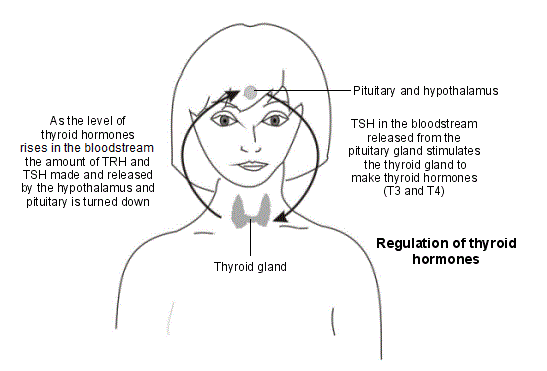
The two hormones, thyroxine (T4) and thyroid-stimulating hormone (TSH), work together and are usually in balance. In a healthy person the brain produces just the right amount of TSH to keep the thyroid gland ticking over. The thyroid gland then produces just the right amount of thyroxine.
This is called a feedback loop: if the thyroid gland makes too much thyroxine it will feed back to the brain to make less TSH. This diagram shows the feedback loop between the thyroid gland in your neck and the pituitary gland in the brain:
Regulation of thyroid hormones
What are thyroid function tests used for?
Thyroid function tests are usually done to find out whether the thyroid gland is working properly. This is mainly to diagnose an underactive thyroid gland (hypothyroidism) and an overactive thyroid gland (hyperthyroidism).
People with some conditions have an increased risk of autoimmune thyroid problems and so are often advised to have thyroid function tests undertaken each year. This conditions include:
Certain medicines can also affect the function of your thyroid - for example, amiodarone and lithium.
Thyroid function tests can also be done to:
Monitor treatment with thyroid replacement medicine for people who have hypothyroidism.
Check thyroid gland function in people who are being treated for hyperthyroidism.
Screen newborn babies for inherited problems with the thyroid gland.
Sponsored
At home thyroid blood test
Understand your thyroid function with a simple blood test at Randox Health. Weight fluctuation, trouble sleeping and sensitivity to heat or cold can all be indicative of a thyroid disorder. They test for 5 key markers to give you a comprehensive overview of your thyroid health.

What happens during a thyroid function test?
A thyroid function test is a simple blood test. The blood sample is then sent to the laboratory for analysis and the results are sent back to the doctor who asked for the tests. The results usually take 1-3 days to come back.
What should I do to prepare for a thyroid function test?
Thyroid function tests usually require very little preparation. Things to consider:
You don't need to fast before the blood test. And it doesn't matter if you have taken your thyroid medicine just before the blood test.
Tell your doctor if you are taking any medication, as some medicines can alter the test results and how they are interpreted.
It is also important to mention if you have had any X-ray tests that have used a special contrast dye, either injected or if you have been asked to swallow a small amount of dye, as this may contain iodine which can affect the results.
Levels of thyroid chemicals (hormones) also change in pregnancy, so tell your doctor if you are pregnant when the test is taken.
Note: all newborn children have their thyroid function tested as part of the heel prick test which is offered to all babies and undertaken when they are 5 days old. See the separate leaflet called Newborn Baby Screening Tests for more information.
Thyroid function test results explained
The thyroid usually changes slowly. It hardly ever changes quickly to being overactive or underactive: it usually takes a few weeks at least, or even a few months. If you have a thyroid function test that shows something is wrong, it's usually worth repeating it in 6-8 weeks. That is because there's always the chance that your thyroid gland could have gone back to normal by itself.
The second thing to bear in mind about thyroid function tests is that medications, and even herbal remedies or vitamin supplements, can affect the accuracy of thyroid results.
For these two reasons it's always recommended to have a thyroid function test if it is recommended to you by a doctor, rather than having it done privately or without a doctor suggesting it.
Normal range
The following are approximate values for what is normal for TSH and thyroxine levels. These are a rough guide only and will vary from hospital to hospital.
Normal range for thyroid-stimulating hormone: 0.4-4.0 mU/L.
Normal range for thyroxine: 9-24 pmol/L.
So in general if your TSH is low and your thyroxine level is high, you may have an overactive thyroid gland.
Conversely if your TSH is high and your thyroxine level is low, you may have an underactive thyroid gland.
There are other options such as having a high TSH but a normal thyroxine and that can indicate something called subclinical hypothyroidism. If this is the case then a thyroid antibody test may also be requested, to help with the decision about whether or not treatment is indicated.
Be aware that there are other conditions that can cause abnormalities with the thyroid function tests (such as adrenal insufficiency) and so the pointers above are a guide only: you should discuss your thyroid function tests with your doctor before reaching any conclusions.
Patient picks for Blood tests
Tests and investigations
Arterial blood gases
Changes in the body cause chemical reactions to occur within the body cells all the time. As part of these reactions, both acid and alkali products will result. These acids and alkali have to be carefully balanced within the body so the body's cells work normally and to avoid cell death. The body has a number of mechanisms to counteract changes in the acid-base balance. The most important of which are the lungs and kidneys. An arterial blood gas (ABG) test is a quick and reliable blood test which can help medical professionals determine the diagnosis and treatment required.
by Dr Caroline Wiggins, MRCGP
Tests and investigations
Antibody and antigen tests
Antibodies are part of the body's defence (immune) system. Antigens are the particles that cause the body to create an antibody. Tests to detect antibodies and antigens help to identify certain infections and some other medical conditions.
by Dr Toni Hazell, FRCGP
Frequently asked questions
How long does it take to get thyroid blood test results back?
The blood sample is sent to a laboratory for analysis, and the results are typically sent back to the requesting doctor within 1 to 3 days.
Further reading and references
- Thyroid disease: assessment and management; NICE guidance (November 2019 - last updated October 2023)
- Hypothyroidism; NICE CKS, May 2021 (UK access only)
- CKS Hyperthyroidism; NICE CKS, January 2021 (UK access only)
About the authorView full bio

Dr Toni Hazell, FRCGP
MBBS, BSc, FRCGP, DFSRH, Dip GU med, DRCOG, DCH (London, UK, 2000)
Dr. Toni Hazell qualified from St. Mary’s Hospital Medical School and did her VTS at Northwick Park Hospital.
About the reviewerView full bio

Dr Hayley Willacy, FRCGP
General Practitioner, Medical Author
MBChB (1992), DRCOG, DFFP, MRCOG (Part 1) MRCGP (2007), DFSRH (2013), MSc - medical education (2020)
Dr Hayley Willacy was an NHS GP working in northwest England, who retired from clinical practice in 2022 after 30 years.
Article history
The information on this page is written and peer reviewed by qualified clinicians.
Article also available in English, German, Spanish, French, Italian, Portuguese, Hindi, Hebrew, Arabic, and Swedish.
Next review due: 13 Sept 2028
15 Sept 2023 | Latest version
Join the conversation
Share your thoughts or experiences with others in our patient communities.

Ask, share, connect.
Browse discussions, ask questions, and share experiences across hundreds of health topics.

Feeling unwell?
Assess your symptoms online for free
Sign up to the Patient newsletter
Your weekly dose of clear, trustworthy health advice - written to help you feel informed, confident and in control.
By subscribing you accept our Privacy Policy. You can unsubscribe at any time. We never sell your data.