Furunkel, Karbunkel und Furunkulose
Begutachtet von Dr Doug McKechnie, MRCGPZuletzt aktualisiert von Dr Colin Tidy, MRCGPZuletzt aktualisiert 20. Jan 2025
Erfüllt die Anforderungen des Patienten Richtlinien des Patienten
- HerunterladenHerunterladen
- Teilen
- Language
- Diskussion
- Audio-Version
- Zu bevorzugten Quellen bei Google hinzufügen
Ein Abszess (Furunkel) ist eine Infektion eines Haarfollikels. Ein Karbunkel tritt auf, wenn eine Gruppe von Haarfollikeln nebeneinander infiziert wird. Es ist wie ein mehrfacher Abszess. Chronische Furunkulose ist ein Zustand, bei dem Sie über einen längeren Zeitraum hinweg immer wieder Abszesse bekommen.
Auf einen Blick
Ein Furunkel ist eine rote, empfindliche Beule auf der Haut, die sich mit Eiter füllt.
Sie treten häufig in behaarten Bereichen wie Gesicht, Hals und Achselhöhlen auf.
Furunkel werden durch Bakterien verursacht, die sich unter der Haut vermehren.
Kleine Furunkel können mit warmen Kompressen zu Hause abheilen.
Größere Furunkel und Karbunkel müssen oft von einem Arzt entleert werden.
Antibiotika können verschrieben werden, um die Infektion zu behandeln.
Wenden Sie sich an einen Arzt bei wiederkehrenden Furunkeln, da diese auf eine zugrunde liegende Ursache hinweisen können.
What is a boil?
Small boils are very common and often go away without any treatment. But they can be irritating and can also cause distress if they are in a prominent position such as on your face. Larger boils usually need treatment. If you get lots of boils that keep coming or don't go away then you may need some tests to check if there is any underlying cause.
Hidradenitis suppurativa is a long-term (chronic) skin condition, leading to painful and repeated lumps of pus (boils or abscesses).
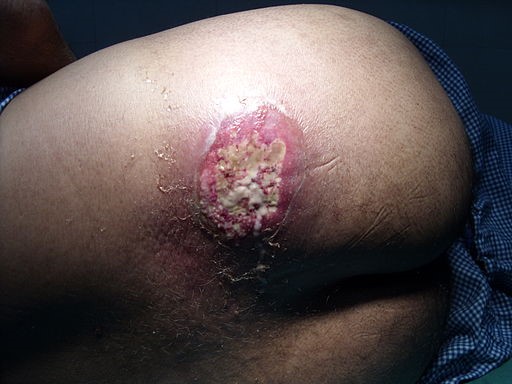
Buttock carbuncle
Sensibler oder grafischer Inhalt
Zum Anzeigen des Bildes schweben oder klicken
© Drvgaikwad, CC BY 3.0, via Wikimedia Commons
See the link for Dermnet NZ in Further Reading below for further images of boils.
What does a boil look like?
Red lump. A boil looks like a small red lump on the skin that is tender.
Swollen skin. The surrounding skin may be swollen and inflamed.
Pus. Thick, infected fluid called pus fills the centre of the boil.
Where do boils usually appear?
A boil on skin can develop in any hairy area of skin. In particular, in sites where there is friction, or where the skin is sweaty. For example, they can appear:
On the neck.
Gesicht.
Achselhöhlen.
Arms.
Gesäß.
Rund um den hinteren Durchgang (Anus).
A boil in the ear canal may be very painful.
Carbuncles most commonly develop on the back of the neck or on the thighs.
Risikofaktoren
A boil or carbuncle can occur in anyone at any age. However, they are uncommon in children and most common in teenagers and young adults. You have a higher risk of developing a boil or carbuncle if you:
Hautzustände. Have other skin conditions that may cause you to scratch and damage the skin - for example, Ekzem oder scabies.
Gewicht. Are very overweight (obese).
Weakened immune system. Have a poor defence against infections (immune system).
Illness. Have an illness making you frail or generally unwell.
Bacteria. Are a carrier of staphylococcal germs (bacteria).
What causes boils?
Germs. Boils are caused by germs (bacteria) multiplying below the skin surface.
Weakened immune system. Your immune system is important in helping you to fight off infection.
That means you have a higher risk of developing a boil or carbuncle if germs get under your skin and your immune system does not kill them quickly enough to stop them multiplying.
Recurring boils causes
If you develop recurring boils (chronic furunculosis), your doctor may suggest some tests to look for an underlying cause.
For example, to check if you have a poor Immunsystem.
You may be prone to boils just because you're generally run down and tired.
But it's important to check there isn't any underlying problem, such as Typ-2-Diabetes.
One cause of recurring boils if you are otherwise healthy is that you, or someone in your family or household, may be a carrier of a special type of staphylococcal germ (bacteria), which is called PVL staphylococcus. This means that a certain number of these bacteria live harmlessly on your skin, or in your nose. If you are a carrier, you tend to be more prone to skin infections and boils. In particular, these bacteria may quickly invade and multiply in broken skin following a minor cut or injury.
Treatment with antibiotics and/or antibiotic nasal cream may clear staphylococcal bacteria from carriers and reduce the chance of boils, or other types of skin infection, from coming back. Always wash your hands to help prevent spreading infection.
Boil treatment
Keine Behandlung. Small boils (furuncles) may subside and go without any treatment other than simple home treatment. You can ease pain by covering the boil with a flannel soaked in warm water. Do this for 30 minutes, 3-4 times a day. (Be very careful that the water is not too hot. It is important to avoid the risk of burns from hot water.)
Purulent drainage. Larger boils and carbuncles are best treated by letting the infected fluid (pus) out. Sometimes this is done by a doctor who drains the pus, using a needle and syringe. Sometimes a small cut in the skin is needed to let out the pus (incision and drainage). The wound is covered with a dressing until the skin heals. The skin usually heals quickly once the pus has been drained.
Antibiotika. A course of an antibiotic medicine, wie zum Beispiel Flucloxacillin, is sometimes prescribed to help clear the infection from the skin. Alternative antibiotics may be needed, such as when an infection is caused by methicillin resistant staphylococcus aureus (MRSA).
What will happen if I do nothing?
Boils. Typically, after several days (sometimes after a week or more) the boil will burst and pus will leak on to the skin. The pain tends to ease when the boil bursts. Once the pus has gone, the infection in the surrounding skin tends to fade away gradually over several days. A scar may be left at the site of the boil.
Carbuncles. A carbuncle tends to increase in size for a few days - up to 3-10 centimetres across, sometimes more. After 5-7 days, various pus-filled lumps appear on the surface and pus leaks on to the skin. It then may break down and form an ulcer on the skin surface before the infection gradually subsides. The skin then gradually heals leaving a deep scar.
While infection and pus are in the skin, there is a risk that some germs (bacteria) may spread in the bloodstream to cause infections in other parts of the body (Sepsis). This is very uncommon but, if it happens, it can lead to serious infections of a bone, the brain, or other parts of the body.
Patientenauswahl für Hautinfektionen
Infektionen
Virale Ausschläge
Viele Virusinfektionen können zusätzlich zu anderen Symptomen einen Ausschlag verursachen. Ausschläge sind bei Virusinfektionen sehr häufig, insbesondere bei kleinen Kindern. Es ist sehr wichtig sicherzustellen, dass der Ausschlag nicht Teil einer ernsthaften Infektion ist - z.B. einer Meningokokkeninfektion, die eine bakterielle Infektion ist und mit Meningitis in Verbindung gebracht werden kann.
von Dr. Toni Hazell, FRCGP
Infektionen
Molluscum contagiosum
Molluscum contagiosum ist eine häufige Erkrankung, bei der kleine warzenartige Beulen (Mollusca) auf der Haut auftreten. Sie wird durch ein Virus verursacht, das durch Hautkontakt oder durch kontaminierte Handtücher, Waschlappen, Kuscheltiere usw. übertragen werden kann. Es ist nicht ernsthaft und verschwindet in der Regel innerhalb von 12-18 Monaten ohne Behandlung.
von Dr. Doug McKechnie, MRCGP
Häufig gestellte Fragen
Kann Stress Furunkel verursachen?
Obwohl Stress nicht direkt als Ursache aufgeführt wird, erwähnt der Artikel, dass Sie anfälliger für Furunkel sein können, wenn Sie allgemein erschöpft und müde sind. Stress kann sicherlich dazu beitragen, sich erschöpft zu fühlen.
Warum bekomme ich immer wieder Furunkel an derselben Stelle?
Wiederkehrende Furunkel, insbesondere an derselben Stelle, können auf verschiedene Gründe zurückzuführen sein. Eine Möglichkeit ist, dass Sie oder jemand in Ihrem Haushalt Träger einer bestimmten Art von Staphylokokkenkeim (PVL-Staphylokokken) sind. Diese Bakterien können harmlos auf Ihrer Haut oder in Ihrer Nase leben, aber wenn sie in eine kleine Schnittwunde oder Verletzung gelangen, können sie sich vermehren und Furunkel verursachen. Eine Antibiotikabehandlung könnte vorgeschlagen werden, um diese Bakterien zu beseitigen und die Wahrscheinlichkeit eines erneuten Auftretens von Furunkeln zu verringern.
Sind Furunkel ein Zeichen von Erschöpfung?
Ja, wenn Sie allgemein erschöpft und müde sind, könnten Sie anfälliger für die Entwicklung von Furunkeln sein. Während dies eine einfache Erklärung sein kann, ist es auch wichtig, dass Ihr Arzt zugrunde liegende medizinische Probleme, wie Typ-2-Diabetes, ausschließt, wenn Sie wiederholt Furunkel haben.
Was befindet sich in einem Abszess?
Ein Furunkel ist mit einer dicken, infizierten Flüssigkeit gefüllt, die als Eiter bekannt ist. Dieser Eiter sammelt sich in der Mitte des Furunkels und bildet eine empfindliche und geschwollene Beule auf der Haut.
Weiterführende Literatur und Referenzen
- Boils; DermNet NZ
- Folliculitis and boils (furuncles / carbuncles); The Primary Care Dermatology Society. Last updated May 2022.
- Furunkel, Karbunkel und Staphylokokken-Trägerschaft; NICE CKS, Mai 2024 (nur Zugang in Großbritannien)
- Shallcross LJ, Hayward AC, Johnson AM, et al; Incidence and recurrence of boils and abscesses within the first year: a cohort study in UK primary care. Br J Gen Pract. 2015 Oct;65(639):e668-76. doi: 10.3399/bjgp15X686929.
Über den AutorVollständige Biografie anzeigen

Dr Colin Tidy, MRCGP
Allgemeinmediziner, Medizinischer Autor
MBBS, MRCGP, MRCP (Paediatrics), DCH
Dr. Colin Tidy ist ein NHS-Arzt mit Sitz in Oxfordshire.
Über den RezensentenVollständige Biografie anzeigen

Dr Doug McKechnie, MRCGP
Medizinischer Autor
MA, MBBS, MSc, DRCOG, MRCP(UK), MRCGP(2021), FHEA
Dr. Doug McKechnie ist ein NHS-Hausarzt, der in London arbeitet. Er arbeitet klinisch in Vollzeit und ist außerdem stellvertretender Leiter des Moduls für klinische und berufliche Praxis an der University College London Medical School.
Artikelverlauf
Die Informationen auf dieser Seite wurden von qualifizierten Klinikern verfasst und begutachtet.
Artikel auch verfügbar in Englisch, Deutsch, Spanisch, Französisch, Italienisch, Portugiesisch, Hindi, Hebräisch, Arabisch, und Schwedisch.
Nächste Überprüfung fällig: 19. Jan 2028
20. Jan 2025 | Neueste Version

Fragen, teilen, verbinden.
Durchsuchen Sie Diskussionen, stellen Sie Fragen und teilen Sie Erfahrungen zu Hunderten von Gesundheitsthemen.

Fühlen Sie sich unwohl?
Bewerten Sie Ihre Symptome online kostenlos
Abonnieren Sie den Patienten-Newsletter
Ihre wöchentliche Dosis klarer, vertrauenswürdiger Gesundheitsberatung - geschrieben, um Ihnen zu helfen, sich informiert, selbstbewusst und in Kontrolle zu fühlen.
Durch das Abonnieren akzeptieren Sie unsere Datenschutzrichtlinie. Sie können sich jederzeit abmelden. Wir verkaufen Ihre Daten niemals.
Mehr zu Infektionen
- Chlamydien
- Blasenentzündung bei Frauen
- Augeninfektion (Herpes simplex)
- Pilzinfektion in der Leistengegend
- Pilzinfektionen
- Pilzinfektion der Nägel
- Pilzinfektion der Kopfhaut
- Hepatitis B
- Hepatitis C
- Lyme-Borreliose
- Mukolytika
- Tollwut und Tollwutimpfung
- Sexuell übertragbare Infektionen
- Tuberkulose
- Harnwegsinfektion bei Kindern
- Wurmmittel
- Hefeinfektion