Discoider Lupus
Begutachtet von Dr Hayley Willacy, FRCGP Zuletzt aktualisiert von Dr Colin Tidy, MRCGPZuletzt aktualisiert 16. Okt 2023
Erfüllt die Anforderungen des Patienten Richtlinien des Patienten
- HerunterladenHerunterladen
- Teilen
- Language
- Diskussion
- Audio-Version
- Zu bevorzugten Quellen bei Google hinzufügen
Discoider Lupus ist eine seltene Hauterkrankung, aber sie ist sehr langanhaltend. Sie ist normalerweise empfindlich gegenüber Sonnenlicht und verursacht Narbenbildung, wenn die Läsionen heilen.
Auf einen Blick
Discoid lupus is a chronic skin rash made worse by sun exposure.
It causes red, scaly patches, mainly on the face, ears, and neck.
It is an autoimmune condition where the body attacks its own skin cells.
Diagnosis is often made by appearance, sometimes requiring a skin biopsy.
Treatment aims to control symptoms and may include creams, tablets, or injections.
Early diagnosis and treatment can improve the outcome and prevent scarring.
Protecting your skin from the sun is an important part of managing discoid lupus.
What is discoid lupus?
Discoid lupus is an uncommon but long-lasting (chronic) skin rash, which is usually made worse by exposure to sunlight (it is photosensitive).
Discoid lupus is also called discoid lupus erythematosus (DLE). Discoid lupus can be localised to affect a small area of skin, or may be more widespread.
'Discoid' lupus erythematosus is confined to the skin and is not associated with symptoms from other organs.
A more severe form of lupus is called systemischer Lupus erythematodes (SLE), which can affect internal organs.
Discoid lupus can be divided into two groups:
Localised discoid lupus occurs when the head and neck only are affected. It is nearly always confined to the skin
Generalised discoid lupus occurs when other areas are affected. Those with widespread skin involvement are more likely to develop SLE, although the overall risk is still low.
DLE may be associated with other problems such as Raynaud-Phänomen, chilblains und hair loss (alopecia).
Discoid lupus can cause permanent scarring if it is not treated or if treatment is not effective.
What causes discoid lupus?
It is thought that discoid lupus is an autoimmune disease. This means that some of the proteins made by the body to fight infection (antibodies), mistakenly attack normal cells in our body. in discoid lupus it is the skin cells that are attacked by these antibodies.
Some families may carry genes that increase the risk of developing discoid lupus. It is thought that discoid lupus is caused by a combination of environmental factors and genetics.
How common is discoid lupus?
Discoid lupus affects between 2 and 5 out of every 10,000 people. Women are much more often affected than men. Discoid lupus usually first starts in people aged between 20 and 40 years. Discoid lupus is more common in people who smoke.
Discoid lupus is the most common form of lupus and is responsible for most cases of lupus that only affects the skin (cutaneous lupus erythematosus).
A small number of people with systemic lupus erythematosus also have discoid lupus.
Discoid lupus may be triggered or made worse by stress, infection or trauma. Some medicines may also trigger discoid lupus.
What are the symptoms of discoid lupus
Discoid lupus mainly affects the cheeks, nose and ears, and sometimes the front of the neck, the upper back, and the back of the hands. Occasionally it is more widespread.
Discoid lupus causes red scaly patches. When the lesions eventually resolve, they may leave areas of increased skin pigmentation, destruction (atrophy) of the affected skin, and white scars.
Discoid_lupus_erythematosus
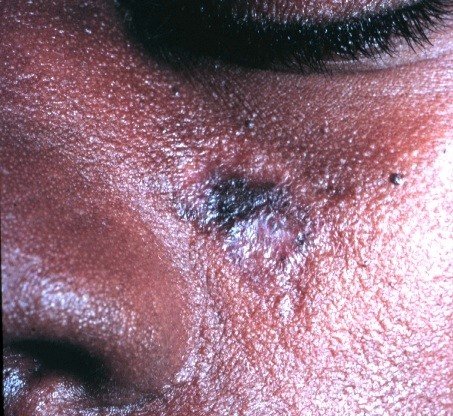
© Leonard C. Sperling, M.D., COL, MC, USA, Department of Dermatology, Uniformed Services University, Public domain, via Wikimedia Commons
Discoider Lupus erythematodes
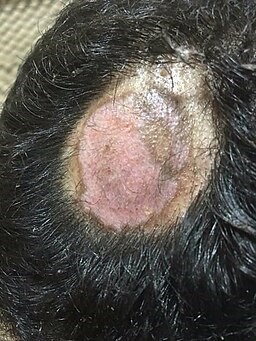
© Mohammad2018, CC BY-SA 4.0, über Wikimedia Commons
The lesions don't usually cause any other symptoms but may cause itching or pain. Discoid lupus mainly affects areas exposed to sunlight, such as the cheeks, nose, ears, upper back, neck and the backs of the hands. It may rarely occur on the palms or the soles.
The discoid lupus lesions may cause wart-like lesions, most often on the back of the arms.
How can discoid lupus be diagnosed?
Your doctor will usually be able to make the diagnosis just on the appearance of your skin. However, you will usually be referred to a dermatologist for further assessment and treatment.
Sometimes tests are needed to confirm the diagnosis. These tests may include blood and urine tests, and taking a skin sample (skin biopsy).
What are the treatments for discoid lupus?
Like many autoimmune conditions, discoid lupus is generally a lifelong condition and there is no cure. However, there are treatments available that are usually effective and can help keep symptoms under control.
Allgemeine Ratschläge
Rauchen can make discoid lupus worse and may also result in a poor response to treatment.
Protect your skin with clothing and sunscreen. Wear a hat to protect your face. Wear a pair of UV protective sunglasses.
Use daily sunscreen when appropriate. You should use a sunscreen with a high sun protection factor (SPF 30 or more) to protect against UVB and UVA.
Strictly avoiding sunlight can reduce vitamin D levels. You should have a diet high in vitamin D (oily fish, eggs, meat, fortified margarines and cereals) and it may be worth taking vitamin D supplements.
Topische Behandlungen
Strong Kortikosteroid-Cremes or steroid injections into the lesions. These can help to reduce inflammation but can thin the skin if used for too long.
Steroid-sparing creams and ointments. Examples include calcineurin inhibitors (such as Tacrolimus-Salbe oder pimecrolimus cream). These treatments do not contain steroid and they act on the immune system to help reduce inflammation.
Topical imiquimod cream is an alternative treatment for widespread discoid lupus.
Skin camouflage can be used where there are areas of plaque involvement or if scarring occurs.
Tablets and injections
Anti-malarial tablets including Hydroxychloroquin and mepacrine. These medications reduce inflammation and so help to control discoid lupus.
Steroidtabletten may be helpful for severe, extensive or scarring discoid lupus.
If there is no response to standard therapy, other medications may be used - for example, acitretin, Methotrexat oder Mycophenolatmofetil. There are risks associated with these treatments and so they are reserved for severe discoid lupus or when other treatments have not been effective.
Andere Behandlungen
Burned-out scarred lesions may be surgically removed.
Photodynamic therapy can be effective for some cases. Photodynamic therapy involves using a light-sensitive medicine and a light source to destroy abnormal cells.
Laser therapy may also be considered for lesions covered with prominent small 'spider' blood vessels (telangiectasias).
What are the complications of discoid lupus?
About 1 in 30 people with discoid lupus go on the develop systemic lupus erythematosus. The risk is greater for children who develop discoid lupus.
Skin cancers (basal cell carcinoma or squamous cell carcinoma) may occur but this is unusual.
Dark skin may lose its protection against sunlight because of loss of pigment (depigmentation).
Wie ist die Aussicht (Prognose)?
The outcome can be greatly improved by early diagnosis and effective treatment. For about half of people with discoid lupus, the condition resolves completely over many years.
The outcome is worse if discoid lupus is associated with Raynaud’s phenomenon, chilblains and alopecia. Ultimately some people with discoid lupus will be left with scarring
Discoid lupus tends to heal with scarring, hair loss and pigment changes if effective treatment is not started early. Pain in the lesions may continue and scars and skin destruction (atrophy) will be permanent.
Patientenauswahl für Hautausschläge

Haut-, Nagel- und Haargesundheit
Aktinische Keratose
Aktinische Keratose (auch bekannt als Sonnenkeratose) ist die häufigste durch Sonnenschäden verursachte Hauterkrankung. Sie entsteht durch langjährige Sonneneinstrahlung, die die Haut schädigt. Aktinische Keratosen sind meist raue, schuppige Flecken auf sonnenexponierten Bereichen wie Kopf und Gesicht. Aktinische Keratosen sind häufig, besonders bei älteren Menschen, von denen viele mehr als eine haben. In der Regel sind sie harmlos, aber es besteht ein geringes Risiko, dass sie sich schließlich in Hautkrebs verwandeln können, weshalb eine Behandlung empfohlen werden kann.
von Dr. Doug McKechnie, MRCGP

Haut-, Nagel- und Haargesundheit
Morbus Bowen
Morbus Bowen ist eine sehr frühe Form von Hautkrebs. Er verursacht ein oder mehrere kleine, schuppige rote Hautstellen. Er tritt auf, wenn Hautkrebszellen in der äußeren Hautschicht wachsen, sich aber nicht tiefer in die Haut oder anderswo im Körper ausbreiten. Da diese Krebszellen in der äußeren Hautschicht bleiben, verursachen sie an sich keine ernsthaften Probleme. Im Laufe der Zeit besteht jedoch die Möglichkeit, dass sich diese Zellen zu einer anderen Art von Hautkrebs entwickeln, die Probleme verursachen kann. Daher wird Morbus Bowen in der Regel behandelt, um dies zu verhindern. Nach der Behandlung ist eine enge Nachsorge erforderlich, um ein Wiederauftreten (Rezidiv) von Morbus Bowen zu überprüfen.
von Dr. Doug McKechnie, MRCGP
Häufig gestellte Fragen
Can discoid lupus affect areas beyond the skin?
Discoid lupus is generally confined to the skin. However, in some cases, it can be associated with other problems such as Raynaud’s phenomenon, chilblains, and hair loss (alopecia). A small number of people with discoid lupus may also go on to develop systemic lupus erythematosus (SLE), which can affect internal organs.
Are there specific things that can worsen or trigger discoid lupus?
Yes, discoid lupus can be triggered or made worse by stress, infection, or trauma. Certain medicines may also act as triggers. Smoking is also known to exacerbate discoid lupus and may lead to a poorer response to treatment.
Are there different types of discoid lupus?
Discoid lupus can be divided into two main categories: localised and generalised. Localised discoid lupus affects only the head and neck. Generalised discoid lupus involves other areas of the body, and those with widespread skin involvement have a slightly higher, though still low, risk of developing systemic lupus erythematosus (SLE).
What is the likelihood of developing skin cancer if I have discoid lupus?
While it is unusual, skin cancers such as basal cell carcinoma or squamous cell carcinoma can occur in people with discoid lupus.
Can discoid lupus impact vitamin D levels?
Yes, strictly avoiding sunlight, which is often recommended for discoid lupus patients due to photosensitivity, can reduce vitamin D levels. It is advisable to maintain a diet rich in vitamin D, including foods like oily fish, eggs, meat, fortified margarines, and cereals, and vitamin D supplements may also be considered.
Weiterführende Literatur und Referenzen
- Discoid Lupus Erythematosus (DLE); DermIS (Dermatologisches Informationssystem)
- Cutaneous lupus erythematosus; DermNet NZ
- Okon LG, Werth VP; Cutaneous lupus erythematosus: diagnosis and treatment. Best Pract Res Clin Rheumatol. 2013 Jun;27(3):391-404. doi: 10.1016/j.berh.2013.07.008.
- Bockle BC, Sepp NT; Smoking is highly associated with discoid lupus erythematosus and lupus erythematosus tumidus: analysis of 405 patients. Lupus. 2015 Jun;24(7):669-74. doi: 10.1177/0961203314559630. Epub 2014 Nov 19.
- Cutaneous lupus erythematosus; Gesellschaft für Dermatologie in der Primärversorgung.
Über den AutorVollständige Biografie anzeigen

Dr Colin Tidy, MRCGP
Allgemeinmediziner, Medizinischer Autor
MBBS, MRCGP, MRCP (Paediatrics), DCH
Dr. Colin Tidy ist ein NHS-Arzt mit Sitz in Oxfordshire.
Über den RezensentenVollständige Biografie anzeigen

Dr Hayley Willacy, FRCGP
Allgemeinmediziner, Medizinischer Autor
MBChB (1992), DRCOG, DFFP, MRCOG (Part 1) MRCGP (2007), DFSRH (2013), MSc - medical education (2020)
Dr. Hayley Willacy war eine NHS-Hausärztin, die in Nordwestengland arbeitete und 2022 nach 30 Jahren aus der klinischen Praxis ausschied.
Artikelverlauf
Die Informationen auf dieser Seite wurden von qualifizierten Klinikern verfasst und begutachtet.
Artikel auch verfügbar in Englisch, Deutsch, Spanisch, Französisch, Italienisch, Portugiesisch, Hindi, Hebräisch, Arabisch, und Schwedisch.
Nächste Überprüfung fällig: 14. Okt. 2028
16. Okt 2023 | Neueste Version

Fragen, teilen, verbinden.
Durchsuchen Sie Diskussionen, stellen Sie Fragen und teilen Sie Erfahrungen zu Hunderten von Gesundheitsthemen.

Fühlen Sie sich unwohl?
Bewerten Sie Ihre Symptome online kostenlos
Abonnieren Sie den Patienten-Newsletter
Ihre wöchentliche Dosis klarer, vertrauenswürdiger Gesundheitsberatung - geschrieben, um Ihnen zu helfen, sich informiert, selbstbewusst und in Kontrolle zu fühlen.
Durch das Abonnieren akzeptieren Sie unsere Datenschutzrichtlinie. Sie können sich jederzeit abmelden. Wir verkaufen Ihre Daten niemals.
Mehr über Haut-, Nagel- und Haargesundheit
- Bettwanzen
- Blasenbildendes Pemphigoid
- Zellulitis
- Kontaktekzem
- Hundebisse und Katzenbisse
- Pilzinfektion in der Leistengegend
- Impetigo
- Eingewachsener Zehennagel
- Lipom
- Mpox-Virus
- Pflastertest für Kontaktdermatitis
- Pemphigus vulgaris
- Polymorphe Lichtdermatose
- Arten von Hautkrebs
- Hautausschläge
- Sonne und Sonnenbrand
- Krampfaderneurodermitis
- Vitiligo