Kinderleukämien
Begutachtet von Dr Toni Hazell, FRCGPZuletzt aktualisiert von Dr Hayley Willacy, FRCGP Zuletzt aktualisiert 30. Nov 2022
Erfüllt die redaktionelle Richtlinien
- HerunterladenHerunterladen
- Teilen
- Language
- Diskussion
- Ask Patient
- Audio-Version
- Zu bevorzugten Quellen bei Google hinzufügen
In dieser Serie:KinderkrebsNeuroblastomRetinoblastomRhabdomyosarkomWilms-Tumor
Leukämie ist eine Krebserkrankung der Zellen, die sich zu Blutzellen entwickeln. Es gibt verschiedene Arten von Leukämie. Die meisten Kinder mit Leukämie haben akute lymphatische Leukämie. Einige haben akute myeloische Leukämie. Die Prognose für Kinder mit Leukämie ist in der Regel sehr gut, und die meisten Kinder werden geheilt. Dieses Informationsblatt gibt einen allgemeinen Überblick über kindliche Leukämien.
Auf einen Blick
Leukaemia is a cancer of blood cells made in the bone marrow.
It occurs when certain blood cells multiply out of control.
Symptoms can include tiredness, easy bruising, bleeding, and serious infections.
Diagnosis often involves a blood test and a bone marrow sample.
The outcome for childhood leukaemia has greatly improved over time.
Videoauswahl für Childhood cancersVideothek
Was ist Leukämie?
Leukaemia is a cancer of cells in the bone marrow (the cells which develop into blood cells).
Cancer is a disease of the cells in the body. There are many types of cancer which arise from different types of cell. What all cancers have in common is that the cancer cells are abnormal and do not respond to normal control mechanisms. Large numbers of cancer cells build up because they multiply 'out of control', or because they live much longer than normal cells, or both.
With leukaemia, the cancerous (malignant) cells in the bone marrow spill out into the bloodstream. There are several types of leukaemia. Most types arise from cells which normally develop into white blood cells. (The word leukaemia comes from a Greek word which means 'white blood'.)
Childhood leukaemia
It is very important to know which type of leukaemia a child has. This is because the outlook (prognosis) and treatments vary for the different types. Before discussing the different types of leukaemia it may help to know some basics about normal blood cells and how they are made.
Aus was besteht normales Blut?
Blutzellen
Diese sind unter einem Mikroskop sichtbar und machen etwa 40% des Blutvolumens aus. Blutzellen werden in drei Haupttypen unterteilt:
Rote Zellen (Erythrozyten). These make blood a red colour. One drop of blood contains about five million red cells. Red cells contain a chemical called haemoglobin. This binds to oxygen and takes oxygen from the lungs to all parts of the body.
Weiße Zellen (Leukozyten). There are different types of white cells, which are called neutrophils (polymorphs), lymphocytes, eosinophils, monocytes and basophils. They are part of the immune system. Their main role is to defend the body against infection.
Blutplättchen. Diese sind winzig und helfen dem Blut zu gerinnen, wenn wir uns schneiden.
Plasma
This is the liquid part of blood and makes up about 60% of the blood's volume. Plasma is mainly made from water. However, it contains many different proteins and other chemicals, such as hormones, antibodies, enzymes, glucose, fat particles, salts, etc.
Wenn Blut aus Ihrem Körper austritt (oder eine Blutprobe in ein einfaches Glasröhrchen entnommen wird), verklumpen die Zellen und bestimmte Plasmaproteine, um ein Gerinnsel zu bilden. Die verbleibende klare Flüssigkeit wird Serum genannt.
Das Knochenmark, die Stammzellen und die Blutbildung
Knochenmark
Blood cells are made in the bone marrow by 'stem' cells. The bone marrow is the soft 'spongy' material in the centre of bones. The large flat bones, such as the pelvis and breastbone (sternum), contain the most bone marrow. To make blood cells constantly you need a healthy bone marrow. You also need nutrients from your diet, including iron and certain vitamins.
Stem cells
Stem cells are immature (primitive) cells. There are two main types in the bone marrow - myeloid and lymphoid stem cells. These derive from even more primitive common 'pluripotential' stem cells. Stem cells constantly divide and produce new cells. Some new cells remain as stem cells; others go through a series of maturing stages ('precursor' or 'blast' cells) before forming into mature blood cells. Mature blood cells are released from the bone marrow into the bloodstream.
Hämatopoetisches System des Knochenmarks
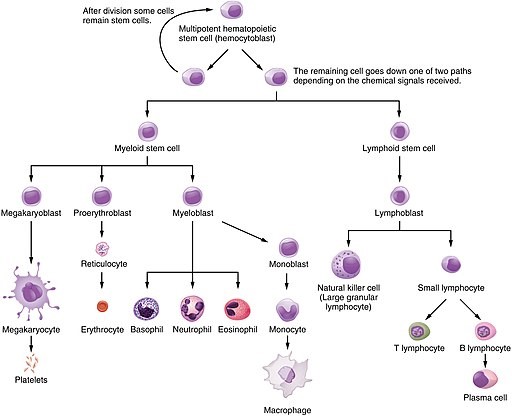
Lymphocyte white blood cells develop from lymphoid stem cells. There are three types of mature lymphocytes:
B lymphocytes make antibodies which attack infecting germs (bacteria, viruses, etc).
T-Lymphozyten helfen den B-Lymphozyten, Antikörper zu produzieren.
Natural killer cells, which also help to protect against infection.
Alle anderen verschiedenen Blutzellen (rote Blutkörperchen, Blutplättchen, Neutrophile, Basophile, Eosinophile und Monozyten) entwickeln sich aus myeloischen Stammzellen.
Blutbildung
The body makes millions of blood cells every day. Each type of cell has an expected lifespan. For example, red blood cells normally last about 120 days. Some white blood cells last just hours or days - some last longer. Every day millions of blood cells die and are broken down at the end of their lifespan. There is normally a fine balance between the number of blood cells that you make and the number that die and are broken down. Various factors help to maintain this balance. For example, certain hormones in the bloodstream and chemicals in the bone marrow called 'growth factors' help to regulate the number of blood cells that are made.
Was verursacht Leukämie?
Leukaemia is thought to start first from one abnormal cell. What seems to happen is that certain vital genes which control how cells divide, multiply and die, are damaged or altered. This makes the cell abnormal. If the abnormal cell survives it may multiply 'out of control' or survive a long time, and develop into a leukaemia.
In most cases of leukaemia, the reason why a cell becomes abnormal is not known. There are certain 'risk factors' which increase the chance that certain leukaemias will develop. However, these only account for a small number of cases. Risk factors for some types of leukaemia include:
High levels of radiation - for example, previous radiotherapy for another condition.
Frühere Behandlung mit Chemotherapie oder anderen Medikamenten, die das Immunsystem schwächen.
Certain inherited (genetic) disorders, the most common is Down-Syndrom.
Exposure to certain chemicals such as benzene.
What are the main types of leukaemia?
The main types of leukaemia that occur in childhood are:
Chronic myeloid leukaemia (CML) can occur in children but is much less common and Chronische lymphatische Leukämie (CLL) is very rare in childhood.
'„Akut“ bedeutet, dass sich die Krankheit recht schnell entwickelt und fortschreitet.
'Chronic' means persistent or ongoing. When talking about leukaemia, the word chronic also means that the disease develops and progresses slowly (even without treatment). Chronic leukaemias are much more common in adults than in children.
'Lymphoblastic' and 'lymphocytic' mean that an abnormal cancerous (malignant) cell is a cell that originated from a lymphoid stem cell.
'„Myeloid“ bedeutet, dass es sich bei einer abnormalen Krebszelle um eine Zelle handelt, die aus einer myeloischen Stammzelle hervorgegangen ist.
Acute lymphoblastic leukaemia (ALL)
In ALL the bone marrow makes large numbers of abnormal immature lymphocytes called lymphoblasts. There are various subtypes of ALL. For example, the abnormal lymphoblasts can be immature B or T lymphocytes. Typically, ALL develops quite quickly (acutely) and rapidly becomes worse (over a few weeks or so) unless treated. ALL can occur at any age but about 6 in 10 cases occur in children. It is the most common form of leukaemia to affect children (although it is an uncommon disease).
Acute myeloid leukaemia (AML)
In AML the bone marrow makes large numbers of abnormal immature white blood cells which are derived from a myeloid stem cell. The abnormal immature cells are called blasts. There are various subtypes of AML, depending on exactly what cell type becomes cancerous and at what stage in the maturing process. Typically, AML develops quite quickly and rapidly becomes worse (over a few weeks or so) unless treated. AML is an uncommon disease. Most cases occur in people over 50 years of age but AML can occur in children.
Chronic myeloid leukaemia (CML)
CML develops due to a problem with a stem cell in the bone marrow, which becomes abnormal. The abnormal stem cell multiplies. The cells that are made from the abnormal stem cells mature and develop into near-normal white cells - mainly neutrophils, basophils and eosinophils (collectively called granulocytes). Typically, CML develops and progresses slowly - over months or years, even without treatment. CML is the rarest of the four main types of leukaemia. It occurs mainly in adults, and becomes more common with increasing age. However, CML may also occur in children, although this is very rare.
See the separate leaflet called Leukaemia for information on leukaemia in adults.
How common is childhood leukaemia?
Childhood leukaemia is rare, but is still the most common cancer in children and teenagers. Leukaemia causes about 1 in every 3 childhood cancers.
About 3 out of 4 leukaemias in children and teenagers are ALL. Most of the remaining cases are AML.
ALL most often first presents in early childhood, most often between 2 and 4 years of age. AML can occur at any time but is slightly more common during the first two years of life and during the teenage years.
Chronic leukaemias are very rare in children. Most children with chronic leukaemia have CML, which more often affects teenagers than younger children.
There are other much less common causes of leukaemia in children that include:
Hybrid or mixed lineage leukaemias: the cancerous (malignant) cells have features of both ALL and AML. These leukaemias are usually treated like ALL and usually respond well to treatment.
Juvenile myelomonocytic leukaemia (JMML): this rare type of leukaemia is neither chronic nor acute. It most often occurs in children under the age of 4 years.
What are the main symptoms of leukaemia?
Da große Mengen abnormaler Blutzellen gebildet werden, füllt sich ein Großteil des Knochenmarks mit diesen abnormalen Zellen. Dadurch wird es für die normalen Zellen im Knochenmark schwierig, zu überleben und genügend normale, reife Blutzellen zu bilden. Außerdem gelangen die abnormalen Zellen in den Blutkreislauf. Daher können sich vor allem folgende Probleme entwickeln:
Anämie. This occurs as the number of red blood cells in the bloodstream goes down. This can cause tiredness, breathlessness and pale skin and lips.
Probleme mit der Blutgerinnung. This is due to low levels of platelets in the bloodstream. This can cause easy bruising, bleeding from the gums and other bleeding-related problems.
Schwere Infektionen. The abnormal white blood cells do not protect against infection. Also, there is a reduced number of normal white blood cells which usually combat infection. Therefore, serious infections are more likely to develop. Depending on the type and site of infection which develops, the symptoms can vary greatly.
Wie lange es nach Krankheitsbeginn dauert, bis diese Symptome auftreten, ist unterschiedlich. Bei ALL oder AML entwickeln sie sich typischerweise innerhalb weniger Wochen. Bei CLL oder CML kann es Monate oder Jahre dauern, bis Symptome auftreten, da diese Leukämien langsam fortschreiten.
The abnormal cells may also build up in lymph glands and in the spleen. This causes swollen lymph glands in various parts of the body and also an enlarged spleen.
Other symptoms which may develop include pain in the bones or joints (mainly with ALL), persistent raised temperature (fever) and weight loss.
How is childhood leukemia diagnosed?
Bluttest
A Bluttest can often suggest the diagnosis of leukaemia, as abnormal cells are often detected in the blood test. Further tests are usually done to confirm the diagnosis.
Eine Knochenmarkprobe
For this test, a small amount of bone marrow is removed by inserting a needle into the pelvic bone (or sometimes the breastbone (sternum)). Local anaesthetic is used to numb the area. A small sample of bone may also be taken. The samples are put under the microscope to look for abnormal cells and are also tested in other ways. This can confirm the diagnosis. (See the separate leaflet called Bone Marrow Biopsy and Aspiration for more detail.)
Zell- und Chromosomenanalyse
Mit den aus einer Knochenmarkprobe oder einer Blutuntersuchung gewonnenen abnormalen Zellen werden häufig detaillierte Tests durchgeführt. Damit lässt sich der genaue Typ oder Subtyp der abnormalen Zelle bestimmen.
X-rays and scans
A Röntgenbild des Brustkorbs, CT-Scan, MRT-Scans, Ultraschall und Knochenszintigrafie may be used to look for any abnormal lymph nodes or other abnormalities in the chest, tummy (abdomen), brain or bones.
Lumbalpunktion
This test collects a small amount of fluid from around the spinal cord - cerebrospinal fluid (CSF). It is done by inserting a needle between the bones (vertebrae) in the lower (lumbar) region of the back. (See the separate leaflet called Lumbar Puncture (Spinal Tap) for more detail.) By examining the fluid for leukaemia cells, it helps to find out if the leukaemia has spread to the brain and spinal cord. This is mainly done when assessing ALL and sometimes AML.
What is the treatment for childhood leukaemia?
The treatment advised depends on the exact type of leukaemia and the stage it is at. For example, ALL is usually treated as soon as possible with intensive chemotherapy. On the other hand, adults in the early stages of CLL may not need any treatment. This is because CLL often progresses very slowly and may not need treatment for several years.
For details of treatments for each type of leukaemia, see the separate leaflets called Acute Lymphoblastic Leukaemia (ALL), Acute Myeloid Leukaemia (AML) und Chronic Myeloid Leukaemia (CML).
What is the outlook for childhood leukaemia?
The outlook varies for each of the different leukaemias. However, the overall outlook may be better than many people imagine. With acute leukaemias, children who are free of the disease after five years are very likely to have been cured. This is because it is very rare for these cancers to return after this long.
For example, the outlook for ALL has greatly improved over the period of 20 years or so. More than 90 out of every 100 children treated for ALL will live for at least five years after treatment and most children are completely cured.
The outlook for children with AML has also improved and between 6 and 7 out of every 10 children treated for AML will live for at least five years after treatment.
However, children who have been cured of leukaemia may have some physical and psychological problems in later life. The physical problems may include reduced height, being overweight, reduced bone strength (Osteoporose) oder Unfruchtbarkeit when they become adults.
The treatment of cancer and childhood leukaemia is a developing area of medicine. New treatments continue to be developed and the information on outlook above is very general. There are some newer medicines that have been introduced in the last few years that show promise to further improve the outlook.
Patientenauswahl für Childhood cancers

Krebs
Retinoblastom
Retinoblastom ist eine seltene Krebserkrankung des Auges, die bei Kindern unter 5 Jahren auftritt. Dieses Informationsblatt beschreibt das Retinoblastom. Es erläutert die Symptome und Anzeichen des Retinoblastoms sowie die Behandlungsoptionen, die Kindern mit Retinoblastom angeboten werden können.
von Dr. Mary Elisabeth Lowth, FRCGP

Krebs
Kinderkrebs
von Dr. Colin Tidy, MRCGP
Häufig gestellte Fragen
What is the difference between chronic and acute leukaemia?
Acute leukaemia develops and progresses quickly, typically within weeks. Chronic leukaemia, on the other hand, develops and progresses slowly over months or even years, even without treatment. Chronic leukaemias are also much more common in adults than in children.
If my child is diagnosed with leukaemia, will they definitely need immediate treatment?
Treatment plans depend on the exact type of leukaemia. For acute leukaemias like Acute Lymphoblastic Leukaemia (ALL), treatment usually begins as soon as possible with intensive chemotherapy. However, for some types, such as Chronic Lymphocytic Leukaemia (CLL) in adults, early stages might not require immediate treatment as it can progress very slowly over several years. This is very rare in children though.
How does leukaemia affect my child's organs besides the bone marrow?
Leukaemia can cause abnormal cells to build up in other parts of the body. This can lead to swollen lymph glands in various areas, and also an enlarged spleen. In rare cases, leukaemia cells can spread to the brain and spinal cord, which is why a lumbar puncture might be performed to check for this.
Are there any long-term health concerns for children who have been cured of leukaemia?
Yes, children cured of leukaemia may experience some physical and psychological challenges later in life. Physical issues could include reduced height, being overweight, weaker bones (osteoporosis), or infertility when they reach adulthood. The goal is to monitor and manage these potential long-term effects.
How common are the different types of childhood leukaemia?
Childhood leukaemia is rare overall, but Acute Lymphoblastic Leukaemia (ALL) accounts for about 3 out of 4 cases in children and teenagers. Most of the remaining cases are Acute Myeloid Leukaemia (AML). Chronic leukaemias are very rare in children, with most of those cases being Chronic Myeloid Leukaemia (CML), which more often affects teenagers.
Weiterführende Lektüre und Referenzen
- Verdacht auf Krebs: Erkennung und Überweisung; NICE-Richtlinie (2015 - zuletzt aktualisiert im April 2026)
- Brivio E, Baruchel A, Beishuizen A, et al; Targeted inhibitors and antibody immunotherapies: Novel therapies for paediatric leukaemia and lymphoma. Eur J Cancer. 2022 Mar;164:1-17. doi: 10.1016/j.ejca.2021.12.029. Epub 2022 Feb 1.
- Chennamadhavuni A, Lyengar V, Shimanovsky A; Leukemia
- Inaba H, Mullighan CG; Pediatric acute lymphoblastic leukemia. Haematologica. 2020 Nov 1;105(11):2524-2539. doi: 10.3324/haematol.2020.247031.
- Bispo JAB, Pinheiro PS, Kobetz EK; Epidemiology and Etiology of Leukemia and Lymphoma. Cold Spring Harb Perspect Med. 2020 Jun 1;10(6). pii: cshperspect.a034819. doi: 10.1101/cshperspect.a034819.
Über den AutorVollständige Biografie anzeigen
Aktualisiert von

Dr Hayley Willacy, FRCGP
Allgemeinmediziner, Medizinischer Autor
MBChB (1992), DRCOG, DFFP, MRCOG (Part 1) MRCGP (2007), DFSRH (2013), MSc - medical education (2020)
Dr. Hayley Willacy war eine NHS-Hausärztin, die in Nordwestengland arbeitete und 2022 nach 30 Jahren aus der klinischen Praxis ausschied.
Verfasst von

Dr Colin Tidy, MRCGP
Allgemeinmediziner, Medizinischer Autor
MBBS, MRCGP, MRCP (Paediatrics), DCH
Dr. Colin Tidy ist ein NHS-Arzt mit Sitz in Oxfordshire.
Über den RezensentenVollständige Biografie anzeigen

Dr Toni Hazell, FRCGP
MBBS, BSc, FRCGP, DFSRH, Dip GU med, DRCOG, DCH (London, UK, 2000)
Dr. Toni Hazell hat ihren Abschluss an der St. Mary’s Hospital Medical School gemacht und ihr VTS am Northwick Park Hospital absolviert.
Artikelverlauf
Artikel auch verfügbar in Englisch, Deutsch, Spanisch, Französisch, Italienisch, Portugiesisch, Hindi, Hebräisch, Arabisch, und Schwedisch.
Nächste Überprüfung fällig: 29. Nov 2027
30. Nov 2022 | Neueste Version
13. Sept 2016 | Ursprünglich veröffentlicht
Verfasst von:
Dr Colin Tidy, MRCGP
Medizinische Fachkräfte
Looking for more in-depth clinical detail? Our Professional Reference articles are written for doctors, nurses and other healthcare professionals. They include comprehensive clinical guidance, diagnostic information and UK/European evidence summaries. If you need the clinical version, you can read the Professional Reference article on this topic.
Teilen Sie Ihre Gedanken oder Erfahrungen mit anderen in unserem Patientengemeinschaften.
Einfacher Zugang zu vertrauenswürdigen Behandlungen und Gesundheitsdiensten online.
Common conditions
Get help with common conditions through the NHS, without a GP appointment.





Abonnieren Sie den Patienten-Newsletter
Ihre wöchentliche Dosis klarer, vertrauenswürdiger Gesundheitsberatung - geschrieben, um Ihnen zu helfen, sich informiert, selbstbewusst und in Kontrolle zu fühlen.
Durch das Abonnieren akzeptieren Sie unsere Datenschutzrichtlinie. Sie können sich jederzeit abmelden. Wir verkaufen Ihre Daten niemals.