Prurigo nodularis
Begutachtet von Dr Toni Hazell, FRCGPZuletzt aktualisiert von Dr Philippa Vincent, MRCGPZuletzt aktualisiert 30 Oct 2026
Erfüllt die redaktionelle Richtlinien
- HerunterladenHerunterladen
- Teilen
- Language
- Diskussion
- Ask Patient
- Audio-Version
- Zu bevorzugten Quellen bei Google hinzufügen
Medizinische Fachkräfte
Fachartikel sind für die Nutzung durch Gesundheitsfachkräfte konzipiert. Sie werden von britischen Ärzten verfasst und basieren auf Forschungsergebnissen, britischen und europäischen Richtlinien. Möglicherweise finden Sie einen unserer Gesundheitsartikel nützlicher.
Synonyms: nodular prurigo, Hyde's disease, picker nodules, lichen corneus obtusus, nodular lichen simplex chronicus, nodular neurodermatitis circumscripta
What is prurigo nodularis?
Prurigo nodularis, also known as nodular prurigo, is a chronic, recalcitrant inflammatory skin condition characterised by pruritic nodules. The nodules are usually skin-coloured though can be darker and are usually located on the extensor surfaces of the extremities.1
Prurigo nodularis aetiology234
The exact cause of the condition is unknown. It is accepted that the itch-scratch cycle plays a role in the development of the condition, but the sequence of events driving this is unclear. It is thought to develop as a reaction to repeated scratching in patients with chronic prurigo of various aetiologies, including dermatological, systemic, infectious, and neuropsychiatric, but there have been claims of an underlying infectious trigger. 1
The constant scratching leads to the development of discrete, excoriated, nodular, hyperpigmented/purpuric lesions with crusted or scaly surfaces. These lesions contain a higher number of Merkel cells and dermis papillary dermal nerve cells; these alterations are not seen in other pruritic skin lesions such as lichen simplex chronicus. There is also a higher density of neutrophils and mast cells as well as products of eosinophils. 1
The pruritus in prurigo nodularis seems to be a result of cutaneous neurogenic inflammation, caused by increased dermal levels of neuropeptides such as substance P, calcitonin gene-related peptide and nerve growth factor, as well as an excess of eosinophils and mast cells.15
Prurigo nodularis epidemiology1
Prurigo nodularis appears to be relatively common, particularly among patients who have some of the associated/precipitating conditions; however, its exact incidence is unknown.
The majority of patients with prurigo nodularis present between the ages of 51 and 65 though it does occur at any age.
It occurs in both males and females but seems to be more severe and frequent in women.
It presents earlier in patients with atopy.
American studies have suggested it is up to 4 times more common in Black patients than White. It is likely that this relates to wider determinants of health rather than a true ethnic variation,6 although other recent studies suggest a genetic predisposition.7
Malignancies, chronic renal failure, untreated HIV, and psychiatric conditions have all been reported as risk factors.
Präsentation
Prurigo nodularis
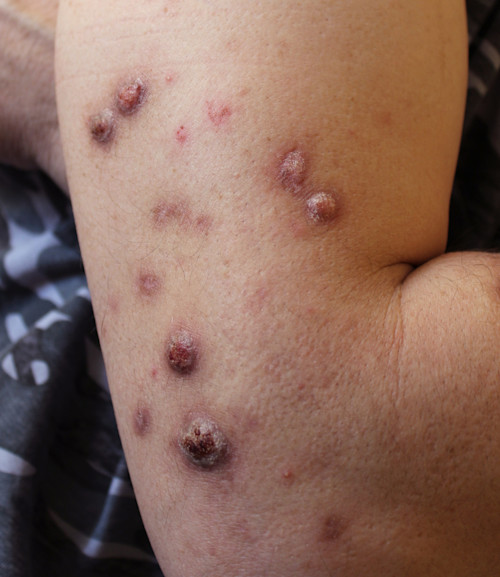
Prurigo nodularis symptoms1
The patient presents with nodules which can vary in size from a few mm to a few cm across. They can be skin-coloured or hyperpigmented.
Initially the skin may appear normal or keratotic; the dome-shaped nodule develops after constant itching of the area.
Nodules do not resolve spontaneously and tend to increase in number over time.
Nodules are most common on the extensor surfaces of the arm and legs where they tend to be found symmetrically. They also occur on the occipital region of the scalp, the upper back, the abdomen, and the sacrum. They tend not to occur in areas that are hard to reach - for example the upper mid back. This sparing pattern is known as the "butterfly sign". The palms, soles, face, and flexures also tend to be spared.
There may be a history of one of the associated conditions (see 'Associated diseases', below).
Anxiety about the nature of the lesion and the itching is common. The itching is often severe and distressing. It can be worse in warm conditions or with sweating.
Differentialdiagnose18
There is a wide-ranging differential:
Amyloidose, nodular localised cutaneous.
Atypical fibroxanthoma.
Cutaneous horn.
Dermatological manifestations of gastrointestinal disease.
Dermatological manifestations of haematological disease.
Dermatological manifestations of renal disease.
Hyperkeratosis lenticularis perstans (Flegel's disease).
Knuckle pads.
Lymphocytoma cutis.
lymphomatoide Papulose.
Mastozytose (urticaria pigmentosa).
Milker's nodules.
Multicentric reticulohistiocytosis.
Mycobacterium marinum infection of the skin (from cleaning out tropical fish tanks).
Papulonecrotic tuberculids.
Pilomatrixoma.
Pretibial myxoedema.
Xanthomas.
Assoziierte Erkrankungen8
Prurigo nodularis has been associated with:
Atopy.
Drugs that produce chronic itch such as antimalarials, opioids, and targeted cancer treatments.
Internal diseases such as:
Krebs.
Lebererkrankung.
Untreated HIV.
The role of these illnesses as precipitants or comorbidities is unclear. They may just be a range of conditions which induce a propensity to skin irritation and unmask a tendency to localised itchiness of the skin.
Untersuchungen8
Prurigo nodularis is a clinical diagnosis. Tests are not always necessary.
Pruritus screening blood tests (such as FBC, CRP, iron studies, U&Es, LFTs, TFTs, serum calcium, glucose, HIV test) may help to detect any underlying illness.
Biopsy of the lesions may be recommended to confirm the diagnosis.
Patch testing to look for evidence of a contact sensitivity precipitant may be carried out in a dermatology clinic.
Dermoscopy may be helpful in differentiating various nodular pruritic conditions.9
Direct immunofluorescence looking for antibody deposition in the skin may be necessary to differentiate from bullous pemphigoid if blisters develop.
Prurigo nodularis treatment and management13810
All treatment is aimed at reducing the itch-scratch cycle. Treatment is multi-faceted and includes education to reduce scratching and picking at the skin. Any underlying cause of itch should be diagnosed and treated. There are no high-powered randomised controlled trials looking at any of the treatment options.
General treatment:
Keep nails very short.
Wear long sleeves and gloves to reduce the risks of itching. Consider bandaging the lesions if clothing is an insufficient barrier.
Use emollients regularly throughout the day to keep the skin well-moisturised.
Use lotions containing calamine, camphor, or menthol to provide itch relief.
Try to reduce time spent in hot environments and try to reduce stress.
Topical treatment:
As well as emollients, the following have been used:
Topical corticosteroids- for example, clobetasol dipropionate 0.05% ointment, applied under occlusion with plastic wrap once at nighttime for at least 2 to 4 weeks.
Intralesional corticosteroids - for example, triamcinolone acetonide, in concentrations of 10 mg/mL to 20 mg/mL, has been shown to flatten lesions and reduce itch.11
Pimecrolimus 1% has shown benefit.12
Calcipotriol has shown some benefit in clearing lesions more quickly than moderately-potent steroids. 13
Antihistamines:
High doses of non-sedating antihistamines during the day, combined with sedating antihistamines at night may help reduce the itch.
Fexofenadine and montelukast have been shown to be beneficial 14 although this study was carried out before the psychiatric side effects of montelukast became evident. 1516
Other studies suggest that there is little benefit from antihistamines. 3
Phototherapy:
Phototherapy has shown benefit in prurigo nodularis. The combination of PUVA and narrow-band UVB has been shown to be more beneficial than PUVA alone.17
Immunosuppressants:
In severe recalcitrant disease, oral immunosuppressants have been tried.
There have been reports of improvement using cyclosporin, methotrexate, azathioprine, cyclophosphamide, and oral tacrolimus.
IV immunoglobulins have also showed some benefit.
Newer treatments:3
Thalidomide and lenalidomide have showed some benefits; lenalidomide appears to have lower risks of peripheral neuropathy.
SSRIs and tricyclic anti-depressants have both been shown to reduce itch.
Naloxone and naltrexone both have been shown to reduce itch.
Dupilumab is the first systemic treatment which has been approved by both the FDA in the United States and the European Medicines Agency for the treatment of prurigo nodularis, following phase 2 trials.6 However, this is not available in the UK under current NICE guidance.18 Phase 3 trials appear to show significant reduction in itch.19
At the time of writing, studies are underway into nemolizumab, benralizumab, vixarelimab, and barzolvolimab.7
Komplikationen6
Prurigo nodularis is a benign condition. However, it can cause severe functional impairment and morbidity due to poor control of the itching/scratching and psychological symptoms. Some lesions may become permanently pigmented or show scarring.
Secondary infection can occur, due to scratching of the lesions, leading to ulceration, abscess formation, and cellulitis.
Prognose10
It is unusual for lesions to resolve spontaneously. They may lessen in severity with treatment but tend to persist over time.
Exklusive Updates für medizinisches Fachpersonal
Bleiben Sie informiert mit den neuesten klinischen Updates, professionellen Einblicken und evidenzbasierten Leitlinien. Der Patient Pro-Newsletter stellt wesentliche Inhalte für Gesundheitsfachkräfte zusammen – direkt in Ihren Posteingang geliefert.
Durch das Abonnieren akzeptieren Sie unsere Datenschutzrichtlinie. Sie können sich jederzeit abmelden. Wir verkaufen Ihre Daten niemals.
Weiterführende Lektüre und Referenzen
- Mullins TB, Sharma P, Riley CA, et al; Prurigo Nodularis.
- Prurigo Nodularis and the Pain Cascade: Understanding the Pathogenesis and Approach to Management; J Bershtein et al; Journal of Clinical and Aesthetic Dermatology
- The State of the Art in Chronic Prurigo Nodularis; E Serra-Baldrich et al; Springer Nature
- Molecular mechanisms of pruritus in prurigo nodularis; Y Shao et al; Frontiers in Immunology
- Zeidler C, Stander S; The pathogenesis of Prurigo nodularis - 'Super-Itch' in exploration. Eur J Pain. 2016 Jan;20(1):37-40. doi: 10.1002/ejp.767. Epub 2015 Sep 28.
- Prurigo nodularis: disease burden, clinical features and approach to management; S Kwatra et al; British Journal of Dermatology
- Prurigo Nodularis: Pathogenesis and the Horizon of Potential Therapeutics; H J Yook and J H Lee; International Journal of Molecular Sciences
- Prurigo nodularis; DermNet NZ
- Errichetti E, Stinco G; Der praktische Nutzen der Dermatoskopie in der allgemeinen Dermatologie. G Ital Dermatol Venereol. 2015 Okt;150(5):533-46. Epub 2015 Jun 18.
- Nodular prurigo; British Association of Dermatologists
- Qureshi AA, Abate LE, Yosipovitch G, et al; A systematic review of evidence-based treatments for prurigo nodularis. J Am Acad Dermatol. 2019 Mar;80(3):756-764. doi: 10.1016/j.jaad.2018.09.020. Epub 2018 Sep 25.
- Siepmann D, Lotts T, Blome C, et al; Evaluation of the antipruritic effects of topical pimecrolimus in non-atopic prurigo nodularis: results of a randomized, hydrocortisone-controlled, double-blind phase II trial. Dermatology. 2013;227(4):353-60. doi: 10.1159/000355671. Epub 2013 Nov 23.
- Kowalski EH, Kneiber D, Valdebran M, et al; Treatment-resistant prurigo nodularis: challenges and solutions. Clin Cosmet Investig Dermatol. 2019 Feb 28;12:163-172. doi: 10.2147/CCID.S188070. eCollection 2019.
- Shintani T, Ohata C, Koga H, et al; Combination therapy of fexofenadine and montelukast is effective in prurigo nodularis and pemphigoid nodularis. Dermatol Ther. 2014 May-Jun;27(3):135-9. doi: 10.1111/dth.12094. Epub 2013 Sep 17.
- Montelukast (Singulair): reminder of the risk of neuropsychiatric reactions; Gov.UK
- Analysis of Neuropsychiatric Diagnoses After Montelukast Initiation; T Paljarvi et al; Journal of the American Medical Association
- Hammes S, Hermann J, Roos S, et al; UVB 308-nm excimer light and bath PUVA: combination therapy is very effective in the treatment of prurigo nodularis. J Eur Acad Dermatol Venereol. 2011 Jul;25(7):799-803. doi: 10.1111/j.1468-3083.2010.03865.x. Epub 2010 Oct 15.
- NICE TA955: Dupilumab for treating moderate to severe prurigo nodularis
- Ramcke T, Kaplan DH; From neuroimmune circuits to targeted therapy of chronic pruritus. Pharmacol Rev. 2026 Mar;78(2):100121. doi: 10.1016/j.pharmr.2026.100121. Epub 2026 Jan 29.
Über den AutorVollständige Biografie anzeigen
Aktualisiert von

Dr Philippa Vincent, MRCGP
Allgemeinmediziner, Medizinischer Autor
MB BS, Bsc, MRCGP (2000), DCH, DFSRH, DRCOG
Dr Philippa Vincent ist ein NHS-Arzt, der in Nordlondon arbeitet.
Über den RezensentenVollständige Biografie anzeigen

Dr Toni Hazell, FRCGP
MBBS, BSc, FRCGP, DFSRH, Dip GU med, DRCOG, DCH (London, UK, 2000)
Dr. Toni Hazell hat ihren Abschluss an der St. Mary’s Hospital Medical School gemacht und ihr VTS am Northwick Park Hospital absolviert.
Artikelverlauf
Artikel auch verfügbar in Englisch, Deutsch, Spanisch, Französisch, Italienisch, Portugiesisch, Hindi, Hebräisch, Arabisch, und Schwedisch.
Next review due: 30 Apr 2031
30 Oct 2026 | Neueste Version
Einfacher Zugang zu vertrauenswürdigen Behandlungen und Gesundheitsdiensten online.
Common conditions
Get help with common conditions through the NHS, without a GP appointment.





Mehr in der Dermatologie
- Allergische Phänomene
- Angioödem
- Balanitis
- Basalzellkarzinom
- Kälteschaden
- Epidermaler Nävus und seine Syndrome
- Epidermolysis bullosa
- Erythema multiforme
- Genitalherpes in der Schwangerschaft
- Ichthyosis hystrix
- Reibeisenhaut
- Lichen sclerosus
- Lineare IgA-Dermatose
- Lipodystrophie-Syndrom
- Kleinere chirurgische Eingriffe in der Primärversorgung
- Parkes Weber Syndrom
- Periorale Dermatitis
- Talgdrüsennaevus
- Erdbeer-Nävus
- Warzen