Neugeborenen-Seborrhoische Dermatitis
Begutachtet von Dr Krishna Vakharia, MRCGPZuletzt aktualisiert von Dr Colin Tidy, MRCGPZuletzt aktualisiert 15. Dez 2022
Erfüllt die redaktionelle Richtlinien
- HerunterladenHerunterladen
- Teilen
- Language
- Diskussion
- Ask Patient
- Audio-Version
- Zu bevorzugten Quellen bei Google hinzufügen
Medizinische Fachkräfte
Fachartikel sind für die Nutzung durch Gesundheitsfachkräfte konzipiert. Sie werden von britischen Ärzten verfasst und basieren auf Forschungsergebnissen sowie britischen und europäischen Richtlinien. Sie finden möglicherweise die Seborrhoische Dermatitis bei Babys Artikel nützlicher oder einer unserer anderen Gesundheitsartikel.
Synonym: cradle cap
Was ist seborrhoische Dermatitis?1
Seborrhoeic dermatitis is a common skin condition in infants, adolescents, and adults. The characteristic symptoms-scaling, erythema, and itching-occur most often on the scalp, face, chest, back, axilla, and groin.
In infants, seborrhoeic dermatitis typically causes yellow crusty greasy scaling. This is most frequently found on the scalp and, when confined to the scalp, is known as 'cradle cap'.
In adults, seborrhoeic dermatitis usually starts around puberty.
Siehe das separate Seborrhoeic Dermatitis Artikel.
Pathogenese1
Seborrhoeic dermatitis is a papulosquamous disorder affecting the areas with most sebum, such as the scalp, face, and trunk. There is known to be an association with skin yeasts of Malassezia spp. This is thought to be due to a reaction to the yeast, rather than a simple infection. Overactivity of the sebaceous glands in the newborn may be a factor.
How common is seborrhoeic dermatitis in infants? (Epidemiology)2
Seborrhoeic dermatitis is extremely common in infants. Many children with the condition are not brought to the attention of the medical services and so the precise incidence is unknown. It most commonly presents in the first six weeks, and the majority resolve over the next few weeks. Less commonly, it persists for 6-9 months or more.
Symptome der seborrhoischen Dermatitis3
Seborrhoeic dermatitis presenting in infancy is a very common condition which may be brought to the attention of the health visitor or GP.
In the majority of cases it is a benign self-limiting condition which usually clears spontaneously during the first 6-12 months of life but, in a small number, it can be particularly troublesome and require treatment.
Infant seborrhoeic dermatitis occurs most commonly in the lipid-rich areas of skin and, in infants, occurs predominantly on the scalp and upper face, producing an appearance which may give rise to some concern from parents. It may also occur behind the ears and in the creases of the neck, axillae and groins.
Cradle cap
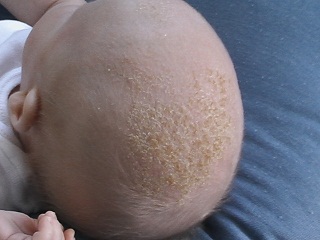
Cradle cap is very common and usually appears in the first few weeks of life. There are greasy, yellow scaling patches that may eventually coalesce to a thick, scaly layer. The condition is not usually itchy and the child is not distressed by it. There may be loss of small amounts of hair in the area of scalp affected. There may be some areas of redness around the plaques. It tends to be very scaly on the scalp, whereas in the flexural areas it may be more erythematous in nature4 .
Differentialdiagnose3 4
Areas of reddened skin with scales may be mistaken for atopic eczema.
If the plaques become infected, they may resemble Impetigo.
Nappy rash or Kandidose in the groin and perianal areas (the rash of seborrhoeic dermatitis is usually sharply demarcated and brightly erythematous).
Psoriasis may cause confusion and can look extremely similar in babies.5 . Indeed there are some who are of the opinion that seborrhoeic dermatitis in the nappy area is in fact psoriasis.6 .
Fungal infections - eg, tinea.
Irritant or contact dermatitis.
Untersuchungen
Usually no investigation is required and the diagnosis is made on clinical appearance alone.
Infant seborrhoeic dermatitis is uncommon in pre-adolescent children and tinea capitis is uncommon after adolescence. Dandruff in a child is more likely to represent a fungal infection. A fungal culture may aid the diagnosis but the disease may occur with a negative culture and a positive culture is not diagnostic.
Infant seborrhoeic dermatitis treatment3
Reassurance - typically resolves spontaneously within a few months.
Scalp is affected ( most common presentation):
Advise massage a topical emollient onto the scalp to loosen scales, brush gently with a soft brush and wash off with shampoo.
If not effective, consider topical imidazole cream (clotrimazole 1% or miconazole 2% cream) daily for up to 4 weeks.
If symptoms persist longer than 4 weeks with treatment, seek specialist advice.
Areas other than the scalp (including the nappy area):
Advise bathing the infant every day using an emollient as a soap substitute. Avoid soaps/detergents and vigorous cleansing.
Encourage frequent nappy changes and use of barrier emollients such as Zinc and Castor Oil ointment BP, or white soft paraffin BP ointment.
Consider a topical imidazole (clotrimazole 1% or miconazole 2%) for up to 4 weeks until symptoms resolve.
If symptoms persist longer than 4 weeks with treatment, seek specialist advice.
Low potency topical corticosteroids (such as 1% hydrocortisone) may be helpful for some infants with nappy rash.
Überweisung3
Consider referral to a dermatologist/paediatrician if there is:
Severe or widespread seborrhoeic dermatitis: consider possible underlying conditions such as immunodeficiency.
Diagnostische Unsicherheit.
Failure to respond to routine treatment.
Komplikationen3 7
Secondary infection can occur occasionally.
Leiner's disease (severe generalised seborrhoeic dermatitis - lesions become confluent and there is widespread redness and scaling). The child becomes unwell with diarrhoea, vomiting and anaemia.
Prognose
This condition usually resolves spontaneously within three to four months.8 In some it takes 6-9 months or longer. The majority of children with infant seborrhoeic dermatitis will have complete resolution and have no further skin disease. It is not known whether they have an increased risk of seborrhoeic dermatitis later in life.4
Exklusive Updates für medizinisches Fachpersonal
Bleiben Sie informiert mit den neuesten klinischen Updates, professionellen Einblicken und evidenzbasierten Leitlinien. Der Patient Pro-Newsletter stellt wesentliche Inhalte für Gesundheitsfachkräfte zusammen – direkt in Ihren Posteingang geliefert.
Durch das Abonnieren akzeptieren Sie unsere Datenschutzrichtlinie. Sie können sich jederzeit abmelden. Wir verkaufen Ihre Daten niemals.
Weiterführende Lektüre und Referenzen
- Clark GW, Pope SM, Jaboori KA; Diagnose und Behandlung der seborrhoischen Dermatitis. Am Fam Physician. 2015 Feb 1;91(3):185-90.
- Cradle cap (infantile seborrhoeic dermatitis); DermNet NZ
- Seborrhoische Dermatitis; NICE CKS, November 2024 (nur für UK-Zugang)
- O'Connor NR, McLaughlin MR, Ham P; Neugeborenenhaut: Teil I. Häufige Ausschläge. Am Fam Physician. 1. Januar 2008;77(1):47-52.
- Sampaio AL, Mameri AC, Vargas TJ, et al; Seborrheic dermatitis. An Bras Dermatol. 2011 Nov-Dec;86(6):1061-71; quiz 1072-4.
- Seborrhoisches Ekzem; Gesellschaft für Dermatologie in der Primärversorgung (PCDS)
- Leiner disease; DermNet NZ
- Gary G; Optimierung der Behandlungsansätze bei seborrhoischer Dermatitis. J Clin Aesthet Dermatol. 2013 Feb;6(2):44-9.
Über den AutorVollständige Biografie anzeigen
Aktualisiert von

Dr Colin Tidy, MRCGP
Allgemeinmediziner, Medizinischer Autor
MBBS, MRCGP, MRCP (Paediatrics), DCH
Dr. Colin Tidy ist ein NHS-Arzt mit Sitz in Oxfordshire.
Über den RezensentenVollständige Biografie anzeigen

Dr Krishna Vakharia, MRCGP
Chief Medical Officer für Gesundheit, Optum UK
MBChB, MRCGP(2013), BMedSci (hons), DFSRH, DRCOG, PGDipDerm (Distn)
Dr. Krishna Vakharia ist eine NHS-Hausärztin. Sie ist auch regelmäßige Prüferin für das postgraduale Diplom in Praktischer Dermatologie an der Cardiff University und zudem Chief Medical Officer für Gesundheit bei Optum UK.
Artikelverlauf
Artikel auch verfügbar in Englisch, Deutsch, Spanisch, Französisch, Italienisch, Portugiesisch, Hindi, Hebräisch, Arabisch, und Schwedisch.
Nächste Überprüfung fällig: 14. Dez 2027
15. Dez 2022 | Neueste Version
Einfacher Zugang zu vertrauenswürdigen Behandlungen und Gesundheitsdiensten online.
Common conditions
Get help with common conditions through the NHS, without a GP appointment.





Mehr in der Pädiatrie
- Atopische Dermatitis und Ekzem
- Gutartige angeborene Hypotonie
- Blount-Krankheit
- Kinderanämie
- Angeborene Herzkrankheit bei Kindern
- Angeborenes primäres Glaukom
- Duchenne-Muskeldystrophie
- Erb-Lähmung
- Fetales Antikonvulsivum-Syndrom
- Erster Anfall
- Gastroenteritis bei Kindern
- Hyperkaliämie bei Kindern
- Inzest
- Nocturne Enuresis bei Kindern
- Verschreibung für Kinder
- Anhaltender Durchfall oder Erbrechen
- Rektale Blutungen bei Kindern
- Rotavirus und Rotavirus-Impfung
- Harnwegsinfektion bei Kindern
- West-Syndrom