Chronic plaque psoriasis
Peer reviewed by Dr Philippa Vincent, MRCGPLast updated by Dr Toni Hazell, FRCGPLast updated 16 Jun 2026
Meets Patient’s editorial guidelines
- DownloadDownload
- Share
- Language
- Discussion
- Audio Version
- Add to preferred sources on Google
Medical Professionals
Professional Reference articles are designed for health professionals to use. They are written by UK doctors and based on research evidence, UK and European Guidelines. You may find the Psoriasis article more useful, or one of our other health articles.
Synonyms: psoriasis vulgaris (chronic stationary type)
What is plaque psoriasis?
Plaque psoriasis is a common, chronic, relapsing, inflammatory skin disorder with a strong genetic basis. Psoriasis is a T cell-mediated autoimmune disorder, resulting from the interaction between multiple genetic and environmental factors. T cells are induced to produce cytokines, which stimulate keratinocyte proliferation and the production of dermal antigenic adhesion molecules in the local blood vessels, further stimulating the T-cell cytokine response.
Epidemiology1
The prevalence of psoriasis is estimated to be about 1.3-2.2% in the UK, with the highest prevalence being in white people.
Men and women are equally affected.
It can occur at any age but the majority of cases first present before the age of 35 years. It is uncommon in children.
Plaque psoriasis accounts for 90% of all people with psoriasis.
Joint disease is associated with psoriasis in a significant proportion of patients (reported in one study to be 13.8%).
Psoriasis risk factors
There is a multifactorial pattern of inheritance. About 30% of patients with psoriasis have a family history and it is estimated that heritability is over 60%.2 Twin studies support the role of genetic factors with a three-fold increase in concordance in monozygotic twins compared with fraternal twins.3 Linkage studies suggest multiple susceptibility loci.
Environmental factors: a number of factors may trigger or exacerbate plaque psoriasis, including:
Sunlight: there is usually a decrease in severity during periods of increased sun exposure (ie it often improves in the summer and is worse in the winter) but a small minority has an aggravation of symptoms during strong sunlight and sunburn can also lead to an exacerbation of plaque psoriasis.
Infection:
Streptococcal infection is strongly associated with the development of guttate psoriasis but this may also apply to chronic plaque psoriasis.
HIV infection can be a triggering factor in some patients with a particular genotype, but psoriasis in patients with HIV may remit after antiretroviral treatment is started. Severe or atypical psoriasis is an indicator condition (one which suggests an HIV prevalence is greater than 1 in 1000) and should prompt HIV testing.45
There is an association with stress, and anxiety and depression, with some evidence for stressful events as a trigger for psoriasis (though this is not found in every trial looking at the issue) and evidence that those with psoriasis are more likely to have experienced adverse childhood experiences than controls.6
Postpartum hormonal changes.7
Drugs including:
Lithium.
Antimalarials.
Withdrawal of systemic steroids.
Beta-adrenoreceptor blocking drugs.
Non-steroidal anti-inflammatory drugs.
Angiotensin-converting enzyme (ACE) inhibitors.
Trazodone.
Terfenadine.
Gemfibrozil.
Antibiotics - eg, tetracycline, penicillin.
Imiquimod.8
Smoking and alcohol.
Trauma - psoriasis may be spread to uninvolved skin by various types of trauma.
Associated diseases
Plaque psoriasis is associated with:9 10
Psoriatic arthritis - a seronegative inflammatory arthritis, which between 7-40% of people with psoriasis will develop.
Inflammatory bowel disease.
Metabolic syndrome (abdominal obesity, hypertension, insulin resistance, dyslipidaemia).
A number of studies have suggested that people with psoriasis may have an increased risk of cardiovascular disease, lymphoma, and non-melanoma skin cancer. Some of this risk may be related to the use of immunosuppressive therapies in patients with psoriasis.111
Psoriasis symptoms
An assessment of any patient with psoriasis should include disease severity, the impact of disease on physical, psychological, and social well-being, whether they have psoriatic arthritis, and the presence of any comorbidities.1
Chronic plaque psoriasis is typified by itchy, well-demarcated circular-to-oval bright red/pink elevated lesions (plaques) with overlying white or silvery scale, distributed symmetrically over extensor body surfaces and the scalp.
Plaque-type psoriasis on arm
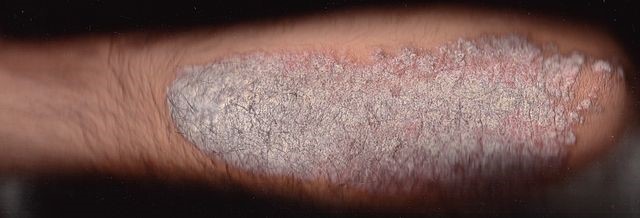
© MediaJet,CC BY-SA-3.0, via Wikimedia Commons
Fissuring within plaques can occur when lesions are present over joint lines or on the palms and soles.
Gentle scraping accentuates the scale (vigorous scraping causes pinpoint bleeding - Auspitz' sign).
The psoriatic lesions are a very distinctive rich, full, red colour. When present on the legs, lesions sometimes carry a blue or violaceous tint.
Psoriatic plaques occasionally appear to be immediately encircled by a paler peripheral zone.
New lesions often appear at sites of injury or trauma to the skin (Köbner's reaction), typically 1-2 weeks after the skin has been injured.
Plaque psoriasis presents slightly differently in children. Plaques are not as thick and the lesions are less scaly. Psoriasis may often appear in the nappy region in infancy and in flexural areas in children. The disease more commonly affects the face in children than it does with adults.
Nail changes are often seen, with pitting, onycholysis, subungual hyperkeratosis, or the oil-drop sign (yellow-red discolouration of the nail bed looking like a drop of oil beneath the nail). See the separate Psoriatic nail disease article.
Acute episodes of plaque psoriasis may evolve into more severe disease - eg, pustular or erythrodermic psoriasis.
Assessment of severity1
The extent and duration of chronic plaque psoriasis are very variable. Lesions vary in size from one to several centimetres. The number of lesions may range from few to many at any given time. Smaller plaques may coalesce into larger lesions, especially on the legs and sacral regions. Scoring systems mentioned below are largely used in secondary care.
When assessing psoriasis severity, the following should be recorded:
The results of a static Physician's Global Assessment (six-point scale assessing overall disease severity at the point of assessment as clear, nearly clear, mild, moderate, severe or very severe).
The patient's assessment of current disease severity - eg, using the static Patient's Global Assessment.
The body surface area affected.
Any involvement of nails, high-impact and difficult-to-treat sites (eg, the face, scalp, palms, soles, flexures and genitals).
Any systemic upset, such as fever and malaise, which are common in unstable forms of psoriasis such as erythroderma or generalised pustular psoriasis.
Plaque psoriasis may be classified as mild, where it affects <5% of the body's surface area, moderate where it affects 5-10% and severe at >10% involvement.12
Tools such as the Psoriasis Area and Severity Index (PASI) may be used to express disease severity, based on severity of lesions and extent of skin involvement.13 14
Differential diagnosis
Cutaneous T-cell lymphoma (consider where a rash is not responding to optimal treatment or if there is colour variation between plaques).
Investigations
Plaque psoriasis diagnosis is usually made on clinical findings, including dermoscopy. Skin biopsy is occasionally required to confirm plaque psoriasis diagnosis or exclude a differential diagnosis. One study showed that those who have skin which isn't white are more likely to need a biopsy - this may be partly related to the relative lack of images of non white skin in dermatology resources.1516
Plaque psoriasis treatment and management
Management options for the treatment of psoriasis include:1
First-line therapy which includes traditional topical therapies - eg, corticosteroids, vitamin D analogues, dithranol and tar preparations. There are various regimes, with a general principle being that the potency of any topical corticosteroid should be less if it is used on the face, flexures or genitals compared to the rest of the body.
Second-line therapy which includes phototherapy, broad-band or narrow-band ultraviolet B light, with or without supervised application of complex topical therapies such as dithranol in Lassar's paste or crude coal tar and photochemotherapy, psoralens in combination with UVA irradiation (PUVA), and non-biological systemic agents such as ciclosporin, methotrexate and acitretin.
Third-line therapy which refers to systemic biological therapies that use molecules designed to block specific molecular steps important in the development of psoriasis, such as the TNF antagonists adalimumab, etanercept and infliximab, and ustekinumab, anti-IL12-23 monoclonal antibody.
There is no strong evidence that any of the interventions have a disease-modifying effect or impact beyond improvement of the psoriasis itself.
General
Give a full explanation of psoriasis, including reassurance that it is neither infectious nor malignant, with appropriate written patient information.
Discuss treatment options (including no active treatment), likely benefit from treatment, and side-effects; agree a management plan.
Ask directly about the social and psychological effects of psoriasis and signpost sources of support, such as patient support groups such as the Psoriasis Association. The impact of psoriasis is not directly related to the overall area affected or disease activity but more to the site distribution and the attitudes of the patient. Tools such as the Dermatology Life Quality Index may be helpful.17
Consider an individual's cardiovascular risk, particularly where the plaque psoriasis is severe (affecting >10% of the body's surface area; if there has been previous inpatient treatment or the patient has had UV light treatment or other systemic therapy) and monitor and manage this appropriately.1819
Screen for the development of psoriatic arthropathy and advise to seek medical help for unexplained joint pain or swelling.
Topical therapy120
The sequence of choice of topical agents will vary according to the extent and pattern of psoriasis and the patient preference. Try to keep the number of treatments per day to a minimum to improve concordance.
Practical support and advice about the use and application of topical treatments should be provided. A potent corticosteroid applied once daily, plus vitamin D or a vitamin D analogue applied once daily (applied separately, one in the morning and the other in the evening) for up to four weeks, should be offered as initial treatment for adults with trunk or limb psoriasis.1
Regular emollients reduce scale and itch. Use liberally and frequently (apply 3-4 times a day in the direction of hair growth) to soften and reduce scaling and irritation. Use a combination of bath oil, soap substitute and emollient. Do not underestimate quantities for prescriptions: adults with generalised disease will need 500 g emollient/week. Ideally, patients with plaque psoriasis should have a daily soak in the bath (with bath oil), then pat their skin dry, and then apply a thick layer of emollient.
Topical steroids
Short-term/intermittent use of a potent topical steroid (eg, beclometasone 0.1%) or a combination product with calcipotriol (eg, Dovobet®).
A Cochrane review found that potent to very potent corticosteroids perform as well as vitamin D analogues, with a lower incidence of local adverse events but combining corticosteroid with vitamin D analogue was the most effective.21
Dovobet® is licensed for up to four weeks' use.
Topical use of potent corticosteroids on widespread psoriasis can lead to systemic as well as to local side-effects and the development of complications such as erythroderma or generalised pustular psoriasis.
Current guidelines therefore suggest that potent steroids can be used in the short term to gain control of chronic plaque psoriasis in a primary care setting but that long-term use should be avoided. Very potent corticosteroids should not be used continuously at any site for longer than four weeks and there should be at least a four week gap between courses of potent or very potent corticosteroids. Potent corticosteroids should not be used continuously at any site for longer than eight weeks.
Vitamin D analogues, usually calcipotriol (eg, Dovonex®), are used for longer-term treatment. Where this causes local irritation, switch to alternatives such as calcitriol or tacalcitol. Improvement generally occurs within two weeks but improvement frequently reaches plateau at eight weeks. Do not exceed the maximum recommended dosage, due to risk of hypercalcaemia and parathyroid hormone suppression.
If a vitamin D analogue is not tolerated or is ineffective, options include:
Coal tar (solution, cream or lotion) - preparations with between 1% and 5% are as effective as stronger ones; stronger tar preparations tend to be messy. A large cohort study did not show any increase in cancer (both skin and non-skin malignancies) associated with the past use of topical tar treatments.22
Tazarotene gel - a vitamin A analogue that is clean and odourless and can be used in combination with topical corticosteroids. Irritation is common (occurs in about 20%) but it is minimised by applying tazarotene sparingly to the plaques and avoiding normal skin. It should not be used by pregnant women or women planning a pregnancy, due to potential teratogenicity. 2324
Short contact dithranol - for 30-minute exposures in patients with few but relatively large plaques, building from 1-10% (as tolerated). Patients need to be shown how to apply creams carefully to minimise side-effects (skin irritation and temporary skin staining). Products can cause permanent staining of fabrics and bath.
Scalp psoriasis20
For patients with thick scaling of the scalp, initial treatment with overnight application of salicylic acid, tar preparations or oil preparations (eg, olive oil, coconut oil) to remove thick scale is recommended.
Facial and flexural psoriasis20
Moderate-potency topical corticosteroids (eg, clobetasone butyrate) are recommended for short-term use in facial and flexural psoriasis.
If moderate-potency topical corticosteroids are ineffective in facial and flexural psoriasis then vitamin D analogues or tacrolimus ointment are recommended for intermittent use.
Widespread plaque psoriasis
For very widespread plaque psoriasis, the same treatments may be appropriate but dithranol is often impractical and more potent corticosteroids hazardous if used on a long-term basis.
Secondary care referral
Referral to a dermatology specialist is indicated if:1
There is diagnostic uncertainty.
Psoriasis is severe or extensive - eg, more than 10% of the body surface area is affected.
Chronic plaque psoriasis cannot be controlled with topical therapy.
Any associated nail disease has a major functional or cosmetic impact.
Psoriasis is having a major impact on a person's physical, psychological or social well-being.
Secondary care management1 20
Phototherapy is a second-line treatment and is used for extensive and widespread disease or where there is resistance to topical treatment:
Narrow-band ultraviolet B (UVB) therapy offers superior efficacy with less risk of burning:
NICE recommends that narrow-band UVB phototherapy should be offered to people with plaque psoriasis that cannot be controlled with topical treatments alone. Treatment with narrow-band UVB phototherapy can be given three or two times a week. A response may be achieved more quickly with treatment three times a week.
The major drawback of this therapy is the time commitment required for treatments and the accessibility of the UVB equipment. A Scottish study reported that home treatment was safe and effective and this is now offered by some NHS trusts.25
Advise patients against the use of sunbeds as a UV source for self-treatment.
Photochemotherapy uses a photosensitising drug (eg, PUVA) to treat patients with more extensive or resistant disease. Therapy is usually administered 2-3 times per week, with maintenance treatments every 2-4 weeks until remission.
Adverse effects of PUVA therapy include nausea, pruritus and a burning sensation.
Long-term complications include increased risks of skin damage and skin cancer.
PUVA has been combined with oral retinoid derivatives to decrease the cumulative dose of UVA radiation to the skin.
Systemic agents are reserved for severe or refractory plaque psoriasis.
Systemic non-biological therapy should be offered to people if psoriasis cannot be controlled with topical therapy, it has a significant impact on physical, psychological or social well-being and one or more of the following apply:
Psoriasis is extensive (eg, more than 10% of body surface area is affected or there is a PASI score of more than 10); or
Psoriasis is localised and associated with significant functional impairment and/or high levels of distress (eg, severe nail disease or involvement at high-impact sites such as the face, flexures, genitalia, scalp, palms and soles); or
Phototherapy has been ineffective, cannot be used or has resulted in rapid relapse (defined as greater than 50% of baseline disease severity within three months).
Systemic agents include methotrexate, ciclosporin, acitretin and biologics such as etanercept and infliximab.
They may be prescribed by secondary care, or by the GP (only if there is a safe and resourced shared care agreement in place) - biologics are always prescribed in secondary care.
Hospital issued medicines should be added to the GP record as a hospital issue, so that interactions and eligibility for some vaccinations can be picked up.
Plaque psoriasis complications
Chronic plaque psoriasis is often associated with significant psychosocial difficulties. The quality of life may be severely affected by pruritus, dry and peeling skin, fissuring and the adverse effects of therapy.1
Self-consciousness and embarrassment about appearance may lead to significant anxiety and depression.
Aggressive use of topical steroids may induce progression to pustular and erythrodermic forms of psoriasis.
Prognosis
The course of plaque psoriasis is unpredictable. It is often intractable to treatment, with relapses occurring in most patients.
Both early onset and a family history of disease are considered poor prognostic indicators.
Pustular flares of disease may be provoked by systemic corticosteroid therapy. Such flares can be fatal. Disease-related mortality is otherwise very rare in psoriasis.
Adverse effects of systemic treatments (eg, hepatic fibrosis from methotrexate) and phototherapy (eg, PUVA-induced skin cancers with metastases) are the primary disease-related causes of death.
Psoriasis prevention
Avoiding specific exacerbating factors may help to prevent or minimise flare-ups but the cause of disease exacerbation is often unknown.
Efforts should be made to prevent or detect and treat the non-cutaneous complications of psoriasis, such as cardiovascular disease and depression.
Exclusive updates for healthcare professionals
Stay informed with the latest clinical updates, professional insights, and evidence-based guidance. The Patient Pro newsletter curates essential content for healthcare professionals—delivered straight to your inbox.
By subscribing you accept our Privacy Policy. You can unsubscribe at any time. We never sell your data.
Further reading and references
- Psoriasis: The assessment and management of psoriasis; NICE Clinical Guideline (October 2012 - last updated September 2017)
- Dand N, Mahil SK, Capon F, et al; Psoriasis and Genetics. Acta Derm Venereol. 2020 Jan 30;100(3):adv00030. doi: 10.2340/00015555-3384.
- Rahman P, Elder JT; Genetic epidemiology of psoriasis and psoriatic arthritis. Ann Rheum Dis. 2005 Mar;64 Suppl 2:ii37-9; discussion ii40-1.
- Arbune M, Arbune AA, Niculet E, et al; Therapeutic challenges of psoriasis in the HIV-infected patient: A case report. Exp Ther Med. 2022 Feb;23(2):175. doi: 10.3892/etm.2021.11098. Epub 2021 Dec 28.
- BHIVA/BASHH/BIA Adult HIV Testing guidelines 2020
- Lei D, Gong C, Wang B, et al; The role of psychological stress in the pathogenesis of psoriasis. Front Med (Lausanne). 2025 Aug 11;12:1614863. doi: 10.3389/fmed.2025.1614863. eCollection 2025.
- Vena GA, Cassano N, Bellia G, et al; Psoriasis in pregnancy: challenges and solutions. Psoriasis (Auckl). 2015 May 18;5:83-95. doi: 10.2147/PTT.S82975. eCollection 2015.
- Patel U, Mark NM, Machler BC, et al; Imiquimod 5% cream induced psoriasis: a case report, summary of the literature and mechanism. Br J Dermatol. 2011 Mar;164(3):670-2. doi: 10.1111/j.1365-2133.2010.10124.x. Epub
- Shani U, Ben-Shabat N, Qassem R, et al; The association between psoriasis, psoriasis severity, and inflammatory bowel disease: a population-based analysis. Ther Adv Gastroenterol. 2024 Jan 27;17:17562848241227037. doi: 10.1177/17562848241227037. eCollection 2024.
- Yamazaki F; Psoriasis: Comorbidities. J Dermatol. 2021 Jun;48(6):732-740. doi: 10.1111/1346-8138.15840. Epub 2021 Mar 25.
- Bellinato F, Gisondi P, Girolomoni G; Risk of lymphohematologic malignancies in patients with chronic plaque psoriasis: A systematic review with meta-analysis. J Am Acad Dermatol. 2022 Jan;86(1):86-96. doi: 10.1016/j.jaad.2021.07.050. Epub 2021 Aug 4.
- Guidelines for the management of psoriasis; DermNet NZ
- PASI score; DermNet NZ
- Psoriasis area severity index calculator
- Wu Y, Sun L; Clinical value of dermoscopy in psoriasis. J Cosmet Dermatol. 2024 Feb;23(2):370-381. doi: 10.1111/jocd.15926. Epub 2023 Sep 14.
- Ahmed F, Fitzsimmons R, Chu EY, et al; Frequency of Skin Biopsies for Psoriasis by Race and Ethnicity. JAMA Dermatol. 2024 Sep 1;160(9):1003-1005. doi: 10.1001/jamadermatol.2024.2554.
- Dermatology Quality of Life Index; Cardiff University
- Boehncke WH, Boehncke S, Schon MP; Managing comorbid disease in patients with psoriasis. BMJ. 2010 Jan 15;340:b5666. doi: 10.1136/bmj.b5666.
- Psoriasis; NICE Quality Standard, August 2013
- Diagnosis and management of psoriasis and psoriatic arthritis in adults; Scottish Intercollegiate Guidelines Network - SIGN (October 2010)
- Mason AR, Mason J, Cork M, et al; Topical treatments for chronic plaque psoriasis. Cochrane Database Syst Rev. 2013 Mar 28;(3):CD005028. doi: 10.1002/14651858.CD005028.pub3.
- Roelofzen JH, Aben KK, Oldenhof UT, et al; No increased risk of cancer after coal tar treatment in patients with psoriasis or eczema. J Invest Dermatol. 2010 Apr;130(4):953-61. Epub 2009 Dec 17.
- Han G, Wu JJ, Del Rosso JQ; Use of Topical Tazarotene for the Treatment of Acne Vulgaris in Pregnancy: A Literature Review. J Clin Aesthet Dermatol. 2020 Sep;13(9):E59-E65. Epub 2020 Sep 1.
- Chen H, Sun J, Yang H, et al; Fixed combination of tazarotene and betamethasone dipropionate for treatment of psoriasis vulgaris: The result of a phase 3, multicenter, randomized controlled trial. J Dermatol. 2020 Jul;47(7):728-734. doi: 10.1111/1346-8138.15349. Epub 2020 Apr 28.
- Cameron H, Yule S, Dawe RS, et al; Review of an established UK home phototherapy service 1998-2011: improving access to a cost-effective treatment for chronic skin disease. Public Health. 2014 Apr;128(4):317-24. doi: 10.1016/j.puhe.2014.01.011. Epub 2014 Apr 13.
About the authorView full bio

Dr Toni Hazell, FRCGP
MBBS, BSc, FRCGP, DFSRH, Dip GU med, DRCOG, DCH (London, UK, 2000)
Dr. Toni Hazell qualified from St. Mary’s Hospital Medical School and did her VTS at Northwick Park Hospital.
About the reviewerView full bio

Dr Philippa Vincent, MRCGP
General Practitioner, Medical Author
MB BS, Bsc, MRCGP (2000), DCH, DFSRH, DRCOG
Dr Philippa Vincent is an NHS GP working in North London.
Article history
The information on this page is written and peer reviewed by qualified clinicians.
Article also available in English, German, Spanish, French, Italian, Portuguese, Hindi, Hebrew, Arabic, and Swedish.
Next review due: 15 Jun 2030
16 Jun 2026 | Latest version

Ask, share, connect.
Browse discussions, ask questions, and share experiences across hundreds of health topics.

Feeling unwell?
Assess your symptoms online for free
More in dermatology
- Bedbugs
- Chondrodermatitis nodularis
- Common childhood rashes
- Congenital pigmented naevus
- Cutaneous filariasis
- Erythema chronicum migrans
- Genital herpes simplex
- Insect bites and stings
- Keratosis pilaris
- Linear IgA dermatosis
- Lipoma
- Malignant melanoma
- Myositis - polymyositis and dermatomyositis
- Pemphigus
- Photodermatoses
- Port-wine stain
- PUVA
- Schamberg's disease
- Skin and subcutaneous nodules
- Thrombotic thrombocytopenic purpura