Harnwegsinfektion bei Kindern
Begutachtet von Dr Krishna Vakharia, MRCGPZuletzt aktualisiert von Dr Colin Tidy, MRCGPZuletzt aktualisiert 26 Aug 2022
Erfüllt die redaktionelle Richtlinien
- HerunterladenHerunterladen
- Teilen
- Language
- Diskussion
- Audio-Version
- Zu bevorzugten Quellen bei Google hinzufügen
Harnwegsinfektionen bei Kindern sind häufig. Sie können verschiedene Symptome verursachen. Eine Behandlung mit sogenannten Antibiotika beseitigt die Infektion in der Regel schnell. In den meisten Fällen erholt sich ein Kind mit einer Harnwegsinfektion vollständig. Manchmal werden nach Abklingen der Infektion Tests zur Überprüfung der Nieren und/oder der Blase empfohlen. Ihr Arzt wird Sie beraten, ob Ihr Kind diese Tests benötigt. Dies hängt vom Alter Ihres Kindes, der Schwere der Infektion und davon ab, ob sie schon einmal aufgetreten ist.
Auf einen Blick
Eine Harnwegsinfektion bei Kindern wird durch Keime verursacht, die in den Urin gelangen.
Symptome bei Kleinkindern umfassen Fieber, Erbrechen, Schläfrigkeit oder ein unwohl wirkendes Erscheinungsbild.
Ältere Kinder können schmerzhaftes oder häufiges Wasserlassen oder Bauch-/Rückenschmerzen haben.
Eine Urinprobe bestätigt die Diagnose, und Antibiotika beseitigen normalerweise die Infektion.
Geben Sie dem Kind reichlich zu trinken und Paracetamol gegen Schmerzen oder Fieber.
Suchen Sie medizinische Hilfe, wenn Sie vermuten, dass Ihr Kind eine Harnwegsinfektion hat.
Verhindern Sie zukünftige Infektionen, indem Sie Verstopfung vermeiden und auf gute Hygiene achten.
Need treatment for a UTI?
Start a quick NHS Pharmacy First consultation online through Patient.info.
- Online and available 24/7, treatment can often be delivered next day.
- Free service, just pay the NHS prescription charge online if required.
- Just answer a few questions then choose a time for a clinician call.
Powered by Evaro, a UK regulated healthcare service supporting over 2 million patients. Reviewed by UK registered clinicians.

What is a urine infection in children?
Die Harnwege
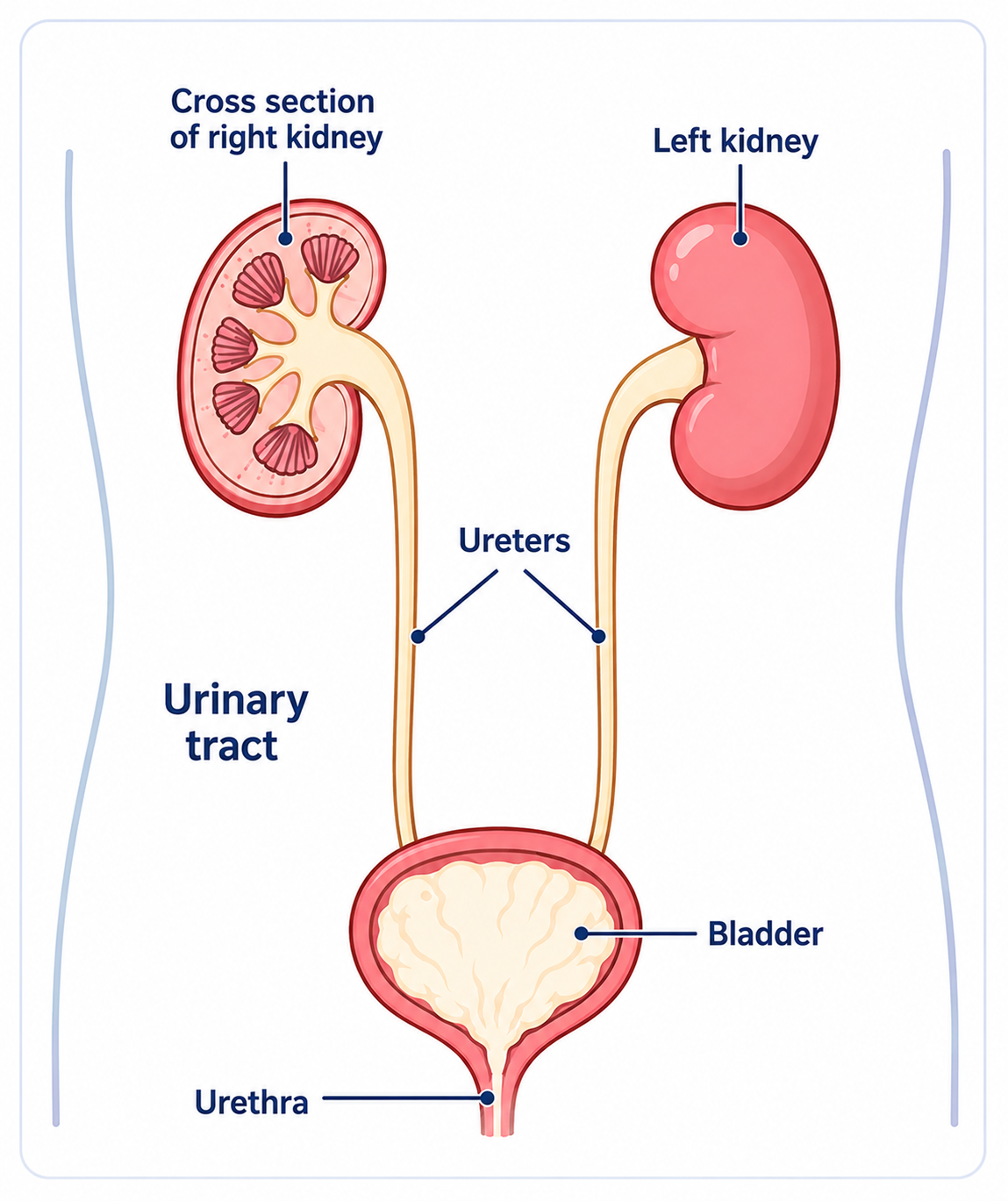
A urine infection is caused by germs (bacteria) that get into the urine. Most urine infections are due to bacteria that normally live in the bowel. They cause no harm in the bowel but can cause infection if they get into other parts of the body. Some bacteria lie around the back passage (anus) after a stool (faeces) has been passed. These bacteria can sometimes travel to the urethra (the tube that passes urine from the bladder) and into the bladder. Some bacteria thrive in urine and multiply quickly to cause infection.
The infection is commonly just in the bladder (when it is called cystitis) but may travel higher up to affect one or both kidneys as well.
Understanding the urinary tract
There are two kidneys, one on each side of the abdomen. They make urine which drains down tubes called ureters into the bladder. Urine is stored in the bladder and is passed out through a tube from the bladder (the urethra) from time to time when we go to the toilet.
Symptoms of a urine infection in children
It can be difficult to tell if a child has a urine infection. If they are very young they may not be able to let you know where the problem is. If they are still wearing nappies, you may not notice them passing urine more often.
Young children, toddlers and babies can have various symptoms which may include one or more of:
Krank sein (Erbrechen) und/oder Durchfall.
Schläfrigkeit.
Crying, going off feeds and generally seeming unwell.
Appearing to be in pain.
Blood in the urine (uncommon).
Cloudy or smelly urine.
Older children may say that they have pain when they pass urine, and pass urine frequently. If a kidney becomes infected they may also have shivers and complain of tummy (abdominal) pain, back pain, or a pain in a side of the abdomen. Bedwetting in a previously dry child is sometimes due to a children's urine infection. Just being generally unwell may be due to a urine infection.
Hinweis: a urine infection should be suspected in any child who is unwell or has a fever with no other clear cause. This is why a urine test is commonly done when a child is unwell. It is important to diagnose and treat a urine infection in children promptly.
How is a urine infection in children confirmed?
A Urinprobe is needed to confirm the diagnosis. Urine normally has no germs (bacteria) present, or only very few. A urine infection in children can be confirmed by urine tests which detect bacteria and/or the effects of infection in the urine.
Ideally, the sample of urine should not come into contact with skin or other materials which may contaminate it with other bacteria. Adults and older children can do this by a midstream collection of urine. This is not easy to do in young children and babies. The following are ways to obtain a sample of urine that is not contaminated:
Young children - the usual way is to catch some urine in the specimen bottle whilst they are passing urine. Just be ready with the open bottle as the child passes urine. (Be careful not to touch the open rim of the bottle with your fingers, as this may contaminate the specimen with bacteria from your fingers.)
Babies - one method is to place a specially designed absorbent pad in a nappy (supplied by a doctor). Urine is sucked into a syringe from the wet pad. Another method is to use a plastic bag that sticks on to the skin and collects urine. If no pad or plastic bag is available, the following might work. Take the nappy off about one hour after a feed. Gentle wiping of the skin over the pubic area, using gauze soaked in cold water, helps trigger peeing.
If you collect a sample at home, take it to the doctor or clinic as soon as possible after collection. If there is a delay, store the urine sample in the fridge.
If you are unable to obtain a sample by the methods above, there are other ways to obtain one. These ways are a little more uncomfortable and are usually done in hospital. A doctor could put a thin, flexible, hollow tube called a catheter into the bladder to get the sample. The tube is then taken out straightaway. Alternatively a doctor can also use a sterile needle to take a sample directly from the bladder, by going through the skin just above the pubic bone. A local anaesthetic is used to avoid hurting the child.
Treatment of a urine infection in children
A course of an Antibiotikum will usually clear the infection within a few days. Depending on where the infection is and how severe it is, the antibiotics may be a three-day course up to a ten-day course.
Sometimes, for very young babies or for severe infections in hospital, antibiotics are given directly into a vein through a drip.
Give lots to drink to prevent a lack of fluid in the body (dehydration). Also, give Paracetamol if needed to ease any pains and high temperature (fever).
How common is urine infection in children?
Around 1 in 30 boys and 1 in 10 girls have at least one urine infection by the time they are 16 years old.
Some terms used by doctors include:
Urinary tract infection (UTI) - which means a urine infection somewhere in the urinary tract.
Cystitis - which means infection or inflammation in the bladder.
Lower UTI - which means the infection is confined to the bladder and urethra. This is much the same as cystitis.
Upper UTI - the infection affects a kidney and/or a tube called a ureter.
Pyelonephritis - a term that means infection of a kidney.
Loin pain - which is a pain in one side of the back, often coming from a kidney.
Does anything increase the risk of developing a urine infection in children?
In most cases
No. In most urine infections in children, there is no underlying problem to account for it.
In einigen Fällen
Retaining some urine in the urinary tract may play a part. When we pass urine, the bladder should empty completely. This helps to flush out any germs (bacteria) that may have got into the bladder since the last toilet trip. However, some abnormalities or problems that affect the urinary tract can make some urine stay (be retained) in the bladder, kidney or urine tubes. This may allow any bacteria to multiply, as urine is a good food for some bacteria. This increases the chance of developing a urine infection in children. The following are the most common causes of retaining urine.
Verstopfung - if large hard stools (faeces) collect in the back passage (anus) they can press on the bladder. The bladder may then not empty fully when the child passes urine. Treating severe Verstopfung sometimes prevents recurring urine infections in children.
Dysfunctional elimination syndrome - this is a condition where a child repeatedly holds on to urine and/or stools. That is, they regularly do not fully empty their bladder or bowel when they go to the toilet. There is no physical cause for this (that is, no abnormality in the urinary tract or rectum). The reason why this occurs is often unclear. Stress or emotional problems may be the underlying cause.
An abnormality of the urinary tract - structural abnormalities can cause retention of urine. The most common condition is called vesicoureteric reflux. This is a structural problem at the junction where the ureter tube enters the bladder. In this condition, urine is passed back (refluxes) up the ureter from the bladder from time to time. This should not happen. The urine should only flow downwards out of the bladder when going to the toilet.
This condition makes urine infections in children more likely. Infected urine that refluxes from the bladder back up to the kidneys may also cause kidney infection, scarring and damage. In some cases this leads to severe kidney damage if urine infections recur frequently. Other rare problems that may be found include Nierensteine, or rare abnormalities of parts of the urinary tract.
Nerve (neurological) or spinal cord disorders - anything that affects the bladder emptying or sensation. These are rare in children.
Andere Erkrankungen
Other conditions which increase the risk of a urine infection include having Diabetes and having a poorly functioning immune system. For example, children having chemotherapy may have a less effective immune system.
Wie ist die Aussicht (Prognose)?
In most cases, this is excellent. Once a child's urine infection is diagnosed and treated, the infection usually clears away and the child recovers fully. In many cases, a urine infection is a one-off event. However, some children have more than one urine infection and some develop several throughout their childhood (recurring UTIs).
In some cases, urine infections in children can be severe, particularly if a kidney becomes badly infected. This can sometimes be serious, even life-threatening in a minority of cases if treatment is delayed. A bad infection, or repeated infections, of a kidney may also do some permanent damage to the kidney. This could lead to kidney problems or high blood pressure later in life.
When are further tests advised?
Urine infection in children is common. In most cases, a child with a urine infection will make a full recovery.
Tests are advised in some cases to check on the kidneys and/or bladder. Your doctor will advise if your child needs further tests. It depends on factors such as the child's age, the severity of the infection and whether it has happened before. For example:
Children over the age of 6 months who have a one-off urine infection which promptly clears with treatment do not usually need any further tests.
Children with a severe infection, or with an infection with unusual features, may need tests.
Children who have two or more infections of any severity may need tests.
The tests that are advised may vary depending on local policies and the child's age. There are various tests (scans, etc) which may be used. These are to check on the structure and function of the urinary tract (the kidneys, the bladder and the tubes which carry urine).
The results of the tests are normal in most cases. However, in some cases, an abnormality such as vesicoureteric reflux may be detected (described above). Depending on whether an abnormality is detected, and how severe it is, a kidney specialist may advise a regular daily low dose of an antibiotic medicine. This treatment is advised in some cases to prevent further urine infections, with the aim of preventing damage to the kidneys.
Hinweis: the general rules as to which children should have further tests following a urine infection have been laid out for England and Wales in guidelines from the National Institute for Health and Care Excellence (NICE). The guidance may differ in other countries. See the link to the NICE guideline in the Further Reading section below.
General tips following a urine infection in a child
To help to prevent a further infection in the future:
Try not to let your child become verstopft. A good diet will help here. Ask your doctor for advice on this if you are not sure what foods are best to prevent constipation.
Make sure your child has plenty to drink each day.
Make sure your child is clean after going to the toilet, and teach them how to do this when they are old enough to go to the toilet alone.
Make sure your child can go to the toilet promptly when they need to; encourage them to do so. You may need to make a nursery/school teacher aware that your child has had a urine infection.
Also, consult a doctor promptly if you suspect your child has another urine infection. If this is confirmed, remind your doctor that your child has had a previous urine infection. Further tests may be advised.
Need treatment for a UTI?
Start a quick NHS Pharmacy First consultation online through Patient.info.
- Online and available 24/7, treatment can often be delivered next day.
- Free service, just pay the NHS prescription charge online if required.
- Just answer a few questions then choose a time for a clinician call.
Powered by Evaro, a UK regulated healthcare service supporting over 2 million patients. Reviewed by UK registered clinicians.
Patientenauswahl für Kinderkrankheiten
Kindergesundheit
Husten und Erkältungen bei Kindern
Husten und Schnupfen werden in der Regel durch eine Infektion mit einem Virus verursacht. Sie verschwinden normalerweise von selbst. Antibiotika helfen nicht und können schädlich sein, zum Beispiel Durchfall und Erbrechen verursachen. Paracetamol oder Ibuprofen können einige Symptome lindern. Stellen Sie sicher, dass das Kind genug trinkt.
von Dr. Doug McKechnie, MRCGP

Kindergesundheit
Mumps
Mumps ist eine durch ein Virus verursachte Infektion. Sie betrifft hauptsächlich die Speicheldrüsen, die sich im Gesicht befinden. Manchmal sind auch andere Körperteile betroffen. Mumps betrifft normalerweise Kinder, kann aber in jedem Alter auftreten. Mumps ist im Vereinigten Königreich inzwischen selten, da Kinder routinemäßig gegen Mumps geimpft werden.
von Dr. Philippa Vincent, MRCGP
Häufig gestellte Fragen
Was ist der Unterschied zwischen einer oberen und einer unteren Harnwegsinfektion?
Eine untere Harnwegsinfektion, auch bekannt als Blasenentzündung, bedeutet, dass die Infektion auf die Blase und die Harnröhre (das Rohr, das den Urin aus dem Körper transportiert) beschränkt ist. Eine obere Harnwegsinfektion hingegen bedeutet, dass die Infektion weiter nach oben gewandert ist, um eine Niere und/oder die Harnleiter (die Röhren, die die Nieren mit der Blase verbinden) zu betreffen. Wenn eine Niere infiziert ist, spricht man von Pyelonephritis.
Wenn mein Kind eine Harnwegsinfektion hatte, ist es dann wahrscheinlicher, dass es eine weitere bekommt?
Während viele Kinder eine Harnwegsinfektion als einmaliges Ereignis erleben und sich vollständig erholen, haben einige Kinder mehr als eine Infektion. Wiederkehrende Infektionen, insbesondere wenn sie die Nieren betreffen, können manchmal zu Nierenschäden oder Bluthochdruck im späteren Leben führen. Wenn Ihr Kind bereits eine Harnwegsinfektion hatte und Sie eine weitere vermuten, ist es wichtig, Ihren Arzt zu informieren, da weitere Tests oder vorbeugende Maßnahmen in Betracht gezogen werden könnten.
Warum bekommen Mädchen häufiger Harnwegsinfektionen als Jungen?
Etwa 1 von 10 Mädchen wird bis zum Alter von 16 Jahren mindestens eine Harnwegsinfektion haben, verglichen mit etwa 1 von 30 Jungen. Der Artikel erklärt nicht direkt, warum Mädchen häufiger betroffen sind, aber es ist ein anerkanntes Muster, das oft mit anatomischen Unterschieden im Harntrakt zusammenhängt.
Können Ernährung oder Diät helfen, Harnwegsinfektionen bei Kindern zu verhindern?
Eine gute Ernährung kann helfen, Verstopfung zu verhindern, was wiederum das Risiko von Harnwegsinfektionen verringern kann. Wenn schwere Verstopfung behandelt wird, kann dies manchmal wiederkehrende Infektionen verhindern. Es wird empfohlen, Ihren Arzt um Rat zu den besten Lebensmitteln zur Vermeidung von Verstopfung zu fragen, wenn Sie unsicher sind.
Was soll ich tun, wenn mein Kind im Kindergarten oder in der Schule dringend auf die Toilette muss, besonders nach einer Harnwegsinfektion?
Es ist wichtig sicherzustellen, dass Ihr Kind bei Bedarf schnell zur Toilette gehen kann, und es dazu zu ermutigen. Möglicherweise müssen Sie den Kindergarten oder die Lehrkraft der Schule darüber informieren, dass Ihr Kind eine Harnwegsinfektion hatte, damit sie Bescheid wissen und die Bedürfnisse Ihres Kindes berücksichtigen können.
Gibt es spezielle Reinigungstechniken nach der Toilettenbenutzung, die helfen können, Harnwegsinfektionen zu verhindern?
Ja, es ist wichtig sicherzustellen, dass Ihr Kind nach dem Toilettengang sauber ist. Wenn sie älter werden, sollten Sie ihnen beibringen, wie sie sich richtig reinigen, wenn sie alleine auf die Toilette gehen können.
Weiterführende Lektüre und Referenzen
- Williams G, Craig JC; Long-term antibiotics for preventing recurrent urinary tract infection in children. Cochrane Database Syst Rev. 2019 Apr 1;4:CD001534. doi: 10.1002/14651858.CD001534.pub4.
- Harnwegsinfektion bei unter 16-Jährigen: Diagnose und Behandlung; NICE-Richtlinie (Juli 2022)
- Harnwegsinfektion - Kinder; NICE CKS, April 2024 (nur in Großbritannien zugänglich)
- Leung AKC, Wong AHC, Leung AAM, et al; Harnwegsinfektion bei Kindern. Recent Pat Inflamm Allergy Drug Discov. 2019;13(1):2-18. doi: 10.2174/1872213X13666181228154940.
- 't Hoen LA, Bogaert G, Radmayr C, et al; Aktualisierung der EAU/ESPU-Richtlinien zu Harnwegsinfektionen bei Kindern. J Pediatr Urol. 2021 Apr;17(2):200-207. doi: 10.1016/j.jpurol.2021.01.037. Epub 2021 Feb 2.
Über den AutorVollständige Biografie anzeigen
Aktualisiert von

Dr Colin Tidy, MRCGP
Allgemeinmediziner, Medizinischer Autor
MBBS, MRCGP, MRCP (Paediatrics), DCH
Dr. Colin Tidy ist ein NHS-Arzt mit Sitz in Oxfordshire.
Über den RezensentenVollständige Biografie anzeigen

Dr Krishna Vakharia, MRCGP
Chief Medical Officer für Gesundheit, Optum UK
MBChB, MRCGP(2013), BMedSci (hons), DFSRH, DRCOG, PGDipDerm (Distn)
Dr. Krishna Vakharia ist eine NHS-Hausärztin. Sie ist auch regelmäßige Prüferin für das postgraduale Diplom in Praktischer Dermatologie an der Cardiff University und zudem Chief Medical Officer für Gesundheit bei Optum UK.
Artikelverlauf
Artikel auch verfügbar in Englisch, Deutsch, Spanisch, Französisch, Italienisch, Portugiesisch, Hindi, Hebräisch, Arabisch, und Schwedisch.
Nächste Überprüfung fällig: 25. Aug. 2027
26 Aug 2022 | Neueste Version
Nehmen Sie an der Diskussion teil
Teilen Sie Ihre Gedanken oder Erfahrungen mit anderen in unserem Patientengemeinschaften.

Fragen, teilen, verbinden.
Durchsuchen Sie Diskussionen, stellen Sie Fragen und teilen Sie Erfahrungen zu Hunderten von Gesundheitsthemen.

Fühlen Sie sich unwohl?
Bewerten Sie Ihre Symptome online kostenlos
Abonnieren Sie den Patienten-Newsletter
Ihre wöchentliche Dosis klarer, vertrauenswürdiger Gesundheitsberatung - geschrieben, um Ihnen zu helfen, sich informiert, selbstbewusst und in Kontrolle zu fühlen.
Durch das Abonnieren akzeptieren Sie unsere Datenschutzrichtlinie. Sie können sich jederzeit abmelden. Wir verkaufen Ihre Daten niemals.