Hoher Cortisolspiegel: Symptome, Ursachen und Tests
Begutachtet von Dr Colin Tidy, MRCGPVerfasst von Heather AinsworthUrsprünglich veröffentlicht 6. März 2026
Erfüllt die Anforderungen des Patienten Richtlinien des Patienten
- HerunterladenHerunterladen
- Teilen
- Language
- Diskussion
- Audio-Version
- Zu bevorzugten Quellen bei Google hinzufügen
If you’ve been feeling unusually tired, noticing stubborn weight gain, or seeing changes in your skin, it could be your body’s way of trying to tell you that cortisol - your stress hormone - is running high.
While cortisol is essential for managing stress, too much can quietly disrupt your body.
Recognising symptoms of high cortisol is key to protecting your health and helping you stay balanced, resilient, and healthy.
Was ist Cortisol?
Cortisol is your body’s main stress hormone. When you feel stressed, scared, or if you're in need of an extra charge, your body releases cortisol to help you respond.
It boosts energy, helps you wake up, and supports your body during challenging situations. Cortisol also plays a role in regulating blood sugar, blood pressure, and inflammation.1
Think of cortisol as your body’s alarm system manager - it helps you react when needed, then calms things back down when the stress is over.
Is high cortisol bad?
Not necessarily. Cortisol rises naturally when you’re under pressure - during a busy week, after poor sleep, or when you’re unwell. In small bursts, it’s helpful.
But when stress becomes constant and cortisol levels stay high, it can start to affect things such as the quality of your sleep, mood, blood sugar levels, weight, blood pressure, and Immunsystem.
What are the symptoms of high cortisol?
High cortisol can develop gradually, and early symptoms are often mistaken for everyday stress.
Because cortisol affects your body in lots of different ways, elevated levels can show up in where you least expect them.
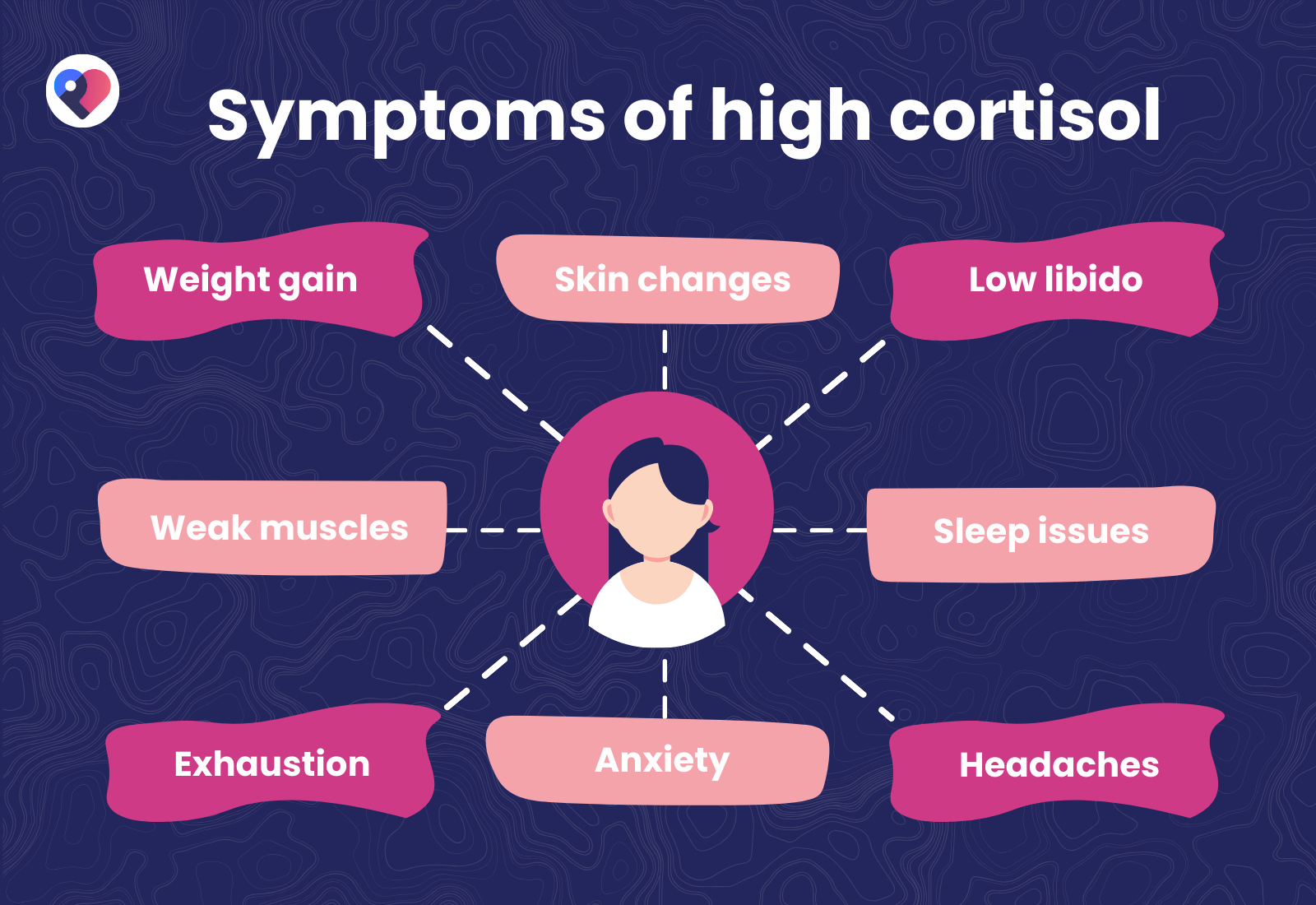
You may have high cortisol levels if you’re experiencing any of the following:
© Patient / Heather Ainsworth
1. Weight gain
One of the most common signs of high cortisol levels is weight gain, particularly around your stomach and face, often leading to a characteristic 'cortisol face' 2- a rounder, puffier appearance with increased fat in the cheeks and under the jaw.
2. Trouble sleeping
High cortisol can disrupt your natural sleep-wake cycle, making it harder to fall or stay asleep.3
Some people feel “tired but wired” at night, meaning their body is exhausted but their mind refuses to power down.
3. Increased anxiety or irritability
Because cortisol is your body’s primary stress hormone, elevated levels may heighten feelings of Angstzustände, restlessness, or mood swings.4
When stress signals stay switched on, it becomes harder for your body and brain to shift into a calm, regulated state.
4. Feeling exhausted
Even though cortisol is linked to alertness, chronically high levels can eventually leave you feeling drained - physically and mentally - as your body stays in a prolonged state of stress that’s difficult to sustain.5
5. Frequent headaches
Prolonged levels of high cortisol may contribute to Spannungskopfschmerzen oder Migräne in some people.6
Long-term stress can promote sustained muscle tension - especially in your neck and shoulders - and may alter pain pathways in the brain, increasing headache frequency or intensity.
6. Muscle weakness
High cortisol can break down muscle tissue over time, leading to reduced strength, especially in your upper arms and thighs.7
Chronically high cortisol promotes protein breakdown, which can gradually decrease muscle mass and make it harder to build or maintain strength.
7. Changes to the skin
Cortisol affects collagen production, which can cause changes to your skin such as thin skin, easy bruising, slow healing of cuts and wounds, and pink or purple stretch marks - often on your stomach, thighs, or breasts.1
8. Low libido
High cortisol can interfere with the production of sex hormones such as oestrogen and testosterone, potentially reducing sexual desire in both men and women.8
When your body remains in a prolonged stress state, it may shift resources away from reproductive functions.
9. High blood pressure
Cortisol plays an important role in regulating blood pressure. When levels remain high, it increases your chance of hoher Blutdruck (Hypertonie).9
High cortisol levels can raise blood pressure by causing your body to hold onto salt and water, making blood vessels tighten more easily, and stiffening your arteries.
10. Difficulty concentrating
Brain fog, memory lapses, and trouble focusing can occur when stress hormones such as cortisol stay high for extended periods.5
Long-term stress may disrupt communication between the brain regions responsible for focus, learning, and short-term memory.
Are symptoms of high cortisol the same in men and women?
Many symptoms of high cortisol are the same in men and women - but some differ due to hormonal variations.
Common symptoms include weight gain, fatigue, high blood pressure, high blood sugar, mood changes, muscle weakness, and sleep problems.
However, women may experience irregular periods, acne, or increased facial hair, while men may notice reduced libido, Erektionsstörungen, oder lower testosterone levels.
What causes high cortisol?
For most people, high cortisol is more commonly caused by:
Ongoing stress.
Disrupted sleep.
Übermäßiger Alkoholkonsum.
Overtraining without recovery.
Certain medicines.
Persistently high cortisol however can also be caused by a medical condition called Cushing-Syndrom.
How to test for high cortisol
If you think your cortisol levels are too high, testing is the only reliable way to confirm it. Because cortisol naturally fluctuates throughout the day, doctors often use specific timing or multiple tests to get an accurate picture.
These tests may include:
A blood cortisol test - usually taken in the morning.
A 24-hour urine cortisol test.
A late-night salivary cortisol test.
A Dexamethason suppression test.
Proper diagnosis is important, as the treatment for lowering cortisol levels depends on identifying the underlying cause.
Zusammenfassung
Cortisol is an essential hormone that helps regulate stress, metabolism, blood pressure, and sleep. Short-term increases are normal and protective. However, persistently high levels may cause fatigue, weight gain, poor sleep, anxiety, high blood pressure, and immune suppression.
Most cases are linked to long-term stress or lifestyle factors, but in rare instances, underlying medical conditions such as Cushing's syndrome may be the cause.
If your symptoms are getting worse, feel intense, or you’re noticing quick weight gain or changes to your skin, you should see a doctor.
Patientenauswahl für Hormonungleichgewicht
Hormone
Die besten Lebensmittel für die hormonelle Gesundheit
If you think you might have a hormone imbalance, it's best to visit your doctor for a formal diagnosis. They can advise you on the best course of action to get you feeling better. There are various types of treatment available to help you manage your hormones. Some of these include making changes to your lifestyle - such as paying close attention to what you eat.
von Victoria Raw
Hormone
HRT: Überprüfung von Risiken und Vorteilen
Mythen über Nebenwirkungen und Risiken der Hormonersatztherapie (HRT) für die Menopause halten sich hartnäckig. Hier überprüfen wir die Realität hinter den Gerüchten und Missverständnissen und geben Ihnen die Wahrheit über die Einnahme dieses Medikaments, das eine entscheidende Rolle dabei spielt, Ihnen zu helfen, die Menopause komfortabler und gesünder zu erleben.
von Lawrence Higgins
Häufig gestellte Fragen
When should I see a doctor about my cortisol levels?
You should see a doctor if your symptoms are getting worse, feel intense, or if you're noticing quick weight gain or changes to your skin. Proper diagnosis is important, as the treatment for lowering cortisol levels depends on identifying the underlying cause.
How does cortisol affect my sugar levels and blood pressure?
Cortisol plays a role in regulating both blood sugar and blood pressure. When cortisol levels remain high, it can increase your blood pressure by causing your body to retain salt and water, tighten blood vessels, and stiffen arteries. High cortisol can also impact your blood sugar levels.
Does high cortisol always mean I have a serious medical condition?
Not necessarily. For most people, high cortisol is more commonly caused by factors like ongoing stress, disrupted sleep, excessive alcohol intake, overtraining without recovery, or certain medicines. However, persistently high cortisol can also be caused by a medical condition called Cushing's syndrome.
Can high cortisol make me feel generally unwell or drained?
Yes, chronically high cortisol levels can leave you feeling drained both physically and mentally. This is because your body stays in a prolonged state of stress, which is difficult to sustain. It can also lead to general feelings of exhaustion.
Weiterführende Literatur und Referenzen
- Kaur et al: Physiology, Cortisol
- Qiang, Jiaqi et al: The Face of Excess Cortisol: Clinical and Morphologic Insights Into Cushing Syndrome
- Balbo et al: Impact of sleep and its disturbances on hypothalamo-pituitary-adrenal axis activity
- Chan II & Wu AMS: Assessing the Role of Cortisol in Anxiety, Major Depression, and Neuroticism
- Sun et al: The impact of prolonged high-concentration cortisol exposure on cognitive function and risk factors: Evidence from Cushing's disease patients
- Leistad et al: Noradrenaline and cortisol changes in response to low-grade cognitive stress differ in migraine and tension-type headache
- Katsuhara et al: Impact of Cortisol on Reduction in Muscle Strength and Mass
- Hamilton et al: Cortisol, sexual arousal, and affect in response to sexual stimuli
- Bautista et al: The relationship between chronic stress, hair cortisol and hypertension
Über den AutorVollständige Biografie anzeigen

Heather Ainsworth
SEO-Managerin
BA (Hons) Betriebswirtschaft und Marketing, IDM Zertifikat DDM, MHFAider®
Heather is the SEO Manager at Patient and a trained Mental Health First Aider. She is also a regular health writer, covering a wide range of topics with a particular interest in mental wellbeing, women's health, and holistic health.
Über den RezensentenVollständige Biografie anzeigen

Dr Colin Tidy, MRCGP
Allgemeinmediziner, Medizinischer Autor
MBBS, MRCGP, MRCP (Paediatrics), DCH
Dr. Colin Tidy ist ein NHS-Arzt mit Sitz in Oxfordshire.
Artikelverlauf
Die Informationen auf dieser Seite werden von qualifizierten Klinikern begutachtet.
Artikel auch verfügbar in Englisch, Deutsch, Spanisch, Französisch, Italienisch, Portugiesisch, Hindi, Hebräisch, Arabisch, und Schwedisch.
Nächste Überprüfung fällig: 6. März 2029
6. März 2026 | Ursprünglich veröffentlicht
Verfasst von:
Heather AinsworthBegutachtet von
Dr Colin Tidy, MRCGP

Fragen, teilen, verbinden.
Durchsuchen Sie Diskussionen, stellen Sie Fragen und teilen Sie Erfahrungen zu Hunderten von Gesundheitsthemen.

Fühlen Sie sich unwohl?
Bewerten Sie Ihre Symptome online kostenlos
Abonnieren Sie den Patienten-Newsletter
Ihre wöchentliche Dosis klarer, vertrauenswürdiger Gesundheitsberatung - geschrieben, um Ihnen zu helfen, sich informiert, selbstbewusst und in Kontrolle zu fühlen.
Durch das Abonnieren akzeptieren Sie unsere Datenschutzrichtlinie. Sie können sich jederzeit abmelden. Wir verkaufen Ihre Daten niemals.
Mehr über Hormone
- 8 häufige Mythen über PCOS (Polyzystisches Ovarialsyndrom)
- Können Bluttests helfen, die Menopause und HRT zu verwalten?
- Funktionieren pflanzliche Heilmittel gegen die Wechseljahre wirklich?
- Benötigen Sie mit 40 einen Wechseljahre-Check?
- Wie man Gelenkschmerzen während der Menopause lindert
- Wie Sie Ihre Perimenopause-Symptome lindern können
- Wie man Hautprobleme in den Wechseljahren bewältigt
- Wie man jemanden während der Menopause unterstützt
- Wie man erkennt, ob man eine Schilddrüsenunterfunktion hat
- HRT: Überprüfung von Risiken und Vorteilen
- Leben mit HRT
- Wechseljahre-Videos
- Überraschende Fakten über Schilddrüsenprobleme
- Die besten Lebensmittel für die hormonelle Gesundheit
- Die Bedeutung einer gesunden Schilddrüse
- Das Problem mit 'bioidentischen Hormonen' für die Menopause
- Die Wahrheit über HRT
- Was HRT für mich getan hat
- Wie es ist, eine frühe Menopause zu erleben
- Ihre Ernährung und die Wechseljahre