Eczema herpeticum
Peer reviewed by Dr Colin Tidy, MRCGPLast updated by Dr Philippa Vincent, MRCGPLast updated 19 May 2023
Meets Patient’s editorial guidelines
- DownloadDownload
- Share
- Language
- Discussion
- Audio Version
- Add to preferred sources on Google
In this series:Atopic eczemaEczema triggers and irritantsEmollients and eczema creamsTopical steroids for eczemaDiscoid eczemaPompholyx
Eczema herpeticum is a rare and serious skin infection caused by one of the herpes viruses. It causes a blistery, painful skin rash. It most often affects children who have eczema. It is often confused with other skin infections. It should be treated as soon as possible to avoid complications. It can become very serious if not treated quickly enough. Treatment with an antiviral medicine usually works very well.
At a glance
Eczema herpeticum is a severe skin infection caused by the herpes virus, similar to the cold sore virus.
It causes painful red spots and blisters, often on areas where someone has eczema.
The rash can spread quickly and you may feel generally unwell with a high temperature.
It is contagious and can spread through skin-to-skin contact.
See a doctor urgently if you suspect eczema herpeticum, as prompt treatment is crucial.
Treatment involves antiviral medicines, sometimes given in hospital.
What is eczema herpeticum?
Eczema herpeticum is a bad skin infection that occurs in people who already have eczema. The herpes virus (the same one that causes cold sores) invades the skin and causes painful red spots. The rash can spread very quickly over the body and needs to be treated quickly.
Is eczema herpeticum contagious?
Usually the virus is caught from somebody who has an infection such as a cold sore. It takes 5-12 days after contact with the infected person for the rash to develop.
Who gets eczema herpeticum?
Eczema herpeticum can happen at any age. However, it is most common in young children who already have eczema. See the separate leaflet called Atopic Eczema. The eczema causes breaks in the skin which allows the virus in. So it can also happen to people who have other causes of skin breaks - for example, burns or other types of skin conditions.
Eczema herpeticum symptoms
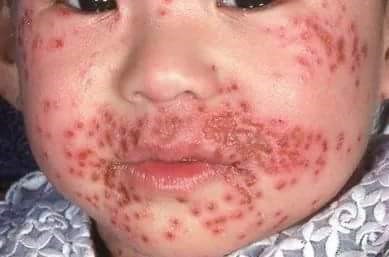
A child or person with eczema herpeticum develops a skin rash which looks like lots of little blisters. These are usually in areas where there has been a skin condition (usually atopic eczema). The spots are usually quite painful. The spots then spread to other areas of skin. Eczema herpeticum can develop on any part of the body but is most common on the face or neck.
The blisters are all around the same size. They are filled with fluid which may be a clear fluid or a yellowish fluid called pus. They may bleed or ooze or weep. They then become crusted over.
People with eczema herpeticum feel unwell. They may have a high temperature and may be able to feel lumps called lymph nodes in your neck, armpits or groin. These come up in response to the infection, to help fight it.
How is eczema herpeticum diagnosed?
Eczema herpeticum is often confused with other skin infections. As it starts with just a few small red spots, it is often confused with chickenpox. The key difference to chickenpox here is that eczema herpeticum has lots of tiny red spots very close together whereas chickenpox often has slightly larger red spots that are a bit further apart.
As eczema herpeticum is often on the face or around the mouth, it is often confused with impetigo (a common skin infection caused by bacteria). The difference is that a child with eczema herpeticum will often be generally unwell, with a fever, whereas with impetigo they don't usually feel ill.
Sometimes the rapid appearance of the red spots of eczema herpeticum is confused with a simple flare-up of eczema. The main difference is that normal eczema is itchy whereas eczema herpeticum is painful.
If you think you or (more likely) your child have eczema herpeticum it is vital that you see a doctor to check the diagnosis: eczema herpeticum needs to be treated correctly and promptly, otherwise it can become very serious.
Hospital specialists may take a small sample (a swab) of the fluid in one of the spots and send it to the laboratory for testing. Specialist tests can show the herpes virus, which confirms the diagnosis. Most GPs do not have access to these tests which are usually only available in hospital.
This photo shows the typical appearance of eczema herpeticum in a young child:
Eczema herpeticum in a young child
© Mohammad2018 (Own work) via Wikimedia Commons
Eczema herpeticum treatment
Hospital treatment
Eczema herpeticum is considered an emergency. This is because it can spread quickly. So it must be treated correctly and quickly. Someone with eczema herpeticum will normally be sent to hospital that day for advice from a specialist. In children it is quite common to be admitted to hospital while having the first few days of treatment. In adults, particularly if the infection is mild, it may be sufficient to take tablets at home.
It is important not to be tempted to put a steroid cream on the eczema herpeticum as this will usually make it a lot worse.
Antiviral medicine
Antiviral medicine such as aciclovir is usually very successful for treating eczema herpeticum. It may be given as a liquid or a tablet. For people who are too unwell to take it as a liquid or a tablet, it can be given by a drip (intravenously).
Antibiotics
Sometimes an antibiotic may be needed as well. This is because the damage to the skin makes it more likely to become infected by the bacteria which is normally harmlessly present on the skin. This is called a secondary bacterial infection.
Is eczema herpeticum infectious?
Herpes is a very infectious (contagious) virus; it can be caught easily by touching the skin of someone with herpes. For example,, there is a high chance of developing a cold sore after kissing someone who has a cold sore.
With eczema herpeticum, someone with damaged skin from eczema who touches eczema herpeticum will have a reasonable chance of developing the infection too. This is particularly so if the eczema is inflamed or the skin is very broken.
If a child is hospitalised with eczema herpeticum, visitors will probably have to wear gloves and an apron. Elderly people or anyone who is unwell or frail will be advised not to visit them in hospital.
So someone with eczema herpeticum should avoid contact with:
Children with atopic eczema.
People who have problems with their immune systems (immunosuppression). This would include people with AIDS, people who have recently had chemotherapyor people who are on steroid medication.
Newborn babies.
What is the outlook for eczema herpeticum?
As long as eczema herpeticum is treated quickly with the correct antiviral medicine, the outlook (prognosis) is very good. The spots usually heal up and go away in 2-6 weeks. If it is not treated quickly, however, it can spread rapidly and may have complications. Information on complications can be found in the Further Reading NICE Clinical Knowledge Summary reference below.
It can cause damage to eyesight, there may be secondary infections with other germs such as bacteria and, in people whose immune systems are not working well, it may occasionally cause death. This is because it may cause damage to other organs such as the brain, liver or lungs if it spreads.
Usually eczema herpeticum is cured by the antiviral medication. Sometimes eczema herpeticum can come back and need to be treated again.
Patient picks for Skin infections

Infections
Pityriasis versicolor
Pityriasis versicolor is a fungal infection of the skin caused by a yeast-like germ that causes a rash to form It is not harmful or passed on through touching (contagious). Treatment can clear the rash. Some people who are prone to this condition need regular treatment to prevent the rash from coming back (recurring).
by Dr Toni Hazell, FRCGP

Infections
Chickenpox in adults and teenagers
Chickenpox causes spots (a rash) and can make you feel unwell. Symptoms tend to be worse in adults than in children. Treatments can ease the symptoms until the illness goes. An antiviral medicine may limit the severity of the illness if the medicine is started within 24 hours of the rash first starting. Full recovery is usual. Serious complications are rare, but are more common in adults than in children. They are more likely to occur in pregnant women and in people with a weakened immune system, such as those on chemotherapy. If you are pregnant and have not had chickenpox (or been immunised) and come into contact with a person with chickenpox - see your doctor urgently, as treatment may prevent chickenpox from developing.
by Dr Colin Tidy, MRCGP
Frequently asked questions
Can eczema herpeticum be cured?
Usually, eczema herpeticum is cured by antiviral medication. However, it can sometimes return and need further treatment.
How long does eczema herpeticum take to heal?
As long as it's treated quickly and correctly with antiviral medicine, the spots typically heal and disappear within 2 to 6 weeks.
Is eczema herpeticum dangerous?
If left untreated, eczema herpeticum can spread rapidly and lead to serious complications. These can include damage to eyesight, secondary bacterial infections, and in people with weakened immune systems, it can occasionally be fatal if it spreads to organs like the brain, liver, or lungs.
Is eczema herpeticum an STD?
No, eczema herpeticum is not a sexually transmitted disease. It is a skin infection caused by the herpes virus, which is the same virus that causes cold sores, and it affects people who already have eczema or other skin breaks.
Can eczema herpeticum heal on its own?
Eczema herpeticum needs to be treated correctly and promptly with antiviral medication. It is considered an emergency because it can spread quickly and lead to serious complications if not treated.
Further reading and references
- Eczema herpeticum; DermNet NZ
- Liaw FY, Huang CF, Hsueh JT, et al; Eczema herpeticum: a medical emergency. Can Fam Physician. 2012 Dec;58(12):1358-61.
- Good NEJM case report with photos of eczema herpeticum; New England Journal of Medicine
- Eczema - atopic; NICE CKS, July 2024 (UK access only)
About the authorView full bio

Dr Philippa Vincent, MRCGP
General Practitioner, Medical Author
MB BS, Bsc, MRCGP (2000), DCH, DFSRH, DRCOG
Dr Philippa Vincent is an NHS GP working in North London.
About the reviewerView full bio

Dr Colin Tidy, MRCGP
General Practitioner, Medical Author
MBBS, MRCGP, MRCP (Paediatrics), DCH
Dr Colin Tidy is an NHS Doctor, based in Oxfordshire.
Article history
The information on this page is written and peer reviewed by qualified clinicians.
Article also available in English, German, Spanish, French, Italian, Portuguese, Hindi, Hebrew, Arabic, and Swedish.
Next review due: 12 May 2028
19 May 2023 | Latest version
Join the conversation
Share your thoughts or experiences with others in our patient communities.

Ask, share, connect.
Browse discussions, ask questions, and share experiences across hundreds of health topics.

Feeling unwell?
Assess your symptoms online for free
Sign up to the Patient newsletter
Your weekly dose of clear, trustworthy health advice - written to help you feel informed, confident and in control.
By subscribing you accept our Privacy Policy. You can unsubscribe at any time. We never sell your data.
More in infections
- Ebola
- Epiglottitis
- Flu
- Fungal ear infection
- Genital herpes
- Hepatitis B vaccine
- HPV vaccine
- Infected wounds
- Japanese encephalitis vaccine
- Laryngitis
- MRSA
- Non-gonococcal urethritis
- Outer ear infection (otitis externa)
- Postherpetic neuralgia
- Pubic lice and body lice
- Shingles
- Stye
- Urinary tract infection in older people
- Vestibular neuritis and labyrinthitis