Schmerzen im Knie und in der Kniescheibe
Patellofemorales Schmerzsyndrom
Begutachtet von Dr Surangi Mendis, MRCGPZuletzt aktualisiert von Dr Rachel Hudson, MRCGPZuletzt aktualisiert 31. Okt 2023
Erfüllt die Anforderungen des Patienten Richtlinien des Patienten
- HerunterladenHerunterladen
- Teilen
- Language
- Diskussion
- Audio-Version
- Zu bevorzugten Quellen bei Google hinzufügen
Most knee conditions cause pain in the front (anterior) of the knee. Patellofemoral pain is the name given to this. Pain at the back of the knee is usually caused by a Baker's cyst (also known as a popliteal cyst). The rest of this leaflet deals with patellofemoral pain syndrome, which is much more common.
Auf einen Blick
Das patellofemorale Schmerzsyndrom verursacht Schmerzen an der Vorderseite des Knies, um die Kniescheibe herum.
Es ist oft schlimmer beim Treppensteigen, Laufen oder nach längeren Sitzphasen.
Es wird angenommen, dass es durch erhöhten Druck zwischen der Kniescheibe und dem Oberschenkelknochen verursacht wird.
Die Behandlung umfasst das Vermeiden von anstrengender Nutzung des Knies, Schmerzmittel und Physiotherapie.
Chirurgie ist normalerweise nicht die erste Behandlungswahl.
What is patellofemoral pain syndrome?
Patellofemoral pain syndrome is the medical term used when pain occurs at the front of the knee, around the kneecap (patella), without signs of any damage or other problems in the knee joint.
Patellofemoral pain syndrome may also be referred to as anterior knee pain, or runner's knee.
Knee cross-section with patella
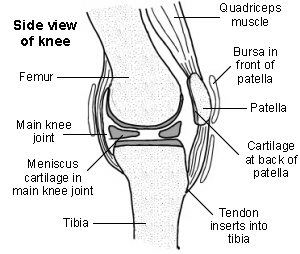
The patella is the kneecap bone. It lies within the quadriceps tendon. This large tendon from the powerful thigh muscles (quadriceps) wraps round the patella and is attached to the top of the lower leg bone (tibia). The quadriceps muscles straighten the knee.
The back of the patella is covered with smooth cartilage. This helps the patella to glide smoothly over the lower part of the thighbone (femur) when you straighten your leg.
Patellofemoral pain is a general term used for pain in the front (anterior) of the knee. However, you might also see some terms referring to specific conditions causing anterior knee pain. These include:
Other causes of knee pain can include:
Knorpelschäden im Knie (meniscal tears).
Knee pain can also be caused by hip problems.
Patellofemoral pain syndrome symptoms
Symptoms of patellofemoral pain syndrome include:
Pain around the knee. The pain is felt at the front of the knee, around or behind the kneecap (patella). Often, the exact site of the pain cannot be pinpointed; instead the pain is felt vaguely at the front of the knee.
The pain comes and goes.
Both knees are often affected at the same time but one is usually worse than the other.
The pain is typically worse when going up or, in particular, going down stairs.
Running, especially downhill, squatting and certain sports can all set it off - anything that leads to the patella being compressed against the lower part of the thighbone.
The pain may be brought on by sitting still for long periods. For example, after going to the cinema or for a long drive, when it will be worse when starting to move about again.
There may be a grating or grinding feeling, or sounds in your knee when it bends and straightens. This is called crepitus. There may also be a clicking feel or sound.
Sometimes there is puffiness or swelling around the kneecap.
The range of motion of the knee is usually normal.
What causes patellofemoral pain syndrome?
It is probably due to a combination of different factors which increase the pressure between the kneecap (patella) and the lower part of the thighbone (femur). This may happen during running, cycling, squatting and going up and down stairs. It is likely that the cause is not the same in everyone affected.
Situations where this can occur include:
Overuse of the knee, such as in certain sports - particularly at times of increased training.
Cycling when the saddle is too low or too far forward.
Some people may have a slight problem in the alignment of the patella where it moves over the lower femur. This may cause the patella to rub on, rather than glide over, the lower femur (this is known as maltracking). It may be due to the way the knee has developed. Or, it may be due to an imbalance in the muscles around the knee and hip - for example, the large quadriceps muscle above the knee and the muscles that stop the hips from tilting when standing on one leg.
Weak hip muscles may cause patellofemoral pain by causing the thighbone to be slightly turned inwards, leading to the patella being pulled slightly to one side.
Foot problems may also play a part - for example, where the feet do not have strong arches (flat feet). This makes the foot roll inwards (pronate), which means the knee has to compensate for the inward movement. However, it is unclear whether this verursacht the knee problems or may be caused by the knee problems.
Injury to the knee - including repeated small injuries or stresses due to sports, or due to slack ligaments (hypermobile joints).
Having obesity or being overweight, and wearing unsupportive footwear may also contribute to patellofemoral pain.
A combination of an alignment problem (see above) and overuse in sport is thought to be the most common reason for having patellofemoral pain.
How is patellofemoral pain syndrome diagnosed?
The diagnosis is made from your symptoms, the history of the problem, plus a physical examination of your knee.
Tests, such as X-rays or scans, cannot diagnose patellofemoral pain and are often not helpful. However, sometimes they might need to be done to diagnose maltracking or look for other conditions.
What causes pain at the front of the knee?
Patellofemoral pain syndrome treatment
In the short term
Avoid strenuous use of the knee - until the pain eases. Symptoms usually improve in time if the knee is not overused. Aim to keep fit but to reduce the activities which cause the pain.
Schmerzmittel - Paracetamol und/oder entzündungshemmende Schmerzmittel wie zum Beispiel Ibuprofen.
Physiotherapy:
Improving the strength of the muscles around the knee and hip will ease the stress on the knee.
Specific exercises may help to correct problems with alignment and muscle balance around the knee. For example, you may be taught to do exercises which strengthen the muscles of the hip and buttock.
The physiotherapist can give advice tailored to your individual situation.
Taping of the kneecap (patella) - this is a treatment which may reduce pain, but doesn't appear to have any long-term benefits. It involves adhesive tape being applied over the patella, to alter the alignment or the way the patella moves. Some people find this helpful. Some physiotherapists can offer patellar taping treatment.
In the longer term
Treatment aims to treat some of the underlying causes - for example, by strengthening hip muscles and helping with foot problems:
Physiotherapy - a long-term home exercise programme, for at least one year.
Suitable footwear - for example, arch supports if you have flat feet; suitable shoes if you are running.
Losing weight if your weight is above the recommend weight for your height is likely to help reduce pain.
Surgery is no longer recommended as first-line treatment for patellofemoral syndrome as the evidence suggests that most people do just as well - if not better - with non-surgical (conservative) treatment. However, surgery is still occasionally considered for people with anterior knee pain who do not respond to conservative treatment, depending on the diagnosis.
Wie ist der Ausblick?
The outlook (prognosis) was thought to be good and that most people got better after 4-6 months with simple treatments such as physiotherapy. However, recent studies suggest that over 50% of people still report pain and difficulties with their knee 5-8 years after physiotherapy treatment. Ongoing research is looking into how this picture can be improved.
Patientenauswahl für Knieschmerzen

Knochen, Gelenke und Muskeln
Baker-Zyste
Ein Baker-Zyste ist eine Schwellung, die sich hinter dem Knie entwickeln kann. Es ist mit der Gleitflüssigkeit gefüllt, die normalerweise im Kniegelenk vorhanden ist, bekannt als "Synovialflüssigkeit". Es tritt am häufigsten auf, wenn eine zugrunde liegende Problematik im Knie besteht, wie z.B. Arthrose. Die Symptome können Schmerzen, Schwellung und Engegefühl hinter dem Knie umfassen. Manchmal kann sich ein Baker-Zyste öffnen (rupturieren) und Symptome im Unterschenkel verursachen, die einer tiefen Venenthrombose (TVT) ähneln. Ein Baker-Zyste heilt oft von selbst ab und verschwindet im Laufe der Zeit. Es gibt jedoch verschiedene Behandlungsmöglichkeiten, die bei Symptomen hilfreich sein können.
von Dr. Philippa Vincent, MRCGP

Knochen, Gelenke und Muskeln
Hausfrauenknie
Hausmädchenknie ist auch bekannt als präpatellare Bursitis. Sie wird durch Entzündung eines kleinen, mit Flüssigkeit gefüllten Sacks (der Bursa) vor der Kniescheibe verursacht. Sie tritt häufiger bei Menschen auf, die längere Zeit knien. Die Behandlung ist in der Regel unterstützend, und die Prognose ist im Allgemeinen sehr gut.
von Dr. Colin Tidy, MRCGP
Häufig gestellte Fragen
Was ist der Unterschied zwischen dem patellofemoralen Schmerzsyndrom und anderen Arten von Knieschmerzen?
Das patellofemorale Schmerzsyndrom bezieht sich speziell auf Schmerzen an der Vorderseite des Knies, um die Kniescheibe herum, ohne Anzeichen von Schäden oder anderen Problemen im Kniegelenk selbst. Andere Zustände wie Chondromalazie der Patella, das sogenannte Hausfrauenknie oder die Osgood-Schlatter-Krankheit sind spezifische Arten von vorderen Knieschmerzen. Allgemeine Knieschmerzen können hingegen von Problemen wie Bänderdehnungen, Knorpelverletzungen, verschiedenen Formen von Arthritis oder sogar Hüftproblemen herrühren, die sich vom patellofemoralen Schmerzsyndrom unterscheiden.
Wenn mein Knie knackt oder knirscht, bedeutet das, dass ich ein patellofemorales Schmerzsyndrom habe?
Ein kratzendes, schleifendes Gefühl oder Geräusche (Krepitation) im Knie beim Beugen und Strecken sowie Klickgeräusche können ein Symptom des patellofemoralen Schmerzsyndroms sein. Diese Geräusche allein reichen jedoch nicht für eine Diagnose aus. Sie sind Teil eines breiteren Symptomspektrums, das in Kombination mit einer körperlichen Untersuchung und der Anamnese des Problems zu einer Diagnose des patellofemoralen Schmerzsyndroms führen kann.
Kann Radfahren zum patellofemoralen Schmerzsyndrom beitragen?
Ja, Radfahren kann zum patellofemoralen Schmerzsyndrom beitragen, insbesondere wenn der Fahrradsattel zu niedrig oder zu weit vorne positioniert ist. Dies kann den Druck zwischen der Kniescheibe und dem Oberschenkelknochen erhöhen und zu Schmerzen führen. Eine Anpassung der Fahrradeinstellung könnte helfen, dieses Problem zu lindern.
Benötige ich ein Röntgenbild oder einen Scan, um das patellofemorale Schmerzsyndrom zu diagnostizieren?
Nein, Röntgenaufnahmen oder Scans können in der Regel das patellofemorale Schmerzsyndrom nicht diagnostizieren und sind für diesen speziellen Zustand oft nicht hilfreich. Die Diagnose wird normalerweise basierend auf Ihren Symptomen, der Vorgeschichte Ihres Knieproblems und einer körperlichen Untersuchung Ihres Knies gestellt. Diese Tests können jedoch manchmal verwendet werden, um andere Zustände zu diagnostizieren oder um eine mögliche Fehlstellung der Kniescheibe zu untersuchen.
Wird Physiotherapie mein patellofemorales Schmerzsyndrom vollständig heilen?
Physiotherapie ist eine wichtige Behandlung für das patellofemorale Schmerzsyndrom, die sich auf die Stärkung der Muskeln um Knie und Hüfte sowie die Korrektur von Ausrichtungsproblemen konzentriert. Obwohl sie erhebliche Linderung bietet und als empfohlene Erstbehandlung gilt, deuten neuere Studien darauf hin, dass über 50% der Menschen auch Jahre nach der Physiotherapie noch über Schmerzen und Schwierigkeiten berichten. Laufende Forschungen zielen darauf ab, diese langfristigen Ergebnisse zu verbessern.
Ist eine Operation eine Option für das patellofemorale Schmerzsyndrom?
Eine Operation wird im Allgemeinen nicht als Erstbehandlung für das patellofemorale Schmerzsyndrom empfohlen. Studien legen nahe, dass konservative Behandlungen, wie Physiotherapie, oft genauso wirksam sind, wenn nicht sogar wirksamer. Eine Operation kann jedoch gelegentlich in Betracht gezogen werden für Personen, deren vordere Knieschmerzen sich mit konservativen Behandlungen nicht bessern, abhängig von ihrer spezifischen Diagnose.
Weiterführende Literatur und Referenzen
- Smith BE, Selfe J, Thacker D, et al; Incidence and prevalence of patellofemoral pain: A systematic review and meta-analysis. PLoS One. 2018 Jan 11;13(1):e0190892. doi: 10.1371/journal.pone.0190892. eCollection 2018.
- Crossley KM, Stefanik JJ, Selfe J, et al; 2016 Patellofemoral pain consensus statement from the 4th International Patellofemoral Pain Research Retreat, Manchester. Part 1: Terminology, definitions, clinical examination, natural history, patellofemoral osteoarthritis and patient-reported outcome measures. Br J Sports Med. 2016 Jul;50(14):839-43. doi: 10.1136/bjsports-2016-096384. Epub 2016 Jun 24.
- McClinton SM, Cobian DG, Heiderscheit BC; Physical Therapist Management of Anterior Knee Pain. Curr Rev Musculoskelet Med. 2020 Dec;13(6):776-787. doi: 10.1007/s12178-020-09678-0. Epub 2020 Oct 30.
- Gaitonde DY, Ericksen A, Robbins RC; Patellofemoral Pain Syndrome. Am Fam Physician. 2019 Jan 15;99(2):88-94.
- Anterior knee pain (patellofemoral dysfunction): physiotherapy exercises; Royal Berkshire NHS Foundation Trust, February 2022
Über den AutorVollständige Biografie anzeigen

Dr Rachel Hudson, MRCGP
Allgemeinmediziner und Medizinischer Autor
MBChB, MRCGP (2008), BSc (Medical Science), DFSRH, DRCOG, DCH
Dr. Rachel Hudson ist eine NHS-Ärztin, die im Nordwesten Englands arbeitet.
Über den RezensentenVollständige Biografie anzeigen

Dr Surangi Mendis, MRCGP
Berater und Medizinischer Autor
MBBS, BSc (1st), MRCGP (2014), DFSRH, PGcert otology and audiology
Surangi Mendis ist Beraterin für Audiovestibuläre Medizin und Neuro-Otologie an den Royal National ENT und Eastman Dental Hospitals, UCLH.
Artikelverlauf
Die Informationen auf dieser Seite wurden von qualifizierten Klinikern verfasst und begutachtet.
Artikel auch verfügbar in Englisch, Deutsch, Spanisch, Französisch, Italienisch, Portugiesisch, Hindi, Hebräisch, Arabisch, und Schwedisch.
Nächste Überprüfung fällig: 29. Okt. 2028
31. Okt 2023 | Neueste Version

Fragen, teilen, verbinden.
Durchsuchen Sie Diskussionen, stellen Sie Fragen und teilen Sie Erfahrungen zu Hunderten von Gesundheitsthemen.

Fühlen Sie sich unwohl?
Bewerten Sie Ihre Symptome online kostenlos
Abonnieren Sie den Patienten-Newsletter
Ihre wöchentliche Dosis klarer, vertrauenswürdiger Gesundheitsberatung - geschrieben, um Ihnen zu helfen, sich informiert, selbstbewusst und in Kontrolle zu fühlen.
Durch das Abonnieren akzeptieren Sie unsere Datenschutzrichtlinie. Sie können sich jederzeit abmelden. Wir verkaufen Ihre Daten niemals.
Mehr über Knochen, Gelenke und Muskeln
- Anästhesie für Hüft- oder Kniegelenkersatz
- Morbus Bechterew
- Rücken- und Wirbelsäulenschmerzen
- Gebrochener Zeh
- Oberarmbruch
- Calcium-Pyrophosphat-Ablagerung
- Chondrocalcinose
- Chondromalacia patellae
- Lupus
- Multiple Sklerose
- Nackenschmerzen
- Osteoarthritis
- Morbus Paget des Knochens
- Polymyalgia rheumatica
- Primärer Knochenkrebs
- Psoriasis-Arthritis
- Rheumatoide Arthritis
- Septische Arthritis
- Tennisarm
- Thorakaler Rückenschmerz