Mallory-Weiss-Riss
Begutachtet von Dr Hayley Willacy, FRCGP Zuletzt aktualisiert von Dr Philippa Vincent, MRCGPLast updated 23. März 2023
Erfüllt die Anforderungen des Patienten Richtlinien des Patienten
- HerunterladenHerunterladen
- Teilen
- Language
- Diskussion
- Audio-Version
- Add to preferred sources on Google
In dieser Serie:Bluterbrechen
Mallory-Weiss-Syndrom (auch Mallory-Weiss-Riss genannt) ist der Name für Blutungen und andere Symptome, die durch einen Riss in der Schleimhaut des oberen Teils des Darms (Magen-Darm-Trakt) verursacht werden. Es wird in der Regel durch eine Untersuchung namens Gastroskopie (Endoskopie) diagnostiziert. Dabei wird ein Schlauch durch die Speiseröhre (Ösophagus) in den Magen eingeführt. In vielen Fällen hat die Blutung bereits aufgehört, wenn die Gastroskopie durchgeführt wird, und eine spezielle Behandlung ist nicht erforderlich. Der Riss heilt in der Regel nach einigen Tagen von selbst.
At a glance
Mallory-Weiss syndrome is bleeding from a tear in the lining of the upper gut.
It is often caused by a sudden rise in pressure, such as from vomiting or violent coughing.
Symptoms include vomiting bright red blood, dark tarry stools, tummy pain, dizziness, or fainting.
A gastroscopy diagnoses the tear and can be used to treat ongoing bleeding.
The tear usually heals by itself within a few days.
You should seek medical attention quickly if you have these symptoms.
In diesem Artikel:
Video picks for Andere Verdauungsbeschwerden
Lesen Sie unten weiter
What is Mallory-Weiss syndrome?
Upper gut
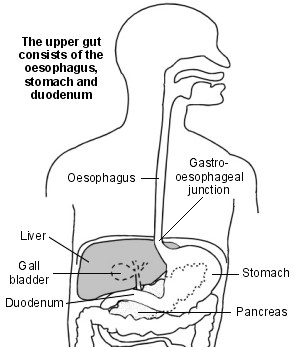
Mallory-Weiss syndrome (also called Mallory-Weiss tear) is the name given to bleeding and other symptoms caused by a tear in the lining of the upper part of the gut (gastrointestinal tract). The upper gut consists of the gullet (oesophagus), stomach and duodenum.
The tear usually occurs at one of two particular places in the upper gut:
The gastro-oesophageal junction - the part of the upper gut where the gullet joins the stomach; oder
Within the lining of the upper part of the stomach.
Mallory-Weiss syndrome was first described in 1929 by two doctors called Mallory and Weiss. They had noticed it in people retching and being sick (vomiting) after bingeing on alcohol.
What causes Mallory-Weiss syndrome?
Zurück zum InhaltThe tear in the lining of the gut that occurs in Mallory-Weiss syndrome can be caused by anything that leads to a sudden rise in pressure in the stomach or the lower part of the gullet (oesophagus). Repeated vomiting and retching after binge drinking, because of severe morning sickness during pregnancy, or because of Bulimia nervosa (episodes of binge eating followed by self-induced vomiting) are among the most common causes of Mallory-Weiss syndrome.
Any condition that causes vomiting or coughing, however, can cause this tear to happen. Less commonly it happens because of violent coughing, hiccupping, excessive straining or heavy lifting. Sometimes an obvious cause for the tear cannot be found.
Lesen Sie unten weiter
Who does Mallory-Weiss syndrome affect?
Zurück zum InhaltThe problem tends to affect people aged in their 30s to 50s, although it can occur at any age. It is more common in men than in women and is also more common in people with a hiatus hernia. (A hiatus hernia occurs when part of the stomach pushes up into the lower chest through a weakness in the diaphragm - the large flat muscle that lies between the lungs and the tummy area. See the separate leaflet called Hiatus Hernia for more details.) It is also more common in patients who drink alcohol above recommended limits.
What are the symptoms of Mallory-Weiss syndrome?
Zurück zum InhaltMost people with Mallory-Weiss syndrome will bring up (vomit) an amount of bright red blood. This will often happen after a bout of normal retching or vomiting. The amount of bleeding (and so blood vomited as a result) varies from person to person. Most people have just a small amount of bleeding but sometimes there can be a lot of blood lost.
Other symptoms can be:
Dark black or tarry-coloured foul-smelling stools (faeces) - this is known as melaena and is caused by blood from the upper part of the gastrointestinal tract changing as it moves through the lower part.
Severe pain in the upper part of the tummy (abdomen).
Dizziness and light-headedness due to the blood loss.
Ohnmacht.
Hinweis: there are many other conditions that can lead to vomiting blood. For example, a Magengeschwür, stomach inflammation (gastritis) or inflammation of the gullet (oesophagus). See the separate leaflet called Vomiting Blood (Haematemesis) for more details. About 5% of cases of bleeding from the upper part of the gut are caused by a Mallory-Weiss tear. Medical attention should be sought quickly with the above symptoms.
Lesen Sie unten weiter
How is Mallory-Weiss syndrome diagnosed?
Zurück zum InhaltMallory-Weiss syndrome is usually diagnosed by having a gastroscopy (sometimes known as an endoscopy or an OGD - oesophago-gastro-duodenoscopy).
A gastroscopy is a test where a clinician looks into the upper part of the gut using an endoscope. . An endoscope is a thin, flexible telescope which is about as thick as a little finger.
The endoscope is passed through the mouth, into the gullet (oesophagus) and down towards the stomach and duodenum. The tip of the endoscope contains a light and a tiny video camera so the operator can see inside the gut. The endoscope also has a side channel down which various instruments can pass in order to be used by the operator.
For further details see the separate leaflet called Gastroscopy (Endoscopy).
A gastroscopy allows the operator to see if a Mallory-Weiss tear is present in the gut lining, as well as its location. They will also be able to see if the tear is still bleeding.
Endoscopic image of Mallory-Weiss tear
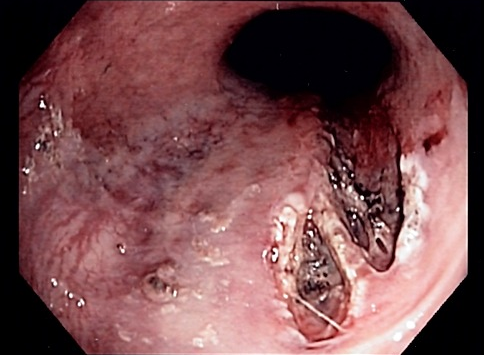
© Samir,CC BY-SA 3.0, via Wikimedia Commons
What is the treatment for Mallory-Weiss syndrome?
Zurück zum InhaltThe first thing that doctors and nurses will do if they suspect Mallory-Weiss syndrome is to make sure that the person's condition is stable. If a lot of blood has been lost, fluids may be given into the veins (intravenously). Sometimes a transfusion of blood may be given. Blood pressure and pulse rate will be closely watched so that the medical staff can check the response to any treatment.
Blood tests will usually be carried out - for example, to check for Anämie (to see how much blood has been lost because of the bleeding) and to check that the blood is clotting normally. Medication may be given to help with symptoms of feeling sick (nausea) or being sick (vomiting).
If people do not show any signs of ongoing bleeding and their condition is stable, they may not be admitted to hospital but may be followed up as an outpatient.
Management will depend on whether the Mallory-Weiss tear is still bleeding when the gastroscopy is carried out. In many cases the bleeding has stopped by the time gastroscopy takes place.
If the Mallory-Weiss tear is still bleeding
If the tear is still bleeding, treatment to stop the bleeding is usually given during the gastroscopy. A number of different treatments are available including:
The tear can be repaired, or closed, using special metal clips passed via the side channel . This is known as haemoclipping.
A band can be used to tie off a bleeding blood vessel. This is known as band ligation.
A heater probe may be passed down the side channel of the endoscope to apply a heat source to the bleeding blood vessels, to stop the bleeding.
Adrenaline (epinephrine) may be injected around the bleeding point. This medication causes closure (constriction) of the bleeding blood vessels thus stopping the bleeding
A combination of these treatments may be used
Very rarely, the above treatments do not stop the bleeding. In this case a procedure known as angiography with embolisation may be used. A special dye is injected into the bloodstream and X-rays are taken which show up the blood vessels (called angiography). In this way, doctors can see where the bleeding is coming from. A substance is then injected directly into the bleeding blood vessel either to stop the bleeding or to block it off (this is called embolisation).
Rarely, surgery is needed to treat Mallory-Weiss syndrome by sewing up the tear if other treatments have failed to stop the bleeding
If the Mallory-Weiss tear has stopped bleeding
If the tear is found to have stopped bleeding by the time gastroscopy takes place then no specific treatment may be needed. The tear should heal by itself. The person may be observed in hospital for a period of time so that they can be monitored closely to ensure that bleeding doesn't return (recur). Medication to suppress stomach acid may be given to help the tear heal.
What is the outlook for Mallory-Weiss syndrome?
Zurück zum InhaltThe outlook (prognosis) is generally very good. In most people, the bleeding stops by itself and no specific treatment is needed. Mallory-Weiss tears usually heal quickly (within a few days).
Can Mallory-Weiss syndrome return?
Zurück zum InhaltIt is not common for Mallory-Weiss syndrome to return (recur). However, if someone has had Mallory-Weiss syndrome in the past, there is the possibility of the condition recurring It is more likely to occur again if the bleeding was extremely heavy the first time.
Patient picks for Andere Verdauungsbeschwerden

Verdauungsgesundheit
Hiatushernie
Hiatus hernia is the term used to describe a condition where part of the stomach pushes up into the lower chest through a weakness in the diaphragm. Not everyone with a hiatus hernia develops symptoms. However, if you have a hiatus hernia you are more prone to reflux acid into your gullet (oesophagus), which can cause heartburn and other symptoms. If symptoms do occur, treatment with acid-suppressing medication usually works well.
von Dr. Colin Tidy, MRCGP

Verdauungsgesundheit
Abdominalmassen
Eine Bauchmasse ist eine im Bauch (Abdomen) gefühlte Beule. Es gibt viele verschiedene Ursachen für eine Bauchmasse. Bei einer neu entdeckten Masse im Bauch sollte umgehend medizinische Hilfe in Anspruch genommen werden.
von Dr. Philippa Vincent, MRCGP
Häufig gestellte Fragen
What is the upper gut and where exactly does a Mallory-Weiss tear typically occur?
The upper gut refers to the gullet (oesophagus), stomach, and duodenum. A Mallory-Weiss tear most commonly happens at either the gastro-oesophageal junction, which is where the gullet meets the stomach, or within the lining of the top part of the stomach itself.
Are there any factors that make someone more likely to develop Mallory-Weiss syndrome?
Yes, some factors increase the likelihood. It is more common in individuals aged 30 to 50, and also more prevalent in men than in women. People with a hiatus hernia or those who consume alcohol above recommended limits also have a higher risk.
Apart from vomiting blood, what other symptoms should I be aware of with Mallory-Weiss syndrome?
Besides bringing up bright red blood, other possible symptoms include dark black, tarry-coloured, foul-smelling stools (melaena), severe pain in the upper tummy, dizziness, light-headedness, and even fainting, all due to blood loss.
How long does it take for a Mallory-Weiss tear to heal?
The outlook is generally very good. Mallory-Weiss tears typically heal quickly, usually within a few days.
After having Mallory-Weiss syndrome, is it possible for it to happen again?
While it's not common for Mallory-Weiss syndrome to return, there is a possibility of recurrence, especially if the initial bleeding was very heavy.
Could my regular coughing or hiccupping cause a Mallory-Weiss tear?
Yes, any condition that causes vomiting or coughing can potentially lead to this tear. Less commonly, violent coughing, hiccupping, excessive straining, or heavy lifting can also be causes.
Weiterführende Literatur und Referenzen
- Holster IL, Kuipers EJ; Management of acute nonvariceal upper gastrointestinal bleeding: current policies and future perspectives. World J Gastroenterol. 2012 Mar 21;18(11):1202-7.
- Wilkins T, Khan N, Nabh A, et al; Diagnosis and management of upper gastrointestinal bleeding. Am Fam Physician. 2012 Mar 1;85(5):469-76.
- Akute obere gastrointestinale Blutung bei über 16-Jährigen: Behandlung; NICE Clinical Guideline (August 2016)
- Rawla P, Devasahayam J; Mallory Weiss Syndrome. Sovah Health, Martinsville, VA, University of South Dakota, 2022.
- National Clinical Guideline Centre (UK) - Acute Upper Gastrointestinal Bleeding: Management; London: Royal College of Physicians (UK), 2012
Lesen Sie unten weiter
About the authorView full bio

Dr Michelle Wright, MRCGP
Allgemeinmediziner, Medizinischer Autor
MB, ChB, MRCGP, DCH, DRCOG
Dr. Michelle Wright qualifizierte sich 1997 im Vereinigten Königreich und arbeitete als Hausärztin in London, bevor sie in die Schweiz zog. Seit 2007 ist sie Autorin bei EMIS.
About the reviewerView full bio

Dr Hayley Willacy, FRCGP
Allgemeinmediziner, Medizinischer Autor
MBChB (1992), DRCOG, DFFP, MRCOG (Part 1) MRCGP (2007), DFSRH (2013), MSc - medical education (2020)
Dr Hayley Willacy was an NHS GP working in northwest England, who retired from clinical practice in 2022 after 30 years.
Artikelverlauf
Die Informationen auf dieser Seite wurden von qualifizierten Klinikern verfasst und begutachtet.
Nächste Überprüfung fällig: 21. März 2028
23. März 2023 | Neueste Version
15 Dec 2011 | Ursprünglich veröffentlicht
Verfasst von:
Dr Michelle Wright, MRCGP

Fragen, teilen, verbinden.
Durchsuchen Sie Diskussionen, stellen Sie Fragen und teilen Sie Erfahrungen zu Hunderten von Gesundheitsthemen.

Fühlen Sie sich unwohl?
Bewerten Sie Ihre Symptome online kostenlos
Abonnieren Sie den Patienten-Newsletter
Ihre wöchentliche Dosis klarer, vertrauenswürdiger Gesundheitsberatung - geschrieben, um Ihnen zu helfen, sich informiert, selbstbewusst und in Kontrolle zu fühlen.
By subscribing you accept our Datenschutzrichtlinie. Sie können sich jederzeit abmelden. Wir verkaufen Ihre Daten niemals.