Akutes Nierenversagen
Begutachtet von Dr Toni Hazell, MRCGPZuletzt aktualisiert von Dr Philippa Vincent, MRCGPZuletzt aktualisiert 4. März 2025
Erfüllt die Anforderungen des Patienten Richtlinien des Patienten
- HerunterladenHerunterladen
- Teilen
- Language
- Diskussion
- Audio-Version
Acute kidney injury can be a confusing name as it suggests an accident or injury to that part of your body, eg from a fall or trauma. However, akutes Nierenversagen is actually a condition where your kidneys suddenly stop working properly. This most often happens when you are unwell from another illness. If you are not in hospital already, you will be sent to hospital to be looked after. The earlier acute kidney injury is picked up, and the more carefully you are monitored and treated, the better the chance of your kidneys recovering.
Acute kidney injury used to be called acute renal failure.
In diesem Artikel:
Videoauswahl für Nierenprobleme
Lesen Sie unten weiter
What is acute kidney injury (AKI)?
If you have acute kidney injury (AKI) your kidneys suddenly stop working as well as they should. This means the fluid, salts and chemicals in your body can rise or fall to abnormal levels and make you very ill.
If there is too much acid or there are too many salts in your body, your other organs can be affected. For example, your heart, lungs, brain, muscles, eyes, etc can stop working properly. If the kidneys aren't getting rid of enough fluid, your body can become overloaded with it. This can cause swelling in your legs, or a build-up of fluid in your lungs making it difficult to breathe.
It is different from chronische Nierenerkrankung (CKD) which is a much more gradual process which tends to happen over many years.
What are the symptoms of acute kidney injury (AKI)?
Zurück zum InhaltThere may be no specific symptoms of AKI. Often you already have symptoms of the illness that has caused AKI.
Symptoms that may happen include:
Passing less urine than usual.
Feeling sick or being sick (vomiting).
Schlechter Appetit.
Atemnot.
Swelling in the legs or other parts of the body.
Lesen Sie unten weiter
How common is acute kidney injury (AKI)?
Zurück zum InhaltIn people who are unwell in hospital, AKI is common. Nearly as many as 1 in 20 people in hospital develop AKI. It is even more common in patients who are extremely unwell in intensive care units where it affects 2 out of every 3 patients.
Who develops acute kidney injury (AKI)?
Zurück zum InhaltAKI is more common over the age of 65. People who have another serious illness and are in hospital are more likely to develop it. It may happen to people who are having operations, especially if they are older. It may happen to some people who are having a special X-ray with a dye (contrast) which contains iodine.
Some things make you more likely to develop AKI in these situations - for example:
Being older.
Having another illness like Diabetes, heart failure or liver disease.
Being dependent on a carer to give you drinks.
Having a severe infection.
Some medicines - for example:
Nichtsteroidale entzündungshemmende Medikamente (NSAIDs), wie Ibuprofen, Diclofenac oder Naproxen.
Some blood pressure pills that work on the kidney.
Some antibiotics called aminoglycosides (such as gentamicin).
'Water tablets' (Diuretika).
Lacking enough fluid in the body (being dehydrated).
Another problem with your kidneys, such as CKD.
Having had AKI before.
Children can develop AKI too. This is more likely if they have:
Starker Durchfall.
A cancer of the blood cells.
To rely on a parent or carer for fluids (more likely to become dehydrated).
Niedriger Blutdruck.
Another kidney illness such as nephritis.
A severe infection.
Lesen Sie unten weiter
What causes acute kidney injury (AKI)?
Zurück zum InhaltThere are many things that can cause the kidneys to stop working properly. Sometimes it happens due to more than one cause.
Ursachen umfassen:
Severe infections.
Blockage in the urinary system.
Mangel an Flüssigkeit im Körper (Dehydration).
Heavy bleeding (haemorrhage).
Niedriger Blutdruck.
Some medicines (see previous section for medicines that can harm the kidneys).
Kidney diseases.
The dye (contrast) that is used for some kinds of scans and X-rays.
How is acute kidney injury (AKI) diagnosed?
Zurück zum InhaltUsually, in the community, AKI is found when doing blood tests for more generalised symptoms. A GP will not usually be looking for acute kidney injury as, if they suspect you have AKI, they would refer you to hospital.
In hospital, where people are more unwell, tests would be done to look for any changes in the blood tests day-to-day, which could include AKI.
Your doctor would test for AKI with urine tests and blood tests.
Urine may be tested with a 'dipstick' to check for protein, blood cells and sugar, amongst other things. This will help work out the cause.
Ein blood test for a substance called creatinine is the best way of diagnosing AKI. This is an indicator for how well the kidneys are working. Higher levels mean that the kidneys aren't getting rid of waste products as effectively as they should. There will often be raised potassium (one of the salts in the blood) levels at the same time.
In hospital, if no other cause can be found, you may need an Ultraschall-Scan to look for blockages in the urinary system. Ultrasound scans use sound waves to create a picture of the kidneys and urinary system.
You may also need other tests to try to find the cause for AKI. These might include other blood tests, scans or X-rays.
Hinweis: Sometimes a blood result will be flagged by a laboratory as showing AKI when it does not meet the threshold based on your previous blood results. At other times, the results might be high but there might be other reasons for this. If this is the case, your GP might suggest repeating the blood test in the first instance.
How is acute kidney injury (AKI) treated?
Zurück zum InhaltThere isn't a specific medicine to treat AKI. The treatment will depend on the cause of AKI and the severity of the AKI.
The treatment is to carefully look after all the things the kidneys usually do. You will normally be in hospital and have blood and urine tests regularly. You are likely to need extra fluid or a particular type of fluid through a drip.
You may be on a restricted diet to help get the balance of proteins and salts right. Any medicines which might be harming your kidneys would be stopped.
The cause of the problem would be treated if this is possible. (For example, you might need antibiotics for an infection or surgery for any blockage if these were the cause.)
Your doctor will keep a close eye on the balance of minerals and salts in your body. You will have regular tests for potassium, sodium, calcium, sugar (glucose), phosphate and creatinine. You may need treatment with medicines or through a drip if the levels are not right.
Dialyse
Sometimes you need to have dialysis if medicines and fluids aren't working and you are becoming more ill. Dialysis is a procedure where your blood is passed through a machine to remove the waste products (as your kidneys would do if they were working).
There are different ways this is done. How often it is done and how long each session lasts will depend on the way it is done. You would be referred to a kidney specialist or an intensive care specialist for this. In most people this can be stopped once the kidneys are working properly again.
These decisions would be made after discussion with you and explaining the options to you (and/or your relatives or carers where appropriate).
Complications of acute kidney injury
Zurück zum InhaltRaised potassium levels can cause your heart to beat irregularly (an "Arrhythmie"). This is an emergency as it can sometimes cause the heart to stop beating altogether (a "cardiac arrest") and death.
A change in the acid levels in your body can cause your other organs to fail. This can be treated with medications but often needs admission to an intensive care unit for very careful monitoring and treatment.
Increased fluid in your lungs and legs can be caused by your kidneys being unable to excrete fluid themselves. This can cause problems with breathing.
Your heart can struggle to pump the increased fluid around and this can lead to Herzinsuffizienz.
Less commonly, acute kidney injury can lead to a Herzinfarkt oder Perikarditis (inflammation of the heart muscle).
How can acute kidney injury (AKI) be prevented?
Zurück zum InhaltPrevention is certainly better than cure for acute kidney injury. Patients in hospital should be tested for AKI regularly. This is done by frequent blood tests and measuring how much urine they produce (and weight for children).
If you are having scans or X-rays with a dye (contrast) should be checked to see how likely they are to develop AKI. The doctor ordering the scan might request a blood test to check the kidneys before the scan - this is important to have as the scan might be cancelled without this. If you are at risk, and if the test is really necessary, the chances of AKI are lower if you have a drip with extra fluid first. Kidney blood tests should be regularly checked after the dye scan.
Medicines which cause kidney damage should be avoided where it is possible. If they can't be avoided, the lowest possible dose should be used and tests done regularly to keep a check on how the kidneys are coping.
Drinking enough fluid probably reduces the risk of acute kidney injury. During hot weather, you are more at risk of an acute kidney injury, if you develop another illness, because you are more likely to get dehydrated. Therefore, increasing the amount of fluid you drink on very hot days will help reduce the risks. If you have had AKI before, you should make especially sure you drink enough fluids (unless you have been told by a doctor to restrict your fluid intake which can be the case for some less common conditions).
Wie ist die Aussicht (Prognose)?
Zurück zum InhaltThe outlook varies hugely. It depends on how bad your kidney function becomes, who is looking after you, the cause of the problem and how ill you were to begin with.
Many people who recover from AKI have normal kidney function afterwards. However, some go on to develop chronic kidney disease (CKD). Some need to keep having dialysis. If you have had AKI once, you are more likely to have it again in the future.
Understanding kidneys: where they are and what they do
Zurück zum InhaltCross-section diagram of the urinary tract
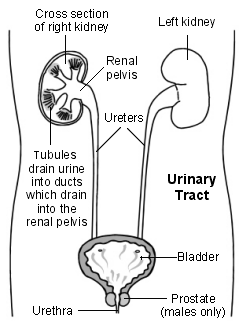
The two kidneys lie to the sides of the upper part of the tummy (abdomen), behind the intestines, and either side of the spine. Each kidney is about the size of a large orange but bean-shaped.
A large artery - the renal artery - takes blood to each kidney. The artery divides into many tiny blood vessels (capillaries) throughout the kidney. In the outer part of the kidneys tiny blood vessels cluster together to form structures called glomeruli.
Each glomerulus is like a filter. The structure of the glomerulus allows waste products and some water and salt to pass from the blood into a tiny channel called a tubule. The liquid that remains at the end of each tubule is called pee (urine). The pee then passes down a tube called a ureter which goes from each kidney to the bladder. Pee is stored in the bladder until it is passed out when we go to the toilet.
The main functions of the kidneys are to:
Filter out waste products from the bloodstream, to be passed out in the pee.
Help control blood pressure - partly by the amount of water passed out of the body as pee and partly by making hormones which are involved in blood pressure control.
Make a hormone called erythropoietin, which stimulates the bone marrow to make red blood cells. This is needed to prevent anaemia.
Control the amount of fluid in the body.
Help keep various salts and chemicals in the blood at the right level.
Patientenempfehlungen für Nierenprobleme

Niere und Harnwege
Nephrotisches Syndrom
Nephrotic syndrome is a condition where the 'filters' in the kidney become 'leaky' and large amounts of protein leak from the blood into the urine. The main symptom is fluid retention (oedema) which is mainly due to the low protein level in the blood. Various diseases can cause nephrotic syndrome, some more serious than others. Treatment and outcome (prognosis) vary, depending on the cause. The most common cause in children, minimal change disease, usually responds very well to treatment.
von Dr. Surangi Mendis, MRCGP

Niere und Harnwege
Nierensteine
Kidney stones are hard stones that can cause severe pain in your side along with blood in your urine, and nausea and vomiting. You are more likely to develop kidney stones if you eat a Western diet, don't drink enough fluids or are overweight. Once you have had one episode they are likely to recur but there are several kidney stone treatment options available.
von Dr. Colin Tidy, MRCGP
Weiterführende Lektüre und Referenzen
- Clinical practice guideline for acute kidney injury; KDIGO (Kidney Disease: Improving Global Outcome), 2012
- Acute kidney injury: prevention, detection and management; NICE Guidance (December 2019 - Last updated October 2024)
- Clinical Practice Guideline Acute Kidney Injury (AKI); The Renal Association. August 2019.
- Preventing AKIs; National Kidney Federation
Lesen Sie unten weiter
Artikelverlauf
Die Informationen auf dieser Seite wurden von qualifizierten Klinikern verfasst und begutachtet.
Nächste Überprüfung fällig: 3. März 2028
4. März 2025 | Neueste Version

Fragen, teilen, verbinden.
Durchsuchen Sie Diskussionen, stellen Sie Fragen und teilen Sie Erfahrungen zu Hunderten von Gesundheitsthemen.

Fühlen Sie sich unwohl?
Bewerten Sie Ihre Symptome online kostenlos
Abonnieren Sie den Patienten-Newsletter
Ihre wöchentliche Dosis klarer, vertrauenswürdiger Gesundheitsberatung - geschrieben, um Ihnen zu helfen, sich informiert, selbstbewusst und in Kontrolle zu fühlen.
Mit dem Abonnieren akzeptieren Sie unsere Datenschutzrichtlinie. Sie können sich jederzeit abmelden. Wir verkaufen Ihre Daten niemals.