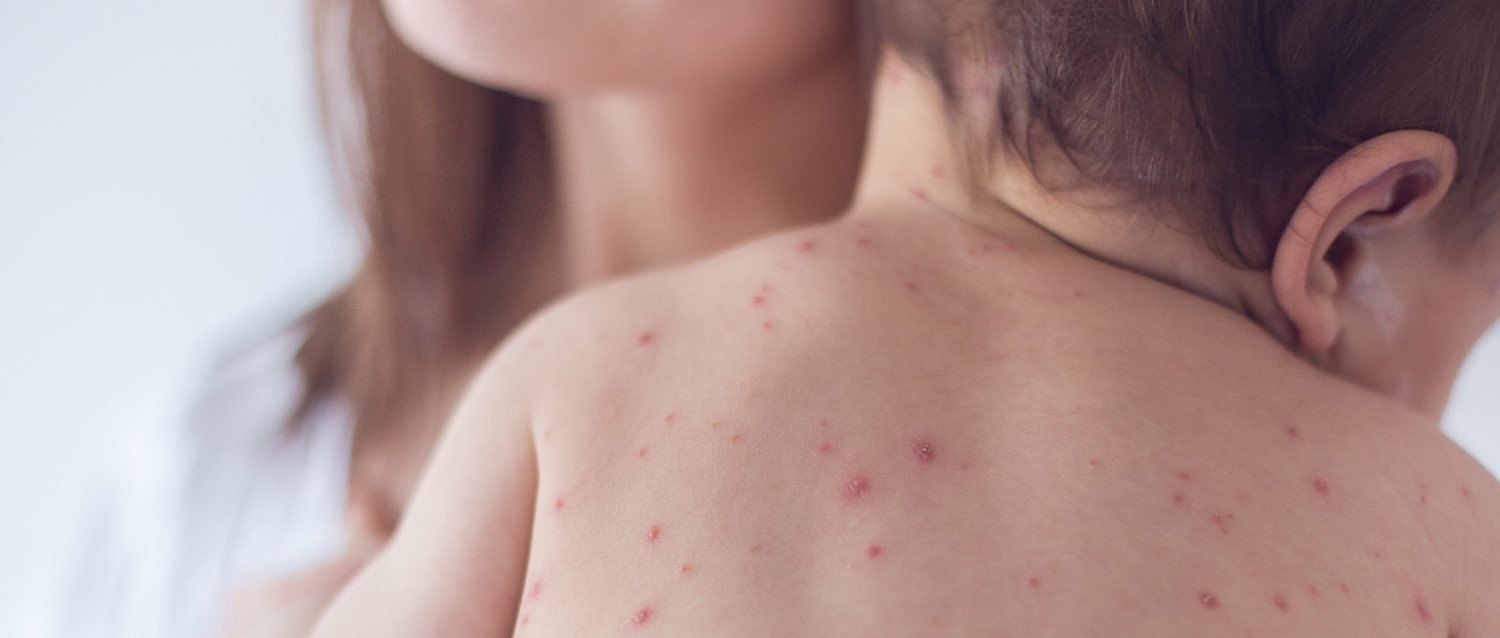
Windpocken bei Kindern
Begutachtet von Dr Hayley Willacy, FRCGP Zuletzt aktualisiert von Dr Colin Tidy, MRCGPZuletzt aktualisiert 16. März 2023
Erfüllt die redaktionelle Richtlinien
- HerunterladenHerunterladen
- Teilen
- Language
- Diskussion
- Ask Patient
- Audio-Version
- Zu bevorzugten Quellen bei Google hinzufügen
In dieser Serie:Virale AusschlägeMasernWindpocken bei Erwachsenen und JugendlichenScharlachHand-Fuß-Mund-KrankheitSchulausschluss bei Infektionen
Windpocken verursachen Flecken (einen Ausschlag) und können dazu führen, dass sich ein Kind allgemein unwohl fühlt. Die Behandlung zielt darauf ab, die Symptome zu lindern, bis die Krankheit vorüber ist. Eine vollständige Genesung ist bei Kindern unter 12 Jahren üblich. Schwere Komplikationen sind selten, treten aber bei Kindern mit einem geschwächten Immunsystem, wie z.B. bei Chemotherapie, häufiger auf.
Auf einen Blick
Windpocken sind eine Infektion, die durch das Varizella-Zoster-Virus verursacht wird.
Symptoms include a rash of itchy spots that blister and scab, and flu-like symptoms.
Die Behandlung zielt darauf ab, die Symptome mit Cremes, Antihistaminika und Paracetamol gegen Fieber zu lindern.
Vermeiden Sie Ibuprofen, da es mit schweren Hautreaktionen bei Windpocken in Verbindung gebracht werden kann.
Die meisten Kinder erholen sich gut, aber achten Sie auf ernsthafte Symptome wie Atemprobleme oder Schläfrigkeit.
Windpocken sind sehr ansteckend, von zwei Tagen bevor der Ausschlag erscheint, bis alle Stellen verkrustet sind.
Der Windpocken-Impfstoff ist in Großbritannien privat für Personen im Alter von 3-65 Jahren erhältlich.
Was ist Windpocken?
Chickenpox is an infection caused by the varicella-zoster virus. Most children have chickenpox at some stage. Most commonly, children get chickenpox before the age of 10 years. The immune system makes proteins called Antikörper during the infection. These fight the virus and then provide lifelong protection against it (immunity). Therefore, it is uncommon to have more than one bout of chickenpox in your lifetime.
Schwere Windpocken bei einem Kind
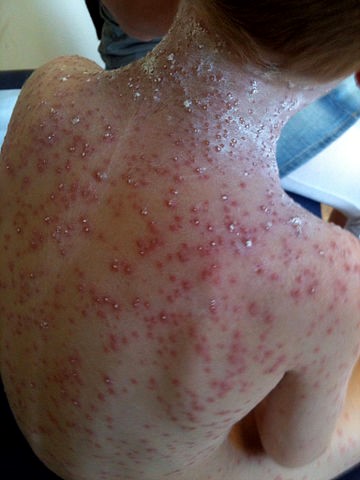
Windpocken Symptome
The main symptom of chickenpox is a rash. Flu-like symptoms are also common and typically start a day or so before a rash. Children with chickenpox may have:
A high temperature (fever), aches and a headache that often starts a day or so before a rash appears.
Spots (rash). Spots appear in crops. They develop into small blisters and are itchy. They can be anywhere on the body. Several crops may develop over several days. Some children may be covered in spots; others have only a few or even none. The rash starts off looking like red spots, which then blister, and then scab over.
Loss of appetite or feeding problems.
Windpocken bei einem Kind
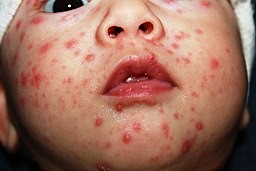
Some children feel quite unwell for a few days. Others appear only mildly ill. Most are much better within a week. The blisters dry up and scab. They gradually fade but may take up to two weeks to go completely.
Windpockenbehandlung
Treatment of chickenpox is mainly aimed at easing symptoms and trying to make your child as comfortable as possible whilst the immune system deals with the virus. Treatments include:
A soothing cream (emollient)
This may help the itch. Calamine lotion is the one most used, although it is not known how effective it is.
A sedating antihistamine
A tablet or liquid medicine may help with sleep if itch is a problem. This can be used in children over 1 year old. Give a dose at bedtime. You can buy these at pharmacies or get them on prescription. Chlorphenamine (Piriton®) is the one most used. It can also be helpful for itch during the daytime but may cause some sleepiness as a side-effect.
Keep fingernails cut short
Keeping your child's fingernails short will help to stop deep scratching.
Dress children comfortably
Use cool smooth fabrics such as cotton so they are not cold or overheated.
How to treat a fever
A fever commonly occurs with chickenpox, and may make your child feel uncomfortable and irritable. The following are things that you can do that may bring the temperature down and make your child feel more comfortable:
You can give paracetamol
This will help to lower a temperature. You can buy Paracetamol in liquid form, or as melt-in-the-mouth tablets, for children. It comes in various brand names. The dose for each age is given with the medicine packet.
Paracetamol does not treat the cause of the fever. It merely helps to ease discomfort. It also eases headaches, and aches and pains. You do not need to use paracetamol if your child is comfortable and not distressed by the fever, aches or pains.
Ibuprofen has been used with paracetamol in the past. The National Institute for Health and Care Excellence (NICE) has recommended that ibuprofen no longer be used for chickenpox. This is because some studies suggested that there may be an association with more severe skin reactions if ibuprofen is used for chickenpox. While more evidence is awaited, the advice is to avoid ibuprofen in this situation.
Take extra layers of clothes off your child
If the room is normal room temperature. It is wrong to wrap up a feverish child. The aim is to prevent overheating or shivering.
Viel zu trinken geben
This helps to prevent a lack of fluid in the body (dehydration). You might find that a child is more willing to have a good drink if they are not so irritable. So, if they are not keen to drink, it may help to give some paracetamol first. Then, try the child with drinks half an hour or so later when his/her temperature is likely to have come down.
Andere Behandlungen
Do not cold-sponge a child who has a fever. This used to be popular, but it is now not advised. This is because the blood vessels under the skin become narrower (constrict) if the water is too cold. This reduces heat loss and can trap heat in deeper parts of the body. The child may then get worse. Many children also find cold-sponging uncomfortable.
Some people use a fan to cool a child. Again, this may not be a good idea if the fanned air is too cold. However, a gentle flow of air in a room which is room temperature may be helpful. Perhaps just open the window or use a fan on the other side of the room to keep the air circulating.
Treatment for special at-risk groups
Some children have a higher risk of developing complications from chickenpox. In addition to the above treatments, they may need extra treatment such as Aciclovir (an antiviral medicine) or vaccination. If your child has not already had chickenpox and is in one in the following groups, you should see a doctor urgently if they have contact with chickenpox, or have symptoms of it:
Children (babies) less than 1 month old.
Children with a poor immune system. For example, children with Leukämie, immune diseases or HIV/AIDS.
Children taking certain medication such as steroids, immune-suppressing medication or chemotherapy.
Children with severe heart or lung disease.
Children with severe skin conditions.
Antiviral medication is also used for adults and teenagers who develop chickenpox, as they too have a higher risk of complications. However, antiviral medication is not normally advised for healthy children aged over 1 month and under 12 years who develop chickenpox.
Komplikationen bei Windpocken
Most of the time, children with chickenpox recover fully and have no complications. Uncommonly, one or more of the following complications can occur.
The spots do not usually scar unless they are badly scratched.
Some spots become infected with germs (bacteria) in some cases. This is the most common complication in children. If this occurs, the surrounding skin becomes red and sore. Antibiotics in the form of creams or medicine may then be needed.
Inflammation of the lung (pneumonia) und Gehirnentzündung (Enzephalitis) are rare complications.
Vary rarely, other serious complications develop. For example:
Reye's syndrome. (a very rare condition with brain and liver problems).
Ataxia (problems co-ordinating movements).
Henoch-Schönlein-Purpura (a condition that can affect the kidneys).
Inflammation of various parts of the eye.
Therefore, although serious complications are rare, it is best to be watchful. See a doctor if your child develops any worrying symptoms that you are unsure about such as:
Atemprobleme.
Weakness such as a child becoming wobbly on his/her feet.
Schläfrigkeit.
Anfälle (Krämpfe).
Pains or headaches which become worse despite paracetamol.
Being unable to take fluids, due to a severe rash in the mouth.
A severe rash, or a rash which bruises or bleeds into the skin (haemorrhagic rash).
Becoming generally more and more unwell.
Gürtelrose
Gürtelrose is caused by the same virus that causes chickenpox and is a very delayed complication of chickenpox. Anyone who has had chickenpox in the past may develop shingles.
Shingles is an infection of a nerve and the area of skin supplied by the nerve. It causes a rash and pain in a local band-like area along the affected nerve. About 1 in 5 people have shingles at some time in their lives. It can occur at any age, but it is most common in people over the age of 50.
The reason why shingles may occur is because the virus does not completely go after you have chickenpox. Some virus particles remain inactive in the nerve roots next to your spinal cord. They do no harm there and cause no symptoms.
For reasons that are not clear, the virus may begin to multiply again (reactivate). This is often years later. The reactivated virus travels along the nerve to the skin to cause shingles. See the separate leaflet called Shingles (Herpes Zoster) for details.
Hinweis: you can catch chickenpox from being exposed to a person with shingles if you have not had chickenpox yourself. However, you cannot catch shingles from a person with chickenpox, or catch shingles from a person with shingles.
Is chickenpox infectious?
A person with chickenpox is very infectious. The virus spreads in the air from person to person. For example, if you have not already had chickenpox, you stand a good chance of catching it if:
You are in the same room as someone with chickenpox for more than 15 minutes; oder
You have any face-to-face contact with someone with chickenpox, such as a conversation.
Nine in ten people who have not had chickenpox would catch it after being exposed in this way.
It takes between 7 and 21 days (most commonly 10-14 days) to develop symptoms after catching the virus (the incubation period).
Andere schützen
A person with chickenpox is infectious from two days before the spots first appear until they have all crusted over (commonly about five days after onset of the rash). A child with chickenpox should stay off school or nursery for five days from the onset of the rash and until all the lesions have crusted. Also, whilst infectious, they should keep away from at-risk people who may develop a severe illness if they get chickenpox. These include:
Pregnant women who have not had chickenpox in the past. Chickenpox can be severe and cause complications during pregnancy. See the separate leaflet called Chickenpox Contact in Pregnancy for more information.
People with a poorly functioning immune system. For example, people with Leukämie, mit HIV/AIDS, on Steroidmedikation, or who are having chemotherapy.
The at-risk children listed earlier.
Healthy adults who have not had chickenpox may also want to avoid catching it, as the illness tends to be worse in adults.
Hinweis: people with chickenpox should not travel by air until all the spots have crusted over.
Are you a healthcare worker?
Healthcare workers come into contact with people with poor immune systems, pregnant women and newborn babies. They should be aware that if they catch chickenpox, they can be infectious for two days before a rash or illness appears, and be a risk to patients. So, if you are a healthcare worker and come into contact with someone who has chickenpox (or who develops it within the following two days), then:
If you have been immunised against chickenpox, or have definitely had chickenpox in the past, you are likely to be immune. You should continue working but contact your occupational health department if you feel unwell or develop a rash.
If you are uncertain about whether you have had chickenpox or been immunised, you should have a test to see if you are immune. If you are not immune you should:
Avoid contact with high-risk patients for 8-21 days after the contact.
Report to occupational health before patient contact if you feel unwell or develop a high temperature (fever) or rash.
Get immunised against the chickenpox virus (the varicella-zoster virus).
Häufig gestellte Fragen
Is there a vaccine against chickenpox?
Yes, there is a vaccine that protects against the virus that causes chickenpox. It is part of the routine childhood immunisation programme in certain countries such as the USA, Canada and Australia. Currently, there are no plans to make immunisation against chickenpox routine for children in the UK.
In the UK, the vaccine is offered by the NHS to certain groups. For example, healthcare workers who are not immune to chickenpox. Also, to people who are not immune to chickenpox and who are in close contact with people with a poor immune system. For example, brothers and sisters of children on chemotherapy.
The chickenpox vaccine is available privately from many pharmacists for people aged 3-65 who are not pregnant, breastfeeding or trying for a baby. You will need a consultation with your pharmacist to check this vaccination is suitable for you or your child before it is given.
See also the separate article Should your child have the chickenpox vaccine?
Should I let my child catch chickenpox?
Some parents encourage their children to mix with others who have chickenpox in order to catch it.
Vorteile
Chickenpox is usually a milder illness in a child than in an adult.
The risk of serious complications is higher in adults. In particular, chickenpox during pregnancy can cause serious complications to both mother and baby.
Most people get chickenpox at some stage. As the risks are fewer if you have it as a child, it may be better to get it over with.
Nachteile
"I could not willingly let my child develop an illness."
Although rare, some children do have serious complications.
Different parents have different views on this issue. And remember, children who develop chickenpox spots (the rash) today will have been just as infectious over the previous two days when they were well, but were incubating the virus.
Also note: if someone in the family or home is temporarily at high risk of complications (listed earlier - pregnant women, etc) then it is best to put off deliberately catching it.
Can I go to work if my child has chickenpox?
If your child has chickenpox, you may need to stay at home to look after them until they can go back to school or nursery (when all the spots have formed a scab, which is usually five days after the spots first appear).
If you're healthy and have had chickenpox, you are otherwise fine to go to work and carry on normally, even if your child has chickenpox, but you should stick to good hygiene such as washing your hands frequently.
If you haven't had chickenpox or can't be certain that you have, you should assume that you will catch it from your child and so stay at home until all your spots have formed a scab. But remember it takes between 7 and 21 days (most commonly 10-14 days) to develop symptoms after catching the virus. It is particularly important to stay away from people who are at greater risk of complications if they catch the chickenpox virus (see special at-risk groups above).
See also the separate leaflet Chickenpox in Adults and Teenagers.
Patientenauswahl für Kinderkrankheiten

Kindergesundheit
Mumps
Mumps ist eine durch ein Virus verursachte Infektion. Sie betrifft hauptsächlich die Speicheldrüsen, die sich im Gesicht befinden. Manchmal sind auch andere Körperteile betroffen. Mumps betrifft normalerweise Kinder, kann aber in jedem Alter auftreten. Mumps ist im Vereinigten Königreich inzwischen selten, da Kinder routinemäßig gegen Mumps geimpft werden.
von Dr. Philippa Vincent, MRCGP

Kindergesundheit
Keuchhusten
Keuchhusten ist eine hochansteckende Lungeninfektion, die schwere Hustenanfälle verursacht, oft mit Pausen, in denen man sich wohl fühlt. Sie dauert in der Regel mehrere Wochen, und die meisten Menschen erholen sich vollständig. Durch Impfungen ist sie bei Kindern im Vereinigten Königreich selten, aber die Immunität kann nachlassen, wodurch einige ältere Kinder und Erwachsene gefährdet sind. Dieses Merkblatt erklärt die Stadien und Symptome, die Behandlung und die Vorbeugung.
von Dr. Caroline Wiggins, MRCGP
Häufig gestellte Fragen
Wie lange ist die Inkubationszeit für Windpocken?
Nach der Exposition gegenüber dem Windpockenvirus dauert es in der Regel zwischen 7 und 21 Tagen, bis sich Symptome entwickeln. Am häufigsten treten die Symptome 10-14 Tage nach der Exposition auf.
Welche Art von Kleidung sollte mein Kind tragen, wenn es Windpocken hat?
Kleiden Sie Ihr Kind in kühlen, glatten Stoffen wie Baumwolle. Dies hilft ihnen, sich wohlzufühlen und verhindert, dass sie zu kalt oder überhitzt werden.
Gibt es fiebersenkende Methoden, die ich vermeiden sollte, wenn mein Kind Windpocken hat?
Ja, Sie sollten ein fieberndes Kind nicht mit kaltem Wasser abreiben. Dies kann dazu führen, dass sich die Blutgefäße unter der Haut verengen, was den Wärmeverlust verringert und die Wärme im Körper einschließen kann. Auch die direkte Verwendung eines Ventilators mit zu kalter Luft auf ein Kind wird nicht empfohlen, obwohl eine sanfte Luftzirkulation in einem Raum bei normaler Temperatur hilfreich sein kann.
Wann kann ein Kind mit Windpocken wieder in die Schule oder den Kindergarten gehen?
Ein Kind mit Windpocken sollte fünf Tage ab dem Auftreten des Ausschlags und bis alle Bläschen verkrustet sind, zu Hause bleiben und nicht in die Schule oder den Kindergarten gehen.
Kann ich mit dem Flugzeug reisen, wenn ich oder mein Kind Windpocken hat?
Nein, Menschen mit Windpocken sollten nicht fliegen, bis alle Bläschen verkrustet sind, aufgrund der hoch ansteckenden Natur des Virus.
Weiterführende Lektüre und Referenzen
- Impfung gegen Infektionskrankheiten - das Grüne Buch (neueste Ausgabe); UK Gesundheitsbehörde für Sicherheit.
- Leitfaden zur Infektionskontrolle in Schulen und anderen Kinderbetreuungseinrichtungen; UK Health Security Agency (September 2017 - zuletzt aktualisiert Februar 2023)
- Cohen J, Breuer J; Windpocken: Behandlung. BMJ Clin Evid. 15. Juni 2015;2015. pii: 0912.
- Fieber bei unter 5-Jährigen: Beurteilung und Erstbehandlung; NICE-Leitlinien (zuletzt aktualisiert im November 2021)
- Windpocken; NICE CKS, Juni 2022 (nur für UK-Zugang)
Über den AutorVollständige Biografie anzeigen
Aktualisiert von

Dr Colin Tidy, MRCGP
Allgemeinmediziner, Medizinischer Autor
MBBS, MRCGP, MRCP (Paediatrics), DCH
Dr. Colin Tidy ist ein NHS-Arzt mit Sitz in Oxfordshire.
Über den RezensentenVollständige Biografie anzeigen

Dr Hayley Willacy, FRCGP
Allgemeinmediziner, Medizinischer Autor
MBChB (1992), DRCOG, DFFP, MRCOG (Part 1) MRCGP (2007), DFSRH (2013), MSc - medical education (2020)
Dr. Hayley Willacy war eine NHS-Hausärztin, die in Nordwestengland arbeitete und 2022 nach 30 Jahren aus der klinischen Praxis ausschied.
Artikelverlauf
Artikel auch verfügbar in Englisch, Deutsch, Spanisch, Französisch, Italienisch, Portugiesisch, Hindi, Hebräisch, Arabisch, und Schwedisch.
Nächste Überprüfung fällig: 14. März 2028
16. März 2023 | Neueste Version
Teilen Sie Ihre Gedanken oder Erfahrungen mit anderen in unserem Patientengemeinschaften.
Einfacher Zugang zu vertrauenswürdigen Behandlungen und Gesundheitsdiensten online.
Common conditions
Get help with common conditions through the NHS, without a GP appointment.





Abonnieren Sie den Patienten-Newsletter
Ihre wöchentliche Dosis klarer, vertrauenswürdiger Gesundheitsberatung - geschrieben, um Ihnen zu helfen, sich informiert, selbstbewusst und in Kontrolle zu fühlen.
Durch das Abonnieren akzeptieren Sie unsere Datenschutzrichtlinie. Sie können sich jederzeit abmelden. Wir verkaufen Ihre Daten niemals.