Dermatophytose
Tinea infections
Begutachtet von Dr Philippa Vincent, MRCGPZuletzt aktualisiert von Dr Doug McKechnie, MRCGPZuletzt aktualisiert 27. Feb 2025
Erfüllt die Anforderungen des Patienten Richtlinien des Patienten
- HerunterladenHerunterladen
- Teilen
- Language
- Diskussion
- Audio-Version
Medizinische Fachkräfte
Fachartikel sind für die Nutzung durch Gesundheitsfachkräfte konzipiert. Sie werden von britischen Ärzten verfasst und basieren auf Forschungsergebnissen, britischen und europäischen Richtlinien. Sie finden möglicherweise die Pilzinfektion in der Leistengegend Artikel nützlicher oder einer unserer anderen Gesundheitsartikel.
In diesem Artikel:
Lesen Sie unten weiter
What is dermatophytosis?1
Dermatophytosis (tinea) infections are fungal infections caused by dermatophytes - a group of fungi that invade and grow in dead keratin. Several species commonly invade human keratin and these belong to the Epidermophyton, Microsporum und Trichophyton genera. They tend to grow outwards on skin, producing a ring-like pattern - hence the term 'ringworm'. They are very common and affect different parts of the body. They can usually be successfully treated but success depends on the site of infection and on compliance with treatment.
Siehe die separate Tinea capitis, Pilzinfektionen der Nägel, Kleienpilzflechte und Kandidose Artikel.
Pathophysiologie23
Zurück zum InhaltInfection is limited to the dead layers of skin but encouraged by a damp and warm local environment.
The infection can be transmitted to humans by anthropophilic (between people), geophilic (from soil) and zoophilic (from animals) spread.
Die häufigsten Organismen sind:
Trichophytons rubrum, Trichophytons tonsurans, Trichophytons interdigitale und Trichophytons mentagrophytes.
Microsporum canis.
Epidermophyton floccosum.
Clinical classification is according to site:
Scalp - tinea capitis.
Feet - tinea pedis.
Hands - tinea manuum.
Nail - tinea unguium (or onychomycosis).
Beard area - tinea barbae.
Groin - tinea cruris.
Body including trunk and arms - tinea corporis.
Lesen Sie unten weiter
How common is dermatophytosis? (Epidemiology)
Zurück zum InhaltInfection is very common all over the world. Some types are more common than others, with tinea pedis being most common in adults and tinea capitis the most common in children. Onychomycosis is also extremely common.
Dermatophytosis symptoms (presentation)2
Zurück zum InhaltAnamnese
Itching, rash and nail discolouration are the most common symptoms of tinea infection.
Hair loss occurs with tinea capitis (mainly a disease of children).
Complications such as secondary infection (cellulitis and impetigo) can lead to symptoms.
It is common in people who play contact sports.
It occurs in immunocompromised patients.
Untersuchung
Tinea pedis:4
It particularly affects the web of the toe where skin may be macerated and erythematous.
It commonly affects the plantar surface of the foot. Erythema, vesicles and pustules can occur.
Tinea pedis - zwischen den Zehen
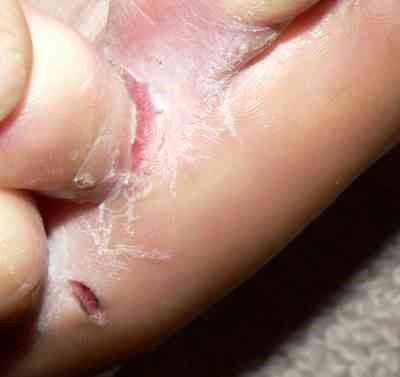
© Benutzer Falloonb auf de.wikipedia, Gemeinfrei, über Wikimedia Commons
It can cause hair loss with broken hairs at the surface (as distinct from alopecia areata).
Clinical appearance is variable, including scaly, crusting, pustules and/or black dot alopecia.
Tinea unguium (onychomycosis):6
Onycholysis or separation of the nail from the nail bed commonly occurs.
Nail dystrophy with thickening and discolouration of the nail develops.
Tinea corporis:7
The skin lesions have annular scaly plaques with raised edges.
There may be vesicles and pustules.
Typically lesions are on exposed skin of the trunk, arms and legs (see 'Differential diagnosis', below).
More unusually the lesions can appear as overlapping concentric circles (tinea imbricate) or even herpetiform subcorneal vesicles or pustules (bullous tinea corporis).
Tinea corporis
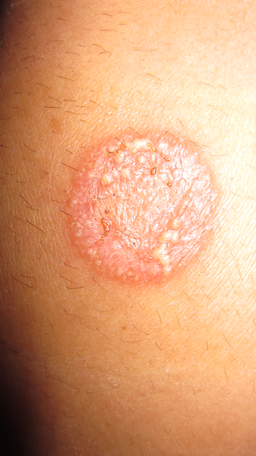
© Corina G., Public domain, via Wikimedia Commons
Tinea manuum:
Usually with tinea pedis.
Typically just affects one hand.
Scaling and redness are prominent.
Incorrect diagnosis and use of steroid may eventually exacerbate the infection.
Tinea cruris:8
Usually occurs in men.
Often tolerated for some time before presentation.
Typically erythematous with central clearing and raised edge.
Tinea barbae:9
Affects the beard area.
Redness, scaling and pustules are common.
Lesen Sie unten weiter
Differentialdiagnose7
Zurück zum InhaltOther annular rashes are often confused with tinea infections. Ekzem und Psoriasis are commonly confused with tinea. Pityriasis versicolor occurs all over the trunk while candida occurs as a flexural rash at extremes of age or in the immunocompromised, those with diabetes or patients on antibiotics.
Treatment with topical steroids often causes confusion, making tinea less scaly and more erythematous. Steroid use also makes the 'active' edge and the inactive centre less distinct (tinea incognito). Clinically the diagnosis can be difficult but, if it is a possibility, take scrapings for mycology. Other fungal infections look nothing like tinea. Other conditions to consider include:
Intertrigo.
Erythrasma.
Diagnosing dermatophytosis (investigations)10
Zurück zum InhaltMicroscopy of skin and nail specimens may reveal hyphae and spores.
Fungal culture can identify the species but is not always reliable and it can take six weeks to obtain results.
Ultraviolet light (Wood's light) is useful for tinea capitis especially. Fluorescence is produced by the fungus. Fluorescence is not seen with tinea corporis or tinea cruris.
Rarely, a biopsy may be needed if the case is atypical or not responding to treatment.
Assoziierte Erkrankungen
Zurück zum InhaltDiabetes, immunocompromised states, atopy and Cushing-Syndrom have all been associated with fungal infections.
Management of dermatophytosis45610
Zurück zum InhaltOffer advice on hygiene measures:
Keep affected skin cool and dry.
Wear cotton, absorbent clothing.
Avoid scratching affected skin.
After washing, dry thoroughly.
Do not share towels, and wash frequently, to reduce the risk of transmission.
Cover feet in communal bathing pools, changing areas and gymnasiums if feet are affected.
Continue school and sporting activities.
Siehe die separate Antimykotika Artikel.
Topical agents containing a corticosteroid are not usually necessary. They may be used if there is a lot of skin inflammation. They should be used for a week only.
Referral may be needed if diagnosis is in doubt.
Complications of dermatophytosis
Zurück zum InhaltSecondary bacterial infection may occur. Hair loss is a complication of tinea capitis. Pain and difficulty with shoes can result from onychomycosis.
A dermatophytid (id) reaction may occur, especially after initiation of systemic antifungal treatment. This is thought to be a type IV hypersensitivity response, and causes a widespread pruritic rash, with papules, maculopapules, papulovesicles, or pustules at sites distinct from that of the original dermatophyte infection.11
Scarring is uncommon but more likely in people with pigmented skin. Scarring usually fades with time. Skin protection such as using a moisturiser cream and sunscreen can be helpful. Extensive or severe scarring may need further treatment, such as using laser therapy.
Dermatophytosis prognosis
Zurück zum InhaltExcellent with good compliance and subsequent precautions to avoid repeat infection.
Prevention of dermatophytosis
Zurück zum InhaltGood skin hygiene.
Good nail hygiene.
Avoiding prolonged wetting or dampness of the skin and feet.
Avoiding trainers, which can retain sweat and promote a warm, moist environment.
Treatment of tinea pedis - helps prevent onychomycosis.6
Wearing clean, loose-fitting underwear.
Weiterführende Lektüre und Referenzen
- Dermatophytide reactions; DermNet NZ
- Sahoo AK, Mahajan R; Management of tinea corporis, tinea cruris, and tinea pedis: A comprehensive review. Indian Dermatol Online J. 2016 Mar-Apr;7(2):77-86. doi: 10.4103/2229-5178.178099.
- Ely JW, Rosenfeld S, Seabury Stone M; Diagnosis and management of tinea infections. Am Fam Physician. 2014 Nov 15;90(10):702-10.
- Martinez DA, Oliver BG, Graser Y, et al; Comparative genome analysis of Trichophyton rubrum and related dermatophytes reveals candidate genes involved in infection. MBio. 2012 Sep 4;3(5):e00259-12. doi: 10.1128/mBio.00259-12. Print 2012.
- The Cutaneous Mycoses; Mycology Online
- Hainer BL; Dermatophyte infections. Am Fam Physician. 2003 Jan 1;67(1):101-8.
- Pilzinfektion der Haut - Fuß; NICE CKS, Juni 2023 (nur UK-Zugang)
- Pilzinfektion der Haut - Kopfhaut; NICE CKS, Juni 2023 (nur UK-Zugang)
- Pilzinfektion der Nägel; NICE CKS, August 2023 (nur für UK-Zugang)
- Pilzinfektion der Haut - Körper und Leiste; NICE CKS, Juli 2023 (nur für UK-Zugang)
- Tinea Cruris; DermNet NZ
- Tinea barbae; DermNet NZ
- Pilzinfektionen der Haut und Nägel: Diagnose und Laboruntersuchung - Schnellreferenz für die Primärversorgung; GOV.UK, 2017
- Leung AK, Lam JM, Leong KF, et al; Tinea corporis: an updated review. Drugs Context. 2020 Jul 20;9:2020-5-6. doi: 10.7573/dic.2020-5-6. eCollection 2020.
Lesen Sie unten weiter
Artikelverlauf
Die Informationen auf dieser Seite wurden von qualifizierten Klinikern verfasst und begutachtet.
Nächste Überprüfung fällig: 26. Feb 2028
27. Feb 2025 | Neueste Version

Fragen, teilen, verbinden.
Durchsuchen Sie Diskussionen, stellen Sie Fragen und teilen Sie Erfahrungen zu Hunderten von Gesundheitsthemen.

Fühlen Sie sich unwohl?
Bewerten Sie Ihre Symptome online kostenlos