
Anatomie des Ohrs
Begutachtet von Dr Colin Tidy, MRCGPZuletzt aktualisiert von Dr Krishna Vakharia, MRCGPZuletzt aktualisiert 18. Okt 2023
Erfüllt die Anforderungen des Patienten Richtlinien des Patienten
- HerunterladenHerunterladen
- Teilen
- Language
- Diskussion
- Audio-Version
- Zu bevorzugten Quellen bei Google hinzufügen
Ihre Ohren leisten die bemerkenswerte Arbeit, Ihnen das Hören einer großen Bandbreite von Geräuschen zu ermöglichen, von einem Flüstern bis zu einem lauten Knall. Dazu wandelt das Ohr Schallenergie in elektrische Signale um, die das Gehirn interpretieren kann. Ihre Ohren helfen auch, Ihr Gleichgewicht zu halten.
Aufbau des Ohrs
Das Ohr - normales Hören
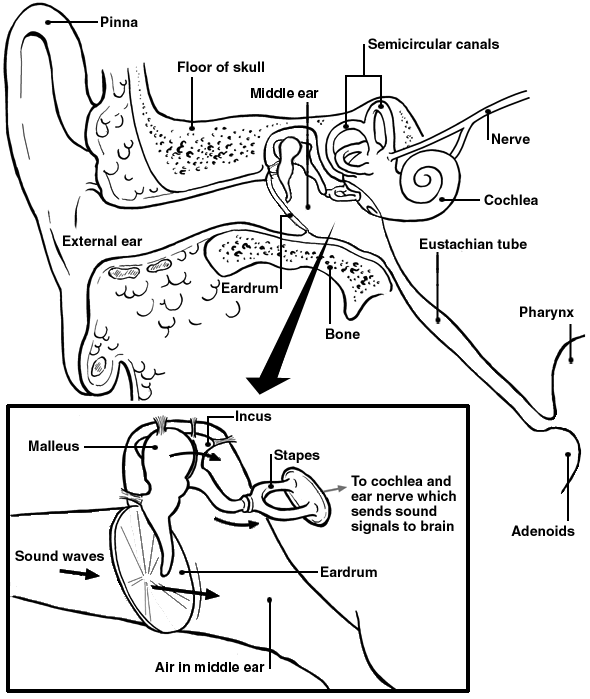
The ear is divided into three parts. The outer (external) ear includes the part you can see (called the pinna) and the narrow tube-like structure - the ear canal. At the end of the canal is the eardrum. This separates the external ear from the middle ear. The eardrum is a tightly stretched membrane, a bit like the skin of a drum.
The middle ear is a small air-filled compartment which sits in the skull between the eardrum and the inner ear. Inside it are the three smallest bones in the body, called malleus, incus and stapes. These bones are connected to each other. The last in the group, stapes, also makes contact with the inner ear. The air space of the middle ear connects to the back of the nose by the Eustachian tube, a narrow tube which can let air in or out of the space. It can also allow infections like the common cold to spread from the throat and nose to the ears.
The inner ear is made up of two components - the cochlea and the vestibular system. The cochlea is involved with hearing, whilst the vestibular system helps with balance.
Innenohr-Diagramm
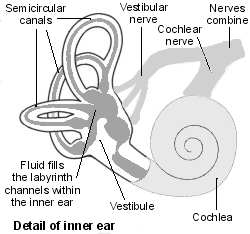
The cochlea is a snail-shaped chamber filled with fluid. It is lined with special sensory cells called hair cells which are sensitive to sound. The hairs are different lengths and each responds to a particular pitch of sound (the pitch of a sound is its musical note). These cells transform sound waves into electrical signals, which are then sent from the cochlea to the hearing area of the brain via the cochlear nerve.
The vestibular system is made up of a network of looped tubes, three in each ear, called the semicircular canals. They loop off a central area called the vestibule. The vestibular system detects movement through special sensory cells which are activated as you tilt or move your head. The vestibular system is very sensitive to small movements of the head. If you make large, fast or prolonged movements (eg, spinning around on the spot) they can take a while to 'settle down' afterwards. This is why the room can appear to continue to spin when we stop spinning. The vestibular system sends signals to the vestibular nerve, which joins the cochlear nerve and carries electrical signals to the brain.
How do you hear?
Sound waves are created when air vibrates. To hear, the ear needs to change sound into electrical signals which the brain can interpret. The outer part of the ear (the pinna) funnels sound waves into the ear canal. When sound waves reach the eardrum they cause it to vibrate. Vibrations of the eardrum cause the tiny bones in the middle ear to move too. The last of these bones, the stapes, passes on the vibrations through another membrane to the cochlea.
When the cochlea receives the vibrations, the fluid inside it moves. As the fluid moves, it causes the sensory cells to create an electrical signal. This electrical signal is sent to the brain. Special areas in the brain receive these signals and translate them into what we know as sound.
Your ears create electrical signals to represent an extraordinary variety of sounds. For example, the speed at which the eardrum vibrates varies with different types of sound. With low-pitched sounds the eardrum vibrates slowly. With high-pitched sounds it vibrates faster. This means that the special hair cells in the cochlea also vibrate at varying speeds. This causes different signals to be sent to the brain. This is one of the ways we are able to distinguish between a wide range of sounds.
How do you keep your balance?
Balance is maintained not only by the vestibular system found in your ears but also by your visual and sensory systems (your eyes and what you physically feel - for example, under your feet). If any one of these systems is damaged, you may experience dizziness or loss of balance.
The brain uses the visual system to help orientate us in our surroundings. The vestibular system detects both circular motion and movement in a straight line. This includes everyday actions such as stopping, starting or turning. The sensory system keeps track of the movement and tension of our muscles and joints. It also monitors the position of our body with respect to the ground. The brain receives signals from all these systems and processes the information gathered to produce a sensation of stability.
The tubes and sacs within the vestibular system are filled with fluid. When we move our heads, this fluid also moves. The vestibular system also contains specialised sensory cells. Movement of the fluid causes these sensory cells to bend. This change results in an electrical signal which is carried, via a nerve, to the brain for interpretation.
Once the brain has interpreted the signals as movement, it controls your eyes so that they keep providing information about your position. The brain also sends signals to your muscles so that they help to ensure balance regardless of the position of your body.
If the signals sent to the brain by the vestibular system do not match those which the eyes and sensory system send then dizziness and motion sickness can result. This can happen, for example, if you travel on a boat but you are looking at the boat rather than at the horizon. Your eyes see that you are not moving relative to the boat but your ears and body can feel that you are moving. It's the discrepancy between the two that causes the motion sickness.
Some common disorders of the ear
Dr. Mary Lowth ist eine Autorin oder die ursprüngliche Autorin dieses Merkblatts.
Patientenauswahl für Ohr

Ohr, Nase und Hals
Finden Sie Ihr Gleichgewicht: 10 natürliche Heilmittel zur Behandlung von Labyrinthitis zu Hause
Der Begriff Labyrinthitis könnte Sie an Labyrinthe - oder sogar David Bowie - denken lassen. Trotz seines faszinierenden Namens ist es jedoch eine recht häufige Erkrankung, die das Innenohr betrifft. Sie kann eine Vielzahl von Symptomen verursachen, wie Schwindel, Gleichgewichtsstörungen und Übelkeit. Wir sprechen mit einem Experten, der einige natürliche Methoden teilt, um die Auswirkungen von Labyrinthitis zu lindern.
von Victoria Raw

Ohr, Nase und Hals
Was ist Schwimmerohr - und warum Sie es nicht ignorieren sollten
The sun is out and you’re feeling hot - what better way to cool down than having a nice relaxing swim. But did you know that water can get stuck inside your ear and develop into something called swimmer’s ear? We asked an audiologist to explain the signs and symptoms of this common ear infection.
by Hannah Boynton-Forshaw
Über den AutorVollständige Biografie anzeigen

Dr Krishna Vakharia, MRCGP
Chief Medical Officer für Gesundheit, Optum UK
MBChB, MRCGP(2013), BMedSci (hons), DFSRH, DRCOG, PGDipDerm (Distn)
Dr. Krishna Vakharia ist eine NHS-Hausärztin. Sie ist auch regelmäßige Prüferin für das postgraduale Diplom in Praktischer Dermatologie an der Cardiff University und zudem Chief Medical Officer für Gesundheit bei Optum UK.
Über den RezensentenVollständige Biografie anzeigen

Dr Colin Tidy, MRCGP
Allgemeinmediziner, Medizinischer Autor
MBBS, MRCGP, MRCP (Paediatrics), DCH
Dr. Colin Tidy ist ein NHS-Arzt mit Sitz in Oxfordshire.
Artikelverlauf
Die Informationen auf dieser Seite werden von qualifizierten Klinikern begutachtet.
Artikel auch verfügbar in Englisch, Deutsch, Spanisch, Französisch, Italienisch, Portugiesisch, Hindi, Hebräisch, Arabisch, und Schwedisch.
18. Okt 2023 | Neueste Version

Fragen, teilen, verbinden.
Durchsuchen Sie Diskussionen, stellen Sie Fragen und teilen Sie Erfahrungen zu Hunderten von Gesundheitsthemen.

Fühlen Sie sich unwohl?
Bewerten Sie Ihre Symptome online kostenlos
Abonnieren Sie den Patienten-Newsletter
Ihre wöchentliche Dosis klarer, vertrauenswürdiger Gesundheitsberatung - geschrieben, um Ihnen zu helfen, sich informiert, selbstbewusst und in Kontrolle zu fühlen.
Durch das Abonnieren akzeptieren Sie unsere Datenschutzrichtlinie. Sie können sich jederzeit abmelden. Wir verkaufen Ihre Daten niemals.
Mehr zu Ohr, Nase und Hals
- 9 Hausmittel gegen Mandelentzündung
- Führt Tinnitus zu Hörverlust?
- Ohrkitzel-Therapie könnte das Altern verlangsamen
- Finden Sie Ihr Gleichgewicht: 10 natürliche Heilmittel zur Behandlung von Labyrinthitis zu Hause
- Wie ich meine Gehörlosen-Identität fand - Rachels Geschichte
- Wie man Mandelentzündung bei Kindern behandelt
- Wie man sich beim Gebrauch von Kopfhörern vor Hörverlust schützt
- Wie man Nasentropfen verwendet
- Ist die britische Gebärdensprache eine gesetzlich anerkannte Sprache?
- Ist Ihr Halsweh etwas Ernsteres?
- Leben mit Tinnitus: Symptome und Lösungen
- Anzeichen von Tinnitus bei Kindern, auf die man achten sollte
- Guter Rat: 6 Möglichkeiten, Ihr Gehör zu schützen
- Was machen die Mandeln?
- Was sagt Ihr Nasenschleim über Ihre Gesundheit aus?
- Wie ist es, taub zu sein?
- Was sollten Sie bei einer Mandelentzündung essen?
- Was verursacht meinen Hörverlust?
- Wenn es sich anfühlt, als ob etwas in deinem Hals steckt
- Warum ein GCSE in Britischer Gebärdensprache ein Wendepunkt sein könnte