Prolaktinom
Begutachtet von Dr Toni Hazell, FRCGPZuletzt aktualisiert von Dr Hayley Willacy, FRCGP Zuletzt aktualisiert 31. Okt 2022
Erfüllt die Anforderungen des Patienten Richtlinien des Patienten
- HerunterladenHerunterladen
- Teilen
- Language
- Diskussion
- Audio-Version
- Zu bevorzugten Quellen bei Google hinzufügen
Ein Prolaktinom ist ein gutartiges Wachstum in der Hypophyse, das ein Hormon namens Prolaktin produziert.
Auf einen Blick
Ein Prolaktinom ist ein gutartiges Wachstum an der Hypophyse im Gehirn.
Dieses Wachstum produziert zu viel von einem Hormon namens Prolaktin.
Symptome bei Frauen können unregelmäßige Perioden, verminderte Fruchtbarkeit oder Milchabsonderung aus den Brüsten umfassen.
Männer können verminderte Fruchtbarkeit, erektile Dysfunktion oder Brustvergrößerung erfahren.
Große Prolaktinome können Kopfschmerzen oder Sehstörungen verursachen.
Verschiedene Behandlungen sind verfügbar, einschließlich Medikamente und manchmal auch Operationen.
Wenn Sie Kopfschmerzen, eingeschränktes Sehvermögen oder Doppeltsehen haben, suchen Sie umgehend einen Arzt auf.
Tucked away deep inside your brain is a gland called your pituitary gland. It may only be the size of a pea in humans, but it has a significant effect on our bodies. One of its main functions is to produce hormones. These are chemical messengers that are made in one part of the body and travel in the blood to one or more 'target' organs where they have an effect.
One of the hormones the pituitary produces is prolactin. It main job is to stimulate a woman's breast to produce milk after childbirth. Prolactin is also made in men.
What is a prolactinoma?
Lage der Hypophyse
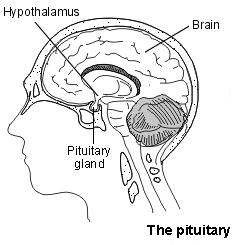
A prolactinoma occurs when some of the cells in the pituitary gland (the ones producing prolactin) multiply more than usual to form a small growth (tumour) in the pituitary gland. The prolactinoma makes too much prolactin and this can cause symptoms.
Prolactinomas are usually very small. Small prolactinomas (less than 1 cm ) are called microprolactinomas. Larger ones (more than 1 cm ) are called macroprolactinomas. There is also a rare type called giant prolactinomas, which are more than 4 cm. However, these are only found in between 1-5 cases of prolactinoma out of 100.
What causes prolactinomas?
For most people the cause is unknown. In rare cases, there may be an inherited cause and this is often linked to multiple endocrine neoplasia type 1.
What are the symptoms of a prolactinoma?
High levels of prolactin in the blood can cause various symptoms, such as headaches. The signs and symptoms differ slightly between men, women and children.
Women may have:
Irregular periods or no periods. This symptom is present in 9 out of 10 pre-menopausal women with prolactinoma.
Reduced fertility.
Vermindertes sexuelles Verlangen.
Milk leaking from the breasts (known as galactorrhoea). This symptom is present in 8 out of 10 women. The milk may leak out by itself, or may only show when the breast is squeezed. (Hinweis: leakage of milk from the breasts is normal towards the end of pregnancy, with recent childbirth, if breast-feeding and for some time after finishing breast-feeding.)
Increased growth of hair on the face or body.
Men may have:
Reduced fertility.
Difficulty having an erection (Erektionsstörungen).
Reduced sex drive (libido).
Breast enlargement (called gynaecomastia).
Very rarely, leakage of milk from the breasts.
Children and teenagers may have:
Reduced growth.
Verzögerte Pubertät.
Prolactinomas which are large may press on the brain or nearby nerves (the nearest nerves are the optic nerves which go to the eye). Some prolactinomas can get bigger during pregnancy. Larger prolactinomas may cause symptoms such as:
Eye symptoms - you may get reduced vision or double vision. The early changes can easily go unnoticed, because they affect the peripheral vision - that is, the edges of your vision to the extreme left and right. This means that you may see less of what is around you, but can still see well if you focus on something directly.
If you have headaches or double/reduced vision, see a doctor urgently - you may need to have treatment promptly to relieve the pressure on the optic nerves
.
Rarely, the prolactinoma may press on the rest of the pituitary gland, stopping it from producing other hormones. This can cause symptoms such as tiredness, fainting, low blood pressure, low blood sugar or collapse. Also (rarely) there may be a leakage of the fluid that surrounds the brain and pituitary gland, felt as watery fluid leaking through the nose. These symptoms need urgent treatment.
How are prolactinomas diagnosed?
The diagnosis may be suspected from the symptoms. Women tend to be diagnosed earlier than men because a change in the woman's periods is an early symptom and is easily noticed. Some prolactinomas are diagnosed by chance if you have tests for another reason. If a prolactinoma is suspected, you may be offered several tests.
Bluttests
The first test for women is a pregnancy test - prolactin goes up in pregnancy, and occasionally an undiagnosed pregnancy can be mistaken for a prolactinoma. A blood sample can check the level of prolactin in the blood. A very high prolactin level usually means that a prolactinoma is present. However, there are other causes of raised prolactin levels. For example, some medicines may cause high prolactin levels. These include:
Der Übelkeitsmedikamente Metoclopramid und Domperidon.
Antidepressants of the selective serotonin reuptake inhibitor (SSRI) type.
Some medicines used to treat Schizophrenie oder bipolaren Störungen.
Other blood tests may be done at the same time. It is important to test the thyroid gland and to check Nierenfunktion, as both these can affect prolactin levels. Further tests may be needed to see if the tumour is causing a lack of other hormones made by the pituitary gland.
Eye tests
Eye tests will assess if the tumour is pressing on the optic nerve - this includes a test of visual fields.
Scans
A MRT-Scan (Magnetresonanztomographie) oder ein Computertomographie (CT) Scan can show the size of the tumour. A bone density scan may be advised for some patients, to check whether they are at risk of 'thinning' of the bones (osteoporosis), which is a possible complication.
How to treat prolactinomas
Treatment usually works well to stop the symptoms of prolactinoma and to improve fertility. There are various options to treat prolactinomas but the usual treatment is medication. Some treatment options depend on the size of the growth.
Not treating may be an option
For a small prolactinoma (a microprolactinoma), if symptoms are not too troublesome then one option is just to monitor the situation. This means having regular blood tests and possibly scans. If symptoms get worse or the prolactinoma seems to be growing, treatment can be started whenever necessary.
If you are choosing the no-treatment option, you may be advised to take oestrogen hormones (for women) or testosterone hormones (for men). This can help to prevent 'thinning' of the bones (osteoporosis).
Medikation
Medication is a very effective treatment for most prolactinomas. The medication is a type called dopamine agonists. These act on the pituitary gland to reduce the amount of prolactin it makes, and they can also shrink the tumour. Usually with this medication, prolactin levels go down to normal in a few weeks. Dopamine agonists can be taken as long-term treatment.
The dopamine agonists are called Bromocriptin, cabergoline oder quinagolide. They are taken as tablets.
What about treatment with medication in pregnancy?
Wenn Sie sind planning a pregnancy, it is best to discuss treatment options with your doctor beforehand. Treating the prolactinoma usually improves fertility, so can help you become pregnant. Bromocriptine is thought to be the safest of the dopamine agonists for pregnancy, because it is the most tried and tested one. Many women have had babies after taking bromocriptine.
Operation
Surgery may be an option if medication does not work, is not wanted, or for larger prolactinomas. The operation is called trans-sphenoidal surgery, because the surgeon gets to the pituitary gland through the sphenoid bone, via a small cut above the upper front teeth or from inside a nostril. It is done under general anaesthetic.
Andere Behandlungen
Sometimes prolactinomas cause a reduction in the other hormones that the pituitary gland produces. If so, you may need to take tablets to replace these hormones. This will depend on your symptoms and blood test results.
How common are prolactinomas?
Prolactinomas are rare but they are the most common type of pituitary gland tumour. It is estimated that about 4 in 10,000 people have a prolactinoma. Prolactinomas occur both in men and in women. Prolactinomas occur most often in women aged 20-50 years, but they can occur at any age.
Are prolactinomas dangerous?
The main complication is the risk of 'Ausdünnung' der Knochen (Osteoporose), which occurs if high prolactin levels are untreated for a long time (over one year). Osteoporosis can be prevented by treating the prolactinoma (as above). Alternatively, replacement oestrogen or testosterone can be taken.
Large prolactinomas may cause complications if they grow and press on the structures nearby: the pituitary gland, the brain and the nerves to the eye. If untreated, the pressure might eventually lead to nasty side-effects such loss of vision, other hormone problems (which could cause severe illness) or severe headaches.
Rare complications are:
A leak of fluid from around the brain into the nose, which causes a risk of infection such as meningitis.
Pituitary apoplexy, which is rare but very serious. There is a bleed inside the tumour, making it suddenly expand. This causes sudden increasing symptoms such as headache and reduced vision, and may cause collapse. It needs urgent treatment and may require surgery.
What is the outlook for prolactinomas?
The outlook (prognosis) for most people with a prolactinoma is very good. Most prolactinomas are successfully treated with medication. If this does not work, surgery is usually successful.
Treatment for women can restore periods and fertility (assuming that the fertility problem was due to the prolactinoma). Fertility for men can also improve with treatment.
For some people, the prolactinoma may be cured after about three years of taking medication. So you may be able to come off treatment.
Prolactinomas can come back, even after successful treatment with medication or surgery. You will still need monitoring (such as regular blood tests) to check that the prolactinoma has not come back. If it has, then treatment can be restarted.
Patientenauswahl für Hormonungleichgewicht

Hormone
Diabetes insipidus
Diabetes insipidus ist eine seltene Erkrankung, bei der der Körper nicht in der Lage ist, das Wasserhaushalt zu kontrollieren. Menschen mit Diabetes insipidus haben starken Durst und müssen häufig urinieren.
von Dr. Doug McKechnie, MRCGP

Hormone
Akromegalie
Akromegalie ist eine seltene, fortschreitende Erkrankung, bei der Sie zu viel Wachstumshormon produzieren. Dies führt zu einer Reihe von Symptomen, die sich allmählich entwickeln, oft über mehrere Jahre hinweg. Die auffälligsten Symptome sind, dass Ihre Hände und Füße größer werden und die Gesichtszüge markanter werden können. Die Ursache ist in der Regel ein kleiner, gutartiger Tumor in der Hypophyse. Zu den Behandlungsmöglichkeiten gehören eine Operation zur Entfernung des Tumors und Medikamente, die die Freisetzung oder Wirkung des Wachstumshormons blockieren.
von Dr. Mohammad Sharif Razai, MRCGP
Häufig gestellte Fragen
Kann ein hoher Prolaktinspiegel Müdigkeit oder Erschöpfung verursachen?
Ja, selten, wenn ein großes Prolaktinom auf den Rest der Hypophyse drückt und diese daran hindert, andere Hormone zu produzieren, können Symptome wie Müdigkeit, Ohnmacht, niedriger Blutdruck, niedriger Blutzucker oder Kollaps auftreten. Diese Symptome erfordern eine dringende Behandlung.
Ist ein Prolaktinom eine Art von Krebs?
Nein, ein Prolaktinom ist ein kleines Wachstum oder Tumor in der Hypophyse, aber es ist nicht krebsartig. Es tritt auf, wenn sich prolaktinproduzierende Zellen mehr als gewöhnlich vermehren.
Wie lange dauert es, bis sich die Prolaktinwerte mit Medikamenten normalisieren?
Normalerweise sinken die Prolaktinwerte mit Medikamenten (Dopaminagonisten) innerhalb weniger Wochen auf normale Werte. Dieses Medikament kann auch den Tumor verkleinern und wird oft langfristig eingenommen.
Kann mein Prolaktinom dauerhaft geheilt werden?
Für einige Personen kann ein Prolaktinom nach etwa drei Jahren medikamentöser Behandlung geheilt werden, sodass sie die Behandlung beenden können. Allerdings können Prolaktinome manchmal auch nach erfolgreicher Behandlung zurückkehren, was eine fortlaufende Überwachung und möglicherweise eine erneute Behandlung erfordert.
Weiterführende Literatur und Referenzen
- Position statement on the use of dopamine agonists in endocrine disorders; Society for Endocrinology (Feb 2009 - reviewed Nov 2011)
- The Pituitary Foundation
- Yatavelli RKR, Bhusal K; Prolactinoma
- Inder WJ, Jang C; Treatment of Prolactinoma. Medicina (Kaunas). 2022 Aug 13;58(8). pii: medicina58081095. doi: 10.3390/medicina58081095.
- Shimon I; Giant Prolactinomas. Neuroendocrinology. 2019;109(1):51-56. doi: 10.1159/000495184. Epub 2018 Nov 7.
Über den AutorVollständige Biografie anzeigen

Dr Hayley Willacy, FRCGP
Allgemeinmediziner, Medizinischer Autor
MBChB (1992), DRCOG, DFFP, MRCOG (Part 1) MRCGP (2007), DFSRH (2013), MSc - medical education (2020)
Dr. Hayley Willacy war eine NHS-Hausärztin, die in Nordwestengland arbeitete und 2022 nach 30 Jahren aus der klinischen Praxis ausschied.
Über den RezensentenVollständige Biografie anzeigen

Dr Toni Hazell, FRCGP
MBBS, BSc, FRCGP, DFSRH, Dip GU med, DRCOG, DCH (London, UK, 2000)
Dr. Toni Hazell hat ihren Abschluss an der St. Mary’s Hospital Medical School gemacht und ihr VTS am Northwick Park Hospital absolviert.
Artikelverlauf
Die Informationen auf dieser Seite wurden von qualifizierten Klinikern verfasst und begutachtet.
Artikel auch verfügbar in Englisch, Deutsch, Spanisch, Französisch, Italienisch, Portugiesisch, Hindi, Hebräisch, Arabisch, und Schwedisch.
Nächste Überprüfung fällig: 30. Okt. 2027
31. Okt 2022 | Neueste Version

Fragen, teilen, verbinden.
Durchsuchen Sie Diskussionen, stellen Sie Fragen und teilen Sie Erfahrungen zu Hunderten von Gesundheitsthemen.

Fühlen Sie sich unwohl?
Bewerten Sie Ihre Symptome online kostenlos
Abonnieren Sie den Patienten-Newsletter
Ihre wöchentliche Dosis klarer, vertrauenswürdiger Gesundheitsberatung - geschrieben, um Ihnen zu helfen, sich informiert, selbstbewusst und in Kontrolle zu fühlen.
Durch das Abonnieren akzeptieren Sie unsere Datenschutzrichtlinie. Sie können sich jederzeit abmelden. Wir verkaufen Ihre Daten niemals.
Mehr über Hormone
- 10-Wochen-Menopausenkurs
- Akute Pankreatitis
- Addison-Krankheit
- Chronische Pankreatitis
- Cushing-Syndrom
- Diabetes insipidus
- Kropf
- Hyponatriämie
- Hypoparathyreoidismus
- Jetlag
- Eierstockzyste
- Überaktive Schilddrüse
- Beckenschmerzen bei Frauen
- Erkrankungen der Hypophyse
- Polyzystisches Ovarialsyndrom
- Synacthen-Test
- Schilddrüsen- und Nebenschilddrüsenprobleme
- Schilddrüsenkrebs
- Unterfunktion der Schilddrüse
- Vaginale Trockenheit