Nackenschmerzen
Begutachtet von Dr Surangi Mendis, MRCGPZuletzt aktualisiert von Dr Philippa Vincent, MRCGPZuletzt aktualisiert 10. Aug 2023
Erfüllt die Anforderungen des Patienten redaktionellen Richtlinien
- HerunterladenHerunterladen
- Teilen
- Language
- Diskussion
- Audio-Version
- Zu bevorzugten Quellen bei Google hinzufügen
In dieser Serie:Zervikale SpondyloseSchleudertraumaSchiefhals
A sudden-onset (acute) bout of neck pain is common. Two out of three people will have neck pain at some time in their lives. In most cases it is not due to a serious condition or neck problem and often the exact cause for the pain is not clear.
The usual advice is to keep the neck active. Painkillers can be helpful until the pain eases. Persistent (chronic) pain develops in some cases and further treatment may then be needed.
Auf einen Blick
Nackenschmerzen sind häufig, etwa die Hälfte der Menschen erlebt sie im Laufe ihres Lebens.
Die häufigste Art ist der 'unspezifische Nackenschmerz', bei dem die genaue Ursache oft unbekannt ist.
Schleudertrauma, Schiefhals, Abnutzung und Nervenkompression sind weitere Ursachen.
Die Symptome bessern sich oft innerhalb von Tagen oder Wochen, aber einige Menschen entwickeln anhaltende Schmerzen.
Bewegen Sie Ihren Nacken sanft und nehmen Sie Schmerzmittel, um die Schmerzen zu lindern.
Gehen Sie zum Arzt, wenn die Nackenschmerzen schlimmer werden, länger als 4-6 Wochen anhalten oder Schwäche oder Taubheitsgefühl im Arm verursachen.
What are the types and causes of neck pain?
Neck pain is common. About 1 in 2 people develop a bout of neck pain at some time in their lives. It is most common in those aged 35-50 years, and it is more common in women than in men.
Types and causes of neck pain include:
Nonspecific neck pain
This is the most common type. This is sometimes called 'simple' or 'mechanical' neck pain. Often the exact cause or origin of the pain is not known. It may include minor strains and sprains to muscles or ligaments in the neck.
Bad posture may also be a contributing factor in some cases. For example, neck pain is more common in people who spend much of their working day at a desk, with a 'bent-forward' posture.
Whiplash
This is most commonly due to an accident involving a vehicle, such as a car crash. It can cause neck pain. See the separate leaflet called Whiplash Neck Sprain for more details.
Sudden-onset (acute) torticollis
This is sometimes called 'wry neck'. A torticollis is a condition in which the head becomes twisted to one side and it is very painful to move the head into a straight position. The cause of acute primary torticollis is often not known although it may be due to a minor strain or sprain to a muscle or ligament in the neck.
It is common for people to go to bed feeling fine and to wake up the next morning with an acute torticollis. The pain usually eases and clears away, without any treatment, over a few days.
Occasionally, torticollis is due to more serious causes. See the separate leaflet called Torticollis for more details.
Abnutzung
Wear and tear of the vertebrae and the discs between the vertebrae is a common cause or recurring or persistent neck pain in older people. This is sometimes called cervical spondylosis.
However, most people over the age of 50 have some degree of degeneration (spondylosis) without getting neck pain. See the separate leaflet called Cervical Spondylosis for more details.
Zervikale Radikulopathie
When the root of a nerve is pressed on or damaged as it comes out from the spinal cord in the neck (cervical) region, the condition is known as cervical radiculopathy.
As well as neck pain, there are symptoms such as numbness, Kribbeln, and pain and weakness in parts of an arm supplied by the nerve. These other symptoms may actually be the main symptoms rather than neck pain.
The common causes of a radiculopathy are cervical spondylosis and a prolapsed disc. (A prolapsed disc is sometimes called a 'slipped disc' but the disc does not actually slip. What happens is that part of the inner softer area of the disc bulges out (prolapses) through the outer harder part of the disc, pressing on the nerve as it passes out of the vertebra.)
Various less common disorders can also cause cervical radiculopathy. These are discussed in more detail in the cervical spondylosis leaflet.
Rarer and more serious causes
Dazu gehören rheumatoide Arthritis, bone disorders, infections, cancers and serious injuries that damage the vertebrae, spinal cord or nerves in the neck.
The rest of this article deals only with the common 'nonspecific neck pain'.
What causes neck pain?
Neck pain symptoms
Pain develops in the neck and may spread to the shoulder, upper back or base of the skull. Movement of the neck feels restricted and moving the neck may make the pain worse. The pain sometimes spreads down an arm, sometimes as far as the fingers.
Sometimes, 'pins and needles' develop in part of the arm or hand. This is due to irritation of a nerve going to the arm from the spinal cord in the neck.
What is the outlook for neck pain?
The outlook is usually good in most cases of sudden-onset (acute) neck pain. Symptoms commonly begin to improve after a few days, and are usually gone within a few weeks. However, the time taken for symptoms to settle varies from person to person.
Some people develop persistent (chronic) neck pain. In chronic neck pain, the tendency is for the pain to come and go with 'flare-ups' from time to time.
Benötige ich irgendwelche Tests?
Usually not. Nonspecific neck pain can be identified from the description of the pain and by an examination. Therefore, usually no tests are needed. There is no test that can prove or confirm nonspecific neck pain.
As previously mentioned, many people over the age of 50 will show some degree of 'wear and tear' (degeneration) on an X-ray, without this necessarily being the cause of the pain.
Current UK guidelines are clear that routine tests such as X-rays and scans should not be done if the diagnosis of nonspecific neck pain is made. Tests such as Röntgenaufnahmen or scans may be advised in certain situations. This is mainly if there are symptoms, or signs during a doctor's examination, to suggest that there may be a more serious underlying cause for the neck pain.
Can neck pain indicate a more serious problem?
A clinician's assessment and examination can usually determine that a bout of neck pain is nonspecific and not due to a more serious cause. The following are the sort of symptoms that may indicate a more serious problem:
If neck pain develops when ill with other problems such as rheumatoid arthritis, AIDS, or cancer.
If the pain becomes progressively worse.
If some function of an arm is affected. For example, weakness or clumsiness of a hand or arm, or persistent loss of feeling (numbness). (As mentioned, some pins and needles may occur with nonspecific neck pain. However, this is mild and usually goes within four weeks.)
If feeling generally unwell with other symptoms such as weight loss or a hohe Temperatur (Fieber).
If the neck bones (vertebrae) are very tender (which may indicate a bone problem).
If any problems develop with walking or with passing urine. This may indicate problems with pressure on the spinal cord.
What are the treatments for neck pain?
Üben Sie Ihren Nacken und bleiben Sie aktiv
The aim is to keep the neck moving as normally as possible. At first, the pain may be quite bad and it may be necessary to rest for a day or so. However, it is important to exercise the neck gently as soon as possible. It should not be allowed to 'stiffen up'.
The range of the neck movements should be increased gradually. Every few hours the neck should be gently moved in each direction. This should be done several times a day and, as far as possible, normal activities should be continued. Damage will not be caused to the neck by moving it.
Medikamente
Schmerzmittel sind oft hilfreich.
Paracetamol In voller Stärke ist oft ausreichend. Für einen Erwachsenen sind dies zwei 500 mg Tabletten, viermal täglich.
Entzündungshemmende Schmerzmittel. Some people find that these work better than paracetamol. They can be used alone or combined with paracetamol. They include Ibuprofen which can be bought at pharmacies or obtained on prescription. Other types such as Naproxen need a prescription. Some people with Magengeschwüre, Asthma, Bluthochdruck, renal impairment, or Herzinsuffizienz may not be able to take anti-inflammatory painkillers.
A stärkeres Schmerzmittel such as codeine is an option if anti-inflammatories do not suit or do not work well. Codein is often taken in addition to paracetamol. Verstopfung is a common side-effect from codeine. To prevent constipation, have lots to drink and eat foods with plenty of fibre.
Andere Behandlungen
Some other treatments which may be advised:
Eine gute Haltung may help. Check that the sitting position at work or at the computer is not poor. It is important to make sure that the head is not flexed forward and also that the back is straight upright when sitting and working. Yoga, Pilates and the Alexander Technique all improve neck posture but their value in treating neck pain is uncertain.
Ein fest stützendes Kissen scheint einigen Menschen beim Schlafen zu helfen. Versuchen Sie, nicht mehr als ein Kissen zu verwenden.
Physiotherapie:
Verschiedene Behandlungen können von einem Physiotherapeuten empfohlen werden. Dazu gehören Traktion, Wärme, Kälte, Manipulation usw. Der Wert jeder dieser Behandlungen ist ungewiss, da die Ergebnisse von Forschungsstudien, die untersuchen, welche Behandlungen am besten wirken, widersprüchlich sein können.
However, what is often most helpful is the advice a physiotherapist can give on neck exercises to do at home.
Low-level laser therapy (LLLT) is a relatively uncommon, non-invasive treatment for neck pain, in which non-thermal laser irradiation is applied to sites of pain. It can be effective in some people.
Treatment may vary and medical advice should be sought:
If the pain becomes worse.
If the pain persists beyond 4-6 weeks.
If other symptoms develop such as loss of feeling (numbness), weakness, or persistent pins and needles in part of an arm or hand, as described previously.
Other pain-relieving techniques may be tried if the pain becomes persistent (chronic). A pain management programme may be offered to help control and live with your pain. Chronic neck pain is also sometimes associated with anxiety and depression which may also need to be treated.
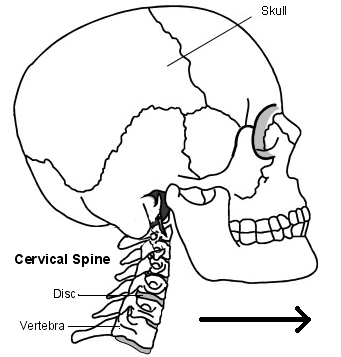
Den Hals verstehen
The back of the neck includes the cervical spine and the muscles and ligaments that surround and support it. The cervical spine is made up of seven bones called vertebrae.
The first two are slightly different to the rest, as they attach the spine to the skull and allow the head to turn from side to side.
The lower five cervical vertebrae are roughly cylindrical in shape with bony projections.
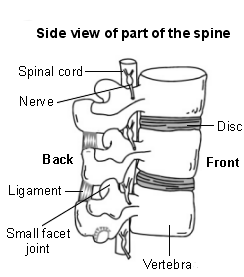
The sides of the vertebrae are linked by small facet joints.
Between each of the vertebrae is a disc. The discs are made of a tough fibrous outer layer and a softer gel-like inner part. The discs act like shock absorbers and allow the spine to be flexible.
Starke Bänder verbinden benachbarte Wirbel, um zusätzliche Unterstützung und Stärke zu bieten. Verschiedene Muskeln, die an der Wirbelsäule befestigt sind, ermöglichen es der Wirbelsäule, sich auf verschiedene Weise zu biegen und zu bewegen. (Die Muskeln und die meisten Bänder sind im Diagramm zur Klarheit nicht dargestellt.)
Das Rückenmark, das Nervengewebe enthält, das Nachrichten zum und vom Gehirn überträgt, wird von der Wirbelsäule geschützt. Nerven aus dem Rückenmark treten zwischen den Wirbeln im Nacken aus, um Nachrichten zum Nacken und zu den Armen zu senden und zu empfangen. Ein großes Blutgefäß, die sogenannte Wirbelarterie, verläuft ebenfalls entlang der Wirbel, um Blut zum hinteren (posterioren) Teil des Gehirns zu transportieren.
Halswirbelsäule
Seitenansicht eines Teils der Wirbelsäule
Patientenauswahl für Allgemeine Anzeichen und Symptome

Anzeichen und Symptome
Beckenschmerzen bei Frauen
Beckenschmerzen sind bei Frauen häufiger. Es gibt viele verschiedene Ursachen für Schmerzen im Beckenbereich. Sie können danach unterschieden werden, wann sie auftreten, ob Sie schwanger sind und ob sie von anderen Symptomen wie vaginalen Blutungen begleitet werden. Die häufigsten Ursachen sind unten aufgeführt. Die meisten bessern sich mit Schmerzmitteln. Für die meisten wiederkehrenden Ursachen sind Behandlungen verfügbar.
von Dr. Hayley Willacy, FRCGP

Anzeichen und Symptome
Chronische Schmerzen
Chronische Schmerzen (auch Langzeitschmerzen oder anhaltende Schmerzen genannt) sind Schmerzen, die länger als drei Monate andauern. Schmerzen können durch eine zugrunde liegende Erkrankung (wie Osteoarthritis, rheumatoide Arthritis, Colitis ulcerosa oder Endometriose) verursacht werden. Chronische Schmerzen können auch primär sein. Chronische primäre Schmerzen haben keine offensichtliche zugrunde liegende Erkrankung, oder die Schmerzen scheinen viel schlimmer zu sein als jede beobachtbare Verletzung oder Krankheit.
von Dr. Hayley Willacy, FRCGP
Häufig gestellte Fragen
Warum tut die Vorderseite meines Kopfes weh, wenn ich Nackenschmerzen habe?
Nackenschmerzen können sich manchmal bis zur Schädelbasis ausbreiten, was als Schmerz an der Vorderseite des Kopfes oder der Stirn empfunden werden kann. Dies liegt daran, dass Nerven im Nacken Schmerzen in verschiedene Bereiche des Kopfes übertragen können.
Was ist der Unterschied zwischen spezifischen und unspezifischen Nackenschmerzen?
Nicht-spezifische Nackenschmerzen sind die häufigste Art, bei der die genaue Ursache oft unbekannt ist und es sich um leichte Zerrungen oder eine schlechte Haltung handeln kann. Spezifische Nackenschmerzen hingegen haben eine identifizierbare Ursache, wie Schleudertrauma, Schiefhals, Abnutzung (zervikale Spondylose) oder zervikale Radikulopathie, bei der eine Nervenwurzel komprimiert wird.
Wie lange sollte ich erwarten, dass Nackenschmerzen anhalten?
In den meisten Fällen von plötzlich auftretenden Nackenschmerzen beginnen sich die Symptome in der Regel innerhalb weniger Tage zu bessern und klingen normalerweise innerhalb weniger Wochen ab. Die Zeit, die es dauert, bis sich die Symptome beruhigen, kann jedoch von Person zu Person variieren.
Wann sollte ich eine Physiotherapie bei Nackenschmerzen in Betracht ziehen?
Physiotherapie kann bei Nackenschmerzen empfohlen werden, und ein Physiotherapeut kann verschiedene Behandlungen wie Traktion, Wärme, Kälte oder Manipulation anbieten. Oft ist einer der hilfreichsten Aspekte der Physiotherapie der Rat zu speziellen Nackenübungen, die zu Hause durchgeführt werden können.
Was ist, wenn meine Nackenschmerzen nach ein paar Wochen nicht verschwinden?
Wenn Ihre Schmerzen länger als 4-6 Wochen anhalten oder sich verschlimmern, ist es ratsam, ärztlichen Rat einzuholen. Wenn Sie auch andere Symptome wie Gefühlsverlust (Taubheit), Schwäche oder anhaltendes Kribbeln in einem Teil eines Arms oder einer Hand entwickeln, sollten Sie ebenfalls medizinische Hilfe in Anspruch nehmen.
Weiterführende Literatur und Referenzen
- Gross A, Langevin P, Burnie SJ, et al; Manipulation and mobilisation for neck pain contrasted against an inactive control or another active treatment. Cochrane Database Syst Rev. 2015 Sep 23;(9):CD004249. doi: 10.1002/14651858.CD004249.pub4.
- Gross AR, Paquin JP, Dupont G, et al; Exercises for mechanical neck disorders: A Cochrane review update. Man Ther. 2016 Aug;24:25-45. doi: 10.1016/j.math.2016.04.005. Epub 2016 Apr 20.
- Barreto TW, Svec JH; Chronic Neck Pain: Nonpharmacologic Treatment. Am Fam Physician. 2019 Aug 1;100(3):180-182.
- Nackenschmerzen - unspezifisch; NICE CKS, April 2023 (Nur für UK-Zugang)
- Nackenschmerzen - zervikale Radikulopathie, NICE CKS, November 2023 (nur Zugang in Großbritannien)
Über den AutorVollständige Biografie anzeigen

Dr Philippa Vincent, MRCGP
Allgemeinmediziner, Medizinischer Autor
MB BS, Bsc, MRCGP (2000), DCH, DFSRH, DRCOG
Dr Philippa Vincent ist ein NHS-Arzt, der in Nordlondon arbeitet.
Über den RezensentenVollständige Biografie anzeigen

Dr Surangi Mendis, MRCGP
Berater und Medizinischer Autor
MBBS, BSc (1st), MRCGP (2014), DFSRH, PGcert otology and audiology
Surangi Mendis ist Beraterin für Audiovestibuläre Medizin und Neuro-Otologie an den Royal National ENT und Eastman Dental Hospitals, UCLH.
Artikelverlauf
Die Informationen auf dieser Seite wurden von qualifizierten Klinikern verfasst und begutachtet.
Artikel auch verfügbar in Englisch, Deutsch, Spanisch, Französisch, Italienisch, Portugiesisch, Hindi, Hebräisch, Arabisch, und Schwedisch.
Nächste Überprüfung fällig: 8. Aug. 2028
10. Aug 2023 | Neueste Version

Fragen, teilen, verbinden.
Durchsuchen Sie Diskussionen, stellen Sie Fragen und teilen Sie Erfahrungen zu Hunderten von Gesundheitsthemen.

Fühlen Sie sich unwohl?
Bewerten Sie Ihre Symptome online kostenlos
Abonnieren Sie den Patienten-Newsletter
Ihre wöchentliche Dosis klarer, vertrauenswürdiger Gesundheitsberatung - geschrieben, um Ihnen zu helfen, sich informiert, selbstbewusst und in Kontrolle zu fühlen.
Durch das Abonnieren akzeptieren Sie unsere Datenschutzrichtlinie. Sie können sich jederzeit abmelden. Wir verkaufen Ihre Daten niemals.
Mehr zu Anzeichen und Symptomen
- Abdominalmassen
- Achalasie
- Hustenmittel
- Bluthusten
- Husten und Erkältungen bei Kindern
- Frühe Anzeichen und Symptome einer Schwangerschaft
- Flüssigkeitsüberladung
- Schlaflosigkeit
- Appetitlosigkeit
- Lymphödem und Lipödem
- Mikrovaskuläre Angina
- Übelkeit und Erbrechen
- Olekranon-Bursitis
- Rotatorenmanschettenverletzungen und -erkrankungen
- Geschwollene Beine
- Geschwollene Lymphknoten
- Eingeschlossene Luft, Gas und Blähungen
- Harnröhrenstriktur
- Vestibularneuritis und Labyrinthitis
- Warzen und Verrucas