PSA-Test
Prostata-spezifisches Antigen
Begutachtet von Dr Toni Hazell, MRCGPZuletzt aktualisiert von Dr Philippa Vincent, MRCGPLast updated 15. Dez 2024
Erfüllt die Anforderungen des Patienten Richtlinien des Patienten
- HerunterladenHerunterladen
- Teilen
- Language
- Diskussion
- Audio-Version
- Add to preferred sources on Google
In dieser Serie:ProstataproblemeVergrößerte ProstataHarnverhaltHarnröhrenstrikturChronische ProstatitisSymptome des unteren Harntrakts bei Männern
The PSA test (prostate specific antigen) is a blood test which assesses for the likelihood of prostate cancer. It is also used to monitor the treatment for Prostatakrebs.
The PSA blood level can also be increased in other conditions. Having an increased PSA test result does not therefore mean that prostate cancer is the diagnosis. At the moment there is no nationale Vorsorgeprogramms for prostate cancer in the UK but there are currently studies looking at whether screening would be appropriate for prostate cancer.
The TRANSFORM randomised controlled trial is being planned to start during 2024. This will include a PSA test amongst others in assessing whether a prostate cancer screening programme is possible or appropriate.
In diesem Artikel:
Video picks for Bluttests
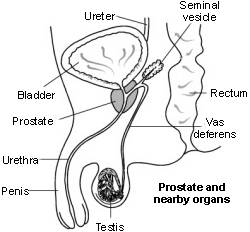
Cross-section diagram of the prostate and nearby organs
Lesen Sie unten weiter
What is a PSA test?
The PSA test (prostate specific antigen) is a blood test that measures the level of prostate specific antigen in the blood. PSA is a protein which is made by the prostate gland. The PSA level in the bloodstream is measured in nanograms per millilitre (ng/mL). PSA is made by normal prostate cells but also by prostate cancer cells.
PSA test preparation
Zurück zum InhaltBefore having a PSA test, it is important not to have:
An active urine infection.
Produced semen during sex or masturbation (ejaculated) in the previous 48 hours.
Exercised heavily in the previous 48 hours.
Had a prostate biopsy in the previous six weeks.
Had an examination of the back passage with a gloved finger (a digital rectal examination) in the previous week.
Had receptive anal intercourse for a period of 48 hours before a PSA test.
Each of these may produce an unnaturally high PSA result, resulting in unnecessary further investigations.
In England, the PSA test may be offered to any man aged 50 and over who requests it as long as they have considered the pros and cons of having the test. The test may be offered to younger men who have a higher risk of prostate cancer.
Lesen Sie unten weiter
The normal range for a PSA test
Zurück zum InhaltThe normal range changes as men age.
PSA Cut-off Values | |
|
|
40-49 | 2.5 micrograms/litre or higher |
50-59 | 3.5 micrograms/litre or higher |
60-69 | 4.5 micrograms/litre or higher |
70-79 | 6.5 micrograms/litre or higher |
There are no age-specific reference limits for men older than 80 years of age. Any referral will depend on local guidelines.
Generally, the higher the level of PSA, the more likely it is to be a sign of cancer.
Benefits and limitations of a PSA test
Zurück zum InhaltBenefits of PSA testing
PSA testing may lead to prostate cancer being detected earlier, before symptoms develop.
Detecting prostate cancer early before symptoms develop may improve the outcome (prognosis) and improve the chance of a complete cure.
Limitations and risks of PSA testing
False negative result: about 15 out of 100 men with a negative PSA test may have prostate cancer.
False positive result: about 75 out of 100 men with a positive PSA test have normal prostate investigations, ie no evidence of cancer.
A false positive PSA test may lead to unnecessary investigations, such as a prostate biopsy, and there may be side-effects from this investigation, such as bleeding or infection. This is less common nowadays as MRI scans are a more common initial investigation which carry lower risks.
A positive result may also lead to unnecessary treatment. Many prostate cancers are slow growing and may not become evident during a man's lifetime. Side-effects of treatment are common and can be serious, such as Harninkontinenz and sexual problems.
Current statistics suggest that, in men between the ages of 50 and 66 who are screened for 13 years, annual PSA testing would result in the avoidance of death from prostate cancer of 1.3 per 1000 men.
Lesen Sie unten weiter
Causes of a raised PSA level
Zurück zum InhaltA raised PSA level may be due to a diagnosis prostate cancer but about three out of four men with a raised PSA level will not be found to have prostate cancer.
Other conditions may also cause a raised PSA level, including:
Inability to pass urine, causing an enlarged bladder (acute retention of urine).
Höheres Alter.
Transurethral resection of the prostate (TURP) operation. TURP is a prostate operation used if you have benign enlargement of the prostate.
Having a catheter in place to help pass urine.
PSA test results
Zurück zum InhaltIf the PSA level is not raised
Prostate cancer is less likely. A digital rectal examination may also be needed to rule this out.
If the PSA level is slightly raised
Prostate cancer is less likely. A digital rectal examination may also be needed to rule this out. Annual PSA tests might be advised.
If the PSA level is definitely raised
The GP will do an urgent referral to a urologist (a specialist doctor) for further tests for prostate cancer. The specialist will discuss the options for further investigations, which may include a sample taken (a biopsy) of the prostate gland and an MRT-Scan.
If prostate cancer is found, what are my options?
Zurück zum InhaltPatient picks for Bluttests
Tests und Untersuchungen
Leberfunktionstests
Leberfunktionstests sind eine Reihe von Bluttests, die häufig durchgeführt werden, um die Gesundheit Ihrer Leber zu überprüfen. Veränderungen in den Leberfunktionstests geben einen Hinweis darauf, ob Ihre Leber belastet, entzündet, infiziert oder erkrankt ist und wie stark. Das Muster der Leberfunktionstests kann einen Hinweis auf die Ursache geben und eine frühzeitige Erkennung unerwarteter Probleme sowie die Überwachung bekannter Probleme ermöglichen.
von Dr. Rosalyn Adleman, MRCGP
Tests und Untersuchungen
Routinemäßiger Bluttest zur Nierenfunktion
Es gibt verschiedene Möglichkeiten, die Funktion der Nieren zu messen. Die gebräuchlichste Methode ist die Bestimmung eines Stoffes namens Kreatinin mittels Bluttest und die Berechnung des sogenannten geschätzten glomerulären Filtrationsrate (eGFR). In der Regel werden auch andere Stoffe wie Harnstoff und Salze im Blut (Kalium und Natrium) gemessen.
von Dr. Doug McKechnie, MRCGP
Weiterführende Literatur und Referenzen
- Prostate cancer risk management programme: overview; Öffentliche Gesundheit England
- Verdacht auf Krebs: Erkennung und Überweisung; NICE-Richtlinie (2015 - zuletzt aktualisiert im April 2026)
- Prostate cancer: diagnosis and management; NICE Guidance (2019 - last updated December 2021)
- Prostatakrebs; NICE CKS, August 2025 (nur in Großbritannien zugänglich)
Lesen Sie unten weiter
About the authorView full bio

Dr Philippa Vincent, MRCGP
Allgemeinmediziner, Medizinischer Autor
MB BS, Bsc, MRCGP (2000), DCH, DFSRH, DRCOG
Dr Philippa Vincent is an NHS GP working in North London.
About the reviewerView full bio

Dr Toni Hazell, MRCGP
MBBS, BSc, MRCGP, DFSRH, Dip GU med, DRCOG, DCH (London, UK, 2000)
Dr. Toni Hazell qualified from St. Mary’s Hospital Medical School and did her VTS at Northwick Park Hospital.
Artikelverlauf
Die Informationen auf dieser Seite wurden von qualifizierten Klinikern verfasst und begutachtet.
Nächste Überprüfung fällig: 14. Dez 2027
15. Dez 2024 | Neueste Version

Fragen, teilen, verbinden.
Durchsuchen Sie Diskussionen, stellen Sie Fragen und teilen Sie Erfahrungen zu Hunderten von Gesundheitsthemen.

Fühlen Sie sich unwohl?
Bewerten Sie Ihre Symptome online kostenlos
Abonnieren Sie den Patienten-Newsletter
Ihre wöchentliche Dosis klarer, vertrauenswürdiger Gesundheitsberatung - geschrieben, um Ihnen zu helfen, sich informiert, selbstbewusst und in Kontrolle zu fühlen.
By subscribing you accept our Datenschutzrichtlinie. Sie können sich jederzeit abmelden. Wir verkaufen Ihre Daten niemals.