Hammerfinger
Begutachtet von Dr Colin Tidy, MRCGPZuletzt aktualisiert von Dr Hayley Willacy, FRCGP Zuletzt aktualisiert 15 Sept 2024
Erfüllt die Anforderungen des Patienten Richtlinien des Patienten
- HerunterladenHerunterladen
- Teilen
- Language
- Diskussion
- Audio-Version
- Zu bevorzugten Quellen bei Google hinzufügen
A finger that bends down at the end joint and cannot be straightened is called a mallet finger. It is caused by an injury to the tendon that straightens (extends) the finger. A splint worn day and night for 6-8 weeks will cure the problem in most cases.
Auf einen Blick
A mallet finger is when the end of a finger bends towards the palm and cannot straighten.
It is caused by an injury that tears the tendon responsible for straightening the fingertip.
Symptoms include pain, swelling, and the inability to straighten the end of the finger.
Treatment usually involves wearing a splint continuously for 6-8 weeks.
Surgery may be needed if splinting does not work or if there is a cut to the finger.
What is a mallet finger?
A mallet finger describes a condition in which the end of a finger is bent (flexed) towards the palm and cannot straighten.
What causes a mallet finger?
The usual cause is an injury to the end of the finger. The injury tears the tendon that straightens (extends) the end of the finger.
It is sometimes called baseball finger, as it is a common injury when trying to catch a fast, hard ball. If the catch is missed slightly then the ball hits the straight finger. This may force the end of the finger to bend (flex) further than normal and tear the tendon. Without the use of this tendon, the finger stays bent (flexed).
Diagram of the hand showing mallet finger
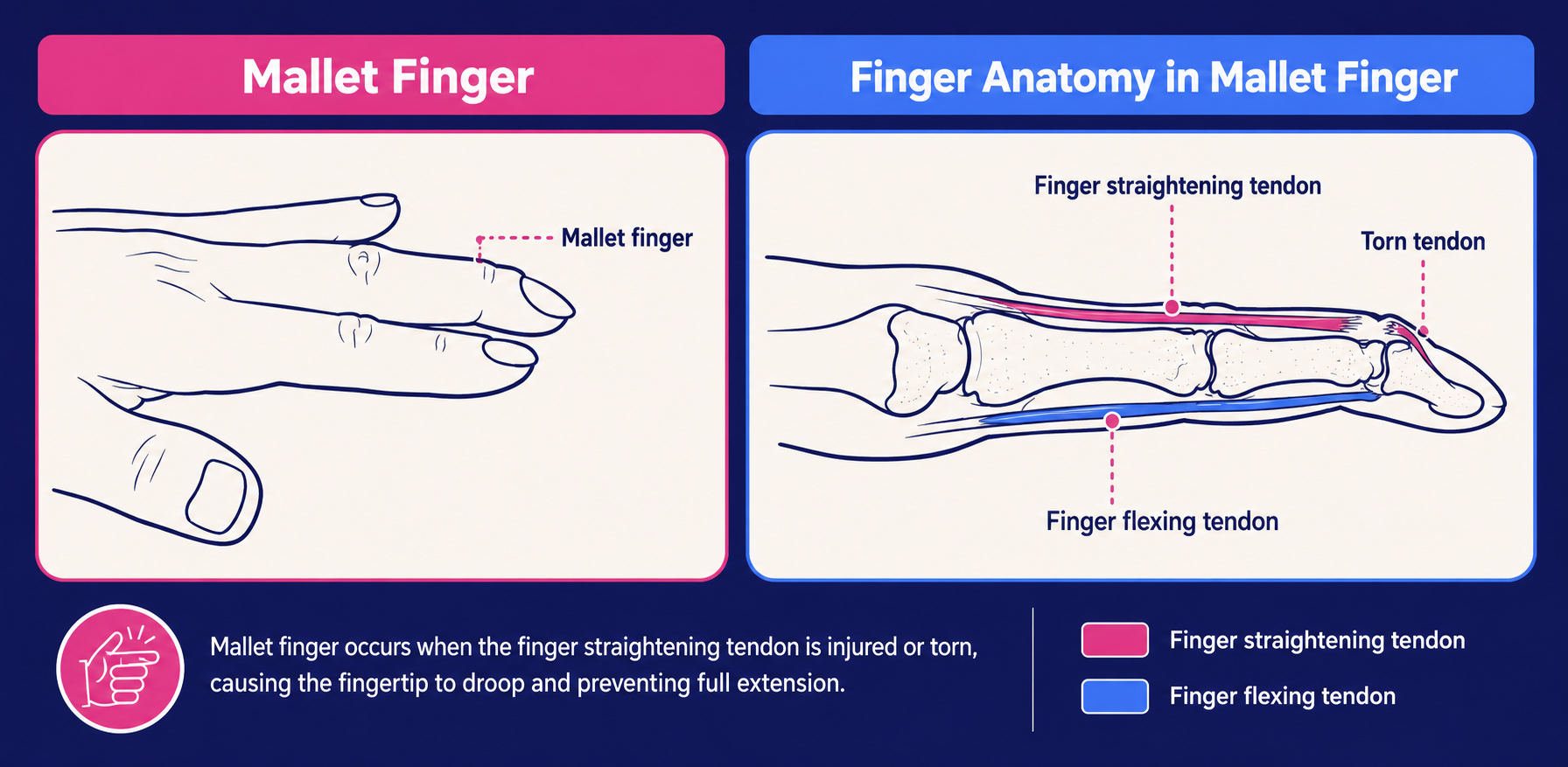
Sportverletzungen are a common cause of mallet finger. However, any injury that forces the end joint of a finger to over-bend can cause it. (Sometimes the tendon does not tear but the injury causes a piece of bone to be pulled off the finger where the tendon is attached. This is called an avulsion fracture. The result is the same, as the tendon then cannot pull on the bone.)
What are the symptoms of a mallet finger?
After the injury, the end of your finger may:
Be painful and swollen.
Lie in a bent (flexed) position.
Not be able to straighten (extend) at the end.
Hammerfinger
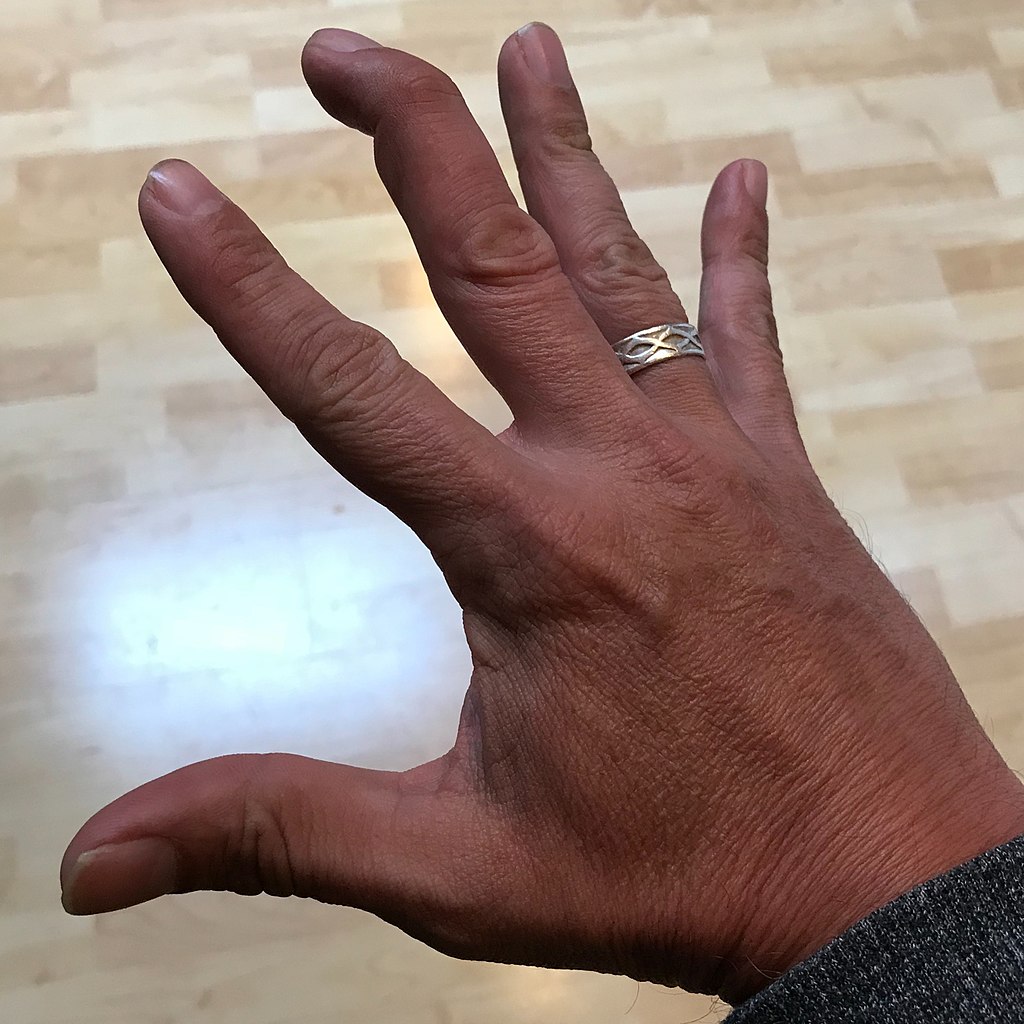
© Clappstar, CC BY-SA 4.0, via Wikimedia Commons
How is mallet finger diagnosed?
The clinician can usually diagnose a mallet finger from listening to how the injury occurred and how the finger looks and feels when examined. If there is any doubt they may request an x-ray.
What is the treatment for mallet finger?
Splint
A splint is worn for 6-8 weeks to keep the finger straight with the end joint bent backwards slightly (overextended). It must be worn all the time, day and night.
There are many different types of splints available. The type of splint given often depends on the size and shape of your finger. You must not take the splint off at any time during this treatment. If you have to take it off (for example, to wash) then you must keep that finger straight and not allow it to bend (flex).
Keeping the finger straight constantly allows the two ends of the torn tendon or bone to stay together and heal. About three in four cases heal well with this treatment.
Operation
Surgery is needed to repair the torn tendon if the above fails. (Surgery may be advised straightaway if there is a cut to your finger; however, most injuries that cause mallet finger do not cut the skin.)
Recovering from mallet finger
It may take several months for your finger to fully recover its function. Any redness, swelling and tenderness of your skin over the end of your finger may persist for the first few months after the injury. These symptoms will usually improve eventually.
Can mallet finger be prevented?
As most mallet finger injuries occur during sports, taking care when playing with a hard ball is advisable but prevention may not always be possible. You can prevent the deformity returning by using the splint exactly as directed by your clinician.
Patientenauswahl für Gelenkschmerzen

Knochen, Gelenke und Muskeln
Schultersteife
Die Schultersteife (medizinisch als adhäsive Kapsulitis der Schulter bezeichnet) ist eine Erkrankung, bei der die Schulter schmerzhaft und steif wird, oft ohne besonderen Grund. Die Bewegungen der Schulter werden eingeschränkt, manchmal vollständig 'eingefroren'. In der Regel betrifft es nur eine Schulter, kann aber auch beide betreffen. Es wird angenommen, dass dies auf die Bildung von narbenähnlichem Gewebe in der Schulterkapsel zurückzuführen ist. Ohne Behandlung verschwinden die Symptome normalerweise, aber dies kann lange dauern, in einigen Fällen bis zu drei Jahren. Verschiedene Behandlungen können die Schmerzen lindern und die Beweglichkeit Ihrer Schulter verbessern.
von Dr. Philippa Vincent, MRCGP

Knochen, Gelenke und Muskeln
Hüftprobleme
Hüftprobleme sind ziemlich häufig. Die Ursache kann offensichtlich sein, wie eine Verletzung, die plötzlich beim Sport auftritt. Manchmal ist die Ursache nicht so klar, und Sie sollten von einem Arzt oder Physiotherapeuten untersucht werden.
von Dr. Rachel Hudson, MRCGP
Häufig gestellte Fragen
What should I do immediately after getting a mallet finger injury?
The article suggests that after the injury, the end of your finger may be painful, swollen, and bent. While it doesn't give immediate first aid advice, generally for an injury that causes pain and swelling, it's advisable to avoid bending the affected finger and seek medical attention to confirm the diagnosis and receive appropriate treatment.
Are there different kinds of splints used for mallet finger?
Yes, there are many different types of splints available for mallet finger. The specific type you receive often depends on the size and shape of your finger.
How do I care for my skin if I'm wearing a splint for 6-8 weeks?
The article states that you must not take the splint off at any time during treatment, even to wash. However, if you absolutely have to remove it, you must keep the affected finger straight and not allow it to bend. This implies that cleaning around the splint or the finger itself would need to be done very carefully to ensure the finger remains straight.
What are the chances of my finger healing well with splint treatment?
About three in four cases of mallet finger heal well with splint treatment, provided it is worn exactly as directed.
When might surgery be considered as a first option for mallet finger?
Surgery may be advised straightaway if there is a cut to your finger. However, most injuries that cause mallet finger do not involve a cut through the skin.
After the splint is removed, can the mallet finger deformity come back?
Yes, the deformity can return. To prevent this, it's crucial to use the splint exactly as directed by your clinician throughout the entire treatment period.
Weiterführende Literatur und Referenzen
- Yee J, Waseem M; Mallet Finger Injuries.
- Handoll HH, Vaghela MV; Interventions for treating mallet finger injuries. Cochrane Database Syst Rev. 2004;(3):CD004574.
- Salazar Botero S, Hidalgo Diaz JJ, Benaida A, et al; Review of Acute Traumatic Closed Mallet Finger Injuries in Adults. Arch Plast Surg. 2016 Mar;43(2):134-44. doi: 10.5999/aps.2016.43.2.134. Epub 2016 Mar 18.
Über den AutorVollständige Biografie anzeigen

Dr Hayley Willacy, FRCGP
Allgemeinmediziner, Medizinischer Autor
MBChB (1992), DRCOG, DFFP, MRCOG (Part 1) MRCGP (2007), DFSRH (2013), MSc - medical education (2020)
Dr. Hayley Willacy war eine NHS-Hausärztin, die in Nordwestengland arbeitete und 2022 nach 30 Jahren aus der klinischen Praxis ausschied.
Über den RezensentenVollständige Biografie anzeigen

Dr Colin Tidy, MRCGP
Allgemeinmediziner, Medizinischer Autor
MBBS, MRCGP, MRCP (Paediatrics), DCH
Dr. Colin Tidy ist ein NHS-Arzt mit Sitz in Oxfordshire.
Artikelverlauf
Die Informationen auf dieser Seite wurden von qualifizierten Klinikern verfasst und begutachtet.
Artikel auch verfügbar in Englisch, Deutsch, Spanisch, Französisch, Italienisch, Portugiesisch, Hindi, Hebräisch, Arabisch, und Schwedisch.
Nächste Überprüfung fällig: 14. Sept 2027
15 Sept 2024 | Neueste Version

Fragen, teilen, verbinden.
Durchsuchen Sie Diskussionen, stellen Sie Fragen und teilen Sie Erfahrungen zu Hunderten von Gesundheitsthemen.

Fühlen Sie sich unwohl?
Bewerten Sie Ihre Symptome online kostenlos
Abonnieren Sie den Patienten-Newsletter
Ihre wöchentliche Dosis klarer, vertrauenswürdiger Gesundheitsberatung - geschrieben, um Ihnen zu helfen, sich informiert, selbstbewusst und in Kontrolle zu fühlen.
Durch das Abonnieren akzeptieren Sie unsere Datenschutzrichtlinie. Sie können sich jederzeit abmelden. Wir verkaufen Ihre Daten niemals.
Mehr über Knochen, Gelenke und Muskeln
- Anästhesie für Hüft- oder Kniegelenkersatz
- Arthritis
- Baker-Zyste
- Bisphosphonate
- Calcium-Pyrophosphat-Ablagerung
- Oberschenkelverletzung
- Hand-Arm-Vibrationssyndrom
- Kniegelenkersatz
- Schmerzen im unteren Rücken
- Meniskusrisse
- Osteomyelitis
- Morbus Paget des Knochens
- Polymyalgia rheumatica
- Erholung von einem Beckenbruch
- Kahnbeinbruch im Handgelenk
- Spinalanästhesie
- Verstauchungen und Zerrungen
- Temporomandibuläre Gelenkstörung (TMD)
- Tendinopathie und Tenosynovitis
- Vitamin-D-Mangel