Feinnadelaspiration
Begutachtet von Dr Hannah Gronow, MBACPZuletzt aktualisiert von Dr. Roger Henderson, MBBSZuletzt aktualisiert 22 Nov 2018
Erfüllt die Anforderungen des Patienten Richtlinien des Patienten
- HerunterladenHerunterladen
- Teilen
- Language
- Diskussion
- Audio-Version
- Zu bevorzugten Quellen bei Google hinzufügen
Diese Seite wurde archiviert.
Es wurde kürzlich nicht überprüft und ist nicht auf dem neuesten Stand. Externe Links und Referenzen funktionieren möglicherweise nicht mehr.
In fine-needle aspiration a thin, hollow needle is used to take a sample of cells from an organ or lump under the skin. The cells are then analysed under a microscope.
Hinweis: Die nachstehenden Informationen sind nur eine allgemeine Orientierung. Die Abläufe und die Durchführung der Tests können in verschiedenen Krankenhäusern variieren. Befolgen Sie stets die Anweisungen Ihres Arztes oder des örtlichen Krankenhauses.
Auf einen Blick
Fine-needle aspiration uses a thin needle to take cell samples from a lump or organ.
This test can help to identify the type of cells in a lump, including detecting cancer.
It is commonly used for breast lumps or the thyroid gland in your neck.
A doctor inserts a thin needle into the lump, sometimes guided by a scan.
You may feel a little sore or get a bruise, but serious complications are uncommon.
What is fine-needle aspiration?
Fine-needle aspiration involves using a thin, hollow needle to remove samples of cells from tissue or fluid in an organ or a lump. It is not quite the same as a biopsy, which takes a very small chunk of tissue away. Once the samples of cells have been removed, they are sent to the laboratory for further testing.
Fine-needle aspiration is usually done to identify the type of cells inside a lump or to see how well treatment of an existing lump is working.
It is commonly used to investigate lumps found in the breast oder a gland found in your neck (the thyroid). However, it can also be used in other parts of the body. It is a very useful way of detecting cancer.
How does fine-needle aspiration work?
A very thin, hollow needle is gently inserted through the skin into the lump or organ below. Often there is a syringe attached to the needle. The doctor can use the syringe to help 'suck' some of the cells into the needle by gently pulling on the plunger.
Usually, the test can be done without the need to make a cut in the skin. This helps to minimise any discomfort for the person having the test, as well as the risk of infection or other complications.
If the lump being tested is very small it might be necessary to use a scanning machine to help guide the needle to the right place. This may be done by an Ultraschall-Scan, a Computertomographie (CT) Scan or an X-ray of the breast (a mammogram).
What happens?
The doctor will clean the skin where the needle is to be inserted. In some cases you will also be given a local anaesthetic to numb the area. This may not be necessary if the lump is very close to the surface of your skin.
The doctor will hold the lump steady with one hand and insert a thin needle (which may be attached to a syringe) into the lump.
Feinnadelaspiration
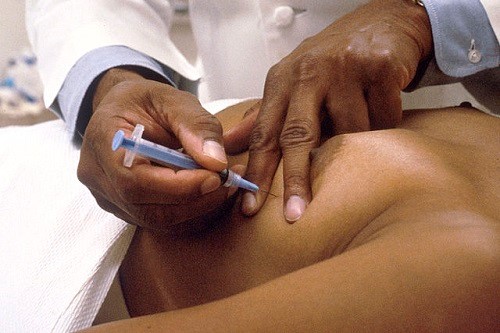
© By Linda Bartlett (photographer), National Institutes of Health, via Wikimedia Commons
They may move the needle in and out of the area to make sure of getting enough tissue or fluid. If there is a syringe attached they will gently pull back on the plunger to help remove the tissue or fluid. The process takes a few seconds to a few minutes. The needle will then gently be removed and your doctor may apply some pressure to help stop any bleeding.
If the doctor cannot easily feel the lump, you may have an imaging test, such as a CT scan, ultrasound scan, or mammogram to see where to put the needle. In this case, a doctor known as a radiologist may do the aspiration. The radiologist may do the investigation but they will not know the result immediately.
If the lump is a fluid-filled sac (a cyst), the fluid is removed and the lump usually goes away.
After the test is over, the cells taken from the needle are sent to the laboratory. It may take a few days to get the results of the test back, depending on what part of your body has been tested.
What should I do to prepare for a fine-needle aspiration?
This depends on what part of your body is being tested. Your local hospital should give you information on what is required. Usually very little preparation is necessary.
Hinweis: if you take a blood-thinning medicine (an anticoagulant) such as warfarin, you may be asked to stop taking this for a few days before the procedure.
What can happen after a fine-needle aspiration?
Most fine-needle aspirations are carried out without any problems.
Commonly, you may feel a little sore for a couple of days after the test. You may develop a bruise at the site where the needle was inserted. Complications are uncommon but can include:
Bleeding or bruising. This should stop and heal quickly.
Infection at the point where the needle went in.
Other complications specific to the site of needle insertion.
Patientenauswahl für Allgemeine Tests und Untersuchungen

Tests und Untersuchungen
Lumbalpunktion
Eine Lumbalpunktion wird zur Diagnose von Meningitis und einigen anderen Erkrankungen des Gehirns und Rückenmarks verwendet.
von Dr. Toni Hazell, FRCGP

Tests und Untersuchungen
Spirometrie
Spirometrie ist ein Test, der helfen kann, verschiedene Lungenerkrankungen zu diagnostizieren, am häufigsten die chronisch obstruktive Lungenerkrankung (COPD). Spirometrie kann auch verwendet werden, um die Schwere einiger anderer Lungenerkrankungen und deren Reaktion auf die Behandlung zu überwachen. Obwohl die Spirometrie sehr nützlich ist, um bei der Diagnose einiger Erkrankungen zu helfen und deren Behandlung zu überwachen, schließt ein normaler Spirometrietest nicht unbedingt einige Formen von Lungenerkrankungen aus, da es Zeiten geben kann, in denen Spirometrietests normal sein können, selbst wenn eine Lungenerkrankung wie Asthma vorliegt. Hinweis: Die unten stehenden Informationen sind nur ein allgemeiner Leitfaden. Die Anordnungen und die Art und Weise, wie Tests durchgeführt werden, können zwischen verschiedenen Krankenhäusern variieren. Befolgen Sie immer die Anweisungen Ihres Arztes oder Ihres örtlichen Krankenhauses.
von Dr. Colin Tidy, MRCGP
Häufig gestellte Fragen
What is the difference between a fine-needle aspiration and a biopsy?
A fine-needle aspiration uses a thin, hollow needle to collect samples of cells, while a biopsy takes a small piece of tissue. Both are sent for laboratory testing, but the aspiration collects individual cells rather than a solid piece of tissue.
Will I feel pain during a fine-needle aspiration?
The doctor may clean the area and, in some cases, give you a local anaesthetic to numb it, especially if the lump is not very close to the skin's surface. This helps minimise discomfort. After the procedure, you might feel a little sore for a couple of days.
How long does a fine-needle aspiration procedure take?
The actual process of inserting the needle and collecting cells typically takes only a few seconds to a few minutes.
How long will it take to get the results back after a fine-needle aspiration?
It may take a few days to receive the results of the test, and the exact time can depend on which part of your body has been tested.
Weiterführende Literatur und Referenzen
- Karadeniz Cakmak G, Emre AU, Tascilar O, et al; Diagnostic adequacy of surgeon-performed ultrasound-guided fine needle aspiration biopsy of thyroid nodules. J Surg Oncol. 2012 Jul 5. doi: 10.1002/jso.23212.
- Yu YH, Wei W, Liu JL; Diagnostic value of fine-needle aspiration biopsy for breast mass: a systematic review and meta-analysis. BMC Cancer. 2012 Jan 25;12:41.
- VanderLaan PA; Fine-needle aspiration and core needle biopsy: An update on 2 common minimally invasive tissue sampling modalities. Cancer Cytopathol. 2016 Dec;124(12):862-870. doi: 10.1002/cncy.21742. Epub 2016 May 16.
Über den AutorVollständige Biografie anzeigen

Dr Roger Henderson, MBBS
Allgemeinmediziner, Medizinischer Autor
MBBS, LMSSA
Dr. Roger Henderson qualifizierte sich 1985 als Hausarzt und schreibt seit Anfang 2013 für EMIS.
Über den RezensentenVollständige Biografie anzeigen

Dr Hannah Gronow, MBACP
Allgemeinmedizinerin
MB, ChB, MBACP
Hannah qualified as a GP in 1997. She joined EMIS (Patient) as a peer reviewer in August 2006.
Artikelverlauf
Die Informationen auf dieser Seite wurden von qualifizierten Klinikern verfasst und begutachtet.
Artikel auch verfügbar in Englisch, Deutsch, Spanisch, Französisch, Italienisch, Portugiesisch, Hindi, Hebräisch, Arabisch, und Schwedisch.
22 Nov 2018 | Neueste Version

Fragen, teilen, verbinden.
Durchsuchen Sie Diskussionen, stellen Sie Fragen und teilen Sie Erfahrungen zu Hunderten von Gesundheitsthemen.

Fühlen Sie sich unwohl?
Bewerten Sie Ihre Symptome online kostenlos
Abonnieren Sie den Patienten-Newsletter
Ihre wöchentliche Dosis klarer, vertrauenswürdiger Gesundheitsberatung - geschrieben, um Ihnen zu helfen, sich informiert, selbstbewusst und in Kontrolle zu fühlen.
Durch das Abonnieren akzeptieren Sie unsere Datenschutzrichtlinie. Sie können sich jederzeit abmelden. Wir verkaufen Ihre Daten niemals.
Mehr zu Tests und Untersuchungen
- Bariumtests
- Biopsie
- Blutzuckertest (Blutzucker) und HbA1c
- Bluttests
- Bluttests zur Erkennung von Entzündungen
- Knochenmarkbiopsie und Aspiration
- Chorionzottenbiopsie
- CT-Scan
- DEXA-Scan
- Echokardiogramm
- Gallium-Scan
- Genetische Tests
- Hörtests
- Ketone im Urin
- Leberfunktionstests
- Urinprobe aus dem Mittelstrahl
- MRCP-Scan
- PET-Scan
- Schwangerschaftsscreening-Tests
- PSA-Test